The Dynamic Decade tells the story of the sweeping makeover of the 200-year-old campus of the University of North Carolina at Chapel Hill. Six million square feet of buildings were constructed and a million square feet of historic buildings were renovated during one vibrant ten-year period. This massive growth required bold thinking and a vision for combining historic preservation, green building, and long-range development. A statewide bond issue, award-winning designs, and unprecedented coordination between town and university made the vision a reality.
Written by authors who held major planning roles, supplemented by interviews of key players, and lavishly illustrated with color photographs and maps, this comprehensive account offers valuable lessons to all concerned with sustainable university growth.
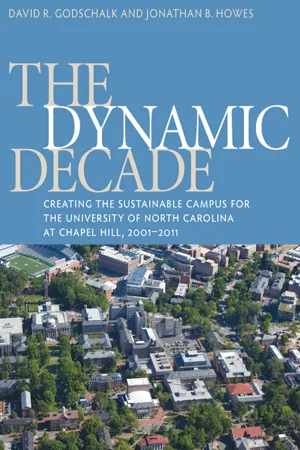
eBook - ePub
The Dynamic Decade
Creating the Sustainable Campus for the University of North Carolina at Chapel Hill, 2001-2011
- 184 pages
- English
- ePUB (mobile friendly)
- Available on iOS & Android
eBook - ePub
The Dynamic Decade
Creating the Sustainable Campus for the University of North Carolina at Chapel Hill, 2001-2011
About this book
Information
Topic
EducationSubtopic
Education AdministrationCHAPTER 1
Sustaining the Campus
UNC’S DYNAMIC DECADE OF CAMPUS DEVELOPMENT
The university campus is a central feature in urban development. While driven by its educational mission, campus growth reflects many of the precepts of private real estate development in its quest for additional space. At the same time, the economic importance of the university casts it into a quasi-public role as community developer. The tensions between these internal and external roles can create substantial town/gown friction as the university seeks to expand and the community requires it to recognize and mitigate the impacts of its growth.
The internal logic of campus development stems from the university’s core mission of teaching, research, and service; this requires attention to knowledge development, disciplinary excellence, and technological advance, as well as to the demands of faculty, student, and alumni constituencies. Arrayed against this is the external logic of the host community, which views the university campus as a very large activity center with associated neighborhood impacts, service demands, and land use implications. Because universities are among the community’s largest landowners and employers, as well as major consumers of public services, they have an array of external constituents that assert claims related to physical location, economic impact, and political decisions (Perry and Wiewel 2005).
University growth, like that of private real estate development, is influenced by national and regional economic conditions. Universities must secure financing and therefore face the challenges posed by economic downturns. University developers are influenced by the same boom and bust cycles that drive the private real estate development market. When economic conditions are favorable, as in the U.S. during the period up to the year 2008, campus growth takes off and local tensions escalate; when conditions are unfavorable, campus growth slows, along with local tensions. As Brutus remarked in Shakespeare’s Julius Caesar, “There is a tide in the affairs of men, which taken at the flood, leads on to fortune.”
University planners must be sensitive to the contending forces of market conditions, growth impacts, and local politics. At the same time, they must respond to the need to keep their campus facilities competitive with those of other universities seeking to outperform them in the arenas of research and teaching, faculty recruitment and retention, student quality and quantity, grant support and fund raising. In short, they must find ways to sustainably develop their campus environments with their blends of historic buildings, new projects, cherished landscapes, and typically inadequate infrastructure.
The purpose of this book is to tell the story of how one university met this complex sustainability challenge while catching the wave of the favorable economic boom during the late 1990’s and early 2000’s to renew itself and leap ahead. It recounts the ins and outs of creating and implementing the Master Plan at the University of North Carolina at Chapel Hill, and draws on this experience to lay out lessons for other universities concerned with planning for long-term sustainability.
UNC’S DYNAMIC DECADE OF DEVELOPMENT: 2001–2011
The story of the “dynamic decade” of campus growth at the University of North Carolina at Chapel Hill is an intriguing mix of planning, politics, and design. Thanks to a state bond issue that provided major capital funding passing at the same time as an innovative master plan was completed, and spurred by inspired political leadership and design guidance, this beautiful old campus was transformed into a sustainable new environment for 21st century teaching, learning, and research during ten fast-moving years of growth.
During that decade from 2001 to 2011, over six million square feet of new buildings were constructed, over a million square feet of existing buildings were renovated, over five million square feet of pedestrian paths and open space were created, a free bus system was initiated, and a new sustainability ethic was adopted. The UNC building boom was echoed across the nation. Nationally, college construction began to shift into high gear in 2000 and peaked in 2006, going from $7.3 billion to $15 billion per year (Abramson 2010).
This growth was catalyzed by $515 million in funding from a statewide Higher Education Bond Referendum in 2000, along with major private contributions. Then Chancellor James Moeser pledged to take that investment and triple it through private support to the University, generating in total some $1.5 billion in capital funding. With this funding boost, implementation of the Master Plan took off at a furious pace. By the end of the decade, between the bond funds, private donations, University investments, and ongoing State appropriations, UNC had invested $2.3 billion on a total of 165 projects.
Meanwhile, enrollment increased by 3,400 students, and 300 new faculty were recruited. Had this growth not been firmly guided and sensitively designed, the resulting impacts on the beautiful forested 18th century campus, chartered in 1789, could have been catastrophic. Fortunately, the University’s newly prepared 2001 Master Plan set forth a powerful vision, generated through wide-ranging public participation, along with careful design guidelines to ensure that new projects would respect the beloved campus character. Realizing in 1998 that its old plan was no longer adequate to meet projected increases in student enrollment and building space, the University selected Ayers Saint Gross of Baltimore to undertake a new plan.
The resulting 2001 Master Plan was unanimously adopted by the UNC Board of Trustees and became the guiding beacon for the development made possible by the bond issue. However, because growth on the campus is subject to concurrent jurisdiction by the University and the Town of Chapel Hill, the story has an important second chapter.
The scale of the massive proposed campus growth ratcheted up political concern and conflict within the community of Chapel Hill. Neighbors of the campus, fearful of the impacts of growth on their neighborhoods, organized the Neighborhood Alliance, which lobbied the Chapel Hill Town Council to intervene on their behalf. Candidates for the Town Council actively sought the endorsement of the Neighborhood Alliance, crafting their platforms on a basis of controlling campus growth.
With a pro-neighborhood majority, the Council took a more active interest in campus development, broadening the scope of their zoning regulations and approval procedures to consider the impacts of campus development from the perspective of community costs and benefits. The Council also pressured the University to provide more on-campus housing to reduce conflicts between student and town residents in existing neighborhoods. Fear of political intervention by Chapel Hill prompted a state legislator to introduce a bill removing the Town’s zoning control over campus development.
Town/gown politics could have short-circuited the planned campus growth. Chapel Hill elected officials like to oversee the details of all development in the Town, subjecting the University to a lengthy and rigorous Special Use Permit process with multiple committee reviews and public hearings. Had this process been applied to each proposed campus building, new development would have proceeded at a snail’s pace. To avoid this gridlock, a new zoning category, Office/Institutional – 4 (OI-4), was negotiated in 2001. That zoning category required Town review and approval of a Development Plan that laid out a ten-year schedule of campus construction.
This new tool, the Development Plan, had to include extensive analyses of the impacts of the proposed ten-year projects in order to assure the community and the Town Council that development impacts were understood and would be mitigated. Once the Development Plan was approved by both the University and the Town, then the Town Manager could approve applications for individual Site Development Permits as an administrative action.
To manage the internal growth issues, the University relied on a multi-centered institutional structure. The Board of Trustees used its Buildings and Grounds Committee to assess new projects prior to formal decision-making by the full Board membership. The existing Chancellor’s Buildings and Grounds group, made up of faculty, staff, and students, provided advice to the Chancellor on plans and projects. At the direction of the Chancellor, the University Architect also formed an outside Design Review Board to work with architects from the early stages of new project designs. Finally, the University hired a new sustainability officer to advocate the inclusion of green development in all new plans and a historic preservation manager to oversee the renewal of the historic buildings, as well as a landscape architect, a stormwater manager, an environmental manager, a forest manager, and an accessibility manager.
Implementation succeeded so well that almost half of the plan’s proposals moved forward in the first five years after completion of the 2001 Master Plan. Most of these were complete or under construction by 2009, as bulldozers and construction crews renewed and expanded the campus landscape.
Meanwhile, as development began to approach the responsible capacity of the existing campus, the University saw the need for a new research and teaching campus to ease space constraints and support new research and business relationships. Bringing the decade to a close, a second Master Plan and a Development Agreement with the Town of Chapel Hill for a new campus—Carolina North—were approved in 2009 after intense town/gown negotiations. At the same time, the national economy slowed, ending the development boom.
Campus growth followed the precepts of the Master Plan and Development Plan, but was continually adjusted in response to community concerns, design elaboration, and learning at each stage of implementation. During that planning and adjustment, important lessons were learned about sustainable campus development. While every campus has certain unique features, the basic sustainability principles are universal.
As we narrate the details of the UNC experience, we continually dig beneath that experience to bring out the more general lessons. These lessons should be relevant to all universities with historic campuses who are concerned with the planning, political, and design actions necessary to update and refurbish existing buildings and common spaces with new buildings and green design standards from today.

1-1. Construction Underway for the Sciences Complex, 2004. Source: Dan Sears, UNC
LESSONS OF SUSTAINABLE CAMPUS DEVELOPMENT
Campus planners striving to retool the physical plants of older universities into sustainable environments for contemporary higher education face both challenges and opportunities. Master plan preparations demand widespread faculty, staff, and student participation to build consensus for innovative concepts. Town/gown politics demands patient and collaborative interaction with the community leaders who hold plan approval power. Furthermore, maintaining the consistent aesthetic appeal of a beautiful traditional campus requires clear and carefully considered design guidelines. However, the payoff for these efforts is a campus that combines the best of both the old and the new.
In this book, we view UNC’s dynamic decade through the lens of sustainable campus development. Although the visionary 2001 Master Plan did not specifically discuss the concept of sustainability, it embodied basic sustainability principles. By viewing sustainability as broader than simply energy conservation and pollution reduction, UNC’s resolution of the deeper issues of campus planning, politics, and design generated a uniquely sustainable solution. Meanwhile, a parallel sustainability effort was growing through administrative channels.

1-2. The Sustainable Campus
Organized efforts to institutionalize sustainability at UNC began in 1999, leading to the formation of the UNC Sustainability Coalition. Executive Order 156 from the NC Governor called on state agencies to adopt sustainable practices. Simultaneously, students requested that the University community become more proactive on environmental issues. After two years of volunteer efforts, the University became the first in the state to employ a full-time Sustainability Coordinator. Cynthia Pollock Shea, LEED AP, was hired in 2001 and in 2003 the department grew to include an Energy Conservation Manager and an administrative assistant.
The sustainable development concept was set forth in 1987 by the Brundtland Commission of the United Nations: sustainable development is development that meets the needs of the present without compromising the ability of future generations to meet their own needs. That concept emphasizes the balance among environment, economy, and equity, sometimes called the “three Es” or the “triple bottom line.”
The concept of campus sustainability requires a somewhat different perspective. Because the historic campus remains in place for generations, its maintenance must be a central focus of sustainable planning. Therefore, the triple bottom line for a campus plan is sustaining the past, present, and future. It is the intersection of these concerns that determines the beauty and functionality of a contemporary university campus.
Our findings can be summarized in terms of five general lessons. These are discussed in more detail in the following chapters and illustrated by experience in the design and implementation of different types of projects. However, we state them here to orient and prepare the reader for what is to come.
Lesson One. Define Sustainability as a Balance of Past, Present, and Future Needs
The master planning process started with recognition of the immense value of the traditional campus. In looking back at what was learned during the planning process, we find that sustainability was a major goal. Thus, our working definition of a sustainable campus is one that meets the needs of today’s learning experience while balancing the need to preserve its historic resources, the need to be a contemporary model of green design and construction, and the need to innovate in order to meet future education capabilities. Its role is to lead in the generation and application of socially useful knowledge. Its plans are sensitive to the needs of both current and future stakeholders, on and off the campus. In short, the sustainable campus is an exemplar of forward-looking planning that does not lose sight of the past.
Lesson Two. Relate Development Proposals to the University’s Mission
One of the foremost goals of the Master Plan was to assist in carrying out the University’s mission, and that became a touchstone for assessing new development proposals. When funding becomes available for a major new construction program, there is a temptation to include many projects that are only marginally related to the mission of the University. Proponents of affordable housing, for example, argue that public funds and land should be devoted to solving the wider community’s affordable housing problem. Environmentalists argue that it is the University’s duty to set aside large tracts of open space. Campus decision-makers must evaluate such worthy proposals against their overall responsibility toward higher education goals.
Lesson Three. Build Consensus with All Stakeholders from the Start
A major effort from the start of the Master Plan process was to understand and work with all affected parties in order to generate a plan that met everyone’s needs. University expansion necessarily generates impacts on both the external community and the internal schools and departments. Calculating the costs and benefits of growth is complex and contentious. If serious efforts are not made at the onset to understand and work with the many stakeholders, then plans will be derailed at the end of the process or watered down by unwise compromises. Money and time spent on building consensus through enlightened tradeoffs is well spent.
Lesson Four. Limit Growth to Responsible Campus Capacity
Most university campuses face space limitations and older campus...
Table of contents
- Cover Page
- THE DYNAMIC DECADE
- Copyright Page
- Contents
- Illustrations, Tables, Sidebars
- Foreword
- CHAPTER 1 - Sustaining the Campus
- CHAPTER 2 - Creating the Framework
- CHAPTER 3 - Setting Priorities
- CHAPTER 4 - Designing Projects
- CHAPTER 5 - Preserving the Historic Campus
- CHAPTER 6 - Enhancing the Historic North Campus
- CHAPTER 7 - Recasting the Twentieth Century Southeast Campus
- CHAPTER 8 - Growing the Health Services Southwest Campus
- CHAPTER 9 - Visualizing a New Research Campus at Carolina North
- CHAPTER 10 - Lessons for Creating a Sustainable Campus
- Afterword
- APPENDIX A Development Project Chronology
- APPENDIX B Carolina North
- References
- Acknowledgements
- Authors’ Biographies
Trusted by 375,005 students
Access to over 1.5 million titles for a fair monthly price.
Study more efficiently using our study tools.
Frequently asked questions
Yes, you can cancel anytime from the Subscription tab in your account settings on the Perlego website. Your subscription will stay active until the end of your current billing period. Learn how to cancel your subscription
No, books cannot be downloaded as external files, such as PDFs, for use outside of Perlego. However, you can download books within the Perlego app for offline reading on mobile or tablet. Learn how to download books offline
Perlego offers two plans: Essential and Complete
- Essential is ideal for learners and professionals who enjoy exploring a wide range of subjects. Access the Essential Library with 800,000+ trusted titles and best-sellers across business, personal growth, and the humanities. Includes unlimited reading time and Standard Read Aloud voice.
- Complete: Perfect for advanced learners and researchers needing full, unrestricted access. Unlock 1.5M+ books across hundreds of subjects, including academic and specialized titles. The Complete Plan also includes advanced features like Premium Read Aloud and Research Assistant.
We are an online textbook subscription service, where you can get access to an entire online library for less than the price of a single book per month. With over 1.5 million books across 990+ topics, we’ve got you covered! Learn about our mission
Look out for the read-aloud symbol on your next book to see if you can listen to it. The read-aloud tool reads text aloud for you, highlighting the text as it is being read. You can pause it, speed it up and slow it down. Learn more about Read Aloud
Yes! You can use the Perlego app on both iOS and Android devices to read anytime, anywhere — even offline. Perfect for commutes or when you’re on the go.
Please note we cannot support devices running on iOS 13 and Android 7 or earlier. Learn more about using the app
Please note we cannot support devices running on iOS 13 and Android 7 or earlier. Learn more about using the app
Yes, you can access The Dynamic Decade by David R. Godschalk,Jonathan B. Howes in PDF and/or ePUB format, as well as other popular books in Education & Education Administration. We have over 1.5 million books available in our catalogue for you to explore.