Addressing polarized narratives of authoritarian control and societal resistance, this volume reconsiders the totalitarianism paradigm in the study of the Soviet Bloc. Historians, philosophers, and literary scholars explore both its enduring explanatory power and its conceptual limits, drawing on insights from social epistemology and the history of social sciences. Case studies on Czechoslovakia, Romania, Poland, Hungary, the former GDR, Ukraine and the Soviet Union reveal how education, publishing, and cultural production shaped institutional life and intra-bloc interactions. The contributions develop new historiographical standards for understanding the complex interplay between imperial influence and local agency across the diverse societies of the former socialist world, while exploring the potential of various social-theoretical frameworks.
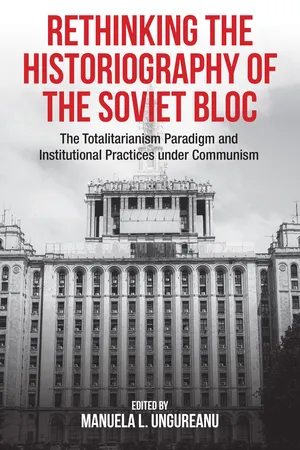
eBook - PDF
Rethinking the Historiography of the Soviet Bloc
The Totalitarianism Paradigm and Institutional Practices under Communism
- 440 pages
- English
- PDF
- Available on iOS & Android
eBook - PDF
Rethinking the Historiography of the Soviet Bloc
The Totalitarianism Paradigm and Institutional Practices under Communism
About this book
Trusted by 375,005 students
Access to over 1.5 million titles for a fair monthly price.
Study more efficiently using our study tools.
Information
Table of contents
- Contents
- Acknowledgments
- Introduction — Historians Reassess Totalitarianism Theory
- Part I — Main Paradigms and Their Evolving Fortunes
- Chapter 1 — Remarks on the Historiography of Rapid Political and Social Change
- Chapter 2 — Carl Friedrich’s Path to “Totalitarianism”
- Chapter 3 — Soviet Society, Social Structure, and Everyday Life: Major Frameworks Reconsidered
- Chapter 4 — The GDR: A Special Kind of Modern Dictatorship
- Chapter 5 — Totalitarian Syndrome as a Case of an Essentially Contested Concept: An Overview of Discussions Held in the Humanities and Social Sciences in Poland
- Chapter 6 — Framing the Rising Discontent with Totalitarianism Theory: The View from Social Ontology
- Chapter 7 — Totalitarianism and the Historians
- Chapter 8 — Why I Say “Totalitarian Regimes”: A Response to Totalitarianism Denial
- Part II — Approaches to Control, Legitimation of Power, and Forms of Resistance
- Chapter 9 — Beyond Totalitarianism: Rethinking Approaches to the GDR and the Nazi Past
- Chapter 10 — The Soviets Abroad: The NKVD, Itelligence, and State Building in East-Central Europe after the Secod World Wr
- Chapter 11 — Postwar Show Trials: The Apogee of Totalitarianism or Political Processes?
- Chapter 12 — The Communist Public Sphere: A Sociolegal Analysis
- Chapter 13 — Inndustrialization, Independence, Identity: Legitimation of Power in Communist Romania, 1965–1971
- Chapter 14 — Homo Sovieticus and the Greengrocer: On Varieties of Dissident Critique of Post-totalitarian Political Culture
- Chapter 15 — On the Origins of “Totalita”: A Social Epistemology of a Nonconcept
- Part III — Soviet-Style Institutions for Higher Education and Research and the Powers of the New Elites
- Chapter 16 — The Counterintuitive Effects of Soviet Totalitarianism: Soviet Universities during Late Stalinism, 1945–1953
- Chapter 17 — Sergei Vavilov and the Soviet Modes of Science Production
- Chapter 18 — A Friendship inside Romanian Academia under Cultural Stalinism: Mihai Ralea and Tudor Vianu
- Chapter 19 — Gatekeeping Institutions of Literary Translation in Soviet Ukraine
- Chapter 20 — Intellectual Autonomy in Socialist Romania: Theories, Methods, and the Case Study of Sociology after 1966
- Chapter 21 — Writing Contemporary History in Late Socialist Hungary: Dissecting Institutional Legacies
- Chapter 22 — “The Tale of Two Cities”: The Historical Multicultural Bucharest versus the Communist Capital of Romania
- Afterword: The Makings of Rethinking the Historiography of the Soviet Bloc, or How to Take Stock of an Elephant and Still Keep Your Bearings
- Index
Frequently asked questions
Yes, you can cancel anytime from the Subscription tab in your account settings on the Perlego website. Your subscription will stay active until the end of your current billing period. Learn how to cancel your subscription
No, books cannot be downloaded as external files, such as PDFs, for use outside of Perlego. However, you can download books within the Perlego app for offline reading on mobile or tablet. Learn how to download books offline
We are an online textbook subscription service, where you can get access to an entire online library for less than the price of a single book per month. With over 1.5 million books across 990+ topics, we’ve got you covered! Learn about our mission
Look out for the read-aloud symbol on your next book to see if you can listen to it. The read-aloud tool reads text aloud for you, highlighting the text as it is being read. You can pause it, speed it up and slow it down. Learn more about Read Aloud
Yes! You can use the Perlego app on both iOS and Android devices to read anytime, anywhere — even offline. Perfect for commutes or when you’re on the go.
Please note we cannot support devices running on iOS 13 and Android 7 or earlier. Learn more about using the app
Please note we cannot support devices running on iOS 13 and Android 7 or earlier. Learn more about using the app
Yes, you can access Rethinking the Historiography of the Soviet Bloc by Manuela Ungureanu in PDF and/or ePUB format, as well as other popular books in Politics & International Relations & Historiography. We have over 1.5 million books available in our catalogue for you to explore.