"Pretty much indispensable to a birder travelling in the subcontinent" - British Birds
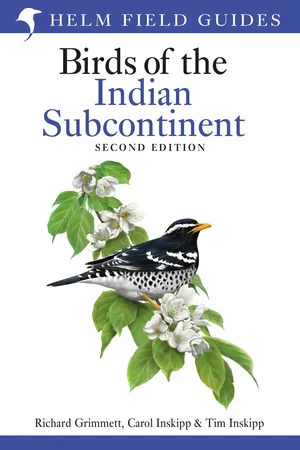
With a wide range of habitats and a dazzling and diverse avifauna, the Indian Subcontinent is one of the world's greatest birding hotspots. This second edition of Richard Grimmett, Carol Inskipp and Tim Inskipp's ground-breaking work is a comprehensive field guide to the region, covering all species known to occur in India, Pakistan, Nepal, Bhutan, Bangladesh, Sri Lanka and the Maldives.
Fully revised and updated, this authoritative book includes more than 240 colour plates of detailed illustrations, alongside concise species accounts describing key identification features, range, habitat and voice with accurate range maps for each species.
Peerless in the scope of its coverage yet still portable enough for field use, Field Guide to Birds of the Indian Subcontinent is an essential companion for any birdwatcher tackling the mountains, rainforests, plains, wetlands or deserts of this magical region.
eBook - ePub
Field Guide to Birds of the Indian Subcontinent
Second Edition
- 576 pages
- English
- ePUB (mobile friendly)
- Available on iOS & Android
eBook - ePub
Field Guide to Birds of the Indian Subcontinent
Second Edition
About this book
Information
Table of contents
- Cover
- Dedication
- Title Page
- Contents
- Acknowledgements
- Introduction
- How to Use this Book
- Plumage Terminology
- Glossary
- The Indian Subcontinent
- Threats and Conservation
- Family Summaries
- Species Accounts and Plates
- Ducks and geese Anatidae
- Megapodes Megapodiidae
- Partridges and pheasants Phasianidae
- Grebes Podicipedidae
- Pigeons and doves Columbidae
- Sandgrouse Pteroclidae
- Bustards Otididae
- Cuckoos, malkohas and coucals Cuculidae
- Frogmouths Podargidae
- Nightjars Caprimulgidae
- Treeswifts Hemiprocnidae
- Swifts Apodidae
- Rails, crakes and coots Rallidae
- Cranes Gruidae
- Jacanas Jacanidae
- Ibisbill Ibidorhynchidae
- Stilts and avocets Recurvirostridae
- Plovers and lapwings Charadriidae
- Painted-snipes Rostratulidae
- Snipes, curlews, sandpipers and stints Scolopacidae
- Buttonquails Turnicidae
- Coursers and pratincoles Glareolidae
- Jaegers and skuas Stercorariidae
- Gulls, terns, noddies and skimmers Laridae
- Tropicbirds Phaethontidae
- Southern storm petrels Oceanitidae
- Shearwaters and petrels Procellariidae
- Storks Ciconiidae
- Frigatebirds Fregatidae
- Darters Anhingidae
- Pelicans Pelecanidae
- Herons and bitterns Ardeidae
- Flamingos Phoenicopteridae
- Osprey Pandionidae
- Hawks, eagles and vultures Accipitridae
- Barn owls Tytonidae
- Typical owls Strigidae
- Trogons Trogonidae
- Hornbills Bucerotidae
- Kingfishers Alcedinidae
- Bee-eaters Meropidae
- Hoopoes Upupidae
- Asian barbets Megalaimidae
- Honeyguides Indicatoridae
- Wrynecks, piculets and woodpeckers Picidae
- Falcons Falconidae
- Parrots and parakeets Psittacidae
- Broadbills Eurylaimidae
- Pittas Pittidae
- Cuckooshrikes and minivets Campephagidae
- Vireos Vireonidae
- Old World orioles Oriolidae
- Woodswallows Artamidae
- Fantails Rhipiduridae
- Fairy flycatchers Stenostiridae
- Drongos Dicruridae
- Shrikes Laniidae
- Crows, magpies and jays Corvidae
- Tits Paridae
- Penduline-tits Remizidae
- Larks ALAUDIDAE
- Bearded Reedling Panuridae
- Cisticolas Cisticolidae
- Reed warblers Acrocephalidae
- Grasshopper warblers and grassbirds Locustellidae
- Cupwings Pnoepygidae
- Martins and swallows Hirundinidae
- Bulbuls Pycnonotidae
- Hypocolius Hypocoliidae
- Leaf warblers Phylloscopidae
- Bush warblers Scotocercidae
- Long-tailed tits Aegithalidae
- Sylvia warblers Sylviidae
- Parrotbills Paradoxornithidae
- White-eyes and yuhinas Zosteropidae
- Scimitar babblers Timaliidae
- Ground babblers Pellorneidae
- Laughingthrushes Leiothrichidae
- Nuthatches Sittidae
- Wallcreeper and spotted creepers Tichodromidae
- Dippers Cinclidae
- Starlings and mynas Sturnidae
- Thrushes Turdidae
- Chats and Old World flycatchers Muscicapidae
- Flowerpeckers Dicaeidae
- Sunbirds and spiderhunters Nectariniidae
- Fairy bluebirds Irenidae
- Weavers Ploceidae
- Munias Estrildidae
- Accentors Prunellidae
- Old World sparrows Passeridae
- Pipits and wagtails Motacillidae
- Finches Fringillidae
- Buntings Emberizidae
- Appendix – Vagrants
- Loons Gaviidae
Trusted by 375,005 students
Access to over 1.5 million titles for a fair monthly price.
Study more efficiently using our study tools.
Frequently asked questions
Yes, you can cancel anytime from the Subscription tab in your account settings on the Perlego website. Your subscription will stay active until the end of your current billing period. Learn how to cancel your subscription
No, books cannot be downloaded as external files, such as PDFs, for use outside of Perlego. However, you can download books within the Perlego app for offline reading on mobile or tablet. Learn how to download books offline
Perlego offers two plans: Essential and Complete
- Essential is ideal for learners and professionals who enjoy exploring a wide range of subjects. Access the Essential Library with 800,000+ trusted titles and best-sellers across business, personal growth, and the humanities. Includes unlimited reading time and Standard Read Aloud voice.
- Complete: Perfect for advanced learners and researchers needing full, unrestricted access. Unlock 1.5M+ books across hundreds of subjects, including academic and specialized titles. The Complete Plan also includes advanced features like Premium Read Aloud and Research Assistant.
We are an online textbook subscription service, where you can get access to an entire online library for less than the price of a single book per month. With over 1.5 million books across 990+ topics, we’ve got you covered! Learn about our mission
Look out for the read-aloud symbol on your next book to see if you can listen to it. The read-aloud tool reads text aloud for you, highlighting the text as it is being read. You can pause it, speed it up and slow it down. Learn more about Read Aloud
Yes! You can use the Perlego app on both iOS and Android devices to read anytime, anywhere — even offline. Perfect for commutes or when you’re on the go.
Please note we cannot support devices running on iOS 13 and Android 7 or earlier. Learn more about using the app
Please note we cannot support devices running on iOS 13 and Android 7 or earlier. Learn more about using the app
Yes, you can access Field Guide to Birds of the Indian Subcontinent by Richard Grimmett,Carol Inskipp,Tim Inskipp in PDF and/or ePUB format, as well as other popular books in Biological Sciences & Zoology. We have over 1.5 million books available in our catalogue for you to explore.