Since 1959, the Cuban revolutionary government has proudly proclaimed that “the revolution is for the children.” Many Cuban Americans reject this claim, asserting that they chose exile in the United States to protect their children from the evils of “Castro-communism.” Anita Casavantes Bradford’s analysis of the pivotal years between the Revolution’s triumph and the 1962 Missile Crisis uncovers how and when children were first pressed into political service by ideologically opposed Cuban communities on both sides of the Florida Straits.
Casavantes Bradford argues that, in Havana, the Castro government deployed a morally charged “politics of childhood” to steer a nationalist and reformist revolution toward socialism. At the same time, Miami exile leaders put children at the heart of efforts to mobilize opposition to Castro’s regime and to link the well-being of Cuban refugees to U.S. Cold War foreign policy objectives. Casavantes Bradford concludes that the 1999 Elián González custody battle was the most notorious recent manifestation of the ongoing struggle to define and control Cuban childhood, revealing the persistent centrality of children to Cuban politics and national identity.
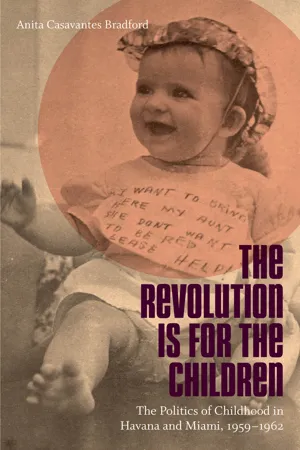
eBook - ePub
The Revolution Is for the Children
The Politics of Childhood in Havana and Miami, 1959-1962
- 278 pages
- English
- ePUB (mobile friendly)
- Available on iOS & Android
eBook - ePub
The Revolution Is for the Children
The Politics of Childhood in Havana and Miami, 1959-1962
About this book
Information
1
For the Children
José Martí and the Politics of Cuban Childhood, 1898–1958
While living in exile in New York City in 1892, José Martí—poet, journalist, pedagogue, and revolutionary father of the Cuban nation—published an essay titled “Nuestra América.” The now classic text is an eloquent statement of Latin American nationalist aspirations, offering an impassioned defense of the region’s moral prerogative to pursue its destiny without outside interference. In morally and emotionally resonant language, Martí placed the notion of childhood at the heart of his argument in favor of his island’s independence. Since Cubans, he argued, were “children of their progenitors whose vices and virtues they reflect,” it was essential that they persevere without compromise in their almost thirty-year struggle for national self-determination. Only a total break from Spain would permit Cubans to move beyond the antidemocratic legacy of the fatherland and realize their individual and shared potential in the context of republican nationhood.1
A few weeks later Martí used similarly child-centered language in an essay for Patria, a journal founded to mobilize U.S.-resident Cubans and Puerto Ricans for the liberation of their homelands from Spanish colonial rule: “Having been born on Spanish soil is not what the oppressed inhabitants of the Antilles detest in the Spaniard; it is the aggressive and insolent occupation of the country where he embitters and atrophies the lives of his own children. The war is fought against the bad father, not the good one. . . . The Spaniard who detests the country of his children will be uprooted by the very war that he has made necessary. The Spaniard who loves his children . . . will safely live in the republic he is helping to create.”2
José Martí’s affection for young people and his belief in their innate goodness were already familiar to readers of his tender poems for and about children, including Ismaelillo and Los Zapaticos de Rosa. However, when Martí chose to articulate his expansive (if somewhat undeveloped) vision for Cuba’s republican future through an equally evocative child-centered discourse, he gave birth to a visceral and particularly durable brand of nationalism that, while undergirded by a foundational Western metanarrative linking children to the destiny of the modern nation-state, would play a uniquely important role in the island’s subsequent and competing nation-making projects. Even before the Spanish-Cuban-American War was launched, Martí’s pro-independence writings had engendered a uniquely permeable Cuban politics of childhood in which a Rousseauian belief in the innate virtue of children and a Lockean notion of the child as tabula rasa would coexist in dynamic tension with repeatedly frustrated efforts to establish honest, effective, and egalitarian government on the island. This tension would be exacerbated by growing U.S. hegemony in Cuba after the end of the war in 1898, driven by the North American belief that Cubans’ racial inferiority and political immaturity left them ill-equipped for independence.
As a result, debates about childhood became a powerful force in the island’s national life throughout the first half of the twentieth century. Even as Cuban leaders increasingly turned to children to express competing political values and to exercise control over state and society, everyday citizens also relied on their understandings of childhood to measure the nation’s progress toward modernity and assess their government’s legitimacy—or lack thereof. Child-centered discourses similarly continued to reflect U.S. reservations about Cubans’ political maturity and capacity for self-rule, as well as Cubans’ own self-doubts about their ability to build a functional and moral republic for their children to inherit.
Between 1902 and 1959, conservative Cuban elites and a growing portion of the U.S.-allied middle class also relied on children to justify the political and economic structures that protected their wealth and positions of prominence in a society marred by instability, corruption, and raced, classed, and gendered inequality. At the same time, however, progressive Cubans continued to insist that discussions about childrearing, welfare, and education should be approached as Martí had framed them—as an integral part of the island’s ongoing quest for sovereignty, democratic government, and multiracial social justice. These actors’ overlapping and conflicting goals, expressed through morally and emotionally resonant representations of childhood and the targeting of actual children as a means of realizing a wide range of political, economic, social, and cultural objectives, came to comprise a republican politics of childhood that dramatically articulated the unfinished nature of the Cuban struggle for independence and helped propel the island toward a second nationalist revolution in 1959.
CHILDHOOD, THE SPANISH-CUBAN-AMERICAN WAR, AND U.S. OCCUPATION, 1898–1902
José Martí’s writing reveals the extent to which the establishment of an independent multiracial Cuban republic depended on claiming, or rather reclaiming, the image of the child as a central trope of national identity. While many modern states had similarly drawn on the figure of the child in support of their nation-making projects, Martí’s politics of childhood possessed a particularly visceral power originating in the dialectic between the liberatory discourse of the independence struggle and U.S. resistance to Cuban self-rule. This resistance was frequently expressed through a competing discourse of childhood that allowed North American commentators to dismiss independentistas’ aspirations toward autonomy and self-determination.
As early as the 1820s, U.S. political leaders had identified Cuba for potential annexation. Annexationist interest grew during the decade preceding the U.S. Civil War, especially among southern politicians, who coveted the island’s fertile agricultural land and saw its large African-origin slave population as essential to the expansion of their plantation-based society. Echoing the racialized and infantilizing discourses that had justified the expansionist Mexican-American War between 1846 and 1848, advocates of Cuban annexation stressed Cubans’ racial inferiority, political and psychological immaturity, and incapacity to assume “adult” responsibility for the care and nurture of an independent republic. Expressing these sentiments in 1859, Richard Henry Dana’s travelogue To Cuba and Back likened Cuba to “a child at play” with the idea of liberty but unable to achieve it, because its citizens lacked the qualities of the Anglo-Saxon race which were essential to self-government.3
Almost forty years later, poet Robert Manners similarly used discourses of childhood to emphasize Cuba’s racially derived unsuitability for self-rule, to discount the hard-won victories that had brought Cubans’ thirty-year independence struggle to its decisive moment by 1898, and to justify the last-minute intervention of the United States in the third and final war against Spain. Characterizing Cuba as “the loveliest child that Nature gave” into the protective care of the United States, Manners dramatized even while denigrating the vain efforts of “Cuba’s valiant children” to establish an independent nation.4 Echoing the theme of Cuba’s vulnerability and inability to act decisively on its own, North American political cartoonists began to depict the island as a fair Spanish señorita in need of rescue by a heroically masculine U.S. military; however, after the war ended, cartoonists also turned to the figure of the child to counter the unexpected resistance of much of the Liberation Army to U.S. intervention.
North American political cartoons, like the discourses opposing Cuban independence that accompanied them, also reflected popular ideas about race that had informed U.S. relations with indigenous peoples during the era of westward expansion and animated increasing U.S. contact with nonwhite people and nations overseas.5 To that end, more sympathetic cartoons depicting Cubans as eager for U.S. tutelage often featured docile white boys and girls; however, those that condemned independentista critiques of the ongoing U.S. military occupation frequently included dirty, half-naked, and ill-behaved black children. The North American media thus interpreted the multiracial insurgent leaders’ desire to assume immediate control of their own government as a shocking display of ingratitude and—as is so often the case with a spoiled child throwing a temper tantrum—an irrational refusal to accept badly needed help from their (white) elders.6
Racialized and infantilized media representations also reinforced popular notions of the United States as a benevolent father, whose duty to protect and uplift “backward” nations—for their own good—exposed him to the immature resentments of the nonwhite peoples on whose behalf he selflessly acted. Most important, they justified U.S. military rule on the island in the immediate aftermath of the war as a measure taken to protect both U.S. and Cuban interests, lest the island fall into the hands of “an irresponsible government of half-breeds.”7
In resisting these racially derived North American representations of Cuba, José Martí and other independentista leaders, including Antonio Maceo and Raimondo Cabrera, had already begun to formulate a counterdiscourse of childhood to mobilize support for a multiracial independence struggle.8 Even as U.S. military officers, journalists, and politicians continued to represent Cubans as dark, childlike savages unfit for self-government, “the child featured in Cuban insurgent rhetoric . . . worked to create an antiracist Cuban nation—in direct opposition to the child featured in U.S. political rhetoric that upheld racial difference within and outside the United States.”9
Martí had long drawn on child-centered language to argue that battle-weary Cuban patriots must continue their liberatory struggle unaided. His own years of exile in New York had opened his eyes to North American imperial designs on Cuba and exposed him to the persistent racial inequalities that continued to mar the U.S. republican project; as a result, he believed that accepting U.S. assistance would almost certainly impose unacceptable limits on the nascent Cuban Republic’s sovereignty. Thus, although Cubans had once had “a childlike confidence in the certain help of the United States,” Martí insisted that their collective coming of age—made manifest in the construction of an autonomous, multiracial, and egalitarian nation—rested on winning the war against Spain without northern intervention.10

This cartoon is one of many racialized portrayals of the nascent Cuban nation to appear in the turn-of-the-century U.S. media. These images critiqued Cubans’ desire for independence while emphasizing their presumed incapacity for self-rule and need for American tutelage. From Chicago Tribune, April 14, 1901.
Martí further elaborated his understanding of the relationship between childhood and the nation within an explicitly egalitarian framework. Since he believed that liberty and equality were closely linked to literacy and culture, Martí’s vision of a color-blind Cuban republic featured a comprehensive public school system that would prepare boys and girls for citizenship in a multiracial democracy. The success of the republican nation-making project rested on the care and education of these children since, he argued, “there will be no true growth for the nation . . . until the child is taught” to uphold its ideals. Within this vision, Cuban patriots would wage war to create the future nation “for the children,” but the island’s youngest citizens would also play a role—albeit a largely symbolic one—in constructing what Martí called “moral republicanism” since “they are the ones who know how to love.”11 These words converted children into an important mobilizing force in the independence struggle and a powerful symbol of the longed-for future nation that would continue to resonate with Cubans of widely varying political persuasions throughout the twentieth century.
The conclusion of the Spanish-Cuban-American War did not usher in the period of peace, prosperity, and self-determination of which nationalists had dreamed. In accordance with the terms of the 1898 Treaty of Paris, the Spanish Crown surrendered control of the island to the U.S. government rather than local leadership. Moreover, though the fourth clause of the Joint Resolution on Cuba (known as the Teller Amendment) had foresworn formal U.S. colonization of the island, it nonetheless provided for an unspecified period of North American occupation to pacify the war-torn society and postponed Cuban self-government to a date to be determined by their new overseers.
On January 1, 1899, the United States assumed formal possession of Cuba from Spain, and a military governor was appointed to oversee progress toward eligibility for self-rule—measured by a set of political, economic, social, and cultural preconditions to be established and evaluated exclusively by the island’s new trustees. However, not all of them were committed to the idea of Cuban independence. For more than seventy-five years, many North American political leaders had clung to the goal of annexation, a pursuit that was central to the ideal of Manifest Destiny that continued to inspire the growth and expansion of the United States. High-ranking officials in the McKinley and Roosevelt administrations argued that the Teller Amendment, while prohibiting the annexation of Cuba as a result of the victory over Spain or as the consequence of U.S. military occupation, did not preclude the possibility of union at a later date.
These officials also pressed for policies that would facilitate the eventual acquisition of the island. These included the development of reciprocal trade agreements and national institutions compatible with U.S. political and economic structures, the recruitment and cultivation of local allies (especially among the islands’ conservative, land-owning white elite), the suppression of Spanish colonial customs, and the widespread Americanization of Cuban society and culture—all of which were presented as necessary preconditions for self-government but would equally well serve the goal of the island’s incorporation as a U.S. territory.
Leonard Wood, the island’s military governor-general from 1900 to 1902, shared the belief that preparation for independence under North American tutelage might simultaneously serve as an impetus toward annexation. While rejecting the acquisition of Cuba by force, he nonetheless hoped that a brief experience of self-rule might satisfy the people’s desire for “theoretical liberty” and remove their resistance to union with their northern neighbor.12 Wood believed, as did many other U.S. military leaders and politicians, that the grounds for this eventuality must be laid through the cultivation of a critical mass of proannexationists on the island, a goal his administration pursued by targeting Cuban children. In line with Progressive Era thought stressing the close relationship between the care and education of the child and the construction of a modern, democratic, and prosperous nation, Wood’s military government quickly set out to prepare the island for self-rule—in harmony with U.S. strategic and commercial interests on the island and without precluding the possibility of annexation—through the creation of a new system of public education geared toward the production of citizens aligned with North America.
Governor Wood’s policies sought to remake Cuban society through the extension of U.S.-style education to all children in Cuba.13 Modeled on their counterparts in the United States, new public schools set out to disabuse Cuban children of their Spanish cultural inheritance, replacing the Catholic instruction and rote learning methods that had dominated Cuban colonial schools with progressive pedagogical approaches designed to inculcate students with the “modern” values necessary to the smooth functioning of a democratic-capitalist society. These included the virtues of hard work, frugality, and self-discipline; respect for the law and property; civic engagement and prudent participation in electoral politics; obedience to duly constituted political authority; and adherence to a Protestant Christian spiritual tradition.
To that end, children in U.S.-occupied Cuba enrolled in coeducational schools modeled after the Ohio state system of public education, attended classes taught by teachers trained at special Harvard summer school programs for Cuban educators, and studied English, U.S. history, geography, and civics, in addition to other subjects taught with Spanish translations of U.S. textbooks. The role of Catholic clergy on local school boards and their influence in the public schools was strictly curtailed, and religious instruction was restricted to private schools, which continued to enroll a significant proportion of children from the island’s elite white families.14 However, even as U.S. officials and private citizens launched a new educational system to prepare Cuban children for citizenship in a modernizing nation, their perception of the island’s people as racially inferior and immature gave them grave doubts about Cubans’ ability to take charge of the education of their own children. Indeed, Cuban teachers sent to Harvard in 1901 were described in the U.S. media as “grown up children . . . who could not understand the significance of what they saw.”15
Paternalist and racist though this educational campaign undoubtedly was, the effects of the military government’s investment in Cuban schools were immediate and dramatic. In the first year of Wood’s administration, the graft and political trafficking in lucrative teaching appointments that had characterized the Spanish colonial educational system was eliminated, teacher salaries were raised (in some cases exceeding those paid in the United States by as...
Table of contents
- Cover Page
- Title Page
- Copyright Page
- Dedication
- Contents
- Illustrations
- Acknowledgments
- INTRODUCTION The Politics of Childhood in Cuba’s Revolution and Exile
- 1 For the Children
- 2 ¿La Revolución—es Para los Niños?
- 3 Childhood and Civil Society in Revolutionary Cuba
- 4 Children, Radicalization, and the Cuban Counterrevolution
- 5 Our Cuban Visitors
- 6 To Save Our Children
- EPILOGUE Understanding Elián
- Notes
- Bibliography
- Index
Trusted by 375,005 students
Access to over 1.5 million titles for a fair monthly price.
Study more efficiently using our study tools.
Frequently asked questions
Yes, you can cancel anytime from the Subscription tab in your account settings on the Perlego website. Your subscription will stay active until the end of your current billing period. Learn how to cancel your subscription
No, books cannot be downloaded as external files, such as PDFs, for use outside of Perlego. However, you can download books within the Perlego app for offline reading on mobile or tablet. Learn how to download books offline
Perlego offers two plans: Essential and Complete
- Essential is ideal for learners and professionals who enjoy exploring a wide range of subjects. Access the Essential Library with 800,000+ trusted titles and best-sellers across business, personal growth, and the humanities. Includes unlimited reading time and Standard Read Aloud voice.
- Complete: Perfect for advanced learners and researchers needing full, unrestricted access. Unlock 1.5M+ books across hundreds of subjects, including academic and specialized titles. The Complete Plan also includes advanced features like Premium Read Aloud and Research Assistant.
We are an online textbook subscription service, where you can get access to an entire online library for less than the price of a single book per month. With over 1.5 million books across 990+ topics, we’ve got you covered! Learn about our mission
Look out for the read-aloud symbol on your next book to see if you can listen to it. The read-aloud tool reads text aloud for you, highlighting the text as it is being read. You can pause it, speed it up and slow it down. Learn more about Read Aloud
Yes! You can use the Perlego app on both iOS and Android devices to read anytime, anywhere — even offline. Perfect for commutes or when you’re on the go.
Please note we cannot support devices running on iOS 13 and Android 7 or earlier. Learn more about using the app
Please note we cannot support devices running on iOS 13 and Android 7 or earlier. Learn more about using the app
Yes, you can access The Revolution Is for the Children by Anita Casavantes Bradford in PDF and/or ePUB format, as well as other popular books in History & Latin American & Caribbean History. We have over 1.5 million books available in our catalogue for you to explore.