In this compelling interdisciplinary study, Linda Grasso demonstrates that using anger as a mode of analysis and the basis of an aesthetic transforms our understanding of American women’s literary history. Exploring how black and white nineteenth-century women writers defined, expressed, and dramatized anger, Grasso reconceptualizes antebellum women’s writing and illuminates an unrecognized tradition of discontent in American literature. She maintains that two equally powerful forces shaped this tradition: women’s anger at their exclusion from the democratic promise of America, and the cultural prohibition against its public articulation.
Grasso challenges the common notion that nineteenth-century women’s writing is confined to domestic themes and shows instead how women channeled their anger into art that addresses complex political issues such as slavery, nation-building, gender arrangements, and race relations. Cutting across racial and genre boundaries, she considers works by Lydia Maria Child, Maria W. Stewart, Fanny Fern, and Harriet Wilson as superb examples of the artistry of angry expression. Transforming their anger through literary imagination, these writers bequeathed their vision of an alternative America both to their contemporaries and to subsequent generations.
eBook - ePub
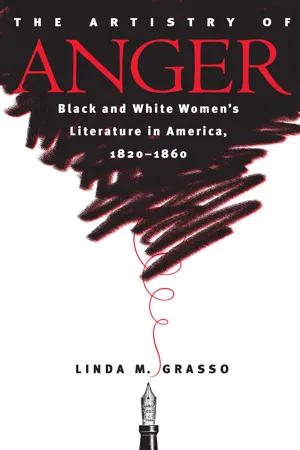
The Artistry of Anger
Black and White Women's Literature in America, 1820-1860
- 264 pages
- English
- ePUB (mobile friendly)
- Available on iOS & Android
eBook - ePub
About this book
Information
Part One: The Anger Paradigm Theories and Contexts
Chapter One: Anger as Analysis and Aesthetic in American Women’s Literature
[T]he emotion which accompanies the first steps toward liberation is, for most women, anger.… Through the exercise of your anger … you gain strength.… [A]nger finds its ultimate meaning as an experience shared with other women. All striving to understand their collective situation, women in a group can help each other through the first, painful phase of outward-directed anger.… Controlled, directed, but nonetheless passionate, anger moves from the personal to the political and becomes a force for shaping our new destiny.
—Susi Kaplow, “Getting Angry” (1971)
Women responding to racism means women responding to anger; the anger of exclusion, of unquestioned privilege, of racial distortions, of silence, ill-use, stereotyping, defensiveness, misnaming, betrayal, and co-optation.… Every woman has a well-stocked arsenal of anger potentially useful against those oppressions, personal and institutional, which brought that anger into being. Focused with precision it can become a powerful source of energy serving progress and change.
—Audre Lorde, “The Uses of Anger: Women Responding to Racism” (1981)
To women envisioning a new America in the 1970s, anger was a vital political tool. It enabled new perspectives, new understandings of oppressive conditions that had previously remained unquestioned. In essays, speeches, manifestos, and direct actions, feminist revolutionaries liberated anger from pejorative connotations by disassociating it from fear, destruction, and masculinity, and reassociating it with courage, growth, and sisterhood. They recognized anger’s relationship to individual and collective political consciousness; they theorized its potential to become “a powerful source of energy serving progress and change”; they relished its transformative capacities. Anger demanded attention; it propelled insight, artistry, action; it exposed knowledge that had been buried, speech that had been silenced. Anger was a link to previous selves, suppressed histories, revolutionary coalitions. “I couldn’t believe—still can’t—how angry I could become, from deep down and way back, something like a five-thousand-year-buried anger,” Robin Morgan declared in the introduction to Sisterhood Is Powerful, one of the earliest textual “actions” of the women’s liberation movement. “Every Black woman in America lives her life somewhere along a wide curve of ancient and unexpressed angers,” Audre Lorde observed. Only when women were able to feel anger, and then recognize, accept, and direct it at the real enemy—a patriarchal system that “launches rockets, spends over sixty thousand dollars a second on missiles and other agents of war and death, slaughters children in cities, stockpiles nerve gas and chemical bombs, [and] sodomizes our daughters and our earth”—could cross-racial female coalition occur.1
Thirty years later, it is incumbent upon the beneficiaries of the feminist movement to once again make women’s anger at gender and racial injustice central. The fundamental premise of this book is that anger can be an organizing principle of American women’s literary history when it is employed as a mode of inquiry. By identifying the sources of women’s anger and analyzing how their anger assumes literary expression, anger can be used as a paradigm for understanding the ways in which women, at different historical moments, have responded to myriad forms of oppression through the literary imagination. With anger as an analytical fulcrum, it becomes possible to chart a history of women’s literature that acknowledges inventive complexity and traverses racial boundaries. The Artistry of Anger tests this proposition by examining women’s literary anger in the antebellum period.
In the chapters that follow, I suggest a method of reading that illuminates an unrecognized tradition in American literature, a specifically gendered tradition of literary discontent that is shaped by two equally powerful forces: women’s anger at exclusion from the failed promises of democratic America, and their inability to express that anger overtly. I explore the evolution of this tradition in the years before the Civil War by analyzing texts written by four major nineteenth-century women writers: Lydia Maria Child, Maria W. Stewart, Fanny Fern, and Harriet Wilson. Because their texts are declarations of personal and national discontent, I read them as political documents embedded in particular historical moments. As such, they are superb examples of the artistry of angry expression. Transforming their anger through the literary imagination, these writers bequeath their vision of an alternative America to both their contemporaries and subsequent generations.
By focusing on Lydia Maria Child’s Hobomok, Maria W. Stewart’s speeches and meditations, Fanny Fern’s Ruth Hall, and Harriet Wilson’s Our Nig, it is not my intention to establish a canon of representative writers and texts, nor to imply that the narrative I present precludes other formulations. On the contrary, my aim is to contribute to a more textured, empathetic understanding of American women’s literary history by proposing a new organizing framework. By reconstructing what it meant for these nineteenth-century women writers to express anger in their literature, I hope to demonstrate the usefulness of the anger paradigm not only for this historical period, but for others as well.
Two concepts guide my interpretation of women’s literary lives and texts and are the foundation of my reading practice: anger as a mode of analysis, and anger as the basis of an aesthetic. These concepts enable an interpretative strategy that analyzes how women’s achievements, failures, frustrations, and desires are literally translated into artistic creation. They are also flexible enough to allow a mapping of similarities as well as differences between writers of different generations, ideological persuasions, religious affiliations, and racial groups.
Using anger as a mode of analysis and the basis of an aesthetic requires utilizing the following perspectives. First, definitions of anger, expressions of anger, and interpretations of anger must be situated in specific historical, ideological, and social contexts. Delineating these contexts enables an understanding of both the possibilities and limitations that affect women’s literary imaginings. Second, recognizing that women invent and practice an artistry of anger to express anger in their literature is imperative. Because gendered ideologies have historically precluded anger from women’s emotional repertoire, women create an art form to express publicly the angered discontent that is culturally prohibited. Third, the issue of power relations is central, not only within the internal worlds of texts, but also within the larger historical arena. Analyzing who has power over whom, how the power functions, and whose purposes it serves, as well as the ways in which women writers resist or embrace existing economic, cultural, class, and racial power relations, is essential. Finally, the supposition that women’s literary anger is “a multifaceted response to the lived realities of the historical moment” is a given.2 Because there is a relationship between feelings and the material world in which feelings are experienced, women’s literary expressions of anger can not be regarded as singular, individual, and psychological. Rather, they must be analyzed as part of a larger, ongoing historical phenomenon. Women’s literary anger is collective, political.
Subjecting texts and contexts to the following questions is equally crucial. What ideologies govern the definition, interpretation, and expression of anger in the culture? How are these ideologies created, disseminated, accepted, or rejected? In what ways are the social, economic, and material conditions of women’s lives anger-producing? In what ways is that anger dramatized and expressed in their literature? What metaphors do women writers employ? What genres do they choose to write in? Do the authors create characters who see themselves as victims of injustice? How is the injustice characterized? How do the characters respond to it? What role does angered discontent play in the text? In the author’s life? In the author’s community?
The wealth of interdisciplinary feminist scholarship produced within the last thirty years makes it possible to locate women’s anger and its expression in their literary texts. Psychological theories, historians’ analyses of women’s culture and politics, and literary critics’ approaches to imaginative literature have taught us how to find women’s anger, recognize its common manifestations, and ascertain its emotional, social, and economic causes. Moreover, the “folk theory of anger” elucidated by linguists Zoltan Kovecses and George Lakoff helps us to see that the lexicon of anger women writers employ is easily recognizable because it is a western cultural phenomenon that can be traced back to antiquity.
Kovecses and Lakoff formulated the “folk theory of anger” after they considered what conventional idioms such as “He was foaming at the mouth”; “You’re beginning to get to me”; “You make my blood boil”; “He is just letting off steam”; “When I told him, he blew up,” all had in common. They conclude that there is “a coherent conceptual organization underlying all these expressions, and that much of it is metaphorical and metonymical in nature.” Their central insight is that what people perceive to be the physiological effects of anger, such as “increased body heat, increased internal pressure (blood pressure, muscular pressure), agitation, and interference with accurate perception,” are also what people use to name, describe, and express the emotion itself. As I will show throughout this book, women writers often use two of the most common anger metaphors—anger as heat, and anger as a dangerous animal that needs to be held in check—in their literary texts.3
The anger paradigm asserts that in the same way there are telltale physical signs of anger—facial expressions, clenched fists, eruptions of violence—so, too, are there textual signs of anger—gestures and expressions that are specifically gendered. Feminist literary critics have identified white women writers’ creation of doubled characters, crying protagonists, diminished men, and heroines’ retreats into madness as coded signals of anger.4 In this book, I suggest that illness, acts of sacrifice, supplicating tones, captivity motifs, death, hunger, and emaciated bodies are also often telltale signs—the textual gestures if you will—of women’s forbidden angry expression. Recognizing how these gestures function in ideological contexts in which women are relegated to separate, unequal spheres in the public imagination provides insight into how women respond to oppression and exclusion, their own and that of the others with whom they identify—the enslaved, the powerless, and the economically disenfranchised.
The Artistry of Anger builds upon thirty years of feminist literary scholarship. The issue of anger is central to an understanding of women’s literature, feminist critics have argued, because the writers’ relationship to it and its expression determines the artistic devices they employ as well as the kinds of stories they tell.5 Women’s repressed anger, they have consistently noted, has had significant effects on their literary imaginings. The insight, for example, that English novelists needed to repress their rage led Sandra M. Gilbert and Susan Gubar to theorize that white nineteenth-century women writers split their protagonists into two, creating a “madwoman in the attic.”6 Carolyn Heilbrun sees the “record of anger” in May Sarton’s 1973 Journal of a Solitude as a watershed in women’s autobiography, because it is a public telling of what has always been forbidden to women. In Heilbrun’s analysis, the prohibition against anger is integrally related to the articulation of voice in women’s narratives. Because they are “[f]orbidden anger, women could find no voice in which publicly to complain; they took refuge in depression or madness.”7 At the same time, however, as Patricia Meyer Spacks notes in one of the field’s earliest studies, women have historically used their anger to create art. In her words, “anger must have been a source of creative energy for … women writers; anger provided the impetus, the subject, and the inventiveness of their work.… The fact remains that many women have written marvelously out of anger.”8
Feminist literary critics and scholars also wrote “marvelously out of anger.” Like the political movement that engendered it, feminist literary criticism was born of anger and infused with the insights it made possible. Pioneering studies such as Kate Millet’s Sexual Politics, Mary Ellman’s Thinking about Women, and Judith Fetterley’s The Resisting Reader were propelled by the writers’ anger at exclusion from the masculinist world of artistic endeavor, the insidious male bias of literary criticism, and the devaluation of white women’s lives, experiences, and creativity. Spurred by the clarity that anger made possible, these critics relentlessly exposed the ways in which perceptions about sexual difference affected how white women writers, as well as their texts, were regarded. They deplored the gendered separation of literature, the “working rule” that “there must always be two literatures like two public toilets, one for Men and one for Women,” and excoriated the “phallic criticism” this separation engendered. “Books by women are treated as though they themselves were women, and criticism embarks, at its happiest, upon an intellectual measuring of busts and hips.”9 They analyzed the “sexual politics” of male dominance that pervaded male texts, demonstrated how “literary descriptions of sexual activity itself” revealed misogynistic notions of smug male superiority, and documented patriarchy’s historical trajectory.10 They discerned what happened when women were taught to read male-authored books that devalued their gender and experiences: “[T]he female reader is co-opted into participation in an experience from which she is explicitly excluded; she is asked to identify with a selfhood that defines itself in opposition to her; she is required to identify against herself.” Heeding Adrienne Rich’s call for “[r]e-vision—the act of looking back, of seeing with fresh eyes, of entering an old text from a new critical direction,” feminist literary critics devised new ways of reading texts and writing literary history. “[T]he first act of the feminist critic,” Judith Fetterley proclaimed, “must be to become a resisting rather than an assenting reader and, by this refusal to assent, to begin the process of exorcising the male mind that has been implanted in us.”11
Refusing “to assent” to the “double jeopardy” of being both black and female, black feminist scholars were also conducting exorcisms. Asserting their presence in a world in which “all the women are white [and] all the blacks are men,” they angrily dispelled the notion that both they and their literary forebears were nonexistent. “Merely to use the term ‘Black women’s studies’ is an act charged with political significance,” Gloria T. Hull and Barbara Smith asserted in the introduction to a path-breaking anthology devoted to that field. “At the very least, the combining of these words to name a discipline means taking the stance that Black women exist—and exist positively—a stance that is in direct opposition to most of what passes for culture and thought on the North American continent.”12 Black feminist critics published studies which “refus[ed] to pay homage to the ‘system’s’ distortions of black women,” and demanded respect for the “black women who are real-life models for images in literature.”13 They expressed outrage at the “white female chauvinism” practiced by white feminist colleagues in the movement and in the academy. The black women’s equivalent of Sisterhood Is Powerful, The Black Woman: An Anthology, also published in 1970, “grew out of impatience,” its editor Toni Cade Bambara reported, “an impatience with the fact that in the whole bibliography of feminist literature, literature immediately and directly relevant to us wouldn’t fill a page.”14 Outraged impatience also motivated the excoriation of white feminist scholars and artists who produced work that routinely excluded black women and failed to acknowledge their humanity and womanhood. “[W]hite women who called themselves feminists,” Alice Walker concluded in a 1979 essay published in Ms, were “as incapable as white and black men of comprehending blackness and feminism in the same body, not to mention within the same imagination.”15
As Walker’s remark suggests, black feminist critics, like their white colleagues, also directed their ire at male colleagues who produced exclusionary versions of literary history. Black women writers were “frequently excised” from African American literary history written by male scholars, they argued, and if their work was addressed, it was treated with condescension and contempt.16 In example after example, scholars such as Barbara Smith, Deborah McDowell, and Mary Helen Washington documented the ways in which male scholars characterized black women’s literature as shallow, d...
Table of contents
- Cover Page
- The Artistry of Anger
- Copyright Page
- Dedication
- Contents
- Acknowledgments
- Part One: The Anger Paradigm Theories and Contexts
- Part Two: Anger in the House and in the Text Four Case Studies
- Conclusion
- Notes
- Bibliography
- Index
Trusted by 375,005 students
Access to over 1.5 million titles for a fair monthly price.
Study more efficiently using our study tools.
Frequently asked questions
Yes, you can cancel anytime from the Subscription tab in your account settings on the Perlego website. Your subscription will stay active until the end of your current billing period. Learn how to cancel your subscription
No, books cannot be downloaded as external files, such as PDFs, for use outside of Perlego. However, you can download books within the Perlego app for offline reading on mobile or tablet. Learn how to download books offline
Perlego offers two plans: Essential and Complete
- Essential is ideal for learners and professionals who enjoy exploring a wide range of subjects. Access the Essential Library with 800,000+ trusted titles and best-sellers across business, personal growth, and the humanities. Includes unlimited reading time and Standard Read Aloud voice.
- Complete: Perfect for advanced learners and researchers needing full, unrestricted access. Unlock 1.5M+ books across hundreds of subjects, including academic and specialized titles. The Complete Plan also includes advanced features like Premium Read Aloud and Research Assistant.
We are an online textbook subscription service, where you can get access to an entire online library for less than the price of a single book per month. With over 1.5 million books across 990+ topics, we’ve got you covered! Learn about our mission
Look out for the read-aloud symbol on your next book to see if you can listen to it. The read-aloud tool reads text aloud for you, highlighting the text as it is being read. You can pause it, speed it up and slow it down. Learn more about Read Aloud
Yes! You can use the Perlego app on both iOS and Android devices to read anytime, anywhere — even offline. Perfect for commutes or when you’re on the go.
Please note we cannot support devices running on iOS 13 and Android 7 or earlier. Learn more about using the app
Please note we cannot support devices running on iOS 13 and Android 7 or earlier. Learn more about using the app
Yes, you can access The Artistry of Anger by Linda M. Grasso in PDF and/or ePUB format, as well as other popular books in Literature & Literary Criticism for Women Authors. We have over 1.5 million books available in our catalogue for you to explore.