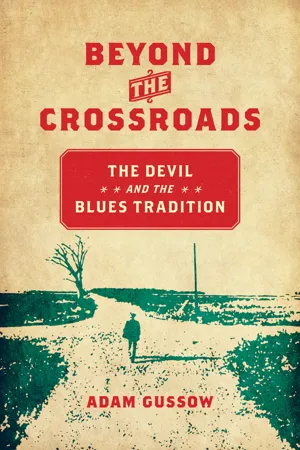
The devil is the most charismatic and important figure in the blues tradition. He’s not just the music’s namesake (“the devil’s music”), but a shadowy presence who haunts an imagined Mississippi crossroads where, it is claimed, Delta bluesman Robert Johnson traded away his soul in exchange for extraordinary prowess on the guitar. Yet, as scholar and musician Adam Gussow argues, there is much more to the story of the devil and the blues than these clichéd understandings.
In this groundbreaking study, Gussow takes the full measure of the devil’s presence. Working from original transcriptions of more than 125 recordings released during the past ninety years, Gussow explores the varied uses to which black southern blues people have put this trouble-sowing, love-wrecking, but also empowering figure. The book culminates with a bold reinterpretation of Johnson’s music and a provocative investigation of the way in which the citizens of Clarksdale, Mississippi, managed to rebrand a commercial hub as “the crossroads” in 1999, claiming Johnson and the devil as their own.
- 416 pages
- English
- ePUB (mobile friendly)
- Available on iOS & Android
eBook - ePub
1: HEAVEN & HELL PARTIES
Southern Religion and the Devil’s Music
My daddy, he was a preacher . . . my mother, she was sanctified
You know my daddy, he was a preacher . . . and my mother, she was sanctified
Well now you know I must’ve been born the devil . . . because I didn’t want to be baptized
—LITTLE SON JACKSON, “Evil Blues” (1949)
PRIMAL SCENES, PREACHERS’ BLUES
Any researcher seeking to understand the role played by the devil in the history and mythology of the blues stumbles repeatedly upon two primal scenes. Both are set in the harsh pastoral of a premodern Mississippi Delta, and both involve young black men determined to realize their destinies as creative artists. The first primal scene has become, arguably, the most visible contemporary manifestation of Southern Gothic: Robert Johnson at the crossroads, selling his soul to the devil—often figured as a larger, older black man—in exchange for supernatural skill on the guitar. The second primal scene, the obverse of the first, also involves a negotiation with larger, older figures who enact retribution on the mortal body of the bluesman-in-training. The figures in this second case are parents, grandparents, “old folks,” who threaten and sometimes whip the disobedient son for daring to manifest an interest in “the devil’s music.”
If the first primal scene, recapitulated in novels, films, documentaries, the visual arts, touristic literature, and countless reviews of The Complete Recordings of Robert Johnson (1990), has become a staple of American pop culture, then the second primal scene has become a staple of the blues interview—“the bluesman’s story,” to invoke the subtitle of Barry Lee Pearson’s trenchant study “Sounds So Good to Me.” Pearson wisely cautions us that blues performers, evolving their life narratives through repeated contact with credulous journalists and audiences, may heighten the family conflict in their retellings as a way of subtly aggrandizing themselves, shaping their self-representations as determined freethinkers.1 One recurring element of the bluesman’s story, an outgrowth of this second primal scene, is an insistence that the blues is not the devil’s music, regardless of what disapproving parents, ministers, and “church people” may say. Born in 1909 in the Delta town of Shelby, Mississippi, Henry Townsend offers a representative defense of his craft:
When you use the term “blues,” [a lot of people] say that’s the devil’s music. Well, it’s just as good as gospel. The only difference is the gospel people singing about biblical days and what they done, but I’m not at biblical times. I’m of this age as of now. They can certainly discard the idea that blues will send you anyplace different from gospel, because as long as it’s the truth, one truth is no greater than the other. So I just stick to the truth, and if you can condemn the truth, then I haven’t got a chance, because that’s all I’m telling. And the “devil’s music”—I don’t think the devil cares much for the truth.2
The “anyplace” referenced by Townsend—the pit into which blues-playing will surely send you—is of course hell, the final destination of all sinners. Rejecting this charge, Townsend depicts himself as a truthteller who is also, and crucially, a modernist. Although gospel music was itself a new and controversial art form in the 1920s and 1930s, one that provoked considerable dissension when it was introduced into mainline black churches in the urban North, Townsend represents it (and, by implication, the spirituals and other church music) as yesterday’s news, a recapitulation of “biblical days.” The blues, by contrast, locates itself squarely in “this age” and inoculates itself against the devil’s-music charge, in Townsend’s eyes, precisely to the extent that it tells the truth about its contemporary moment and milieu.
For those who inveighed against the “devil’s music,” however, a chief provocation was the truth, the contemporary social evidence, as they saw it: the worldly, “sinful” behaviors and attitudes exhibited by the young folk who produced and consumed the blues. Blues culture in Townsend’s youth was marked by, if not defined by, violence, promiscuity, profanity, and alcoholism—this during Prohibition, when the presence of alcohol meant that the law was being broken as well.3 Blues culture was a dynamic, disputatious, disreputable subculture. It excited young people, especially those in the restless working class trapped by plantation sharecropping. It animated the imaginations of young musicians in particular with an intoxicating promise of financial gain, artistic self-realization, social status, and sexual pleasure. For precisely the same reasons, blues culture alarmed black elders—parents and grandparents charged with juvenile discipline; ministers charged not just with safeguarding their congregants’ virtue but also with increasing their flocks and their collections in a time of restless migration; educators and other middle-class guardians of respectability who hewed to an ideology of behavioral and economic uplift that viewed the spendthrift denizens of the jukes as a negative ideal. This alarm expressed itself within the family circle as threats, whippings, and warnings about the hellish provenance of the blues. Bluesmen evoke this primal scene with a vibrancy that conveys its shaping impact. Disobedience was catastrophic; yet disobedience was required if the music’s call was to be honored. A minister’s son born in Lambert, Mississippi, in 1921, harmonica player Snooky Pryor told an interviewer about the first time he played a house party on a plantation in the town of Vance, ten miles away:
At that time I wasn’t allowed to go out there, and that’s when James Scott used to steal me out of the house, and then had to get back in there before everybody woke up and got up. If I didn’t I’d be on the killin’ floor!
You couldn’t miss getting’ back in. No. If one of us had got caught, you wouldn’t be able to be interviewin’ me today. No, there wouldn’t have been no Snooky. ’Cause my old man would have killed me. I know he would have. ’Cause he hated that kind of music anyway, you know what I mean. . . . He told me that was devil music. It wasn’t no devil’s music then, it ain’t no devil’s music now. I wished he was alive now so he could see what the devil’s music has did for me and is doin’ for me.”4
Pryor left home in 1936 at the age of fifteen and worked his way north through Arkansas, Missouri, and Cairo, Illinois, before arriving in Chicago in 1940. It was in 1936 that Robert Johnson, a decade older than Pryor and just as restless, recorded “Sweet Home Chicago,” “Rambling on my Mind,” and “Cross Road Blues.” Johnson’s stepfather, Dusty Willis, was no minister, merely a hardworking Delta sharecropper who disliked the blues, warned young Robert to stay out of the local juke joints, and beat him for his unwillingness to labor in the fields during the decade (1919–29) in which Robert lived with him. “His mother and stepfather didn’t like for him to go out to those Saturday night balls,” Son House claimed, “because the guys were so rough. He didn’t care anything about working in the fields, and his [step]father was so tight on him about slipping out and coming where we were, so he just got the idea he’d run away from home.”5
The same motifs—a restless prodigal son grasping at forbidden musical fruit, a violent and beckoning nightlife, moralistic and repressive parental figures—show up with remarkable frequency in the lives of bluesmen who came of age during the 1920s and 1930s, when the blues were emergent in the southern jukes and the devil’s music was suddenly a commodified form of entertainment. The association of African American secular music with the devil and “sinfulness” has a long prehistory, of course, one that considerably predates its usage in blues contexts. As I’ll explore in a moment, it is impossible to speak coherently about the association between the devil and the blues without discussing the transformations wrought on African American slaves and their fiddle-driven frolics by the evangelical Christianity that swept across the South during the eighteenth and early nineteenth century. By the same token, something new happens—or rather, many historical developments converge and collide—during the period in question, and that newness is what interests me.
One historical development is the introduction of the inexpensive steel-string guitar, a novel iteration of a familiar instrument, into the scene of southern music-making; its association with a new generation of traveling musicians; and its almost immediate condemnation as a “devil’s plaything” by an older generation of church-identified African Americans in the South. A second development is the explicit adoption of the devil as countercultural icon, a constituent element of the socially projected self, by performers such as Peetie Wheatstraw and Robert Johnson—a strategy that psychologist Erik Erikson has termed “foreclosure into a negative identity,”6 although bluesmen deploy that identity with a greater sense of irony than the myth of hellhound-haunted crossroads pacts suggests. (I explore this aesthetic stance in chapters 3 and 5.) Standing just behind this latter development is a significant attitudinal divergence between the conservative, religious parental generation, which sociologist Louis Jones in his 1941–42 study of the Mississippi Delta called the “railroad generation,” and a rootless, skeptical, irreverent younger cohort—a black southern version of the Lost Generation, hard-drinking and newly mobile, flouting parental and church-imposed strictures within the confines of Jim Crow segregation. Homegrown blues wasn’t the only music this generation danced to; the jukeboxes in Clarksdale, Mississippi, featured the latest pop, swing, and jazz hits by national stars. But blues, especially in the Delta, was the native sound that focused regional ambition and anchored community musicianship. As such, it suffered the brunt of the devil’s-music charge.
John Lee Hooker, native of Clarksdale and singer of lines such as “Ain’t no heaven, ain’t no burnin’ hell,” is a representative figure here, and nowhere is he more representative than in the fact that he is the blues-singing child of a Baptist minister, one who could only realize his artistic gifts by leaving his father’s house. A partial list of southern-born blues and R & B performers whose fathers were disapproving ministers or deacons includes not just Hooker and Pryor but also Skip James, Bessie Smith, W. C. Handy, Sunnyland Slim, the blues-playing fathers of Honeyboy Edwards and Eddie Burns, Big Joe Duskin, Lillie Mae “Big Mama” Glover, John Cephas, Chief Ellis, H. Bomb Ferguson, Ida Goodson, Sterling “Mr. Satan” Magee, Johnny Ace, and Sam Cooke. To this list must be added blues singers (and the occasional jazzman) who, although not directly descended from men of the cloth, report being chastised by their families and churches for their secular musical involvements, including Muddy Waters, Mississippi Fred McDowell, Mance Lipscomb, Koko Taylor, Jessie Mae Hemphill, Cedell Davis, Pops Staples, Eddy Clearwater, Jack Owens, Nappy Brown, Nat D. Williams, Lonnie Pitchford, and Mary Johnson. As the musicians later recount, the chastisements invariably failed to achieve their desired goal. “My grandmother . . . told me that devil music would surely bring about my downfall,” Jelly Roll Morton told Alan Lomax, “but I just couldn’t put it behind me.”7
The tension between black Christianity and the devil’s music took on unprecedented weight during the decades of the blues’ ascendance, however, not just because the conflict was frequently situated within the primal scene of a family romance but also because the black southern ministers whose condemnation of the blues underwrote parental admonitions were themselves struggling with a range of profound challenges. This was especially true in the Mississippi Delta of the 1920s and 1930s, with its restless, rootless, notably youthful population. “Young people have begun to look down on the old-fashioned Negro preacher,” wrote sociologist Gunnar Myrdal in 1944, summarizing his investigations of the previous five years. “Lately the problem seems to have become as serious in rural areas as in cities.”8 The claim I intend to explore in this chapter begins with that youthful disdain but quickly broadens: black southern preachers who condemned blues as the devil’s music did so, I believe, because they were suffering from a multiply sourced anxiety, a kind of ministerial blues, that led them to see blues performers as their direct competitors for social status, money, audiences, and erotic attachments. Mocked as greedy and concupiscent by the bluesmen, derided by skeptical youth, viewed as superstitious by some in the rising black middle class, and—especially in the Delta—frustrated and financially distressed by the decimation of their congregations and collections as parishioners streamed north during the Great Migration, black southern preachers responded by blaming the blues: the dances it provoked, the passions and dissipations it engendered, the fallen souls it condemned to hell. The wounds they suffered and projected onto the music became, unexpectedly, a part of what the music was about. At the same time, some preachers struggled to adapt to the vagaries of their young parishioners and the beckoning presence of a newly commodified public sphere, relaxing their proscriptions on “devilish” entertainment and, in one notable case, recording a sermon that defended blues singing on biblical grounds.
GRIOTS, GODS, AND GOJE MUSIC
Seeking the “roots of the blues” in Africa has been a familiar gesture of blues scholarship since the publication of Paul Oliver’s Savannah Syncopators: African Retentions in the Blues (1970), and scholarly due diligence requires that we ask whether there are any plausible African precedents for the figure who haunts this study, the guitar-toting bluesman who purveys “sinful” music. To what extent, more specifically, does the idea of the blues as devil’s music—rather than strictly musical elements such as syncopation, call-and-response, and microtonal melodic nuance—trace back to the world from which enslaved Africans were forcibly exiled to America?
One possible precedent suggested by Oliver and others is the griots of Senegambia and Mali, regions from which the slave trade drew heavily. A caste of professional musician/storytellers attached to royal courts who traveled widely as young men to study with master musicians, griots (or jeliw) played the kora, a stringed instrument resembling a cross between a lute and a harp. Respected for their musicianship and verbal skills, griots were also regarded with some uneasiness by their fellow townspeople as being in communication with evil spirits; Wolof griots, notes Keith Cartwright, were “traditionally . . . buried inside the trunks of large hollow baobab trees at the margins of the bush, rather than in the cemetery.”9 To anybody familiar with Robert Johnson’s “Me and the Devil Blues,” with its insouciant final verse (“You may bury my body down by the highway side . . . So that my old evil spirit can catch a Greyhound bus and ride”), the griot theory might seem a productive line of inquiry. Blues musicians were sometimes viewed as unredeemed prodigal sons and, at burial time, held at arm’s length by disapproving ministers and their congregations. The problem with the griot theory is an inconvenient fact: no definitive evidence exists for any griot ever having been brought to America as part of the antebellum slave trade.10 Lucy Duran, a historian of African music, acknowledges the evidentiary gap only to insist that it doesn’t matter. “Even if griots themselves were never enslaved,” she argues, “there is plenty of evidence to suggest that timbres and musical instruments from West African griot traditions were recreated by slave communities across the Atlantic.” But the absence of boots on the ground remains a problem—the result, it would appear, of the wily opportunism of a griot caste whose members, if their patrons were killed and enslavement seemed imminent, would change allegiance to the new rulers, rather than be enslaved. Even as some contemporary Malian musicians such as kora player Toumani Diabate (b. 1965, of the jeli caste) and guitarist Ali Farka Touré (1939–2006) present themselves as living incarnations of the blues’ African roots, it is a caste-wide point of pride to have evaded the slave trade. “The non-enslavement of...
Table of contents
- Cover Page
- Title Page
- Copyright Page
- Dedication
- Contents
- Introduction
- 1: Heaven and Hell Parties: Southern Religion and the Devil’s Music
- 2: Sold it to The Devil: The Great Migration, Lost Generations, and the Perils of the Urban Dance Hall
- 3: I’m Going to Marry the Devil’s Daughter: Blues Tricksters Signifying on Jim Crow
- 4: THE DEVIL’S GONNA GET YOU: Blues Romance and the Paradoxes of Black Freedom
- 5: Selling it at the Crossroads: The Lives and Legacies of Robert Johnson
- Conclusion
- Acknowledgments
- Appendix: Devil-Blues Recordings and Selected Sermons, 1924–2015
- Notes
- Bibliography
- Song Credits
- Index
Trusted by 375,005 students
Access to over 1.5 million titles for a fair monthly price.
Study more efficiently using our study tools.
Frequently asked questions
Yes, you can cancel anytime from the Subscription tab in your account settings on the Perlego website. Your subscription will stay active until the end of your current billing period. Learn how to cancel your subscription
No, books cannot be downloaded as external files, such as PDFs, for use outside of Perlego. However, you can download books within the Perlego app for offline reading on mobile or tablet. Learn how to download books offline
Perlego offers two plans: Essential and Complete
- Essential is ideal for learners and professionals who enjoy exploring a wide range of subjects. Access the Essential Library with 800,000+ trusted titles and best-sellers across business, personal growth, and the humanities. Includes unlimited reading time and Standard Read Aloud voice.
- Complete: Perfect for advanced learners and researchers needing full, unrestricted access. Unlock 1.5M+ books across hundreds of subjects, including academic and specialized titles. The Complete Plan also includes advanced features like Premium Read Aloud and Research Assistant.
We are an online textbook subscription service, where you can get access to an entire online library for less than the price of a single book per month. With over 1.5 million books across 990+ topics, we’ve got you covered! Learn about our mission
Look out for the read-aloud symbol on your next book to see if you can listen to it. The read-aloud tool reads text aloud for you, highlighting the text as it is being read. You can pause it, speed it up and slow it down. Learn more about Read Aloud
Yes! You can use the Perlego app on both iOS and Android devices to read anytime, anywhere — even offline. Perfect for commutes or when you’re on the go.
Please note we cannot support devices running on iOS 13 and Android 7 or earlier. Learn more about using the app
Please note we cannot support devices running on iOS 13 and Android 7 or earlier. Learn more about using the app
Yes, you can access Beyond the Crossroads by Adam Gussow in PDF and/or ePUB format, as well as other popular books in Media & Performing Arts & Music. We have over 1.5 million books available in our catalogue for you to explore.