In this collection of essays, Lawrence O. Gostin, an internationally recognized scholar of AIDS law and policy, confronts the most pressing and controversial issues surrounding AIDS in America and around the world. He shows how HIV/AIDS affects the entire population — infected and uninfected — by influencing our social norms, our economy, and our country’s role as a world leader.
Now in the third decade of this pandemic, the nation and the world still fail to respond to the needs of persons living with HIV/AIDS and continue to tolerate injustice in their treatment, Gostin argues. AIDS, both in the United States and globally, deeply affects poor and marginalized populations, and many U.S. policies are based on conservative moral values rather than public health and social justice concerns.
Gostin tackles the hard social, legal, political, and ethical issues of the HIV/AIDS pandemic: privacy and discrimination, travel and immigration, clinical trials and drug pricing, exclusion of HIV-infected health care workers, testing and treatment of pregnant women and infants, and needle-exchange programs. This book provides an inside account of AIDS policy debates together with incisive commentary. It is indispensable reading for advocates, scholars, health professionals, lawyers, and the concerned public.
eBook - ePub
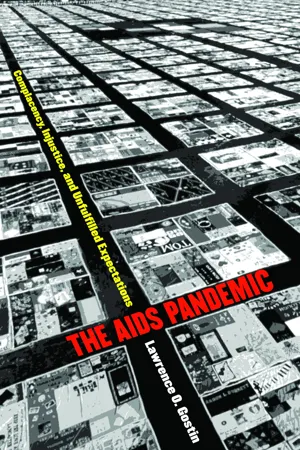
The AIDS Pandemic
Complacency, Injustice, and Unfulfilled Expectations
- 496 pages
- English
- ePUB (mobile friendly)
- Available on iOS & Android
eBook - ePub
About this book
Information
Topic
MedicineSubtopic
Diseases & AllergiesPart 1 AIDS in the Courtroom
Chapter 1
AIDS Policy, Politics, and Law in Context
We can win. We can stop the spread of AIDS. We can prevent new infections. We can [better] treat those who suffer. In time, we can hope to find a cure. I propose to confidently hold up the prospect of a world free of AIDS.—James D. Wolfensohn, president, World Bank (2001)
This introductory chapter places the principal themes of the book in context. It frames the major AIDS policy debates retrospectively and outlines their current and ongoing implications. This discussion will put the AIDS epidemic in historical perspective, examine the positions of the major players, assess contemporary policies, and predict future directions. AIDS policies are covered in greater depth, and with more detailed support, in the following series of essays. This chapter follows the book’s five-part organization: AIDS in the Courtroom; Rights and Dignity; Policy, Politics, and Ethics; Special Populations; and AIDS in the World.
AIDS in the Courtroom
The first essay (Chapter 2) examines AIDS in the courtroom and presents data from the U.S. AIDS Litigation Project (ALP). The ALP is a historically important
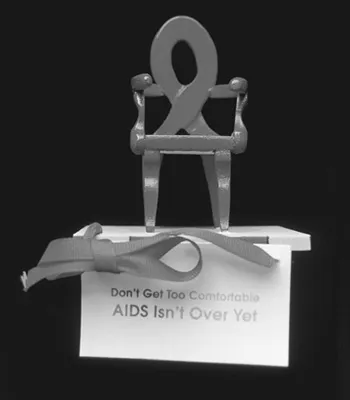
Originating from the United States, the red ribbon has become an international symbol for the fight against AIDS. In 2000 Michael Ransom carved the AIDS Ribbon Chair as a symbol of support in this indiscriminate pandemic.
event because it systematically tracked all significant court cases involving HIV/AIDS for more than a decade. Twentieth-century America is well known for being a highly litigious society. Even so, there had never been a disease that provoked as much litigation as HIV/AIDS. The ALP tracked several thousand court and human rights cases on almost every imaginable topic. Just to give a few illustrations, civil litigation was brought in the fields of torts, family law, and constitutional law. Litigation penetrated most social institutions, ranging from prisons to the blood supply system. Even judges found themselves as defendants. The fact patterns in these cases vividly illustrate the social upheaval wrought by this modern pandemic.
Torts
Contracting an infectious disease used to be perceived as a matter of chance or inadvertent misfortune. But in the first decade of the HIV/AIDS epidemic, it was not uncommon for an exposed person to search for fault and, with it, liability. Claims of lack of due care, even bad faith, by those who were exposed to HIV found their way to the courtroom. The depth of mistrust spanned many relationships: patients against physicians, health care professionals against hospitals, and sex partners against their lovers. Tort litigation was instigated, for example, concerning false diagnoses of HIV infection, failure to diagnose, and fear of exposure. The judiciary wrestled with the issue of whether to provide a remedy for those who were not actually harmed but exhibited fear and anxiety resulting from a perceived exposure to infection. For the most part, the courts required some actual harm before awarding damages to ensure that the plaintiff’s case was genuine.1
Family Law
The potential for HIV/AIDS to stir conflict within the family is apparent. Infection can be transmitted sexually and perinatally, affecting the spouse and future offspring. The attachment of blame to persons living with HIV/AIDS can be used as a weapon in divorce, custody, and visitation disputes. Finally, the person’s health, including his or her mental health, can be used to imply incapacity to care for, or supervise, a child. Cases on all of these issues, and more, found their way to the courts. AIDS cases did not have a significant effect on the development of family law. However, the fact patterns demonstrate that HIV, because it could be transmitted sexually and perinatally, caused serious upheaval in many marriages and families.
Constitutional Law
The HIV/AIDS epidemic forced the courts to grapple with some of the most fascinating constitutional issues in the field of public health. The judiciary issued important rulings in relation to cherished freedoms—association, expression, and liberty. Bitter disputes over the freedom to associate occurred when public health authorities closed bathhouses in the mid-1980s. Gay men claimed the right to select their sex partners and to have privacy in places of their own choosing. Public health officials, however, felt that bathhouses posed unacceptably high risks of HIV transmission because they provided a venue for anonymous sexual encounters. From a public health perspective, the issue was not easy. Bathhouses were high-risk settings, but if they were closed, health officials might lose the opportunity to provide education and distribute condoms to patrons. The courts, for the most part, upheld the discretion of public health officials.2
The issue of free expression was raised when politicians regulated adult book stores and cinemas, arguing that they endangered the public’s health. Although many restrictions on video shops or bookstores did promote the state’s moral agenda, it is doubtful whether they promoted the public’s health. At most, state restrictions prevented masturbation and other activities that pose no risk of HIV transmission. Yet the federal courts upheld local ordinances that required viewing booths to be open and visible to the public.3
Litigation within the Nation’s Major Institutions
AIDS-related litigation penetrated the nation’s major institutions such as blood suppliers, prisons, and the judiciary. Court cases substantially affected how these institutions operate and the rights afforded to those who interact with the system.
Prior to wide-scale screening, the transfusion of blood or blood products constituted one of the principal modes of HIV transmission.4 A large number of cases seeking compensation on behalf of HIV-infected individuals, their sex partners, and their family members ensued. These cases raised a number of interesting policy issues. Many courts found that the identity of blood donors could be forcibly disclosed during the course of a trial. In this context, the judiciary appeared more concerned with the smooth administration of justice than the privacy of blood donors.5 The courts also generally limited the liability of blood suppliers when HIV was contracted during a transfusion. The courts usually required a showing of negligence (rather than strict liability), which was consistent with legislative policy. Since many suppliers followed the industry standard for HIV screening procedures, courts were reluctant to impose liability. Most controversial of all was the fact that the industry transfused HIV-con-taminated blood-clotting agents to persons with hemophilia. This led not only to litigation, but also to political investigations into the safety of the system and the veracity of industry leaders.6
Litigation against federal and state prison officials was rife in the early years of the epidemic. Prisoners, and organizations representing their interests, were angry at what they saw as repressive policies. Many prisoners were compulso-rily tested, and if they were HIV positive they could be segregated and excluded from many activities.7 At the same time, prisoners often complained that they did not receive adequate medical treatment.8 In most of these cases, the courts upheld the discretion of prison officials, often without a searching inquiry about whether such policies were necessary for the public’s health.9 In a small number of cases, however, the courts vindicated the rights of inmates living with HIV/AIDS, particularly the right to privacy.10
The prejudicial treatment of persons living with HIV/AIDS in the early years of the epidemic extended even to courts—the branch of government designed to promote justice. Consider the 1988 New York State judicial guidelines suggesting that judges could press defendants to waive their right to appear in court; surgical gloves, masks, and plastic shields could be kept on hand but out of sight; and “court officers may guard an afflicted person … from a distance of up to 10 feet.”11 These kinds of policies, born of irrational fear and prejudice, were reflected in cases across the country in which HIV-infected defendants claimed that they were denied a fair trial because court officers wore rubber gloves or face masks.12
The quantity of litigation surrounding HIV/AIDS is smaller now than it was during the early years of the epidemic. Many interpersonal and societal struggles have been diffused. Although HIV/AIDS still evokes trepidation and intolerance among some individuals, many people see the human side. There is less of a tendency to attribute blame and more to facilitate access to services. Citizens will continue to resort to the courts, but it is hoped that most of the disputes will be settled through scientific inquiry and ethical discourse. That may be an overly optimistic assessment, but history shows that epidemics often start with social turmoil and then become assimilated into the culture. As families and communities begin to see AIDS in their own members, they will perceive it less as being a plague of “the other” and more as a part of the human condition.
Rights and Dignity
In retrospect, it should not be surprising that the social construction of HIV/AIDS would be so similar to, and yet so different from, diseases that preceded it. The similarities to other epidemics are unmistakable. Like bubonic plague, cholera, and smallpox in the nineteenth century and tuberculosis (TB), polio, and syphilis in the twentieth century, HIV/AIDS instilled dread.13 Fears led to animus, prejudice, and separation. Persons living with HIV/AIDS, particularly those associated with disfavored groups, such as gays and injection drug users (IDUS), were blamed for their disease—in contrast to “innocent” AIDS babies and hemophiliacs. This is reminiscent of venereal insontium (venereal disease of the innocent) in the early twentieth century.14 Popular indignation was evident in ...
Table of contents
- Cover Page
- The AIDS Pandemic
- Copyright Page
- Contents
- Illustrations
- Figures, Tables, and Maps
- Foreword
- Preface
- Part 1 AIDS in the Courtroom
- Part 2 Rights and Dignity
- Part 3 Policy, Politics, and Ethics
- Part 4 Special Populations
- Part 5 AIDS in the World
- Notes
- Selected Bibliography
- Index of cases
- General Index
- Studies in Social Medicine
- About the Author
Trusted by 375,005 students
Access to over 1.5 million titles for a fair monthly price.
Study more efficiently using our study tools.
Frequently asked questions
Yes, you can cancel anytime from the Subscription tab in your account settings on the Perlego website. Your subscription will stay active until the end of your current billing period. Learn how to cancel your subscription
No, books cannot be downloaded as external files, such as PDFs, for use outside of Perlego. However, you can download books within the Perlego app for offline reading on mobile or tablet. Learn how to download books offline
Perlego offers two plans: Essential and Complete
- Essential is ideal for learners and professionals who enjoy exploring a wide range of subjects. Access the Essential Library with 800,000+ trusted titles and best-sellers across business, personal growth, and the humanities. Includes unlimited reading time and Standard Read Aloud voice.
- Complete: Perfect for advanced learners and researchers needing full, unrestricted access. Unlock 1.5M+ books across hundreds of subjects, including academic and specialized titles. The Complete Plan also includes advanced features like Premium Read Aloud and Research Assistant.
We are an online textbook subscription service, where you can get access to an entire online library for less than the price of a single book per month. With over 1.5 million books across 990+ topics, we’ve got you covered! Learn about our mission
Look out for the read-aloud symbol on your next book to see if you can listen to it. The read-aloud tool reads text aloud for you, highlighting the text as it is being read. You can pause it, speed it up and slow it down. Learn more about Read Aloud
Yes! You can use the Perlego app on both iOS and Android devices to read anytime, anywhere — even offline. Perfect for commutes or when you’re on the go.
Please note we cannot support devices running on iOS 13 and Android 7 or earlier. Learn more about using the app
Please note we cannot support devices running on iOS 13 and Android 7 or earlier. Learn more about using the app
Yes, you can access The AIDS Pandemic by Lawrence O. Gostin in PDF and/or ePUB format, as well as other popular books in Medicine & Diseases & Allergies. We have over 1.5 million books available in our catalogue for you to explore.