Between 1940 and 1974, the number of African American farmers fell from 681,790 to just 45,594 — a drop of 93 percent. In his hard-hitting book, historian Pete Daniel analyzes this decline and chronicles black farmers' fierce struggles to remain on the land in the face of discrimination by bureaucrats in the U.S. Department of Agriculture. He exposes the shameful fact that at the very moment civil rights laws promised to end discrimination, hundreds of thousands of black farmers lost their hold on the land as they were denied loans, information, and access to the programs essential to survival in a capital-intensive farm structure.
More than a matter of neglect of these farmers and their rights, this “passive nullification” consisted of a blizzard of bureaucratic obfuscation, blatant acts of discrimination and cronyism, violence, and intimidation. Dispossession recovers a lost chapter of the black experience in the American South, presenting a counternarrative to the conventional story of the progress achieved by the civil rights movement.
eBook - ePub
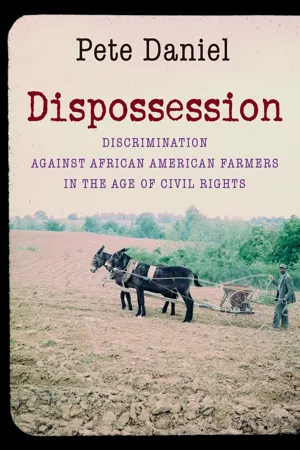
Dispossession
Discrimination against African American Farmers in the Age of Civil Rights
- 352 pages
- English
- ePUB (mobile friendly)
- Available on iOS & Android
eBook - ePub
About this book
Information
1
INTENDED CONSEQUENCES
I was born free, and in order to live free I chose the solitude of the countryside.
—Miguel de Cervantes, Don Quixote
—Miguel de Cervantes, Don Quixote
On April 22, 1965, Secretary of Agriculture Orville Freeman encouraged the U.S. Department of Agriculture (USDA) staff to “put into effect with dispatch” comprehensive policies that would end discrimination. “The right of all of our citizens to participate with equal opportunity in both the administration and benefits of all programs of this Department is not only legally required but morally right,” he stressed. Nearly every secretary of agriculture since Freeman has issued a similar plaintive decree.
The 1964 Civil Rights Act, of course, legally banned discrimination, but a scathing March 1965 report by the U.S. Commission on Civil Rights, the independent agency created by the Civil Rights Act of 1957 to investigate and report on a broad spectrum of discriminatory practices, alerted Freeman that racism infected every office in his department. Equal Opportunity in Farm Programs: An Appraisal of Services Rendered by Agencies of the United States Department of Agriculture revealed that blacks had no input in policy, had no representation on county agricultural committees, were refused loans and benefits, and suffered encompassing discrimination.1 But civil rights laws and Freeman’s memorandum, it seemed, only intensified the USDA’s bureaucratic resolve to resist the concept of equal rights. Realizing that overt resistance would be futile, the staff perfected passive nullification, that is, pledging their support even as they purposefully undermined equal opportunity laws. By the 1970s, USDA leaders would claim full compliance with equal opportunity laws even as they subverted programs to deny benefits to African Americans, Native Americans, Hispanics, and women. Despite support from President Lyndon B. Johnson, Secretary Freeman failed to control vindictive and parlous bureaucrats in Washington or to police state and county USDA offices throughout the South. At the moment that civil rights laws promised an end to discrimination, tens of thousands of black farmers lost their hold on the land, in part because of the impact of science and technology on rural life but also because they were denied loans, information, and access to programs essential to survival in a capital-intensive farm structure.
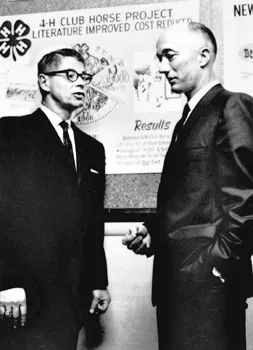
Secretary of Agriculture Orville Freeman (left) with Federal Extension Service administrator Lloyd Davis. Courtesy of National Archives and Records Administration, Record Group 16, 2288 ST.
Orville Freeman came to the USDA after serving three terms as governor of Minnesota, and he succeeded Republican Ezra Taft Benson. Not even the dour and humorless Benson, who vowed to cut New Deal programs, could derail the runaway USDA train that delivered so much to so many. In January 1964, Rodney E. Leonard, one of Secretary Freeman’s deputies, suggested to the secretary that the department had “developed almost into a shadow government serving mainly rural America. We provide credit and power, we encourage conservation and recreation and we support education.” Leonard’s vision was modest. “There were four or five USDA programs in every one of the three thousand counties in this country,” Freeman recalled in a 1988 interview. “I mean, the magnitude of the Department of Agriculture is very, very extensive and not realized at all.” By the mid-1960s, the USDA had become so vast, its constituency so demanding, its programs so contradictory, and its lines of communication and responsibility so tangled that it often seemed at war with itself. Paradoxically, the USDA’s contradictions only strengthened it, for it offered generous benefits to a vast constituency that wielded enormous political power.2
Freeman had been reluctant to take on the USDA, with its two massive buildings (the main building located on the National Mall alongside Smithsonian Institution museums), eight miles of corridors, and nearly 5,000 rooms. Under Secretary Benson, one room, it was reported, housed a counterfeit-currency operation with a press and plates. When Freeman arrived at the USDA in 1961, there were over 96,000 employees, some 12,000 stationed in Washington, and roughly 13 million farmers. In 2010, by contrast, there were 113,000 employees and only some 2 million farmers. Under Freeman, nearly all USDA employees were white, all supervisors were white males, and, except in the Negro Extension Service, nearly all blacks employed by the USDA were custodial workers. On April 5, 1963, two years before Freeman issued his civil rights memorandum, his image appeared on the cover of Time magazine. The Time story commented on Freeman’s World War II Marine experience, his terms as governor of Minnesota, his squash games with Secretary of Defense Robert McNamara, and the complex issues facing U.S. farmers, but there was nothing about discrimination in USDA programs or the drastic decline of farmers, African Americans in particular. “For some strange reason and coming in as a liberal,” he stated in a 1969 interview, “I worked well with Southerners; I had quite a number of Southerners in the department.” He left the implications of working well with southerners hanging, but his compatibility with them may well have developed from his accommodation to their prejudices. Freeman did not discuss the 1965 Commission on Civil Rights report or comment on how the civil rights movement played out in the South during his tenure. His interviews stress domestic and international agricultural policy, dealings with Congress, and his relationship with presidents John F. Kennedy and Lyndon B. Johnson, but he ignored discrimination and hardly mentioned African Americans.3
Freeman’s pledge to end discrimination, like that of subsequent secretaries of agriculture, failed. New Frontier liberals such as Freeman, while offering support for civil rights, lacked grounding in southern history and culture, especially concerning how segregation and discrimination distorted relations between blacks and whites. By the time he came to the USDA, southern whites had demonstrated how viciously they would fight to preserve segregation, and as civil rights activity increased in the southern countryside, USDA officials manipulated government programs to punish activist farmers. Apparently, Freeman never realized the extent to which employees outside his executive staff, both in Washington and throughout the South, resisted implementing civil rights edicts or the fact that his aides protected him from most discrimination complaints. Without pressure from Freeman’s office, discrimination would not only continue but also flourish.
Thirty years after Secretary Orville Freeman left office, Judge Paul L. Friedman handed down the landmark Pigford v. Glickman decision, the successful class-action suit brought by North Carolinian Timothy Pigford that found the USDA guilty of widespread discrimination. Judge Friedman began his 1999 decision with that familiar broken promise from the Civil War and Reconstruction eras: “Forty acres and a mule.” The case concerned the USDA’s sorry civil rights record and its denial of federal benefits to black farmers in the eighteen years since 1981. Judge Friedman suggested that General William T. Sherman’s unfulfilled promise of land during Reconstruction resonated with black farmers’ journey from slavery to freedom to sharecropping to ownership and, finally, to debt and dispossession. As the Pigford decision made clear, racism had continued to circulate through federal, state, and county USDA offices long after Secretary Freeman pledged to end it, and employees at every level twisted civil rights laws and subverted programs to the detriment of black farmers. Judge Friedman admitted that the Pigford case would “not undo all that has been done” but insisted that it was a “good first step.”
By the time Congress finally appropriated the funds in 2010, many of the litigants had lost their farms or died, and there was no compensation for discrimination prior to 1981. When Judge Friedman handed down his decision only months before the end of the millennium, he observed that only some 18,000 black farms remained, and many of those were endangered. While black and white farmers throughout the country wrestled with mechanization, chemicals, and government programs, black farmers also confronted USDA discrimination. In the 1960s, the number of southern white farm owners decreased from 515,283 to 410,646, and the number of white tenants dropped from 144,773 to 55,650. Farms owned by blacks fell from 74,132 to 45,428, and black tenants declined from 132,011 to 16,113. Many tenants and sharecroppers, of course, became superfluous as tractors, combines, mechanical cotton harvesters, and herbicides reduced the demand for intensive hand labor. Adapting to capital-intensive operations threatened many farmers, but if African American farmers had left agriculture at the same rate as white farmers since 1920, former U.S. Commission on Civil Rights staffer William C. Payne Jr. calculated, there would still be 300,000 left. Underlying Judge Friedman’s decision was a disturbing contradiction: black farmers suffered the most debilitating discrimination during the civil rights era, when laws supposedly protected them from bias. The increase in programs and the USDA’s swelling bureaucracy had an inverse relationship to the number of farmers: the larger the department, the more programs it generated, and the more money it spent, the fewer farmers that survived.4
Black farmers who endured to the twenty-first century represented the remnants of former slaves who began the long march to ownership during the Civil War and Reconstruction. It was difficult to move from sharecropping, where the landlord sold the crop and paid the farmer, to tenancy, where the farmer sold the crop and paid rent to the landlord, to ownership. Black and white farmers fought stubbornly to maintain control of their crops and their labor only to watch crop-lien and labor laws erode their fortunes. Chained to a punishing annual work routine that in some ways resembled a stock car race—round and round with disaster likely at any moment—farmers battled nature, bankers, merchants, and landlords, and they were often poorer at settlement time in autumn than when they planted in spring. Their meager diets fostered rickets and pellagra, the lack of sanitation encouraged hookworm and dysentery, labor laws forced them to work to fulfill contracts or go to prison, and venal politicians ignored their education-starved children. Still, many escaped the cycle of debt and purchased land.
Slaves emerged into freedom with a keen understanding of farming that allowed many to navigate the boundary between exploitation and sufficiency. In rural areas, blacks and whites necessarily worked side by side, and despite white supremacy, friendly relationships developed across the color line. Industrious African American farmers deferred when necessary and earned the respect of their white neighbors, learning, as educator Booker T. Washington advised, how to cultivate white support. A combination of husbandry, diplomacy, and ambition allowed black farmers to secure land, and the fact that so many succeeded during some of the darkest years of racist violence testifies to their character and determination. Demonstrating tremendous energy and sagacity, they mediated a maze of law and custom and gained land and standing in southern communities. Despite their hard work, African Americans owned smaller farms and sold less than their white neighbors. In 1969, for example, nonwhite farms (mostly African American) averaged 78 acres compared to 310 for other farms, and only some 1,900 had sales of $20,000 or more. Over half of all black farmers were over fifty-five years old, and only 5 percent were thirty-five or younger.5
In the tense and troubled years after the 1954 Brown v. Board of Education decision, however, most of the advances made by black farmers since the Civil War were erased. The decline of black farmers after World War II contrasted starkly with their gains in the half century after Emancipation. By 1910, African Americans held title to some 16 million acres of farmland, and by 1920, there were 925,000 black farms in the country. After peaking in these decades, however, the trajectory of black farmers plunged downward. In a larger sense, there was an enormous decline among all farmers at mid-century. Between 1940 and 1969, the rural transformation, fueled largely by machines and chemicals and directed by the USDA, pushed some 3.4 million farmers and their families off the land, including nearly 600,000 African Americans. From 1959 to 1969 alone, 185,000 black farmers left the land, and only 87,000 remained when Richard Nixon entered office. Farm failures were endemic, and in the 1950s, about 169,000 farms failed annually; between 1960 and 1965, some 124,000 failed each year; and 94,000 per year failed between 1966 and 1968.6
What happened to African American farmers in the three decades from 1940 to 1974 can be measured both by their decline and by the fact that their departure went largely unremarked. Although some scholars have argued that the structural shift from labor-intensive to capital-intensive operations explained the decline, others have argued that blacks fled the countryside of their own volition, forcing large owners to use machines and chemicals to replace them. Historians have rarely glanced offstage at the vast USDA federal, state, and county apparatus that generated research, distributed information, assigned allotments, made loans, and controlled funding that dictated the direction and pace of this rural transformation.
For a century and a half, the USDA has presided over monumental changes in the U.S. countryside. Since its founding during the Civil War, it has encouraged better farming methods, and over time, its staff has swelled and its reach has extended to every crossroads and farm. In 1862, Congress provided for land-grant colleges in each state to focus on rural life. Because blacks were not admitted to these white schools, in 1892, Congress tardily established underfunded African American land-grant schools. The Hatch Act of 1887 created federal experiment stations that explored better farming methods and distributed information on helpful science and technology. Early in the twentieth century, the Federal Extension Service (FES), operating out of land-grant schools, became a conduit for feeding farmers advice on the latest science and technology from experiment stations, university research centers, and corporations. Some farmers welcomed and utilized research findings, others were skeptical of experts and outsiders, and still others never received information. USDA personnel, many educated at land-grant institutions, often denigrated farmers who did not accept their gospel of science and technology, echoing an enduring national tradition that pitted book learning against common sense and prized technology at the expense of husbandry. Knowledge handed down or gained by trial and error was devalued and forgotten while formulaic methodology and machines grew in importance. The staggering human cost that accompanied this transformation was eclipsed by the celebratory sheen of tractors and picking machines, insecticides and herbicides, and hybrids and genetically engineered seeds.
In popular memory, the conflicted history of rural life and the civil rights movement settled into a revised version that recast the South’s segregated, impoverished, and backward history into a neoconservative success story. Distaste for the civil rights movement converted white Democrats into southern-strategy Republicans, and conversely, African Americans continued to leave the party of Lincoln for that of Roosevelt, Kennedy, and Johnson. Science and technology, the tale went, ended backbreaking work, freeing sharecroppers and tenants to move to lucrative urban jobs throughout the country. This heroic fable of capital-intensive agriculture demeaned its labor-intensive forebears by dismissing millions of farmers as inept and unable to adjust to science and technology. This sanitized version of rural life ran parallel to that of a successful civil rights movement in the 1950s and 1960s that brought equal rights to all Americans. Both tellings leveled mountains of conflict and ignored valleys of despair, for the transformation of the southern countryside in the mid-twentieth century painfully affected millions of people.
An ideology of progress infused the transformation of rural life. Early in the twentieth century, the spread of electricity, automobiles, powered flight, and automation stirred enthusiasm for modernization and rejection of older ways. In her significant analysis of rural industrialization, Every Farm a Factory, the historian Deborah Fitzgerald targets “economists, farm managers, employees of agricultural colleges, and particularly farm and home-demonstration agents, rural banks and insurance companies, and agricultural businesses such as those centered on farm mac...
Table of contents
- Cover Page
- Dispossession
- Copyright Page
- Dedication
- CONTENTS
- ILLUSTRATIONS
- PREFACE
- ABBREVIATIONS
- 1 INTENDED CONSEQUENCES
- 2 EVIDENCE
- 3 FREEDOM AUTUMN
- 4 CHEATING DEMOCRACY
- 5 DISSOLUTION
- 6 DUALITY
- 7 THE CASE OF WILLIE STRAIN
- 8 CREDITWORTHY
- 9 THE END GAME
- NOTES
- ACKNOWLEDGMENTS
- INDEX
Trusted by 375,005 students
Access to over 1.5 million titles for a fair monthly price.
Study more efficiently using our study tools.
Frequently asked questions
Yes, you can cancel anytime from the Subscription tab in your account settings on the Perlego website. Your subscription will stay active until the end of your current billing period. Learn how to cancel your subscription
No, books cannot be downloaded as external files, such as PDFs, for use outside of Perlego. However, you can download books within the Perlego app for offline reading on mobile or tablet. Learn how to download books offline
Perlego offers two plans: Essential and Complete
- Essential is ideal for learners and professionals who enjoy exploring a wide range of subjects. Access the Essential Library with 800,000+ trusted titles and best-sellers across business, personal growth, and the humanities. Includes unlimited reading time and Standard Read Aloud voice.
- Complete: Perfect for advanced learners and researchers needing full, unrestricted access. Unlock 1.5M+ books across hundreds of subjects, including academic and specialized titles. The Complete Plan also includes advanced features like Premium Read Aloud and Research Assistant.
We are an online textbook subscription service, where you can get access to an entire online library for less than the price of a single book per month. With over 1.5 million books across 990+ topics, we’ve got you covered! Learn about our mission
Look out for the read-aloud symbol on your next book to see if you can listen to it. The read-aloud tool reads text aloud for you, highlighting the text as it is being read. You can pause it, speed it up and slow it down. Learn more about Read Aloud
Yes! You can use the Perlego app on both iOS and Android devices to read anytime, anywhere — even offline. Perfect for commutes or when you’re on the go.
Please note we cannot support devices running on iOS 13 and Android 7 or earlier. Learn more about using the app
Please note we cannot support devices running on iOS 13 and Android 7 or earlier. Learn more about using the app
Yes, you can access Dispossession by Pete Daniel in PDF and/or ePUB format, as well as other popular books in Social Sciences & North American History. We have over 1.5 million books available in our catalogue for you to explore.