The nineteenth-century American Colonization Society (ACS) project of persuading all American free blacks to emigrate to the ACS colony of Liberia could never be accomplished. Few free blacks volunteered, and greater numbers would have overwhelmed the meager resources of the ACS. Given that reality, who supported African colonization and why? No state was more involved with the project than Virginia, where white Virginians provided much of the political and organizational leadership and black Virginians provided a majority of the emigrants.
In An African Republic, Marie Tyler-McGraw traces the parallel but seldom intersecting tracks of black and white Virginians' interests in African colonization, from revolutionary-era efforts at emancipation legislation to African American churches' concern for African missions. In Virginia, African colonization attracted aging revolutionaries, republican mothers and their daughters, bondpersons schooled and emancipated for Liberia, evangelical planters and merchants, urban free blacks, opportunistic politicians, Quakers, and gentlemen novelists.
An African Republic follows the experiences of the emigrants from Virginia to Liberia, where some became the leadership class, consciously seeking to demonstrate black abilities, while others found greater hardship and early death. Tyler-McGraw carefully examines the tensions between racial identities, domestic visions, and republican citizenship in Virginia and Liberia.
eBook - ePub
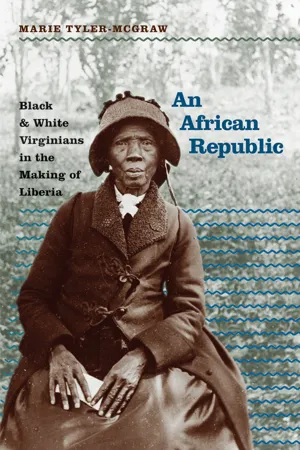
An African Republic
Black and White Virginians in the Making of Liberia
- 264 pages
- English
- ePUB (mobile friendly)
- Available on iOS & Android
eBook - ePub
About this book
Information
Notes
Note: References to Virginia emigrants to Liberia—their ages, occupations, skills, level of literacy, family members, place of origin, ships on which they traveled, and time of arrival in Liberia—are taken from a database titled Virginia Emigrants to Liberia (VEL), compiled by Marie Tyler-McGraw and Deborah Lee. The project was funded by a grant from the Virginia Foundation for the Humanities with the support of the Afro-American Historical Society of Fauquier County. The database was compiled primarily from the ACS journal, the African Repository and Colonial Journal, 1825-92; emigrant rolls in the Records of the American Colonization Society (RACS), Library of Congress, Washington, D.C.; and U.S. Senate, Roll of Emigrants That Have Been Sent to the Colony of Liberia, 28th Cong., 2nd sess., 1844, S.Rep. 150, 152-414. I also used emigrant lists compiled by Tom W. Shick, “Emigrants to Liberia, 1820-1843: An Alphabetical Listing” (Liberian Studies Working Paper Number 2, Department of Anthropology, University of Delaware, Newark, for Liberian Studies Association, 1971); and Robert T. Brown, Immigrants to Liberia, 1843-1865: An Alphabetical Listing (Philadelphia: Institute for Liberian Studies, 1980). This database will be at the center of a website provided by the Virginia Center for Digital History and funded by a further grant from the Virginia Foundation for the Humanities.
Abbreviations
| ACS | American Colonization Society |
| AR | African Repository and Colonial Journal |
| JNH | Journal of Negro History |
| JSH | Journal of Southern History |
| LC | Library of Congress, Washington, D.C. |
| LSJ | Liberian Studies Journal |
| LVA | Library of Virginia, Richmond |
| RACS | Records of the American Colonization Society, Manuscript Division, Library of Congress, Washington, D.C. |
| RMCS | Records of the Maryland Colonization Society, Maryland Historical Society, Baltimore |
| SHC | Svend Holsoe Collection, Archive of Traditional Music, Indiana University, Bloomington |
| UVA | University of Virginia, Charlottesville |
| VCS | Virginia Colonization Society |
| VEL | Virginia Emigrants to Liberia database |
| VHS | Virginia Historical Society, Richmond |
| VMHB | Virginia Magazine of History and Biography |
Introduction
1 Recent studies that explore this aspect of African colonization include Eric Burin, Slavery and the Peculiar Solution (Gainesville: University Press of Florida, 2005). Burin investigated the long national history of the ACS and concludes that it tended to undermine slavery. Other studies have focused on emigration from Maryland, Mississippi, Arkansas, and North Carolina, using those regions to ask larger questions about the intentions and realities of African colonization. See Robert Hall, On Afric’s Shore: A History of Maryland in Liberia, 1834-1857 (Baltimore: Maryland Historical Society, 2003); Alan Huffman, Mississippi in Africa (New York: Gotham Books, 2004); Kenneth C. Barnes, Journey of Hope: The Back-to-Africa Movement in Arkansas in the Late 1800s (Chapel Hill: University of North Carolina Press, 2004); and Claude A. Clegg, The Price of Liberty: African Americans and the Making of Liberia (Chapel Hill: University of North Carolina Press, 2004).
2 “Memorial of the ACS to the Senate and House of Representatives,” reel 304, RACS. The final draft is printed in National Intelligencer, January 18, 1817; and in Annals of Congress, 14th Cong., 2nd sess., January 14, 1817, 481-83.
3 For early emancipation plans among black and white Americans, see Mary S. Locke, The Neglected Period of American Antislavery, 1619-1808, 1901 (reprint, Gloucester, Mass.: Peter Smith, 1965); Floyd Miller, The Search for a Black Nationality: Black Emigration and Colonization, 1787-1863 (Urbana: University of Illinois Press, 1975); and Gary B. Nash, Race and Revolution (Madison, Wis.: Madison House, 1990).
4 For the history of American construction of race, cornerstone texts remain Winthrop Jordan, White over Black: American Attitudes toward the Negro, 1550-1812, 1968 (New York: W. W. Norton, 1977); David Brion Davis, The Problem of Slavery in the Age of Revolution, 1966 (rev. ed., Cambridge: Oxford University Press, 1988); David Brion Davis, Slavery and Human Progress (Cambridge: Oxford University Press, 1984); Edmund Morgan, American Slavery, American Freedom: The Ordeal of Colonial Virginia (New York: W. W. Norton, 1975); and George Fredrickson, The Black Image in the White Mind: The Debate on Afro-American Character and Destiny, 1817-1914 (New York: Harper and Row, 1972). Very useful is Robert Forbes, “Slavery and the Evangelical Enlightenment,” in Religion and the Antebellum Debate over Slavery, ed. John R. McKivigan and Mitchell Snay (Athens: University of Georgia Press, 1998). See also Bruce Dain, A Hideous Monster of the Mind: American Race Theory in the Early Republic (Cambridge, Mass.: Harvard University Press, 2002); and David Brion Davis, “The Culmination of Racial Polarities and Prejudice,” Journal of the Early Republic 19, no. 4 (Winter 1999): 757-75.
5 Philip Staudenraus, The African Colonization Movement, 1816-1861 (New York: Columbia University Press, 1961), 29-30, 50-56, 63-66. See also Douglas Egerton, Charles Fenton Mercer and the Trial of National Conservatism (Jackson: University Press of Mississippi, 1989). Although some of those appointed as vice presidents, such as Andrew Jackson, never joined or participated, the society claimed many Upper South politicians, such as Henry Clay, as well as influential clergymen and the men of business who ran the society.
6 Eric Burin’s chapter on the Pennsylvania Colonization Society, in Slavery and the Peculiar Solution, 79-99, suggests what this northward tilt meant for the national society.
7 Examples include Jordan, White over Black, 551-68; William Freehling, The Reintegration of American History: Slavery and the Civil War (New York: Oxford University Press, 1994), 148; and William G. Shade, Democratizing the Old Dominion: Virginia and the Second Party System, 1824-1861 (Charlottesville: University Press of Virginia, 1996), 191, 194.
8 “Tabulation of Emigrants to the End of the Year 1866, AR 43 (1867): 109-17; Tom W. Schick, “Emigrants to Liberia, an Alphabetical Listing,” Liberian Studies Working Paper Number 2, Department of Anthropology, University of Delaware, Newark, for Liberian Studies Association, 1971; Robert T. Brown, “Immigrants to Liberia, 1843 to 1865: An Alphabetical Listing,” Philadelphia: Institute for Liberian Studies, 1980.
9 Their arguments survive in the unpublished correspondence of such emigrants as Lott Cary, Joseph Jenkins Roberts, and John Day. Their private letters are frequently critical of the ACS and of American politics and society. An example is in John Saillant, ed., “‘Circular Addressed to the Colored Brethren and Friends in America’: An Unpublished Letter by Lott Cary, Sent from Liberia to Virginia, 1827,” VMHB 104, no. 4 (Autumn 1996): 481-504.
10 Instructive on the creation of nationhood, moral authority, and patriotism among antebellum free blacks are Patrick Rael, Black Identity and Black Protest in the Antebellum North (Chapel Hill: University of North Carolina Press, 2002); and Dickson D. Bruce Jr., The Origins of African American Literature (Charlottesville: University Press of Virginia, 2001). For an influential and very negative black response to colonization after its first dozen years, see David Walker, Appeal to the Colored Citizens of the United States, ed. Peter P. Hinks (University Park: Pennsylvania State University Press, 2000); and Peter P. Hinks, To Awaken My Afflicted Brethren: David Walker and the Problem of Antebellum Slave Resistance (University Park: Pennsylvania State University Press, 1997).
Chapter One
1 Commonwealth v. Sam Byrd, testimony of Ben Woolfolk; Commonwealth v. Solomon , testimony of Prosser’s Ben and Toby; Communication of Solomon, under sentence of death; Testimony of Patty, re trial of Daniel, box 8, “Gabriel’s Insurrection,” Virginia Executive Papers (September-December 1800), LVA; Douglas R. Egerton, Gabriel’s Rebellion: The Virginia Slave Conspiracies of 1800 and 1802 (Chapel Hill: University of North Carolina Press, 1993), 55-56.
2 Commonwealth v. Gabriel, testimony of Gilbert; “Information from Mr. Foster,” September 23, 1800; Commonwealth v. Isham, testimony of Isham; for Gabriel’s capture, see Thomas Hinton, Norfolk to Gov. James Monroe, Richmond, September 24, 1800, box 8, “Gabriel’s Insurrection,” Virginia Executive Papers, LVA.
3 Commonwealth v. Gabriel, evidence of Prosser’s Ben; Commonwealth v. Solomon, evidence of Prosser’s Ben; Commonwealth v. Charles, testimony of Patrick; Commonwealth v. George, testimony of Ben Woolfolk; box 8, “Gabriel’s Insurrection,” Virginia Executive Papers (October-December 1800), LVA; Egerton, Gabriel’s Rebellion , 104-8, 182-85.
4 That Ga...
Table of contents
- The John Hope Franklin Series in
- Title Page
- Copyright Page
- Table of Contents
- Dedication
- Illustrations
- Acknowledgements
- Introduction
- One - A Small Frisson of Fear, Soon Soothed
- Two - The Alchemy of Colonization
- Three - Auxiliary Arms
- Four - Ho, All Ye That Are by the Pale-Faces’ Laws Oppressed
- Five - My Old Mistress Promise Me
- Six - Revising the Future in Virginia
- Seven - Virginians in Liberia
- Eight - Liberians in Africa and America
- Nine - Civil War to White City
- Notes
- Bibliographical Essay
Trusted by 375,005 students
Access to over 1.5 million titles for a fair monthly price.
Study more efficiently using our study tools.
Frequently asked questions
Yes, you can cancel anytime from the Subscription tab in your account settings on the Perlego website. Your subscription will stay active until the end of your current billing period. Learn how to cancel your subscription
No, books cannot be downloaded as external files, such as PDFs, for use outside of Perlego. However, you can download books within the Perlego app for offline reading on mobile or tablet. Learn how to download books offline
Perlego offers two plans: Essential and Complete
- Essential is ideal for learners and professionals who enjoy exploring a wide range of subjects. Access the Essential Library with 800,000+ trusted titles and best-sellers across business, personal growth, and the humanities. Includes unlimited reading time and Standard Read Aloud voice.
- Complete: Perfect for advanced learners and researchers needing full, unrestricted access. Unlock 1.5M+ books across hundreds of subjects, including academic and specialized titles. The Complete Plan also includes advanced features like Premium Read Aloud and Research Assistant.
We are an online textbook subscription service, where you can get access to an entire online library for less than the price of a single book per month. With over 1.5 million books across 990+ topics, we’ve got you covered! Learn about our mission
Look out for the read-aloud symbol on your next book to see if you can listen to it. The read-aloud tool reads text aloud for you, highlighting the text as it is being read. You can pause it, speed it up and slow it down. Learn more about Read Aloud
Yes! You can use the Perlego app on both iOS and Android devices to read anytime, anywhere — even offline. Perfect for commutes or when you’re on the go.
Please note we cannot support devices running on iOS 13 and Android 7 or earlier. Learn more about using the app
Please note we cannot support devices running on iOS 13 and Android 7 or earlier. Learn more about using the app
Yes, you can access An African Republic by Marie Tyler-McGraw in PDF and/or ePUB format, as well as other popular books in Social Sciences & North American History. We have over 1.5 million books available in our catalogue for you to explore.