Even as substantial legal and social victories are being celebrated within the gay rights movement, much of working-class America still exists outside the current narratives of gay liberation. In Steel Closets, Anne Balay draws on oral history interviews with forty gay, lesbian, and transgender steelworkers, mostly living in northwestern Indiana, to give voice to this previously silent and invisible population. She presents powerful stories of the intersections of work, class, gender, and sexual identity in the dangerous industrial setting of the steel mill. The voices and stories captured by Balay — by turns alarming, heroic, funny, and devastating — challenge contemporary understandings of what it means to be queer and shed light on the incredible homophobia and violence faced by many: nearly all of Balay’s narrators remain closeted at work, and many have experienced harassment, violence, or rape.
Through the powerful voices of queer steelworkers themselves, Steel Closets provides rich insight into an understudied part of the LGBT population, contributing to a growing body of scholarship that aims to reveal and analyze a broader range of gay life in America.
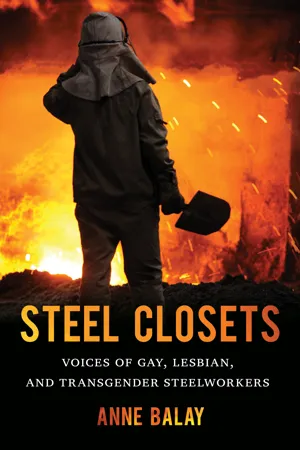
- 192 pages
- English
- ePUB (mobile friendly)
- Available on iOS & Android
eBook - ePub
About this book
Information
CHAPTER ONE
Setting the Scene
During the twenty-first century, tolerance for and even acceptance of gay and lesbian people has increased. President Barack Obama’s public support for gay marriage preceding his reelection in 2012 and the Supreme Court’s DOMA ruling in 2013 are prominent markers of this shift. Yet this change is not consistent or universal. Anti-trans violence is still common, and queer teens are bullied to death regularly. And most of the GLBT steelworkers I interviewed do not feel safe enough to come out at work, fearing rejection, violence, and dismissal, among other consequences. Their stories back up these fears. This chapter explores what it is about steel mills—the work, the location, the people, the history—that makes them so inhospitable to queers, even as the culture in which they are set becomes more accepting. Our sense of what it means to be queer remains incomplete until we understand and include these people and their experiences.
The mills are huge, physically remote structures, covering many acres. They are frightening, mysterious, beautiful anachronisms. A powerful, almost prehistoric magic adheres to them, like a fine gray dust. And it adheres to steelworkers as well.
A Century of Steel
The first mills to come to Northwest Indiana were Inland Steel in East Chicago (1901) and United States Steel (USX) in Gary (1906). Both plants were built on largely unsettled land, situated near Lake Michigan and thus convenient to barge and rail transport of raw materials from the Mesabi Iron Range in Minnesota and from Canada, and both towns were built for the workers who arrived to construct and then work in the mills. Youngstown Sheet and Tube was founded in 1923, right across from Inland. The Bethlehem Plant in Burns Harbor (1964) and National Steel in Portage (1960) were the last basic steel mills built in the area. All these mills are now owned by ArcelorMittal (an international conglomerate) except Gary Works, which is still owned by U.S. Steel.
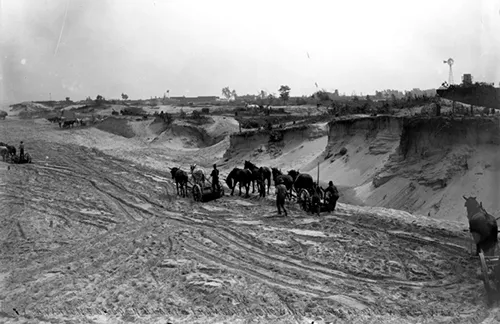
Excavation for open hearth, U.S. Steel, Gary, 1906. Courtesy of the Calumet Regional Archives.
What a basic steel mill does is both simple and hugely complicated, largely due to issues of scale. Steel has two main ingredients: iron ore and carbon, which often comes in the form of a by-product of coal called coke. The goal is to heat the iron ore enough to get impurities out of it and to make possible its chemical bond with carbon. This then becomes iron. Next, the resulting molten metal must be combined with other agents (lime, for example) and poured into billets or else continuously cast into finished product. Early on (since the late 1800s) this heating was done through the Bessemer process. The large, curling black smokestacks visible in most steel mills persist from this time, though they are no longer in use. Open-hearth furnaces, blast furnaces, and the Bessemer process were how steel was made in the basic steel mills in and around Gary until late in the twentieth century. Gradually, after that, each plant switched over to the currently used basic oxygen furnaces (BOFs). While the Bessemer process blows air through iron to purify it, which takes about twelve hours per (large) batch, BOFs blow just oxygen through the iron, which takes a fraction of the time (as little as forty minutes). Additionally, BOFs require much less labor, so as they became standard, each mill’s worker pool could become correspondingly smaller without reducing output.
The steelworkers I interviewed believe that the mills in Northwest Indiana waited too long to make this modernizing switch, thus lessening their competitiveness with foreign-made steel. Indeed, open-hearth furnaces were still being built in the region long after they were no longer state-of-the-art. Further, continuous casting was slow to catch on in area mills, though it is now standard. In continuous casting, steel is produced, refined, and poured as part of one, uninterrupted process, rather than being cast into billets and then remelted to be rolled or pressed later.
What remains constant in the basic steel process is this: iron ore is delivered, heated to very high temperatures, then combined with carbon and other chemicals as needed; slag (impurities resulting from this process) is poured off, and the steel is poured, rolled, cut, coated, and otherwise prepared for market; it is then labeled and stored until it gets shipped, either by rail or truck. The slag must be disposed of somehow, often in slag heaps on mill property.
Steelworkers perform many of these jobs remotely now. Mechanization and increased efficiency mean that many steelworkers sit in pulpits, which are small glass-walled rooms overlooking the mill floor. There, they observe huge machines, watch readouts on monitors, and wait for something to go wrong. At any given moment, there are only a few workers on the mill floor, performing maintenance tasks, or getting a closer look at some piece of equipment. Other workers service the many machines and computers on the floor. Some work in labs, performing chemical tests on the product, and others monitor safety. Many move things around—coils of steel, loads of coke or slag, pieces of equipment, hot slabs that need to be cut. Emergency workers are always on site, as are cafeteria workers and janitorial staff. All the work is dirty, loud, and dangerous, because of particles in the air and because of the constant risk of explosion from impurities (such as water) in the product. And though the process has been modernized and now can be done by fewer workers, it remains in many ways consistent across time and between mills.
Over the course of the twentieth century, demand for steel continued to increase, though the type of steel required gradually shifted from heavier to lighter product, as consumer goods such as cars, appliances, and even food cans gained precedence over train tracks, locomotives, and I-beams. While many plants, such as those in Pittsburgh and Baltimore, have shut down, the four large mills in Northwest Indiana continue to produce huge volumes of steel. Yet, because the workforce is greatly reduced and at least the noticeable pollution lessened, the work that goes on there is increasingly less visible, even within the region. Nevertheless, what steelworkers made and how they made it has remained crucial to the myth-making that has defined “America,” despite the fact as the twentieth century progressed, steel production (and all industry and manufacturing work) lost economic dominance and cultural capital. Jobs in technology, entertainment, and the service sector began to define the ideal America, while mills were seen as smelly, dirty polluters, preferably not visible from stylish urban centers, and perhaps even better located overseas.
No one factor makes integrated steel mills different from other industrial or factory workplaces, and consequently more hostile to queers. Several circumstances, in combination, distinguish steelworkers and the tasks that they do from workers in an auto plant, a garment factory, a nuclear power facility, or an oil refinery. The isolation of the mills (both physically and socially), immediate and long-term danger to workers, the cooperative structure of work within a mill, and the glacial pace of change within the industry all contribute to this difference. Danger and cooperation will be discussed in subsequent chapters, while the more geographic factors will be explored here. Taken together, these differences prove significant for the people who work there, especially the gay ones.
First, the mills are deliberately kept apart from the towns that they border. Several sets of train tracks snake between the mills and the urban centers of Northwest Indiana. Signs warn people not to cross these tracks unless they are on authorized business. Then, there are guarded gates. Some workers have permission to enter and park inside the mill, but most instead drive to parking lots several miles away, where they catch buses into the mill. These buses are gray so that the dust they collect in the mill proper will be less visible. A workplace so controlled that even its workers are bused in takes its isolation very seriously.
Second, most workers take showers at the end of their shifts. Some jobs require showering as a means to reduce the spread of toxic chemicals out into the community. Other jobs simply provide showers, which most workers use to reduce the filth spread to their cars and homes. Even with showers at work, many homes in the region come equipped with a shower in the basement. In a Wall Street Journal article, the journalist Robert Matthews described how many workers enter their homes through the basement door and shower again before heading upstairs to join their families. This tradition of showering at work, typically in an open room with no privacy, is another factor that makes working in a basic steel mill unique.
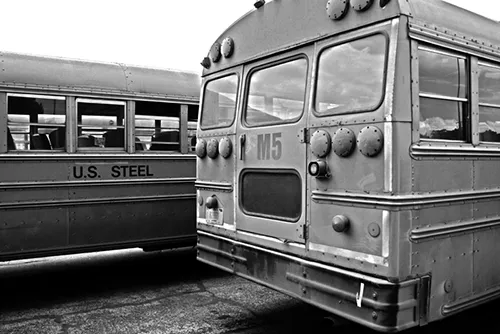
U.S. Steel transport buses, 2012. Photograph by Patrick Bytnar.
Finally, most mills, though modernized, are fundamentally the same structures that were built a century or more ago. Workers describe working in essentially the same place, doing the same job as their grandfathers. They describe rats, raccoons, and beavers who now treat the mill as a part of the natural environment. The daily routines of these workers and the equipment that they use have remained hauntingly constant.
Historians of steel mills and workers within those mills agree that this longstanding stasis is reinforced by the fact that basic steel mills have modernized little since the 1980s; this is one reason the U.S. steel industry has struggled in recent decades. In countries like Austria, Finland, and Brazil, steel profits were spent (at least in part) on technical improvements that increased productivity and safety. In the United States, as workers like Marie point out, our mills stayed the same, apparently believing they could continue to succeed “by doing the same things in the same way they had always done.” Resistance to change, then, characterizes the physical space of the mills and rubs off on the people whose lives are shaped by them.
Many workers I interviewed talk about the weight of the past and its impact on their lives. Hugo, for example, describes the system by which clothes are stored in the locker room. “There’d be hooks all around these rooms, that’d go up and you could unlock it, and let the rope down, and this chain comes down, and you’d hang your clothes and boots on this chain, and then you’d haul it back up, so it looked like there were 100 people hung from the ceiling because your boots would be the last thing you’d hook on the chain. . . . So when you’d arrive to change into your work clothes, the boots are all hanging there. . . . It was the strangest sight . . . Kinda ghostly.” This routine sight of hanging bodies is more than a convenient storage system. It’s also a reminder—a static, palpable, visceral reminder—of the risk of fatality that is an ongoing reality of mill work. In this description, and in so many of the steelworkers’ anecdotes, risk and resistance to change are linked. Tradition, repetition, and ritual help stave off anxiety, while simultaneously serving as reminders of danger, and as reenforcers of social stasis.
Shift work creates another level of isolation. Most steelworkers work alternating turns: one week of 7:00 A.M. to 3:00 P.M., one week of 3:00 P.M. to 11:00 P.M., and one week of 11:00 P.M. to 7:00 A.M. The rotation continues ad infinitum. This makes social interaction with non–mill workers difficult. You can’t be part of a regular bowling team, for example, because of how irregularly you have to be at work. It is very difficult to schedule day care in such a way that your kids are supervised during your shifts but you’re still able to spend time with them when you’re not working. Therefore, parents (especially mothers) are unlikely to take more time away from home for social interactions. And people who aren’t part of the culture don’t really understand how the schedule works, or how it affects those who are locked into its cycle. Thus, steelworkers tend to interact chiefly with other steelworkers, to minimize irritation and stress.
Demonstrating that steel mills are isolated, slow to change, and stable begins to explain why the big integrated mills are so inhospitable to queers. When a community is permeable, and new people flow in and out of it regularly, or interact with its principal players in significant ways, it stands to reason that it would be more likely to change than a community that is closed, and therefore reinforces its inherited patterns. R. W. Connell attributes homophobia in working-class work settings to traditional family ideology and accompanying gender roles, which he notes persist in ethnic enclaves and isolated areas longer than they would in more mobile, heterogeneous communities (109).
In addition, steelworkers often do their work in pairs or groups, depending on their co-workers for their success and their survival, a situation that creates a certain solidarity, reinforced by the exclusion of difference (of some or all of women, blacks, ethnics, or queers). William Serrin has published a history of the Homestead Steel mills (outside of Pittsburgh) in which he observes that the communal nature of the work creates familiarity and uniformity (19). Olshana remembers: “I had the feeling that when I was there, with such big things going on all around you I really think that people had a sense that their lives were in the hands of their co-workers, and you never knew when you would have to depend on that co-worker to do something that would save your life or get you out of the way. So you may not get along outside, or you may not hang out outside, but in the mill you were kind of forced to be attentive and co-operate with your co-workers, no matter who they were.” If your coworker might have to snatch you out of harm’s way, you need to trust that person, which is a feeling that often derives from shared values.
Working partnerships and a sense of community are, then, crucial for safety, and they can be a significant source of pleasure as well. A woman quoted in James Lane’s “Calumet Regional Steelworkers’ Tales” points out that “in the mill you would be assigned to an experienced millwright and would basically just hang around with him for six or eight months. The two people would do everything together. They’d eat lunch and take their breaks together. The training partnership was a social relationship when it worked well. Just being a woman made that difficult” (69). Scholars Mary Margaret Fonow and Ruth Needleman have established, respectively, the challenges women and blacks confront in connecting to their white male co-workers, but the challenges are even stronger for queers, especially gay men.
Sense of community, camaraderie, and an easy-going, pleasant workplace depend, at least in part, on the absence of queers—at least visible ones. Michael Warner argues that our culture creates hierarchies of sex, and of shame, whose aim is to shut down sexual variance. He claims that all sex is demonized, but some acts of, or places for, sex are more privileged, and are granted a certain neutrality, or naturalness. In this context, those who stand out “become a lightning rod not only for the hatred of difference, of the abnormal, but also for the more general loathing for sex” (23). This process of shaming, in which deviance and perversion cling only to queer subjects, who can then be symbolically or literally excluded in order to make the dominant group feel united and normal, was repeated often in the stories steelworkers told me.
For example, Zach describes navigating the mill’s group mentality and what happens if you don’t fit in: “We help each other at work so, to me it’s still good. It is what it is. You know it could be a whole lot worse. . . . I mean, it could be horrible. . . . I’d say in that kind of environment, if they don’t like you they’re gonna make your life hell.” And Bernard, whose co-workers suspect he is gay, though he has never explicitly said so, has felt ostracized more often than not. In one incident, a manager “was also belittling and harassing me that I’m not being manly enough to do the job. He would do it with an audience of people. I’d go to tell the section manager about it, nothing would change this man’s behavior. The thing that came to a head, was October 21st, a 3:00 to 11:00 shift, I had went to the restroom, I was coming back to the tempered metal line, when Sal stopped me, he says, ‘Nobody likes you, all the guys don’t like you. You don’t work with nobody, you don’t help out, you’re not participating, and everybody’s going to go to management to have you kicked out in the sequence and put in labor or somewhere else in the mill.’” Incidents like this one illustrate how groups of workers can create a sense of shared values through identifying a common enemy, and a person whose gender or sexuality doesn’t fit the norm is often chosen for that position.
This targeting of sexual outsiders is possible, in part, because people in the twentieth century have identified “sexual orientation” as a meaningful component of identity—maybe the meaningful component. Eve Sedgwick observes that same-sex desire and behavior has “a long, rich history,” and that what changed at the turn into the twentieth century was that “every given person, just as he or she was necessarily assignable to a male or female gender, was now considered necessarily assignable as well to a homo- or a hetero-sexuality, a binarized identity that was full of implications, however confusing, for even the ostensibly least sexual aspects of life” (2). Everyone—straight, gay, and otherwise—feels the effects of this change, as our “sexual orientation” defines who and what we are both broadly and deeply. Without this shift, it might have been possible to argue that being gay is irrelevant to job choice or work culture. As it is, being gay or lesbian isn’t seen as something a person stops doing at work, since it sets the terms of possibility for myriad actions and conversations that bear no direct relation to sex or gender. Furthermore, being gay is not just one half of a binary, it’s the stigmatized half—the “other” half—easy to blame or victimize since, as a minority, queers define what counts as “straight” simply by representing its opposite.
THIS BOOK EXPLORES the dynamic of sexuality and work by listening to GLBT steelworkers as they tell their stories. I should say that I did not start out with a specific sense of what constitutes a GLBT steelworker, or any GLBT person for that matter. People who came to me identifying themselves as GLBT, I took at their word. Many of those I interviewed had been in straight relationships, from which they had children. Two were in straight relationships at the time of our interview. I did not prod these or any of my narrators to discuss why or how they identified as gay—I simply took it as a given, since they had chosen to talk to me. Each person, merely by entering this conversation, became part of a queer counterpublic, accepting the stigma and acknowledging that he or she was not above the “indignity of sex” (Warner 35).
The interviews were very unstructured. Typically, once the steelworkers got started, there was no stopping them. Stories often poured out for hours. Sometimes I would raise certain topics if they hadn’t touched on them already: gay community, union support, coming out, drugs. If they didn’t take the bait, I didn’t push. And, really, I didn’t have to. All of the narrators had plenty to say when I simply let them wander.
Ben is a big guy, with a jocular, confiding manner. I interviewed him in my office, where it immediately became clear that he loves to tell stories and capture his audience’s attention. He was dressed causally in jeans and a sweatshirt, and he adjusted his gut occasionally, for comfort. Chris was almost his opposite—thin, well-groomed, and precise. I interviewed Chris in his immaculate home, in which classical r...
Table of contents
- Cover Page
- Title Page
- Copyright Page
- Dedication
- CONTENTS
- ILLUSTRATIONS
- ACKNOWLEDGMENTS
- Introduction
- CHAPTER ONE Setting the Scene
- CHAPTER TWO Bridging the Divide between Work and Home
- CHAPTER THREE Secrecy—Its Logic and Consequences
- CHAPTER FOUR Female Masculinity in the Steel Mill
- CHAPTER FIVE Male Masculinity in the Steel Mill
- CHAPTER SIX Danger and Death in and out of the Mills
- CHAPTER SEVEN Unions in Twenty-First-Century America
- Epilogue
- APPENDIX The Narrators
- Works Cited
- Index
Trusted by 375,005 students
Access to over 1.5 million titles for a fair monthly price.
Study more efficiently using our study tools.
Frequently asked questions
Yes, you can cancel anytime from the Subscription tab in your account settings on the Perlego website. Your subscription will stay active until the end of your current billing period. Learn how to cancel your subscription
No, books cannot be downloaded as external files, such as PDFs, for use outside of Perlego. However, you can download books within the Perlego app for offline reading on mobile or tablet. Learn how to download books offline
Perlego offers two plans: Essential and Complete
- Essential is ideal for learners and professionals who enjoy exploring a wide range of subjects. Access the Essential Library with 800,000+ trusted titles and best-sellers across business, personal growth, and the humanities. Includes unlimited reading time and Standard Read Aloud voice.
- Complete: Perfect for advanced learners and researchers needing full, unrestricted access. Unlock 1.5M+ books across hundreds of subjects, including academic and specialized titles. The Complete Plan also includes advanced features like Premium Read Aloud and Research Assistant.
We are an online textbook subscription service, where you can get access to an entire online library for less than the price of a single book per month. With over 1.5 million books across 990+ topics, we’ve got you covered! Learn about our mission
Look out for the read-aloud symbol on your next book to see if you can listen to it. The read-aloud tool reads text aloud for you, highlighting the text as it is being read. You can pause it, speed it up and slow it down. Learn more about Read Aloud
Yes! You can use the Perlego app on both iOS and Android devices to read anytime, anywhere — even offline. Perfect for commutes or when you’re on the go.
Please note we cannot support devices running on iOS 13 and Android 7 or earlier. Learn more about using the app
Please note we cannot support devices running on iOS 13 and Android 7 or earlier. Learn more about using the app
Yes, you can access Steel Closets by Anne Balay in PDF and/or ePUB format, as well as other popular books in Social Sciences & Gender Studies. We have over 1.5 million books available in our catalogue for you to explore.