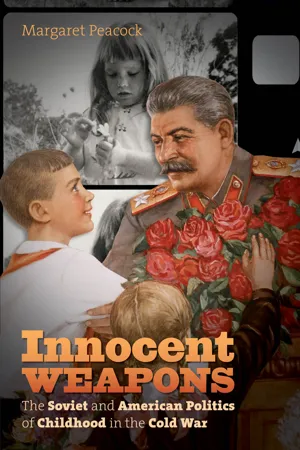
In the 1950s and 1960s, images of children appeared everywhere, from movies to milk cartons, their smiling faces used to sell everything, including war. In this provocative book, Margaret Peacock offers an original account of how Soviet and American leaders used emotionally charged images of children in an attempt to create popular support for their policies at home and abroad.
Groups on either side of the Iron Curtain pushed visions of endangered, abandoned, and segregated children to indict the enemy’s state and its policies. Though the Cold War is often characterized as an ideological divide between the capitalist West and the communist East, Peacock demonstrates a deep symmetry in how Soviet and American propagandists mobilized similar images to similar ends, despite their differences. Based on extensive research spanning fourteen archives and three countries, Peacock tells a new story of the Cold War, seeing the conflict not simply as a divide between East and West, but as a struggle between the producers of culture and their target audiences.
eBook - ePub
Innocent Weapons
The Soviet and American Politics of Childhood in the Cold War
- 304 pages
- English
- ePUB (mobile friendly)
- Available on iOS & Android
eBook - ePub
About this book
Information
Index
- Abrams, Henry, 168
- Abuladze, Tengiz, 1, 9, 143, 147, 149, 159. See also Someone Else’s Children
- Acheson, Dean, 162
- Acheson-Lilienthal Plan, 162
- Adler v. Board of Education, 74
- African American children, images of, 5, 10, 69, 194; and Boy Scouts, 111–13; education and, 47; girls, 49; in Soviet propaganda, 46–49, 51; threatened by poverty, 112–13; threatened by white America, 49, 111. See also Civil rights movement; “Other” children, images of
- Agitprop, 78
- Aid to Dependent Children of Unemployed Parents Act, 89
- Akhmadulina, Bella, 79
- Akhmatova, Anna, 123
- Alcohol, 56, 83
- Alexandrov, Grigorii, 46
- Alexeiev, Nina I., 53–55, 233 (n. 26)
- All-Russia Physics and Mathematics Olympiad, 66
- American children, images of: as affluent, 19, 27–34; and civil defense, 36–39, 162–63, 172; as contained, 18–19, 33–35, 39–41, 92–97, 106, 149, 190, 218; as creative, 39, 42; as deprived, ideologically empty, imperialist, neglected, racist, selfish, and violent, 9, 42–50; as emissaries and activists for peace, 95, 105–17; as happy, 22; as jealous of Soviet youth, 8, 46, 104; as mobilized, 23
- –as threatened by: atom bomb, 3, 6, 10, 37, 40, 45, 56, 69, 108, 118, 161–79, 189–92; bad education, 62; communism, 36, 40, 51, 55, 72–75, 112, 118; consumerism, 87; delinquency, 84–86; media, 88–89; parents, 85–87; the state, 160–62, 187 See also Boy Scouts of America; Children, images of; Girl Scouts of America; “Other” children, images of
- American Educational Policies Commission, 59
- American Education Defense Act, 59
- American Exhib...
Table of contents
- Cover Page
- Innocent Weapons
- Copyright Page
- Dedication
- Contents
- Figures
- Introduction
- I: BUILDING AN IMAGE, BUILDING A CONSENSUS
- II: REVISING AN IDEAL
- Conclusion
- Notes
- Bibliography
- Acknowledgments
- Index
- Series
Trusted by 375,005 students
Access to over 1.5 million titles for a fair monthly price.
Study more efficiently using our study tools.
Frequently asked questions
Yes, you can cancel anytime from the Subscription tab in your account settings on the Perlego website. Your subscription will stay active until the end of your current billing period. Learn how to cancel your subscription
No, books cannot be downloaded as external files, such as PDFs, for use outside of Perlego. However, you can download books within the Perlego app for offline reading on mobile or tablet. Learn how to download books offline
Perlego offers two plans: Essential and Complete
- Essential is ideal for learners and professionals who enjoy exploring a wide range of subjects. Access the Essential Library with 800,000+ trusted titles and best-sellers across business, personal growth, and the humanities. Includes unlimited reading time and Standard Read Aloud voice.
- Complete: Perfect for advanced learners and researchers needing full, unrestricted access. Unlock 1.5M+ books across hundreds of subjects, including academic and specialized titles. The Complete Plan also includes advanced features like Premium Read Aloud and Research Assistant.
We are an online textbook subscription service, where you can get access to an entire online library for less than the price of a single book per month. With over 1.5 million books across 990+ topics, we’ve got you covered! Learn about our mission
Look out for the read-aloud symbol on your next book to see if you can listen to it. The read-aloud tool reads text aloud for you, highlighting the text as it is being read. You can pause it, speed it up and slow it down. Learn more about Read Aloud
Yes! You can use the Perlego app on both iOS and Android devices to read anytime, anywhere — even offline. Perfect for commutes or when you’re on the go.
Please note we cannot support devices running on iOS 13 and Android 7 or earlier. Learn more about using the app
Please note we cannot support devices running on iOS 13 and Android 7 or earlier. Learn more about using the app
Yes, you can access Innocent Weapons by Margaret Peacock in PDF and/or ePUB format, as well as other popular books in History & North American History. We have over 1.5 million books available in our catalogue for you to explore.