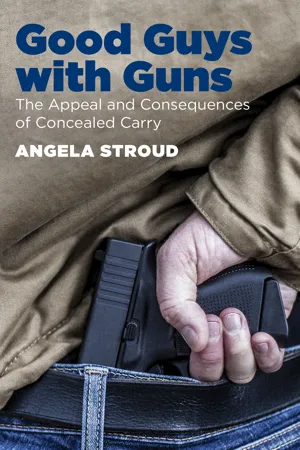
Although the rate of gun ownership in U.S. households has declined from an estimated 50 percent in 1970 to approximately 32 percent today, Americans' propensity for carrying concealed firearms has risen sharply in recent years. Today, more than 11 million Americans hold concealed handgun licenses, an increase from 4.5 million in 2007. Yet, despite increasing numbers of firearms and expanding opportunities for gun owners to carry concealed firearms in public places, we know little about the reasons for obtaining a concealed carry permit or what a publicly armed citizenry means for society. Angela Stroud draws on in-depth interviews with permit holders and on field observations at licensing courses to understand how social and cultural factors shape the practice of obtaining a permit to carry a concealed firearm. Stroud’s subjects usually first insist that a gun is simply a tool for protection, but she shows how much more the license represents: possessing a concealed firearm is a practice shaped by race, class, gender, and cultural definitions that separate “good guys” from those who represent threats.
Stroud’s work goes beyond the existing literature on guns in American culture, most of which concentrates on the effects of the gun lobby on public policy and perception. Focusing on how respondents view the world around them, this book demonstrates that the value gun owners place on their firearms is an expression of their sense of self and how they see their social environment.
- 200 pages
- English
- ePUB (mobile friendly)
- Available on iOS & Android
eBook - ePub
About this book
Information
1 Introduction
I met John at his firearms training school located in a rural part of Central Texas where he and other instructors teach various safety and self-defense courses, from introductory pistol to SWAT tactics.1 I was a couple of months into my research on concealed handgun licensing, and my enculturation into the worldview of license holders was well under way.2 Though I started this project uncertain about why a person would feel the need to carry a firearm in public, by the morning John and I met, I had already heard enough stories about violent assaults and the horror of being helpless when confronted by an armed criminal that I was developing anxiety about the idea of victimization, and I was starting to see the appeal of carrying a handgun. This was happening despite my familiarity with the empirical evidence that clearly showed that violent crime rates were continuing a two-decade-long trend of steep decline and my deep reservations about what it would mean for our society to have an ever-growing cadre of armed citizens. Would we become increasingly suspicious of one another? How would basic social ties be affected? These questions loomed in the background as I interviewed John.
If proponents of concealed handgun licenses (CHLs) could handpick a spokesperson to promote their cause, John would be an excellent candidate. He is smart and articulate and speaks quickly and convincingly about why handgun licensing is effective social policy. For example, he explained that the likelihood of a police officer’s being around when you need one is virtually zero: “It doesn’t mean that they’re bad people … [or] that their organization is a failure. It means that they have a limited number of officers, and we wouldn’t want to live in a country where you have a police officer at your elbow twenty-four hours a day anyway. And most of the police officers would not want to work in an environment like that either. They’re not interested in that. By definition that means that if you’re going to be able to defend yourself against a violent attack from someone that has no justification for attacking you other than greed, malice, sexual, whatever, then, you’ve pretty much gotta be ready to take care of yourself.” He continued, “Our joke is, ‘It’ll never happen to me’ … is not a self-defense plan. But the vast majority of unarmed people, that’s their self-defense plan. They say, ‘Well why do you carry a gun? Nothing bad is ever gonna happen to me.’ And I say, ‘Well, let me give you some phone numbers. You know, let’s talk to people that, yeah, they said that too. Right before something did. Or something happened to somebody they knew.’ ”
The likelihood that a person will become a victim of crime is a product of both the overall crime rate and whether that person falls into a “high risk” demographic (Koppel 1987). And while it is true that anyone can become a crime victim, it is also the case that the violent crime rate has dropped dramatically over the past few decades. For example, between 1993 and 2013 the violent victimization rate—which includes rape, sexual assault, robbery, aggravated assault, and simple assault—dropped from 79.8 to 23.2 victimizations per 1,000 people in the population who are twelve and older (Truman and Langton 2014). The homicide rate has experienced similarly steep declines and in recent years has reached lows last seen in the 1960s (Cooper and Smith 2011).3 Factors that increase the odds that a person will be a victim of violent crime include sex (males are victimized more than females), race (blacks are victimized more than whites and Hispanics), and age (victimization is much higher for those between twelve and thirty-four than for those thirty-five and older; Truman, Langton, and Planty 2013).
As a forty-four-year-old white man who splits his time between a rural area with very low crime and a moderate-size city, John is not likely to be a victim of violent crime, and he knows it. But according to John, a firearm is needed not because a person is likely to become a crime victim but because of what he calls “low-probability, high-consequence” events. In other words, the only time that a CHL holder will use a gun is in the very unlikely event that his or her life is threatened and there is no other alternative: “The first rule of a gunfight is have a gun. And you can’t be in a gunfight if you don’t have one; all you can be in is a shooting.”
John said there is much you can do to “increase your risk of being in a shooting,” for example, “if you hang out with people who have criminal records” or “if you buy and sell narcotics,” but it is also the case that you can avoid high-risk behaviors and still be at the wrong place at the wrong time. He likens this scenario to someone’s having an unforeseen medical crisis: “My cousin dropped dead in front of her preschool class. [She] had a brain aneurism while she was teaching preschool. [She’s] teaching, [her] eyes roll back in her head, boom! Hit the ground. Goodbye. No warning. Nothing. That was it. Brain aneurism, never saw it coming, didn’t know it was gonna happen.” John sees this as an analogy for random acts of violent crime: “There are people, you know, I’m going about my day, I’m doing my thing, I’m at Luby’s, WHAM! There’s some nutbag who just drove through the [door], he’s got a gun, he’s shooting people. That’s why I carry a concealed handgun. Because you can do everything right. Everything right. And still be at the wrong place at the wrong time.”
John mentioned Luby’s (a chain of cafeteria restaurants based in Texas) because of a mass shooting that occurred in Killeen in October 1991, when George Hennard drove his pickup truck through the restaurant’s front windows armed with two 9mm handguns—a Glock-17 and a Ruger P-89—and at least six magazines of ammunition. Hennard walked through the restaurant and shot people at random, ultimately killing twenty-two. At the time it was the worst mass shooting in U.S. history.
Like similar stories that respondents refer to (e.g., Columbine, Virginia Tech), the Killeen incident captures the essence of how vulnerability functions for CHL holders: because we live in a society in which guns are readily available, at any time, any place, a person with a gun can decide to take your life. According to this perspective, the only safe response is to be armed in self-defense. To that end the CHL holders I interviewed argue that a gun is simply a tool. As John explained:
It’s just part of the deal. You need a fire extinguisher to put out a fire, you need a seatbelt to keep you from flying out of your car in a car wreck, you know, you need a flashlight when it gets dark, and somebody tries to kill you, you need a gun. It’s a tool for a job and a situation, in a low-probability, high-consequence situation, and if you’re not wearing your seatbelt, you go flying out of your car and you die. If [your] kitchen catches on fire and you don’t have a fire extinguisher, your house burns down. If it’s dark and you need a flashlight and you don’t have one, you can’t see anything. If somebody tries to kill you and you don’t have a gun, you’re probably gonna die. It’s pretty straightforward.… It’s not this big deal. People get all wound up about guns being some magic thing that has magic powers to modify people’s personalities. You know, it’s a hammer, it’s a flashlight, it’s a fire extinguisher, it’s a piece of gear, it’s designed to do something, it’s used for certain things at an appropriate place at an appropriate time. And you learn how to use it and you have it available, and when you need it, you use it.… It’s not as big a deal as people make it out to be.
John presents a compelling explanation for why carrying a concealed firearm is a reasonable, even responsible self-defense tactic. Given such logic it is easy to find oneself imagining that there are no negative consequences to this social policy and that handgun licensing is simply a prudent response to potential victimization.
After approximately ninety minutes we were out of time, and on my way out John offered to show me the classrooms and firing ranges that make up his training facility. As we walked to the range, I felt lost in thoughts related to my own vulnerability. Like the unprepared people John had referenced, I did not have a self-defense plan or own a gun, and I considered whether I was failing in my duty to protect myself and my children from harm. I stared at the humanoid figures used for target practice and wondered how I would stop an assailant. Was I being irresponsible?
As John walked me to my car I managed to squeeze in one last question: I asked if he felt that gun rights are threatened in this country. Though he does not fear our government, he does believe that we might need guns to protect ourselves from the type of people our government produces, people he described as ineffectual, dependent, and reliant on criminal activity to satisfy their basic needs. He explained that Ayn Rand’s books have had a significant impact on his way of thinking about human nature, and he believes that there are “contributors” who want to help make society a better place and “noncontributors” who only want to take from others. A friend of his, a police officer in an urban area, says that 5 percent of the population could disappear overnight and the only clue that they were gone would be that the crime rate would go down. While John did not claim this view as his own, and even seemed somewhat embarrassed while repeating it, the fact that he chose to share it anyway suggests at least a partial endorsement.
Listening to these comments I was instantly snapped back into awareness that carrying a firearm for self-defense is not simply a practice intended to guard against an abstract notion of indeterminate threat, and a firearm is not just like any other tool. It is a tool used to kill people, and to carry one with you is to be prepared to do that at any time. I was troubled by that reality and concerned that John’s “noncontributors” comment was boilerplate culture-of-poverty rhetoric, which holds that at least some segment of the poor are likely to be criminal and that society would be better off if they disappeared. Contributors or not, we were talking about human beings. Yet as I reflect back on that day what strikes me most is that I drove away from the interview having been drawn into the logic of concealed carry. While I was concerned about how John and other respondents I had interviewed described the people they imagined as “bad guys,” I was intoxicated by the rhetoric of the “good guy.” I wanted to be prepared to protect myself and my family, and I wanted to have the power to respond to any threat we might face. My concern for the human costs of handgun licensing and the impacts on society were being replaced by a personal worry about victimization and a growing fear that I was vulnerable. Never had I wanted a gun more, and never had I come so close to mailing in my already completed application for a CHL.
In the research that follows I consider the social meanings of handgun licensing through an analysis of in-depth formal interviews that I conducted with nearly forty people who are licensed to carry guns in public and ethnographic data collected at gun ranges, a licensing course, and a women’s handgun self-defense class. Whereas the participants I interviewed suggested that a concealed firearm is simply a tool for protection, I argue that it is much more. Caught up in a binary idea of “good guys” and “bad guys,” they use their concealed firearms as part of a much larger discursive strategy that obscures dynamics of privilege and inequality operating via race, class, and gender. Their CHLs allow them not only to feel that they are safe in a world that they perceive is increasingly dangerous; their licenses also confirm that they are one of the good guys, a status that is about much more than not breaking the law.
The Push for CHLs in Texas
The shooting at the Luby’s in 1991 was a pivotal moment in the push for CHL legislation in Texas. Not only was the shooting itself sensational, but one person who was most deeply affected had a very compelling story to tell about why private citizens should have the right to be armed. Once she realized what was happening, Suzanna Hupp, who was at the restaurant with her parents, reached for her purse and the .38 revolver that she had carried for most of her adult life. In her memoir recalling the event Hupp (2010, 38) writes, “Then it occurred to me with sudden and utter clarity that, just a few months earlier, I had made the stupidest decision of my life: my gun was not in my purse any longer!” There was no way for a private citizen to legally carry a concealed handgun in Texas in 1991, and because Hupp feared that a weapons charge could harm her thriving chiropractic practice, she had stopped carrying one. Her parents were among the people killed.
The Killeen shooting happened on the same day that Congress held debates on a national crime bill that would ban semi-automatic rifles, commonly referred to as “assault rifles,” and high-capacity magazines for semi-automatic handguns (Barrett 2012). As news of the events spread, lawmakers on various sides of the issue used it as evidence to bolster their claims. Those in favor of the ban argued that Hennard would not have been able to kill so many people if his magazines had been limited to the standard ten rounds. For those opposed it did not matter how many bullets each magazine held because changing magazines on a semi-automatic handgun takes an experienced shooter a matter of seconds.
While Congress debated the national crime bill, debates at the state-level focused on whether individuals should have the right to carry concealed firearms. In the late 1980s and continuing through the 1990s, states throughout the United States started to loosen their restrictions on carrying concealed firearms (Wintemute 2006). In April 1993 the Texas House approved a bill that would allow Texans with a license to carry a handgun on their body either concealed or in the open. Those who opposed the measure argued that concealed weapons holders would only contribute to violent crime. Texas governor Ann Richards’s spokesperson summarized the opposition to the bill as follows: “People who are scared, people who are frightened, people who are paranoid have absolutely no business having a gun” (Robison 1993a). Ron Wilson, a Democrat from Houston who sponsored the bill, responded to such sentiments by saying, “I don’t live in a Norman Rockwell painting. I live in urban America.… Everybody is already on the street carrying guns, but it’s the wrong folks” (Robison 1993a).
Though crime was generally on the decline during the 1980s, the violence associated with the buying, selling, and use of crack cocaine led to an increase in violent crime in urban areas (Reinarman and Levine 1997), while at the same time, semi-automatic handguns, which are much more lethal than revolvers because their magazines can hold many more rounds, became the weapons of choice for people involved in the drug trade (Barrett 2012). The combined effect of these two phenomena was an increase in homicides in urban areas. However, this increase in violence was not random; its primary perpetrators and its victims were young people directly involved with the drug trade (Wintemute 2006). Nevertheless the violent crime climate and high-profile mass shootings like the incident in Killeen contributed to the shifting legislative winds throughout the United States.
In June 1993 a concealed handgun licensing bill passed both houses of the Texas legislature. In front of television cameras, with a few dozen police officers at her side, Governor Richards vetoed the bill, saying, “I especially want to thank you for choosing to stand by me on this day, when we say ‘no’ to the amateur gunslingers who think somehow they are going to be braver and smarter with a gun in their hand” (Robison 1993b). Richards’s opposition to the concealed handgun legislation drew the ire of pro-gun groups like the National Rifle Association (NRA), who financially backed her opponent, George W. Bush, in the next gubernatorial election. Bush, having promised to make CHLs a legislative priority, defeated Richards, and CHLs became legal in Texas in 1995 (South 1996).
The 1992 national crime bill failed to garner enough support to become law, but it was up for debate again in 1994, and most attention turned to the component of the bill known as “the Assault Weapons Ban.” Hupp offered congressional testimony in opposition to the ban, presumably because her personal story would provide a compelling narrative that would justify the importance of firearms for self-defense. Since the shooting she had become a leading advocate for concealed handgun legislation (Hupp 2010). Afte...
Table of contents
- Cover
- Title Page
- Copyright
- Epigraphs
- Contents
- List of Figures and Tables
- Acknowledgments
- 1: Introduction
- 2: Men and Guns
- 3: Refuse to Be a Victim? Femininity, Guns, and Victimization
- 4: Good Guys and Bad Guys
- 5: Self-Defense and Personal Responsibility
- Conclusion: The Social Implications of an Armed Citizenry
- Appendix I: Demographic Characteristics of Respondents
- Appendix II: Texas Handgun License Law
- Notes
- Bibliography
- Index
Trusted by 375,005 students
Access to over 1.5 million titles for a fair monthly price.
Study more efficiently using our study tools.
Frequently asked questions
Yes, you can cancel anytime from the Subscription tab in your account settings on the Perlego website. Your subscription will stay active until the end of your current billing period. Learn how to cancel your subscription
No, books cannot be downloaded as external files, such as PDFs, for use outside of Perlego. However, you can download books within the Perlego app for offline reading on mobile or tablet. Learn how to download books offline
Perlego offers two plans: Essential and Complete
- Essential is ideal for learners and professionals who enjoy exploring a wide range of subjects. Access the Essential Library with 800,000+ trusted titles and best-sellers across business, personal growth, and the humanities. Includes unlimited reading time and Standard Read Aloud voice.
- Complete: Perfect for advanced learners and researchers needing full, unrestricted access. Unlock 1.5M+ books across hundreds of subjects, including academic and specialized titles. The Complete Plan also includes advanced features like Premium Read Aloud and Research Assistant.
We are an online textbook subscription service, where you can get access to an entire online library for less than the price of a single book per month. With over 1.5 million books across 990+ topics, we’ve got you covered! Learn about our mission
Look out for the read-aloud symbol on your next book to see if you can listen to it. The read-aloud tool reads text aloud for you, highlighting the text as it is being read. You can pause it, speed it up and slow it down. Learn more about Read Aloud
Yes! You can use the Perlego app on both iOS and Android devices to read anytime, anywhere — even offline. Perfect for commutes or when you’re on the go.
Please note we cannot support devices running on iOS 13 and Android 7 or earlier. Learn more about using the app
Please note we cannot support devices running on iOS 13 and Android 7 or earlier. Learn more about using the app
Yes, you can access Good Guys with Guns by Angela Stroud in PDF and/or ePUB format, as well as other popular books in Social Sciences & Discrimination & Race Relations. We have over 1.5 million books available in our catalogue for you to explore.