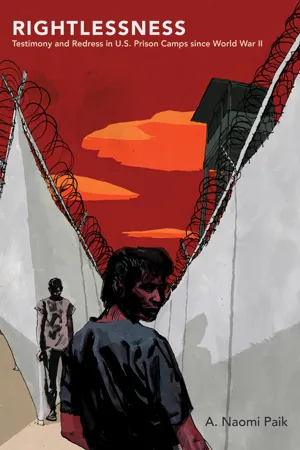
In this bold book, A. Naomi Paik grapples with the history of U.S. prison camps that have confined people outside the boundaries of legal and civil rights. Removed from the social and political communities that would guarantee fundamental legal protections, these detainees are effectively rightless, stripped of the right even to have rights. Rightless people thus expose an essential paradox: while the United States purports to champion inalienable rights at home and internationally, it has built its global power in part by creating a regime of imprisonment that places certain populations perceived as threats beyond rights. The United States' status as the guardian of rights coincides with, indeed depends on, its creation of rightlessness.
Yet rightless people are not silent. Drawing from an expansive testimonial archive of legal proceedings, truth commission records, poetry, and experimental video, Paik shows how rightless people use their imprisonment to protest U.S. state violence. She examines demands for redress by Japanese Americans interned during World War II, testimonies of HIV-positive Haitian refugees detained at Guantánamo in the early 1990s, and appeals by Guantánamo’s enemy combatants from the War on Terror. In doing so, she reveals a powerful ongoing contest over the nature and meaning of the law, over civil liberties and global human rights, and over the power of the state in people’s lives.
eBook - ePub
Rightlessness
Testimony and Redress in U.S. Prison Camps since World War II
- 332 pages
- English
- ePUB (mobile friendly)
- Available on iOS & Android
eBook - ePub
About this book
Information
Part I
Japanese internment camps
United States (various locations)
May 1942–March 1946
On 14 February 1942, two months after Japanese forces attacked Pearl Harbor and the United States officially entered the Second World War, President Franklin D. Roosevelt signed Executive Order 9066, authorizing the mass evacuation and imprisonment of all ethnic Japanese persons living on the West Coast, including 80,000 U.S. citizens. The Wartime Civilian Control Administration (WCCA), the federal agency hurriedly created to manage the evacuation, gave these 120,000 citizens and residents as little as two weeks to settle their affairs. Properties were sold short; businesses shuttered. The WCCA then transported this suspect group of people—now called “internees”—en masse to nearby assembly centers, some of them in whitewashed horseracing or fairground facilities. In these cases, families took the place of horses. From assembly centers, internees were then removed to one of ten internment camps located in the deserts of the West or in the swamps of Arkansas.
The War Relocation Authority (WRA), another civilian government agency established to administer internment, built the camps within a few months. The camps ranged in size, holding anywhere from 7,000 to nearly 19,000 inmates. They were organized into housing blocks that each contained rows of barracks, a mess hall, a communal hall, laundry facilities, and men’s and women’s bathrooms. The camps also contained administrative buildings and housing for soldiers, as well as buildings that served as hospitals, schools, religious sites, canteens, and post offices. The barracks each measured about 120 feet by 20 feet, and were divided to house up to six families. Each apartment contained a single light fixture, a stove for heating, and a cot for each resident. Hastily constructed out of cheap materials and covered with tar paper, this housing offered little privacy or shelter from the extreme weather. The windows and doors often did not fit their frames; large gaps grew between the planks of wood as time wore on.
The internees brought what they could carry with them to the camps. Since the WRA wanted the camps to be as self-sufficient as possible, internees were encouraged to work within their confines. Some planted gardens or raised livestock. Others worked in the camp administration, commissary, school, or hospital. Select internees could even leave their camps to work on nearby farms that desperately needed labor for harvesting. Children attended school. The internees could take recreational craft classes and play organized sports. Many tried to make the best of their situation, establishing some sense of productivity and normalcy under detention.
Some resisted their imprisonment. They protested against camp conditions or declined to complete questionnaires used to separate the loyal from the disloyal. Men who refused to profess loyalty to the U.S. government and then be drafted into military service were sent to prison as draft dodgers. Eventually, so many internees were deemed disloyal that the WRA moved them to Tule Lake, a California internment camp converted in 1943 into a “segregation center,” placing them under more severe control. Whether compliant or resistant, internees remained imprisoned on barren, desolate lands, surrounded by barbed wire and under the surveillance of watchtowers. And despite efforts to ease the boredom, the internees’ lives were filled with empty time, waiting in various lines for food and other provisions throughout the day, waiting for the war, and their imprisonment, to end.
1: Internment Remains
The 1988 Civil Liberties Act and Racism Re-Formed
Can we trust you to handle this sacred part of our experience responsibly and with sensitivity? . . . Or, have we engaged in a game to which everyone, you, the Commission, and us, the victims, loses, and only the racists and those who would thwart justice win? Will we feel that once again we have been exploited, humiliated, and violated?
—Lloyd Wake, 1981
On 10 August 1988, President Ronald Reagan signed into law the Civil Liberties Act, which granted redress to the ethnic Japanese men and women who had been relocated and interned without due process during World War II. Removed to the camp, they had been severed from the political community that provides the precondition for rights to have meaning. The Civil Liberties Act attempted to confer acknowledgment and restitution four decades after their release from camp. In 1981, during the long buildup to the act’s passage, surviving internees reflected on their camp experiences and testified to rightlessness in a series of hearings convened by the government as part of its investigation into the history of internment. Each survivor, two years after the redress bill became law, received official letters of apology signed by current president George H. W. Bush, and a payment of $20,000. With its apology, the U.S. government seemed to “acknowledge the fundamental injustice” of internment,1 as the act phrases it, while offering a symbolic gesture of restitution. Reagan remarked at the bill’s signing ceremony, “No payment can make up for those lost years. So, what is important in this bill has less to do with property than with honor. For here we admit a wrong; here we reaffirm our commitment as a nation to equal justice under the law.”2 Redress enabled the United States to situate internment as an unfortunate mistake, as the exception that proves the rule that we are, in fact, loyal to our deepest values.
The Civil Liberties Act suggested that the entire nation could now move beyond this aberrant moment in history, safe in the knowledge that the government would not commit such a grave error again. Yet debates about the meaning of internment persist and have become increasingly virulent following the attacks of 11 September 2001. Under the War on Terror, internment’s history has been deployed to justify the racial profiling and wholesale capture of Arab and Muslim men for the sake of “homeland security.”3 In her book In Defense of Internment, the Asian American conservative commentator Michelle Malkin criticizes redress as “the never-ending slogging in white guilt,” further arguing: “Lies about the past continue to color and poison the current national security debate over how best to defend ourselves from terrorist invasion.”4 Malkin not only demeans internees, disregarding their losses and suffering, but also casts their political organizing for redress as manipulating a lie—that internment was based on racism—one that exposes us to imminent dangers. While Malkin deploys sensational language to make her point, she draws attention to the broader, continuing conflicts over internment’s historical meaning, the persistent denial of the injustice of internment, and the significance that historical interpretation carries for the present moment. Beyond these discursive battles, internment persists in material ways. The rationales for Japanese American internment have morphed as they are applied to new target populations. Camps have hardly been eradicated from the country’s arsenal of political strategies. Against the claims of the redress act to “discourage the occurrence of similar injustices and violations”5 in the future, the U.S. government has responded to crises with mass imprisonment and deployed camps to detain new groups of rightless people.
Although redress seems to complete the story of internment, it actually marks a shift, not an ending, in the ways the U.S. government deploys racism. Focusing on the moment of Japanese American redress, rather than the moment of internment, emphasizes how the U.S. government has adapted its use of racism at a critical historical juncture—after the height of the civil rights movement and in the twilight of the Cold War. As its title suggests, the 1988 Civil Liberties Act is framed as a product of the civil rights movement, one more victory on the path toward formal racial equality. Yet that path is anything but straightforward. Though the U.S. government has professed its support of rights, it has nevertheless maintained its long-established ability to affirm racial hierarchies; the difference is that now those hierarchies must be publically disavowed, and affirmed only through veiled tactics. Furthermore, as Japanese American redress demonstrates, the federal government deploys civil rights as a tool in advancing its global interests and influence. The 1988 act sought not only to complete a narrative of official antiracism emerging from the civil rights era but also to “make more credible and sincere any declaration of concern by the United States over violations of human rights by other nations.”6 The act at once functioned to obscure the country’s own rights abuses and to frame human rights violations as something committed by “other nations.” While the U.S. state continues to produce rightless subjects, it must now achieve these race-addled aims without actually referring to race.
Redress provides a particularly illuminating lens on this shift. The 1988 act demonstrated the country’s progress toward formal equality by rehabilitating Japanese Americans not as unassimilable enemy aliens, but rather as model minorities. Yet this recuperation has worked to obscure the continued workings of state racism against other racial others or supposed problem minorities. Redress demonstrates how the parameters of U.S. liberal governance can seem to become more inclusive without changing the logic of the state’s racially differentiated investment in the rightful and the rightless. The acceptance of some racial others through the auspices of liberal inclusion is not only limited and provisional but also works to entrench domains of exclusion. Indeed, former internees were just one group to point out this illusory inclusiveness. Some foresaw these concerns at the moment of redress and have troubled the redemptive narrative of redress from the beginning. As Lloyd Wake, clergyman of the Glide Memorial Methodist Church and former internee of Poston, testified during the 1981 hearings, he and other internees feared that redress only staged a spectacle, giving the impression of an honest grappling with internment’s history, while in fact exploiting internees’ painful memories to “thwart justice”—the exact opposite of redress’s ostensible goals.7 As he indicated, the many supporters and leaders of the redress movement fought hard to create a solution they believed was just. The problem, however, is that redress does not conclude or resolve the story of internment, but instead marks the ascendance of a racism re-formed—a state-supported racial equality that obscures the actual maintenance of racial hierarchy. As Wake presciently envisaged, this liberal affirmation could be deployed not to repair internment’s harms, but to reproduce the conditions of rightlessness, restructured under the aegis of rights ascension.
SPECTACLES OF REMORSE
The attack on Pearl Harbor and the United States’ official entry into World War II ignited the mobilization to imprison all Japanese persons living on the U.S. West Coast, but long-established anti-Asian racism—as seen, for example, in legal bars to immigration, citizenship, and property ownership, as well as resentment over economic competition—had paved the way for internment. Ultimately justified by the notion that Japanese people were inherently inclined to be disloyal to the United States, internment grew out of and affirmed the preexisting logic of Asians as permanent foreigners, regardless of citizenship. As the historian Mae Ngai notes, internment “nullified” the rights of these captives “exclusively on grounds of racial difference.”8
The federal government chose to site the camps in isolated deserts and swamplands not only because of their remote locations but also in hopes that the internees, many of whom were adept farmers, could make this unproductive and undesirable land arable.9Furthermore, the War Relocation Authority (WRA) built the Poston and Gila River camps on the lands of American Indian reservations in Arizona, legally ambiguous zones governed by tribal councils but still subject to the demands of the federal government. Indeed, the tribal councils of the Colorado River Indian Reservation and the Gila River Indian Community opposed the building of internment camps on their lands, but found themselves overruled by the Office of Indian Affairs and could not stop the camps’ construction.10
The Japanese American Citizens League (JACL)—the largest community organization based on the West Coast and led by Nisei, second-generation Japanese American citizens—worked with the U.S. government to facilitate the evacuation and internment. It encouraged Japanese people to peacefully comply with Executive Order 9066 and advised Nisei to inform on potentially anti-American community members. The JACL also advocated that the WRA use the camps to foster U.S. assimilation among the interned, encouraged reinstating the draft of Japanese Americans, and supported the further segregation of ostensibly disloyal internees, determined by the infamous loyalty questionnaire distributed throughout the camps. On the basis of this questionnaire, the WRA separated the seemingly disloyal, who were sent to the Tule Lake Segregation Center, a camp held under heightened security, from the loyal, who could be paroled out of camp for school, work, or military service.11 While men who refused to profess their loyalty to the United States and be drafted were eventually sent to prison or Tule Lake, the loyalty questionnaire enabled the enlistment and conscription of Japanese American servicemen, including those who joined the all-Nisei 442nd Regimental Combat Team, one of the most decorated units of its size and length of activity in the history of the U.S. military, with more than 18,000 soldiers serving during its three-year activation.12 This duality—both giving excluded citizens the opportunity to serve in the military and (further) incarcerating internees who refused—elucidates how the WRA managed the camps not solely, or even primarily, through the use of physical violence. Instead, it also sustained rightlessness—removal to the camp—through liberal means. In addition to providing resources like school and recreation, the WRA established community analysts, social scientists who communicated with internees about their camp experiences, as well as project attorneys. However, these resources were designed not to give internees critical listeners to whom they could voice their concerns or opposition to internment, but to help with the efficient management of the camps. The project attorneys helped supposedly loyal internees leave the camp on an ad hoc basis, but they did not address internment’s fundamental infringement of all the internees’ rights.13 The community analysts further shaped the perception of the camps as liberal projects, their research demonstrating to the government and the public that, as the anthropologist Orin Starn notes, “far from being an ugly irrational racist enterprise, relocation was fair and democratic.”14 Indeed, these liberal tactics, ones advocated by the JACL, not only cast the WRA as benevolent but also worked to obscure the repression inherent to camp imprisonment. The thorny history of the JACL’s position on internment during the Second World War would reverberate across the decades through the redress movement.
Internment occurred at a time when rights—both civil rights and human rights—had not yet become the lingua franca of U.S. and international political discourse, as they would be at the time of redress. Internment marks one instance of the U.S. state rendering a population rightless by imprisoning them in camps without due process. It stripped the interned not solely of liberty and the pursuit of happiness but of the precondition that makes such fundamental rights possible—inclusion in the political community. More than forty years later, the passage of the Civil Liberties Act is a product of the ascension of rights that occurred in the intervening decades. The ascension of rights offered internees and their advocates an intelligible discourse to appeal for redress, to make a claim on state power on their behalf, even for a past injustice. This temporal gap also means that the ...
Table of contents
- Cover Page
- Rightlessness
- Copyright Page
- Dedication
- Contents
- Figures
- Acknowledgments
- Introduction
- Part I
- Part II
- Part III
- Conclusion
- Notes
- Bibliography
- Index
Trusted by 375,005 students
Access to over 1.5 million titles for a fair monthly price.
Study more efficiently using our study tools.
Frequently asked questions
Yes, you can cancel anytime from the Subscription tab in your account settings on the Perlego website. Your subscription will stay active until the end of your current billing period. Learn how to cancel your subscription
No, books cannot be downloaded as external files, such as PDFs, for use outside of Perlego. However, you can download books within the Perlego app for offline reading on mobile or tablet. Learn how to download books offline
Perlego offers two plans: Essential and Complete
- Essential is ideal for learners and professionals who enjoy exploring a wide range of subjects. Access the Essential Library with 800,000+ trusted titles and best-sellers across business, personal growth, and the humanities. Includes unlimited reading time and Standard Read Aloud voice.
- Complete: Perfect for advanced learners and researchers needing full, unrestricted access. Unlock 1.5M+ books across hundreds of subjects, including academic and specialized titles. The Complete Plan also includes advanced features like Premium Read Aloud and Research Assistant.
We are an online textbook subscription service, where you can get access to an entire online library for less than the price of a single book per month. With over 1.5 million books across 990+ topics, we’ve got you covered! Learn about our mission
Look out for the read-aloud symbol on your next book to see if you can listen to it. The read-aloud tool reads text aloud for you, highlighting the text as it is being read. You can pause it, speed it up and slow it down. Learn more about Read Aloud
Yes! You can use the Perlego app on both iOS and Android devices to read anytime, anywhere — even offline. Perfect for commutes or when you’re on the go.
Please note we cannot support devices running on iOS 13 and Android 7 or earlier. Learn more about using the app
Please note we cannot support devices running on iOS 13 and Android 7 or earlier. Learn more about using the app
Yes, you can access Rightlessness by A. Naomi Paik in PDF and/or ePUB format, as well as other popular books in History & North American History. We have over 1.5 million books available in our catalogue for you to explore.