- 344 pages
- English
- ePUB (mobile friendly)
- Available on iOS & Android
eBook - ePub
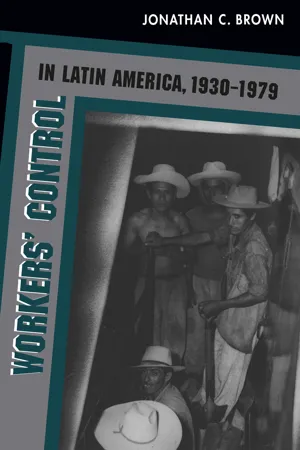
Workers' Control in Latin America, 1930-1979
About this book
The years between 1930 and 1979 witnessed a period of intense labor activity in Latin America as workers participated in strikes, unionization efforts, and populist and revolutionary movements. The ten original essays ÆMDNMØin this volume examine sugar mill seizures in Cuba, oil nationalization and railway strikes in Mexico, the attempted revolution in Guatemala, railway nationalization and Peronism in Argentina, Brazil's textile strikes, the Bolivian revolution of 1952, Peru's copper strikes, and the copper nationalization in Chile — all important national events in which industrial laborers played critical roles. Demonstrating an illuminating, bottom-up approach to Latin American labor history, these essays investigate the everyday acts through which workers attempted to assert more control over the work process and thereby add dignity to their lives. Working together, they were able to bring shop floor struggles to public attention and — at certain critical junctures — to influence events on a national scale. The contributors are Andrew Boeger, Michael Marconi Braga, Jonathan C. Brown, Josh DeWind, Marc Christian McLeod, Michael Snodgrass, Andrea Spears, Joanna Swanger, María Celina Tuozzo, and Joel Wolfe.
Chapter One: To Relieve the Misery: Sugar Mill Workers and the 1933 Cuban Revolution
The standard of living of Cuban sugar mill and cane field workers declined steadily during the 1920s as the sugar industry attempted to reduce costs of production and to battle the effects caused by worldwide overproduction. With the onset of the Great Depression in the 1930s, the living standards of sugar workers declined even further. Mill owners slashed wages and reduced employment, leaving both cane and mill workers in a state of abject misery. At first, sugar workers were prohibited from protesting against their deteriorating position by the strongarm tactics of President Gerardo Machado. But when the Machado government fell in August 1933, sugar workers reacted explosively. They demanded higher wages, shorter workdays, improvements in living conditions, job security, and the recognition of labor unions by employers. Management refused to meet these demands, and workers seized the majority of sugar mills on the island. They threatened the lives of managers. They helped themselves to food and supplies from company storehouses. The workers remained in control of the mills for most of September, forcing changes in legislation governing practically every aspect of sugarcane production. As a result, workers obligated owners to pay a minimum wage to both mill and field workers. They also compelled management to obey work rules on the shop floor and prohibited the firing of employees without just cause. These were certainly among the most significant reforms that occurred as a result of the revolution of 1933.
Thus far, the historical literature has overlooked the role of sugar workers in this revolution. Historians of the events of 1933 prefer to deal with the student uprisings, increasingly violent defiance in urban areas, and the rebellion within the military. Cuban and Soviet authors have recently given more than passing attention to sugar mill takeovers, but many questions still remain unanswered.1 For instance, why did sugar workers take over the sugar mills? To what extent was the power vacuum created by the fall of Machado and the rebellion in the military responsible for the success of their movement? What did the workers do when they were in charge of the mills? Why did they eventually return the mills to the owners? What were the major points of contention between management and labor during contract negotiations? And what were the long-term consequences of the workers’ actions?
In order to answer these questions, this chapter draws on documents contained in the Braga Brothers Collection at the University of Florida at Gainesville. The collection houses the complete records of the Czarnikow Rionda Company, its affiliates, and subsidiaries, which at the time of the uprisings owned five sugar mills and had an interest in a number of others.2 Based on the information gleaned from these and other sources, it is possible to conclude that workers rebelled because they were hungry, because they were frustrated at a decade-long decline in their living standards, and because they were angry at management’s intransigent neglect of their conditions. The collapse of the Machado administration in August 1933 and the Sergeants Rebellion led by Fulgencio Batista in September of the same year provided workers with a window of opportunity. Cane cutters and railway and factory employees, led by a vanguard of skilled mechanics and technicians, consequently established control over sugar mills across the country. The uprising was largely spontaneous and led by local union leaders, many of whom were labor agitators who had taken jobs at the mills in the years immediately preceding the revolution. Communists and other labor organizers acknowledged that the movement took them by surprise. They had to scramble to send delegates to the distant mills to help direct worker activities. Although managers called for assistance to put down the insurgency, the government and the military were in a complete state of disarray at the time and could not respond. Managers found themselves with few alternatives other than to concede to most of the labor demands. When workers finally opted to return the mills to owners, they had completely restructured relations of production in the weakened sugar industry. In the process, they restored lost dignity to themselves and gained greater control over their lives.
Working-Class Tensions
The sugar industry dominated Cuba’s economy and society since the late eighteenth century. The single-minded focus on this one product brought occasional prosperity to the island. At the same time, Cuba depended on overseas markets and was vulnerable to dramatic swings in international commodity prices. Periodic recessions, triggered by changes in market conditions, accentuated already simmering tensions between members of the sugar industry’s multiethnic workforce and also between labor and capital. Rebellions, racial conflicts, insurgency, and all-out guerrilla warfare were often the consequences.3 By the time of the sugar mill takeovers in 1933, the sugar industry was directly or indirectly responsible for the livelihood of two-thirds of the Cuban population. Sugar sales represented four-fifths of the country’s export earnings.4 In Cuba, the cyclical nature of the sugar economy and tensions within the working class set the pace for political and social life.
The Cuban sugar industry consisted of an agricultural sector devoted to the cultivation and harvesting of cane and an industrial sector concerned with the processing of raw sugar. In 1933, foreign capital dominated both the agricultural and industrial sectors of the sugar industry. United States and Canadian corporations and banks owned or controlled approximately 100 of the 135 operating sugar mills as well as 20 percent of the arable land, producing some three-quarters of Cuba’s total sugar output.5 These North American–owned mills tended to place English-speaking foreigners in the top-level management and technical positions. This meant that Cubans did not control the profits from their principal industry and were relegated to the role of servants to foreign capital. The relationship between Cuban workers and North American managers was consequently tainted by feelings of resentment. These feelings were easily exploited by nationalists, which contributed to the unrest of 1933.
Similar antagonism existed among sugar workers themselves. The labor force consisted of hundreds of thousands of workers with varying skill levels, racial and ethnic backgrounds, and standards of living. Such heterogeneity made it difficult for workers to form a united front against capital and fight for their needs. But over the years, workers learned to broaden their movement as much as possible, incorporating workers with widely disparate skills and backgrounds. Although the diverse groups of sugar workers never truly bonded, they were all equally frustrated by their declining living standards and lack of control over their lives. Their simultaneous explosion in 1933 helped many workers to achieve what they wanted.

Map 1. The Rionda Company sugar mills in Cuba, 1933
Field workers employed at plantations were the most divided of all. They came from different countries, did not speak the same languages, and had dissimilar standards of living. Cane farmers and sugar companies hired field workers on a temporary basis during the harvest season. They cut cane by hand and loaded the stalks onto oxcarts and railway cars to be taken to the mills. At first, field work was done primarily by former slaves, poor white peasants, and seasonal European immigrants from the Canary Islands. But when these workers declined to work for low pay and began agitating for wage increases from 1912 onward, the larger and more modern plantations at the eastern end of the island increasingly began to import black workers from other Caribbean islands.6 Haitians and Jamaicans were willing to work for less money than native Cubans and endured the miserable living and working conditions. In turn, these immigrants spoke Creole French or English, making them less easily influenced by Spanish-speaking labor organizers. By 1933, approximately half of the five hundred thousand cane cutters working the harvest were Haitians or Jamaicans. Although they were originally supposed to return to their countries of origin after the harvest season, most of them resided in Cuba year-round. In the dead season, when harvest activity ceased, they would simply drift off into the countryside or head to the cities to find work.7
Native Cubans strongly objected to the presence of Haitian and Jamaican workers, because these immigrants represented a threat to their livelihood. In response, native Cubans took their struggle to the political level, attempting to convince the government to impose bans on the hiring of immigrant labor. Although workers finally succeeded in getting laws passed in the 1920s, sugar companies paid no attention to the bans and continued to import workers.8 As a result, native Cubans retained a deep animosity for the immigrant cane cutters and never joined with them to fight against the capitalist class. Field workers also bore similar feelings of antipathy toward Spanish-born supervisors, as well other foreign administrators, for hiring immigrants in the first place. Tensions and animosity, therefore, divided the class of workers that labored in the cane fields and also set one class against another.
Some heterogeneity also divided the mill workers. Yet they had proved more willing than field workers to join together in labor unions. The milling process required both skilled and unskilled labor. The unskilled tasks, such as cleaning the mill floor and keeping the channels under it from getting clogged, were handled by African Cubans, whereas the jobs requiring mechanical, electrical, chemical, or woodworking skills were monopolized by Spaniards and white Cubans. Following independence in 1902, Spanish immigrants flooded into Cuba to take advantage of expanding job opportunities. They were initially preferred by mill owners because they tended to work hard to establish themselves in Cuba and also because they often remained aloof from Cuban labor struggles during the years preceding World War I. Consequently, Spaniards displaced Cubans from technical and middle-level management positions in the mills, thereby creating sources of animosity.9 In addition to ethnic conflict between Spaniards and Cubans, considerable racial tension existed between white and black workers within the mills. But these considerations tended to be played down as the effects of the Great Depression and industry recession wore on and the need to develop a united front became apparent.
Ultimately, Spaniards and Cubans, blacks and whites, fought together during the takeover movement, presenting unified lists of demands in many places that called for an end to racial discrimination.10 By 1933, mill workers realized the power of an uprising of the masses of field workers and the fear it generated in the capitalist class. So mill workers began to associate themselves with that power in order to obtain their demands. In return, petitions began to include the requirements of both industrial and agricultural labor. Throughout, however, the approximately fifty thousand mill workers on the island clearly represented the vanguard of the takeover movement.
By the time of the 1933 revolution, workers were loosely organized into unions affiliated with the Cuban National Confederation of Workers and the National Sugar Industry Workers Union.11 However, management had not recognized these unions. With the help of the government troops, known as the Rural Guard, mill owners had made every effort to repress union activity. Perhaps an even harder task than unifying their own members, therefore, was the workers’ struggle against management to be allowed to organize and form unions. Most sugar mills in Cuba operated like independent fiefdoms. The owners had almost complete control over who could live and work within the mill compound and the adjoining fields. Utilizing the Rural Guard, management usually found it easy to rout out union agitators from the general population of workers and exile these troublemakers and their families from the plantations.12 Consequently, mill workers had to overcome two significant obstacles prior to the takeover movement of 1933. They had to unify the working class, and they had to organize in the face of intense opposition from mill owners and the Rural Guard. Communists, anarcho-syndicalists and other prolabor organizations helped workers overcome these barriers. Organizers were clandestinely sent to the mills to help disseminate...
Table of contents
- Cover Page
- Workers’ Control in Latin America, 1930–1979
- Copyright Page
- Dedication
- Contents
- Preface
- Introduction: What Is Workers’ Control?
- Chapter One: To Relieve the Misery: Sugar Mill Workers and the 1933 Cuban Revolution
- Chapter Two: Acting for Themselves: Workers and the Mexican Oil Nationalization
- Chapter Three: Rehabilitating the Workers: The U.S. Railway Mission to Mexico
- Chapter Four: Maintaining Unity: Railway Workers and the Guatemalan Revolution
- Chapter Five: As You Sow, So Shall You Reap: Argentine Labor and the Railway Nationalization
- Chapter Six: Topics Not Suitable for Propaganda: Working-Class Resistance under Peronism
- Chapter Seven: There Should Be Dignity: São Paulo's Women Textile Workers and the “Strike of 300,000”
- Chapter Eight: Struggling for Emancipation: Tungsten Miners and the Bolivian Revolution
- Chapter Nine: Continuing to Be Peasants: Union Militancy among Peruvian Miners
- Chapter Ten: Defending the Nation's Interest: Chilean Miners and the Copper Nationalization
- Conclusion: Workers’ Control in Latin America
- Selective Bibliography of Twentieth-Century Latin American Labor History
- Notes on the Contributors
- Index
Frequently asked questions
Yes, you can cancel anytime from the Subscription tab in your account settings on the Perlego website. Your subscription will stay active until the end of your current billing period. Learn how to cancel your subscription
No, books cannot be downloaded as external files, such as PDFs, for use outside of Perlego. However, you can download books within the Perlego app for offline reading on mobile or tablet. Learn how to download books offline
Perlego offers two plans: Essential and Complete
- Essential is ideal for learners and professionals who enjoy exploring a wide range of subjects. Access the Essential Library with 800,000+ trusted titles and best-sellers across business, personal growth, and the humanities. Includes unlimited reading time and Standard Read Aloud voice.
- Complete: Perfect for advanced learners and researchers needing full, unrestricted access. Unlock 1.5M+ books across hundreds of subjects, including academic and specialized titles. The Complete Plan also includes advanced features like Premium Read Aloud and Research Assistant.
We are an online textbook subscription service, where you can get access to an entire online library for less than the price of a single book per month. With over 1.5 million books across 990+ topics, we’ve got you covered! Learn about our mission
Look out for the read-aloud symbol on your next book to see if you can listen to it. The read-aloud tool reads text aloud for you, highlighting the text as it is being read. You can pause it, speed it up and slow it down. Learn more about Read Aloud
Yes! You can use the Perlego app on both iOS and Android devices to read anytime, anywhere — even offline. Perfect for commutes or when you’re on the go.
Please note we cannot support devices running on iOS 13 and Android 7 or earlier. Learn more about using the app
Please note we cannot support devices running on iOS 13 and Android 7 or earlier. Learn more about using the app
Yes, you can access Workers' Control in Latin America, 1930-1979 by Jonathan C. Brown in PDF and/or ePUB format, as well as other popular books in History & Latin American & Caribbean History. We have over 1.5 million books available in our catalogue for you to explore.