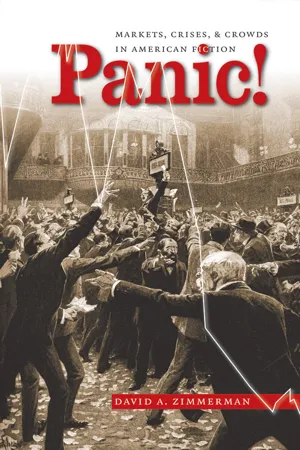
During the economic depression of the 1890s and the speculative frenzy of the following decade, Wall Street, high finance, and market crises assumed unprecedented visibility in the United States. Fiction writers published scores of novels in the period that explored this new cultural phenomenon. In Panic!, David A. Zimmerman studies how American novelists and their readers imagined — and in one case, incited — market crashes and financial panics.
Panic! examines how Americans' attitudes toward securities markets, popular investment, and financial catastrophe were entangled with their conceptions of gender, class, crowds, corporations, and history. Zimmerman investigates how writers turned to mob psychology, psychic investigations, and conspiracy discourse to understand not only how financial markets worked, but also how mass acts of financial reading, including novel reading, could trigger economic disaster and cultural chaos. In addition, Zimmerman shows how, by concentrating on markets in crisis, novelists were able to explore the limits of fiction’s aesthetic, economic, and ethical capacities. With readings of canonical as well as lesser-known novelists, Zimmerman provides an original and wide-ranging analysis of the relation between fiction and financial modernity.
- 312 pages
- English
- ePUB (mobile friendly)
- Available on iOS & Android
eBook - ePub
About this book
Trusted by 375,005 students
Access to over 1.5 million titles for a fair monthly price.
Study more efficiently using our study tools.
Information
Chapter 1
Panic and the Pétroleuse
What shall we call the man and the men who seduce, but do not assassinate,—Guiteaus of political economy who would overcome, not one, but all departments of our government; who travel by night and under-ground to betray trusts they have invited; who, living among us as fellow-men and neighbors, loyal to the covenants of society, are traitors to all the ties of honor, justice, and mercy that make the American community possible, and the want of which makes the Paris commune?
Henry Demarest Lloyd on Jay Gould
James B. Weaver, A Call to Action
In an address to socialist sympathizers at Boston’s Fanueil Hall in 1903, the ex-minister George Herron called on his audience to consider the continuing relevance of the Paris Commune of 1871 for the revolutionary movement in the United States. The memory of the Commune still smoldered in the minds of socialists, even after thirty years. His audience remembered how the Parisian working class, humiliated by the National Assembly’s capitulation to the Prussian army and infuriated by the French government’s subsequent attempt to disarm and subjugate the city, elected its own leaders and waged a brief, bloody, and disastrous defense against French troops that left thousands of Parisians dead. For Herron, as for many American labor radicals, the Commune represented a glorious experiment in popular democracy, a fleeting but monumental triumph for the working class, and an inspiration for the ongoing class struggle. Aware that most Americans remembered the French civil war only as “a time of red and meaningless terror” and that the Commune endured primarily as a catchword for anarchy and social pathology, Herron awaited the writer who would “sing the true epic” of the Communist government.1 This writer would reveal the Paris revolution to be the source and model of the better days ahead, a future when “these evil days of capitalist misgovernment . . . shall have passed away forever.”2 Looking back to 1871, the romancer of the Revolution would confirm what Herron took to be the lesson of the Commune: socialists must accept the inevitability of class conflict and resist any accommodation to capitalism.
Frederic Isham was not the writer Herron had in mind.3 Isham’s financial panic novel Black Friday (1904), published a year after Herron’s jeremiad, makes ample and important use of the Paris Commune, but in the novel the Commune represents the apocalyptic fulfillment of modernity’s worst trends, a nightmarish vision of a lawless, leaderless society in which arson-prone mobs of women burn the ancient city, cast their vengeance on innocent citizens, and disdain whatever conserving agency history and the state might offer. Nothing in Isham’s representation suggests that the Commune has anything to do with class. Indeed, nothing in the novel suggests that the Commune has anything to do with anything at all: the spasm of anarchy that marks its culmination remains unexplained, seemingly causeless.
Isham’s failure or unwillingness to identify the Commune as a working-class revolt is striking, for throughout the last decades of the nineteenth century, as Nell Irvin Painter, Philip Katz, and other historians have documented, the Commune “served as the prevailing image for Americans faced with labor unrest.”4 The great wave of strikes beginning in 1877 “fixed the image of the Commune—violence, burning, and bloodshed—on the very idea of organized workers and socialists of any sort,” and observers, dreading economic and social rupture, continued to identify strikes, labor demonstrations, anarchist violence, and populist insurgency with the Paris uprising through the turn of the century.5 Isham’s refusal to suggest historical causes or contexts for the violence seems doubly odd, given the novel’s overt concern with history and historical explanation. Mingling established fact with romantic invention, the middle “book” or section of the novel (there are three “books” in all) offers a history of “Black Friday,” the sensational financial panic of Friday, 24 September 1869, a crisis precipitated by Jay Gould’s brief, bold corner of the nation’s gold market. Isham accounts for the gold corner’s conspiratorial beginning, its chaotic climax, and its dramatic demise when President Ulysses S. Grant steps in and ends it. For Isham, Black Friday is the first crisis to test the stability and progress of the newly united nation, and in telling its story, Isham means to shed light on the momentous years after the Civil War, a “period of wondrous awakening” and an economic “golden age” of business combination and consolidation that, in Isham’s revisionary imagination, serves as historical origin and business model of the industrial trust boom in his own day.6
Even stranger, the Commune plot, although it directly succeeds the Black Friday plot, has no obvious narrative connection to it. The two stories, set two years and an ocean apart, constitute discrete sections of the novel, and the hero’s successful efforts to quell the financial panic in the Black Friday plot play no apparent role in his subsequent adventures in Paris. Indeed, reviewers of Black Friday based their critique of the novel on the seeming gratuitousness of the Commune plot; they found it “bizarre” and “totally unnecessary to the story.”7 The odd fit of the Commune narrative invites a number of questions: What are we to make of the presence of the Commune in a novel that centers on a financial panic? Why give the legendary panic a detailed, if partly fanciful, history and offer no explanation at all for the equally legendary uprising? Why structure a novel—a novel otherwise committed to dramatizing causes and effects—around two plots that have only an accidental historical and narrative relation to each other?
My answer, put simply, is that Black Friday and the Paris Commune function as allegorical refigurements of economic crisis and proletarian revolution, and that Isham, anxious to preempt the imagining of class violence in the United States, represses any causal connection between the two phenomena. In truth, however, the panic plot and the Commune are not entirely disconnected. They are linked obliquely by the marriage crisis that arcs through the entire novel. In book 1 of the novel (“Fluctuations”), the hero, Richard Strong, meets and marries Elinor Rossiter, the daughter of a recently bankrupted American aristocrat. The marriage sours immediately: on their honeymoon, chilled by his preoccupation with business, she tells him she cannot love him. In book 2 (“Black Friday”), during the buildup to the fateful panic, he strikes her after he sees her accept a kiss from another man, and she flees to Paris with her father. In book 3 (“Readjustment”), two years later, he goes to Paris to rescue her from the chaos of the Commune, and his heroics move her, months after the Commune plot has concluded, to return to him. The panic and Commune plots are also linked, however tenuously, by the discomfiting presence of another woman, a French actress who, during the market crisis, attempts to subvert Strong’s marriage, and who, during the chaotic last days of the Commune, appears on a Paris stage, semi-nude, draped in revolutionary garb, exciting a fevered crowd while the theater goes up in smoke, set on fire by one of the female arsonists haunting the city. The sudden and sensational reappearance of the actress invites a final pair of questions about the formal logic of the novel: Why make such a dangerously modern woman—an actress, a free lover, a Communist (as Commune supporters were called), and a proxy for the legendary “pétroleuses” (gasoline throwers) who ravage Paris—one of the two main links between the financial crisis and the class revolt? Why make a wayward but finally mainstreamed wife the other?
This chapter aims to make figural and ideological sense of Black Friday’s extraordinary triangulation of financial panic, class conflict, and female independence and to illuminate the remarkable historical work this triangulation performs. I argue that Isham has two related ambitions in Black Friday, both of which merit explication and justify, I hope, the attention I am giving to a book few people have read in a century. First, he uses the financial panic at the center of Black Friday to expose, dramatize, and connect an astonishing array of cultural evils he sees transforming modern America. No other American novel equates market crises with so many distinctly cultural disorders; and no other novel deploys a financial panic to render such a sweeping and sensational judgment on American cultural decline. Although the Commune plot, following the financial plot, may make no narrative sense, it has a clear thematic rationale. We are meant to equate the Commune and the gold panic, recognize them as commensurable threats to social order, and associate both with the most dangerous developments of modernity: feminism, free love, popular culture, class mingling, the treacherous repudiation of private and public bonds, and liberalism run riot—all of which lead, in the historical narrative and analogical web constructed by Isham, to mob violence, political rebellion, and economic chaos.
For Isham, French anarchy and American financial panic stand for each other and for the social, political, and economic turmoil attending the complete “maddening” of values in Gilded Age America (BF 279). Formally, anarchy and panic serve as general equivalents, like money, rubrics under which seemingly disparate social dislocations can be brought together, compared, and substituted for each other. The connection between panic, anarchy, and money is not accidental, for Isham’s novel centers on a money panic. Gould and the gold clique undermine the stability of money’s value, confound currency prices, and by doing so put all values in flux. Money, the universal commodity, is the measure and “prop”—Isham’s word—of all values (BF 116), and its manipulation, made possible by the absence of a gold (or any other) standard in 1869, introduces instability throughout economic and social life. It provides a metaphor for the vertiginous unanchoring of cultural values coincident with, if not also caused by, the financial crisis. “Here was chaos. Values had run mad,” Isham tells us (BF 279): wives rebel against their husbands, merchants make claims upon aristocrats, and French women set their national and cultural capital aflame.
If markets, as some have argued, are arenas in which communities resolve their differences by giving individuals and groups a rational (or, at least, predictable) means of negotiating and thus agreeing on values, then panics, as in Black Friday, are occasions when the structure for resolving differences breaks down and the community’s values are up for grabs. How panics are quelled, for Isham, suggests not just how markets should be made safe for investment again, but also how cultural crises, and, in particular, women’s rejection of marriage obligations, might be brought to order. This may seem to be a clichéd equation of volatile markets and unruly women and an equally clichéd expression of patriarchal disciplinary authority. It turns out to be something else, however, for Isham shows, with considerable anxiousness, how independent women, unlike markets, cannot be compelled to return to their normal, natural function. They must choose to return to their husbands, and in their consent lies their historical and political significance.
Isham’s desire to diagnose and remedy the gender trouble plaguing modern America is inseparable from his second primary ambition in Black Friday: to (re)construct a history of (and thus a prophecy for) modern America purged of any trace of class conflict. At bottom, Isham fears class and cultural revolution produced by economic crisis. The novel displaces this trauma by taking the narratives and buzz-words of the most sensational moments of class crisis around the turn of the century—the Haymarket affair, the silverite insurgency in the 1890s, and McKinley’s assassination by an anarchist in 1901, moments many thought foreshadowed the coming apocalypse—and recasting them within a politically innocuous narrative that exactly reverses their ideological valence. These upheavals provide the “shadow narratives,” to use Russell Reising’s term, that organize the “massive residue of sociohistorical reference” encoded within the novel, the accreted traces of specific ideological pressures that shape all novels during their composition and often queer their narrative resolution.8 In short, the gold panic in Isham’s novel serves as an allegorical (p)revision of these crises. As such, it offers a means of re-emplotting American capitalist development in order to safeguard it, at least its imagining, from anticorporate challenges.
Isham’s novel reminds us that populists and socialists (and rogue capitalists such as Thomas Lawson) were not the only ones writing sensational novels about financial panics. Friends of corporate gigantism, equally preoccupied with the dangers posed by economic upheaval, also produced alarmist panic fiction. Black Friday deserves special attention not because it acknowledges a threat to capitalism’s progress but rather because it neutralizes this threat by locating it in capitalism’s speculative fringe, not its proletarian underbelly. In Isham’s historical recontextualization, we are meant to forget the Paris Commune’s association with labor and populist militancy and instead focus on its identification with the volatility produced by financial speculators. In the end, we are meant to read capitalist crisis not as an inevitable or necessary collision between capital and labor, but rather as a single, decisive skirmish between capitalism’s virtuous and vicious avant-gardes, between its progressive center and its radical margin, a skirmish finally won by the elite torchbearers of corporate capitalism—the progressive center—once a strong central government comes to its aid. Seemingly unrelated to this internecine battle, revolution, waged anarchically by its own torchbearers, the pétroleuses of Paris and their American equivalents, simply disappears from view, dislodged from the historical narrative and displaced by the very different kind of class rapprochement represented by the resolution of the marriage plot. In this way, Isham’s capitalist romance preserves history’s arrow from the possibility of any radical deflection.
The novel’s remarkable cultural and ideological work operates along two interrelated and ultimately contradictory axes, one thematic (or analogical) and one historical (or causal). The first half of this chapter explicates Isham’s thematic argument, an argument about gender, history, and corporate modernity sustained by parallels (and contrasts) between the novel’s three major crises. The second half excavates the historical sources—the source material as well as the animating anxieties—of the novel’s treatment of economic crisis and historical causation. In psychoanalytic terms, this analysis moves from the manifest to the latent historical “pretexts” of Isham’s financial allegory, sorting out Black Friday’s figural displacements and illuminating its historical repressions and narrative returns. Moving backward from the economic crisis of the mid-1890s to the class violence of the mid-1880s, this regression ultimately reveals how the novel’s panic about history—more precisely, about one shape that history can take—shapes its history of panic.
Black Friday, 1869, and Black Friday, 1904
In 1869, Jay Gould, one of Wall Street’s most notorious and daring operators, succeeded in cornering the nation’s gold supply, triggering one of the most sensational financial panics in the nation’s history. Since 1861, the nation had been without a stable currency. Congress had declared greenbacks, or paper dollars, legal currency, and their value, untied to any standard, fluctuated against the price of gold. The New York Gold Exchange, the “wildest market in American history,” as one financial historian has described it, served as a market for the metal, setting prices around the nation.9 The overwhelming portion of the trading, $70-90 million worth on an average day, consisted of the betting by speculators on gold’s price movements.
In August 1869, Gould formed a clique with the equally notorious operator Jim Fisk to buy up all the available gold in New York, control its price, and eventually sell it to traders and speculators who desperately needed specie to meet their commercial obligations.10 One problem loomed from the start, however. If President Grant or his treasury secretary, George Boutwell, decided to open the vaults of the U.S. Treasury and release a flood, even a stream, of gold into the money market, the corner would disintegrate. Gould met the problem head on: he bribed Grant’s brother-in-law and confidant, Abel Corbin. With Corbin in ...
Table of contents
- Table of Contents
- Title Page
- Copyright Page
- Dedication
- Acknowledgements
- Introduction
- Chapter 1 - Panic and the Pétroleuse
- Chapter 2 - I Can Do Anything with Words: Thomas Lawson’s Frenzied Fictions
- Chapter 3 - Frank Norris and the Mesmeric Sublime
- Chapter 4 - Melodrama and the Moral Implications of Financial Panic
- Chapter 5 - The Financier and the Ends of Accounting
- Epilogue
- Notes
- Works Cited
Frequently asked questions
Yes, you can cancel anytime from the Subscription tab in your account settings on the Perlego website. Your subscription will stay active until the end of your current billing period. Learn how to cancel your subscription
No, books cannot be downloaded as external files, such as PDFs, for use outside of Perlego. However, you can download books within the Perlego app for offline reading on mobile or tablet. Learn how to download books offline
Perlego offers two plans: Essential and Complete
- Essential is ideal for learners and professionals who enjoy exploring a wide range of subjects. Access the Essential Library with 800,000+ trusted titles and best-sellers across business, personal growth, and the humanities. Includes unlimited reading time and Standard Read Aloud voice.
- Complete: Perfect for advanced learners and researchers needing full, unrestricted access. Unlock 1.5M+ books across hundreds of subjects, including academic and specialized titles. The Complete Plan also includes advanced features like Premium Read Aloud and Research Assistant.
We are an online textbook subscription service, where you can get access to an entire online library for less than the price of a single book per month. With over 1.5 million books across 990+ topics, we’ve got you covered! Learn about our mission
Look out for the read-aloud symbol on your next book to see if you can listen to it. The read-aloud tool reads text aloud for you, highlighting the text as it is being read. You can pause it, speed it up and slow it down. Learn more about Read Aloud
Yes! You can use the Perlego app on both iOS and Android devices to read anytime, anywhere — even offline. Perfect for commutes or when you’re on the go.
Please note we cannot support devices running on iOS 13 and Android 7 or earlier. Learn more about using the app
Please note we cannot support devices running on iOS 13 and Android 7 or earlier. Learn more about using the app
Yes, you can access Panic! by David A. Zimmerman in PDF and/or ePUB format, as well as other popular books in Literature & North American Literary Criticism. We have over 1.5 million books available in our catalogue for you to explore.