Between 1865 and 1920, Congress passed laws to regulate obscenity, sexuality, divorce, gambling, and prizefighting. It forced Mormons to abandon polygamy, attacked interstate prostitution, made narcotics contraband, and stopped the manufacture and sale of alcohol. Gaines Foster explores the force behind this unprecedented federal regulation of personal morality — a combined Christian lobby.
Foster analyzes the fears of appetite and avarice that led organizations such as the Women’s Christian Temperance Union and the National Reform Association to call for moral legislation and examines the efforts and interconnections of the men and women who lobbied for it. His account underscores the crucial role white southerners played in the rise of moral reform after 1890. With emancipation, white southerners no longer needed to protect slavery from federal intervention, and they seized on moral legislation as a tool for controlling African Americans.
Enriching our understanding of the aftermath of the Civil War and the expansion of national power, Moral Reconstruction also offers valuable insight into the link between historical and contemporary efforts to legislate morality.
eBook - ePub
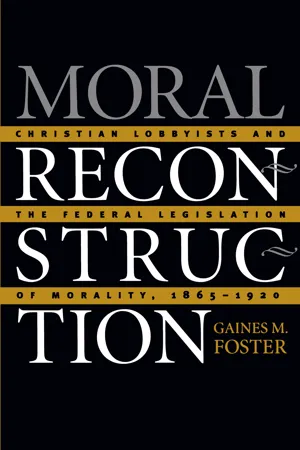
Moral Reconstruction
Christian Lobbyists and the Federal Legislation of Morality, 1865-1920
- 336 pages
- English
- ePUB (mobile friendly)
- Available on iOS & Android
eBook - ePub
Moral Reconstruction
Christian Lobbyists and the Federal Legislation of Morality, 1865-1920
About this book
Information
Chapter One: The Antebellum Moral Polity
The founders of the American Republic built into its polity a fundamental tension. The nation state would have no responsibility to promote religion even though, most of the founders believed, the survival of the new nation depended in part upon its citizens’ morality, which most saw as deriving from religion. In the Northwest Ordinance, Congress proclaimed unequivocally that “Religion, Morality and knowledge” were “necessary to good government and the happiness of mankind.” Yet in it Congress provided financial support for schools but not churches.1
The Constitution, written the same year, contained no appeal to God for sanction or guidance, not even to the vague “Nature’s God” or “Creator” of the Declaration of Independence. It did include “in the Year of our Lord” in the date and prohibited counting Sunday in the ten days allowed the president to veto a bill, but neither provision undermined the inescapable conclusion that the writers of the Constitution purposefully left God out, that they intended to create a secular national government, one with no responsibility for religion or morality. The Constitution left both religion and morality to the states. The First Amendment, with its troubling tension between a ban on establishing religion and “prohibiting” its “free exercise” (a confusion that has kept courts occupied into a third century) did nothing to undermine the secular nature of the new federal government. Rather, the Bill of Rights, of which it was a part, affirmed and codified the Revolution’s emphasis on individual liberty. The First Amendment did not apply to the states, of course. Most provided some acknowledgment of God’s guidance in their constitutions, and in all, regulating public morality remained, as one historian has concluded, a “crucial obligation.” Even the states, though, disestablished religion. Starting in Virginia in 1785 and ending in Massachusetts in 1833, all of the states that had once had established churches separated church and state.2
The founders, in sum, created a thoroughly secular national government, which left the regulation of morals to the states and the promotion of morality among its citizens primarily to the churches. What came to be called a voluntary system of religion emerged; even though churches received no aid from the government, they tacitly assumed responsibility for ensuring the moral population most Americans still thought necessary to a republic’s survival. After the Civil War, Christian lobbyists would challenge the system created by the founders, and even before the war, not all Americans favored the new voluntary system. Some—especially among New England Federalists—sought an acknowledgment by the state of God’s authority as well as a role for the national government in enforcing morality. The first major controversy over the emerging moral polity erupted over the government’s transportation and delivery of the mail on Sunday.
The post office had transported mail on Sunday since the beginning of the Republic, but in 1810, Congress passed a law requiring postmasters to open their offices every day on which mail arrived and to deliver any item requested by a patron on any day of the week. Even though the postmaster general interpreted the law to minimize the time post offices would open and to avoid conflicts with worship services, ministers and churches protested the new law. Much of the agitation arose among Presbyterians and Congregationalists, denominations within a Reformed tradition that taught that the state was an institution of God and that people were called not only to salvation but to shape their society. Over the next five years, Presbyterians, Congregationalists, and other church people sent Congress over one hundred petitions against Sunday mail service. Lawmakers took no action, however, and the post office continued to operate on Sunday.3
In 1828, protests over Sunday mail service revived, led by the newly formed General Union for Promoting the Observance of the Christian Sabbath. Some of its leaders opposed lobbying the government, but others favored it. One of them, Jeremiah Evarts, a Boston lawyer, spent two years in Washington lobbying for a change in the law. His efforts were buttressed by over 900 petitions, a little over half from the mid-Atlantic states and New England, demanding an end to Sunday mail.4
The petitions offered various arguments against transporting the mail and operating post offices on Sunday. They contended that Christians had a right to undisturbed worship, or proclaimed the temporal and spiritual benefits of a day of rest, or pointed to the hardships faced by postal workers who had to work on Sunday. Some of the petitions also maintained that the government itself had a responsibility to follow God’s law and warned that if the nation did not, it was doomed. Other petitions claimed that the government had a responsibility to stop “the iniquities prevailing in private life.” The transportation and delivery of the mail on Sunday are “injurious to the morals and to the civil and religious institutions of our country,” proclaimed a Maryland group. Sabbath desecration threatened to undermine morality and, in the words of a pamphlet that compiled the petitions, “leave our beloved land a moral desolation.”5
Despite all the petitions, Evarts found little support in Congress for changing the law. Few legislators even attended church regularly, he complained, and most greatly feared “that religion is likely to gain too much influence.” Congress’s official response came in two reports by Richard M. Johnson, a Jacksonian Democrat from Kentucky. One was presented in 1829, when Johnson served in the Senate, the other the following year, after he had been elected to the House.6
The “proper object of government,” Johnson’s first report stated, “is to protect all persons in the enjoyment of their religious, as well as civil rights,” and therefore, he added in the second report, the “principles of our Government do not recognize in the majority, any authority over, the minority, except in matters which regard the conduct of man to his fellow man.” The reports also implicitly defended the American system of separation of church and state, explicitly extolled the religious freedom it promised Christians, Jews, and even pagans, and warned that past religious persecution would recur if these principles were violated even in so small a way as stopping the mail on Sunday. The diversity of moral opinion among “the good citizens of this nation,” Johnson implied, made such restraint especially necessary. Jews and others did not observe the same Sabbath as Christians, and the government had no right to declare the practice of one faith right and the other wrong. The Constitution gave Congress no authority “to inquire and determine what part of time, or whether any, has been set apart by the Almighty for religious exercises.” Determining God’s law, in other words, was not a federal responsibility. If any “arm of Government be necessary to compel men to respect and obey the laws of God,” Johnson argued, the states should. But in the final analysis, he questioned whether compelling men to be moral was the job of any level of government. Ensuring public morality, he concluded, rested with Christians themselves. When they succeeded in instructing “the public mind” and awakening “the consciences of individuals to make them believe that it is a violation of God’s law to carry the mail, open post offices, or receive letters, on Sunday, the evil of which they complain will cease of itself, without any exertion of the strong arm of the civil power.”7
A few legislators challenged Johnson’s reports. One senator tried again to stop Sunday mails, but the Senate tabled his motion to instruct the Post Office Committee to report such a bill. Congress steadfastly refused to legislate an end to post office activities on Sunday. The Sabbatarian movement did help secure administrative changes that later restricted Sunday mail shipments. By that time, the organized opposition had ended, although Congress continued to receive petitions against Sunday mail up to and during the Civil War; Christian lobbyists would revive the issue in the 1880s.8
Johnson’s reports on Sabbath mail expressed what had become the dominant conception of the nation’s moral polity in the antebellum years. Most Americans thought the federal government had no religious authority and no power to legislate morality, which belonged solely to the states. They consistently opposed the encroachment of government into the realm of religion and remained deeply suspicious of national laws and even some state ones designed to ensure morality because of the threat they posed to individual or personal liberty. Many Americans, especially those like Johnson in the Democratic Party, doubted the power of the majority to tell individuals what to believe or, within limits, even how to behave. Yet these Americans still thought that the stability and success of popular government demanded a moral population. The process of ensuring proper belief and behavior began in the home, where, in what historians have called “Republican motherhood,” mothers instilled in their children the virtues needed by the Republic. To supplement their efforts, Americans depended on the voluntary system—the efforts of the churches— and moral suasion. In the first half of the nineteenth century, a host of societies and associations formed to shape individual behavior through various types of moral suasion. Revivals, too, became a major aspect of American life. While serving to recruit church members, revivals also employed an intense form of moral suasion to encourage conversion, which resulted in moral individuals.9
If the outcome of the Sunday mail fight in Congress testified to the existence of a moral polity based in personal liberty, states’ rights, and moral suasion, the Sabbatarians’ crusade, nevertheless, revealed that some Americans doubted that such a moral polity could ensure the moral populace that the nation needed. Two goals of the opponents of Sunday mail would remain central to the crusade for moral legislation over the next century. First, worried about the religious authority of the state, they wanted it to acknowledge God’s sovereignty and respect God’s laws. Second, they reconceived the federal government’s role in shaping individual behavior; they wanted it to have the power to make people follow God’s law, in so far as possible, that is, to make them behave morally. The goals were intertwined, since a state with religious authority could have the power to regulate morals and a state that encouraged morality had religious authority.
During the later antebellum period, Congress occasionally passed minor moral legislation. In 1839, Congress prohibited dueling in the District of Columbia. Three years later, having earlier forbidden postmasters to act as agents for lotteries, Congress outlawed lotteries there as well. In 1842, Congress added to a tariff law a section prohibiting the importation of “all indecent and obscene prints, paintings, lithographs, engravings, and transparencies” and, fourteen years later, added obscene “images, figures, and daguerreotypes, and photographs” to the list of banned imports. In 1860, Congress passed a law to protect females immigrating to America from seduction and abandonment by the captains and crews of the steamships that brought them. All of these bills involved clear existing federal powers and evoked little opposition. More dramatic expansions of the federal government’s moral powers sparked considerable congressional debate. Attempts to secure legislation to restrict the use of alcohol and the practice of polygamy, both of which the federal government would act against after the Civil War, revealed the difficulty of overcoming opposition to the federal legislation of morality before it.10
Although most temperance reformers limited their efforts to curtail or eliminate drinking to municipal or state legislation, a few advocated the use of federal power against alcohol. They petitioned Congress for an end to liquor sales in the District of Columbia and for a ban on the importation of intoxicating liquors. Congress ignored their appeals, but it did consider proposals to end the sale of liquor to Native Americans and to eliminate the spirit ration in the Navy.11
Few if any people suffered more from the ravages of alcohol than Native Americans, who learned to drink to excess from the Europeans. Early in the nineteenth century many Native Americans and government officials realized that the problem existed. In a series of measures passed between 1802 and 1827, Congress attempted to limit the sale of liquor to Native Americans within what was termed “Indian territory” and then, in 1832, banned all transportation of liquor there. Later, in congressional acts and treaties, the government adopted additional measures to restrict the use of alcohol by Native Americans. Nothing worked very well. The natives’ appetite for liquor, the white traders’ desire for profits, and weaknesses in the law, especially the difficulty of defining what constituted the “Indian country,” made enforcement almost impossible. Only the fact that relations with Native Americans were clearly under federal control and the fact that white Americans considered Native Americans savages, certainly not citizens possessing liberties, made it possible to try to prohibit sales to them.12
In the antebellum period, Congress was asked to stop the distribution of alcohol to one group of citizens, sailors. The Navy’s spirit or grog ration, the custom of issuing a daily drink of liquor to all on board ship, predated the Revolution; later the army added liquor to its fixed daily ration as well. Beginning in 1829, Congress debated the merits of furnishing sailors and soldiers liquor. In 1832, the army, where the daily ration was set by its own regulations rather than law, eliminated liquor. Law mandated the navy’s spirit ration, so the navy could only adopt a voluntary program that allowed sailors to take cash payments instead of rum. In 1834, the secretary of the navy who had instituted it, asked Congress to end the spirit ration outright, and over the next few years, various temperance associations sent petitions in support of his proposal. In 1842, Congress finally responded, but only by reducing the spirit ration.13
Naval officers and temperance groups continued to urge Congress to eliminate liquor from the navy ration, and in 1845, the House Committee on Naval Affairs finally reported a bill that condemned “habitual indulgence in intoxicating liquors” as injurious to both health and morality, but it did not pass. During the next four Congresses legislators received more petitions and continued to discuss abolishing the spirit ration in the navy. In March 1853, Charles Sumner tried once more to end it through an amendment to a naval appropriations bill, but the Senate defeated the attempt, fourteen votes to twenty-eight. Seventeen of the no votes were cast by southern or border state senators; only three southern and two border state senators voted for the amendment. Northern senators split more evenly, eleven against, nine in favor. Voting followed party lines only roughly: Whigs and Democrats voted on both sides of the issue; the Senate’s five Free-Soilers, though, voted as a block in favor of the measure. The next year the House voted on a proviso to a naval appropriations bill that prohibited the navy from purchasing and any officer from drinking intoxicating liquors (except for medicinal purposes). It failed when the Speaker broke a tie. In a preliminary vote, thirty-four of seventy-five negative votes came from the South. Only six southerners voted to prohibit the purchase of alcohol.14
The second antebellum congressional battle over moral legislation, that over Mormon polygamy, had greater significance but revealed similar sectional divisions. After several moves forced by mob attacks and the murder of their prophet Joseph Smith in Illinois, the Mormons finally settled around the Great Salt Lake in Utah. Under a new leader, Brigham Young, the Mormons established a thriving colony and appealed to Congress for statehood. Entangled in the debates that led to the Compromise of 1850, the request ended not in state-hood but in the creation of the Utah Territory. Appointed the territory’s governor, Young consolidated power within his and the Mormon leadership’s hands. Confident of its control, the Church of Jesus Christ of Latter-day Saints in 1852 publicly proclaimed as revealed doctrine what had been practiced in secret, polygamy. Most Americans were horrified; they regarded plural marriage as a violation of Christian morality, a threat to the family, and therefore subversive of the social order.
Congress soon confronted the problem. In 1854, the House of Representatives debated legislation to allow land sales in Utah. It included a section that granted land there to any white male citizen of the United States, with a proviso that none go to anyone who had more than one wife. The restriction set off a debate over the merits of federal action against polygamy, which quickly involved a discussion of slavery as well. Objecting to limiting the grants to white men, a Rhode Island representative declared that he would just as soon have a polygamous state in the Union as a slave state, where the law did not recognize marriage for much of the population and many citizens practiced concubinage. A Virginia Democrat quickly defended slavery and slave marriage, criticized his colleague from Rhode Island for supporting polygamy, and endorsed the ban on land for polygamists. Another Virginia Democrat also supported the proviso.15
Other southerners feared that legislating morality in the territories, even if it involved something they believed to be so clearly immoral as polygamy, would establish a dangerous precedent that could be turned against the South’s own peculiar institution. They rested their case against the proviso on broader principles, however. Alexander H. Stephens of Georgia argued that Congress had no power “to establish any religion” or “to touch the question of morals, which lie at the foundation of all systems of religion.” “If we discriminate to-day against Mormons,” he added, “to-morrow, perhaps, we shall be asked to discriminate against Baptists, Methodists, Presbyterians, or Catholics.” An Alabama Democrat also condemned the proviso as one more step toward “centralization” and government regulation of “morality.” The bill died in the House.16
Two years later, in 1856, the House considered even more drastic action against polygamy, a motion to instruct the Committee on the Judiciary to report a law prohibiting any married person “from intermarrying or cohabiting with another within any of the Territories of the United States.” The resolution required a two-thirds vote and failed by eighty-five ayes to fifty-six noes. Five southerners voted yes; thirty-two voted no. That summer, the Republican Party’s presidential campaign platform proclaimed “the right and the imperative duty of Congress to prohibit in the Territories those twin relics of barbarism—Polygamy, and Slav...
Table of contents
- Cover Page
- Title Page
- Copyright Page
- Dedication
- Contents
- Illustrations
- Acknowledgments
- Introduction
- Chapter One: The Antebellum Moral Polity
- Chapter Two: Christ and Prohibition in the Constitution?
- Chapter Three: Sexuality and the Family
- Chapter Four: Appetite, Avarice—and an Alliance
- Chapter Five: The Sabbath and Religious Authority
- Chapter Six: The Lottery and the South
- Chapter Seven: A Broad Agenda of Moral Legislation
- Chapter Eight: Aligning the Government against Alcohol
- Chapter Nine: The Final Step: Prohibition
- Conclusion
- Appendix One: Moral Legislation Entered in Congress
- Appendix Two: Petitions to Congress for Moral Legislation
- Notes
- Bibliography
- Index
Trusted by 375,005 students
Access to over 1.5 million titles for a fair monthly price.
Study more efficiently using our study tools.
Frequently asked questions
Yes, you can cancel anytime from the Subscription tab in your account settings on the Perlego website. Your subscription will stay active until the end of your current billing period. Learn how to cancel your subscription
No, books cannot be downloaded as external files, such as PDFs, for use outside of Perlego. However, you can download books within the Perlego app for offline reading on mobile or tablet. Learn how to download books offline
Perlego offers two plans: Essential and Complete
- Essential is ideal for learners and professionals who enjoy exploring a wide range of subjects. Access the Essential Library with 800,000+ trusted titles and best-sellers across business, personal growth, and the humanities. Includes unlimited reading time and Standard Read Aloud voice.
- Complete: Perfect for advanced learners and researchers needing full, unrestricted access. Unlock 1.5M+ books across hundreds of subjects, including academic and specialized titles. The Complete Plan also includes advanced features like Premium Read Aloud and Research Assistant.
We are an online textbook subscription service, where you can get access to an entire online library for less than the price of a single book per month. With over 1.5 million books across 990+ topics, we’ve got you covered! Learn about our mission
Look out for the read-aloud symbol on your next book to see if you can listen to it. The read-aloud tool reads text aloud for you, highlighting the text as it is being read. You can pause it, speed it up and slow it down. Learn more about Read Aloud
Yes! You can use the Perlego app on both iOS and Android devices to read anytime, anywhere — even offline. Perfect for commutes or when you’re on the go.
Please note we cannot support devices running on iOS 13 and Android 7 or earlier. Learn more about using the app
Please note we cannot support devices running on iOS 13 and Android 7 or earlier. Learn more about using the app
Yes, you can access Moral Reconstruction by Gaines M. Foster in PDF and/or ePUB format, as well as other popular books in History & North American History. We have over 1.5 million books available in our catalogue for you to explore.