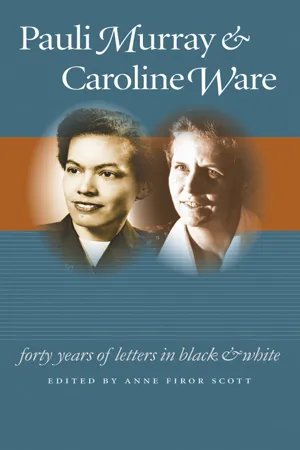
In 1942 Pauli Murray, a young black woman from North Carolina studying law at Howard University, visited a constitutional law class taught by Caroline Ware, one of the nation’s leading historians. A friendship and a correspondence began, lasting until Murray’s death in 1985. Ware, a Boston Brahmin born in 1899, was a scholar, a leading consumer advocate, and a political activist. Murray, born in 1910 and raised in North Carolina, with few resources except her intelligence and determination, graduated from college at 16 and made her way to law school, where she organized student sit-ins to protest segregation. She pulled her friend Ware into this early civil rights activism. Their forty-year correspondence ranged widely over issues of race, politics, international affairs, and — for a difficult period in the 1950s — McCarthyism.
In time, Murray became a labor lawyer, a university professor, and the first black woman to be ordained an Episcopal priest. Ware continued her work as a social historian and consumer advocate while pursuing an international career as a community development specialist. Their letters, products of high intelligence and a gift for writing, offer revealing portraits of their authors as well as the workings of an unusual female friendship. They also provide a wonderful channel into the social and political thought of the times, particularly regarding civil rights and women’s rights.
eBook - ePub
Pauli Murray and Caroline Ware
Forty Years of Letters in Black and White
- 216 pages
- English
- ePUB (mobile friendly)
- Available on iOS & Android
eBook - ePub
About this book
Information
1 THE CORRESPONDENCE BEGINS
In 1942 the country was at war, and victory was by no means certain. War production was barely under way, though President Roosevelt assured citizens that they could do what was necessary. They could indeed, and in a very short time the needs of the war would take over the economy, with attendant disruptions to the accustomed way of doing things. For black citizens, war brought opportunities for work in defense plants or in service jobs hitherto filled by white people. It also brought army service and overseas experience to many young black men. These changes would bear directly on the concern for human rights shared by Pauli Murray and Caroline Ware.
It was in this wartime context that the two became friends. Ware was forty-two, Murray ten years younger. They began with something of a teacher-student relationship. In the ensuing year the two met often, in class and out, and became well acquainted. Murray drew Ware into the student protest movement she had helped to organize seeking to end segregation in Washington, D.C. Ware introduced Murray to The Farm and to Gardiner, of whom Murray soon spoke as a friend.
The two women responded in various ways to the events of the 1940s. Ware served on the National Defense Advisory Commission, wrote The Consumer Goes to War, worked in her garden, and taught history to soldiers-in-the-making. Murray, whose focus was on the struggle for human rights, was engaged in active protest and in the study of law. She argued vehemently in many venues that the United States could not claim to be fighting for freedom as long as it permitted discrimination against black citizens. Whatever the two women may have discussed or thought in other settings, their letters exhibit no interest in the military situation that filled the headlines.
In the summer of 1943, at the end of her second year in law school, Murray went off to New York to earn a little money during the summer vacation, and the correspondence began.
Like most professional women of her generation, Lina Ware was deeply involved in the work of several voluntary associations. The American Association of University Women was her longest-running volunteer base.1 Within that organization she supported racial integration long before the membership as a whole was ready for such a change. She promoted the idea of consumer protection within the organization as well and often represented the AAUW before congressional committees and various governmental bodies.
Planting potatoes and corn was, possibly, a response to wartime need; however, a large vegetable garden continued for many years to be characteristic of the Ware-Means ménage, and Lina Ware always found that gardening restored her after hard work in other dimensions of her life.
Vassar, of which she was a loyal alumna and former faculty member, was one of her frequent ports of call. She often went to spend time with her close friend of many years, Helen Lockwood, a member of the English Department, with whom she shared a deep interest in what was going on at the college. Next to Gardiner Means, Lockwood was her closest intellectual companion.
Vienna, Virginia
14 July 1943
Dear Pauli:
[The letter begins with advice about training a Sheltie puppy given Pauli by the Ware-Means family.] I have a reprieve on teaching for which I am thoroughly glad. The summer school enrollment is so small that I had no classes. That let me replant corn, and finish the potatoes last week. Then, when I called to find my schedule for army classes, I managed to arrange not to start with the first batch of boys who came in today but to start with the batch that comes in the middle of July. So I can go to Vassar for a couple of weeks and farm for the rest of June—with time out for an AAUW board meeting in the midst of which I am now—one week on the farm has almost put me back into circulation.
A little more and I will be 100%. [The rest of the letter is about friends and dogs.]
Be good—Pumpkin—Lina
Two weeks later Murray responds on the letterhead of the Workers Defense League, an organization with which she had worked on the Odell Waller case, and one that the FBI and the House Committee on Un-American Activities considered to be Communist controlled. Common Sense was a progressive journal for which she had written a number of essays. She was also writing for the newspaper PM and other contemporary publications. Her “first long poem” was Dark Testament. Her comment that “you will hardly recognize” the Common Sense article suggests that she had already begun what would become her lifelong habit of sending drafts to her mentor for editing and comment. The misspelling “Lena” suggests that this was an early letter; the error did not occur again.
July 31, 1943
Dear Lena,
Have just finished typing my first long poem. It represents six years of struggling with words. I’ve put my best into it. What more can I say. Either you’ll say I’m a poet when you finish this—or you’ll tell me to study law and leave the poetry be.
Incidentally, may I take you up on that offer to coach me in Constitutional Law? If so where will you be Sept. 1–13?
I’m “slinging hash”—better known as waiting table down town at Allerton House Grill on east 39th street. Doing pretty well. Getting plenty of fruit juices and nourishing foods, and leaving some time free to whip my writing into shape. The Common Sense article was slashed so, you’ll hardly recognize it at all. It’s less than one-fourth its original length, hence jumpy and says little. Be good—Pauli
[A handwritten note at the top of the page adds:] I joined the Socialist Party about two weeks ago. FDR is unhappily wedded to white supremacy, I am afraid.
During Pauli Murray’s final year at Howard the two women were once again in the same place, and there is no record of what they talked about. Murray was still involved in the ongoing student protests against segregation in the District of Columbia, and was, at the same time, studying ferociously hard. Ware, while teaching, continued to be in and out of the government as a consultant on consumer matters.
When Murray succeeded in graduating at the head of her class and as a result was given the Rosenwald Scholarship for advanced work in law, she followed a long-standing Howard tradition by applying to Harvard Law School for graduate work. The dean responded frostily, “Your picture and the salutation on your college transcript indicate that you are not of the sex entitled to be admitted to the Harvard Law School.” She protested in several forceful letters, but despite strong support for her application from President Roosevelt and other weighty alumni, Harvard did not relent.2 Now, in the summer of 1944, she is in California, planning to enter Boalt Hall, the Law School at the University of California at Berkeley, as soon as there is a place for her. While she waits, she is earning her living as a journalist, sending articles to PMand other left-wing publications.3 One theme runs through all the early letters—whatever else she is doing, Pauli Murray sees herself as a writer needing time to practice her craft.
Ware writes from a summer institute at Vassar; as usual she has her finger in several pies at once. Teaching at a summer school for office workers is part of her lifelong commitment to helping people who wanted more education.
Vassar Summer Institute
Poughkeepsie, N.Y.
August 8 [1944]
Hi Little Lamb P
I was glad to hear that you had got to L.A. I want to hear more of what you are finding and doing. Mrs. R.4 was here, & mentioned, when I tried to bring her up to date on your whereabouts, that she had heard from you—and that it would be easier to keep up with you if you weren’t such a bobber-upper (language mine not hers).
My summer has been spotty—a good YW[CA] national conference, a bat at summer school for office workers. Then 3 weeks at the Vassar Summer Institute. Pauline [Coggs, who worked for the Washington Urban League] came up here to give an excellent lecture on housing. Then we had a race relations forum which blew the lid off & has caused revelations a-plenty [from] Jewish, Negro, Chinese & white gentile Americans. The group was shocked to hear what the Negro women tend to think of whites. Ever since they have been trying to get me to tell them it wasn’t true—
Now I am off for a week with my parents in New England. Then back to Washington and job hunting. I haven’t yet decided just how & where. I miss the kids at Howard. I enclose a messy copy of a poem I came across the other day and thought you would like. Do I gather that you are doing some writing? And are you working for Mr. McBetty? And are you headed for Berkeley? And have you had yourself a bit of rest and added flesh to those bones? I hope so. Whatever it is, good luck and affectionate greetings—Skipper
Two days later Murray writes this odd letter that sounds more like one from a college freshman than from a young woman of thirty-four. Her casual style includes giving up capital letters as well as using slang words and many ellipses. She complains that Lina Ware has not written her recently. “Al” and “Pauline” are not identified, but presumably are people who share her antisegregation activism. The story of her hair-raising trip to California with her sister Mildred, a nurse, is found also in Song in a Weary Throat. The tone and the use of lowercase does not continue in future letters.
“The Barn” 5871 Crocker St. (no crockers have appeared yet)
L.A.3, Cal.
August 10, 1944
Well, Skipper, you’re trying to see if I can take it huh? You won’t write, huh? Just for that am sending progress report of the doings of Pauli Frantic and the musings of Peter Panic. So there.
May I celebrate the occasion of receipt of a check for $100.00 for Dark Testament, sold to South Today,5 and $50.00 check from P.M. for a revised Footnote for Minority Americans. The story of the P.M. check is a scream. While on the way two tires blew out, our money was low, I wired P.M. from Pittsfield, Ill., saying funds depleted, special story on the way, wire advance and Harold Lavine, assistant editor out of the goodness of his heart wired personal loan of $50.00 ahead to Denver. The $50 bought two new tires, tools and car repairs so was broke again upon arrival. I borrowed $100 dollars to eat while typing and revising Dark Testament, and now the 100 of Lillian Smith repays that loan and I’m broke again, but writing for a living.
Covered the FEPC6 Los Angeles Railway story for PM. Wired them a story on blind instinct collect, using PM check to cover costs of wire until it was rejected or accepted, then when the news got hotter, on sheer chance wired another long story, then scooped the settlement between fepc employers and union last night, first reporter hit wires with union settlement and statement from fepc, only to find later that harold lavine had wired the day before to send 1,000 word story on the situation. Is that mental telepathy or aint it.
Al will get a laugh out of this one. Tell him I’m a lousy little reporter on an up and coming little Negro paper called the Los Angeles Sentinel, and one of my superiors on paper is Loren Miller, the managing editor is J. Robert Smith, formerly of Amsterdam News Afro, Public Relations for United Seaman’s organization, on west coast for about two years, one of the organizers of National Negro Congress in Philadelphia and former organizer in American Youth Congress. How’m I doing for walking into lion’s den? The story is already around town that I am a trotskyite, and dear brother Smith killed a feature story of mine on interview with six L.A. railway workers which according to publisher was the story of the week, and now publisher is sore with smith because he assigned me to do it, and the office is in uproar in less than three days. Oh well, it’s nice to know that there are worse things than messing up on an exam—having your story killed for instance after you risked your neck to talk to guys and gals that spewed out venom stronger than lye, and some that didn’t.
Reynal and Hitchcock’s editor-in-chief, Frank E. Taylor, writes me at Howard asking how about an interview—and me 3200 miles away from dream of a lifetime. My “agent” Clara Clayman is seeing him in New York for me. Shall it be a novel, Skipper or a Master’s in law? I am considering each, maybe both.
Harvard has still not recovered from a letter which ended thusly: “Humorously, gentlemen, I’d happily change my sex to fulfill your requirements but since the way has not been revealed as to how I can do this, there is no other recourse but to induce you to change your minds.” One smart alecy friend said I should have used another word, but that Harvard is wise—it would never be the same if they break down and let me in. But a local legal sheet reports and Dean Hastie affirms there is every likelihood they [Harvard] will open the Medical School to women in 1945.7
Judge Sarah Hughes writes from Texas, July 31, “this is not a matter [her rejection by Harvard] that the Committee on Economic and Legal status of Women of the American Association etc [of University Women] has considered. However, I shall be glad to discuss the problem at the next meeting of the committee which is in September […]. If there is any change in your situation, will you please advise me. After the meeting of the Committee I will write you with reference to its attitude.”
Hopeful enough, I’d say. You can snoop around if you like.
With a letter from the Surgeon General’s office Army reaffirming “jimcrow” blood donor policy, while admitting my statement with reference to no scientific distinction in human blood is in accord with the belief of such office due to protest after I was personally solicited for blood here and told no segregation then later told Negro blood was separated because Negro soldiers had asked for Negro blood—praise peanuts—that about ends the story of the mad-murray-go-round enterprises.
Oh yes—university of california says maybe with juggling of schedules and modifications of certain courses I submitted it can take me in October 1944. Original information after arriving here was it couldn’t take me until march 1945 when Mrs. Armstrong, labor law specialist returns.8
NOW SKIPPER—what’s wrong? Are you canning, fighting drought, teaching at vassar, taking a vacation, going back to howard or not going back to howard next fall—or what?
Am I entitled to know anything or am i really in doghouse exile or what. al won’t answer a letter, pauline won’t answer, you wont answer, the matter of restaurants looks as if the commies have moved in if washington tribune is accurate—is that good bad or indifferent—and is the east as decadent as some people here would have me believe? love to all—pauli. P.s. west wind blowing by peter panic—flash … flash sister mil becomes first sepia nurse at federal veterans hospital bonsall in west los angeles next door to beautiful beverly hills … sidelights of fepc hearings … mike rose looks like harpo marx and seems quite nice on surface … realized I was covering for pm so gave me the breaks on the news … boris shishk...
Table of contents
- Cover Page
- PAULI MURRAY & CAROLINE WARE
- Copyright Page
- Dedication
- CONTENTS
- PREFACE
- INTRODUCTION
- 1 THE CORRESPONDENCE BEGINS
- 2 THE COLD WAR, McCARTHYISM, AND CIVIL RIGHTS
- 3 FAMILY HISTORY, GLOBAL HISTORY
- 4 GHANA, UNESCO, AND BEYOND
- 5 WRITING, EDITING, AND BRANDEIS
- 6 THE LAST PHASE
- APPENDIX
- ACKNOWLEDGMENTS
- INDEX
Trusted by 375,005 students
Access to over 1.5 million titles for a fair monthly price.
Study more efficiently using our study tools.
Frequently asked questions
Yes, you can cancel anytime from the Subscription tab in your account settings on the Perlego website. Your subscription will stay active until the end of your current billing period. Learn how to cancel your subscription
No, books cannot be downloaded as external files, such as PDFs, for use outside of Perlego. However, you can download books within the Perlego app for offline reading on mobile or tablet. Learn how to download books offline
Perlego offers two plans: Essential and Complete
- Essential is ideal for learners and professionals who enjoy exploring a wide range of subjects. Access the Essential Library with 800,000+ trusted titles and best-sellers across business, personal growth, and the humanities. Includes unlimited reading time and Standard Read Aloud voice.
- Complete: Perfect for advanced learners and researchers needing full, unrestricted access. Unlock 1.5M+ books across hundreds of subjects, including academic and specialized titles. The Complete Plan also includes advanced features like Premium Read Aloud and Research Assistant.
We are an online textbook subscription service, where you can get access to an entire online library for less than the price of a single book per month. With over 1.5 million books across 990+ topics, we’ve got you covered! Learn about our mission
Look out for the read-aloud symbol on your next book to see if you can listen to it. The read-aloud tool reads text aloud for you, highlighting the text as it is being read. You can pause it, speed it up and slow it down. Learn more about Read Aloud
Yes! You can use the Perlego app on both iOS and Android devices to read anytime, anywhere — even offline. Perfect for commutes or when you’re on the go.
Please note we cannot support devices running on iOS 13 and Android 7 or earlier. Learn more about using the app
Please note we cannot support devices running on iOS 13 and Android 7 or earlier. Learn more about using the app
Yes, you can access Pauli Murray and Caroline Ware by Anne Firor Scott in PDF and/or ePUB format, as well as other popular books in Social Sciences & North American History. We have over 1.5 million books available in our catalogue for you to explore.