Much of the violence that has been associated with the United States has had particular salience for the South, from its high homicide rates, or its bloody history of racial conflict, to southerners' popular attachment to guns and traditional support for capital punishment. With over 95 entries, this volume of The New Encyclopedia of Southern Culture explores the most significant forms and many of the most harrowing incidences of violence that have plagued southern society over the past 300 years.
Following a detailed overview by editor Amy Wood, the volume explores a wide range of topics, such as violence against and among American Indians, labor violence, arson, violence and memory, suicide, and anti-abortion violence. Taken together, these entries broaden our understanding of what has driven southerners of various classes and various ethnicities to commit acts of violence, while addressing the ways in which southerners have conceptualized that violence, responded to it, or resisted it. This volume enriches our understanding of the culture of violence and its impact on ideas about law and crime, about historical tradition and social change, and about race and gender — not only in the South but in the nation as a whole.
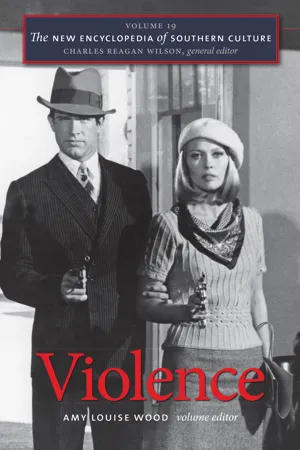
eBook - ePub
The New Encyclopedia of Southern Culture
Volume 19: Violence
- 320 pages
- English
- ePUB (mobile friendly)
- Available on iOS & Android
eBook - ePub
About this book
Information
Print ISBN
9780807872161
9780807835227
Subtopic
North American HistoryVIOLENCE IN THE AMERICAN SOUTH
Over the past 400 years, violence of all sorts has bloodied the southern landscape: from the whipping and torture of slaves to slave revolts, from gentlemen’s duels to backwoods feuding, from the brutal backlash against Reconstruction in the 1860s to the massive resistance against civil rights protests in the 1960s. Murder rates in southern states have long exceeded those in other states, and southerners, both black and white, have historically been more disposed than other Americans to step outside the law to settle personal grievances. Even today, southerners are more likely to own and use guns, to favor a strong national defense, and to condone the corporal punishment of children, all of which suggest a greater level of comfort with the use of violence to resolve social problems.
All the same, it is difficult to think about violence as a particularly southern phenomenon. Violence is endemic to most human societies. And the United States as a whole, not just the South, has experienced gun ownership, homicidal crime, police brutality, and mob violence on a scale unprecedented in modern, Western democracies. Violence has been central to the formation of America as a nation, from the first European battles with American Indians in the 17th century, to the Revolution, to the Civil War, to the brutal expansion into the West in the 19th century. As historian Richard Slotkin has shown, it has also been central to American myths, the symbolic narratives that Americans have told about themselves, through which national ideologies and identities have been constructed and imparted. For Slotkin, the most significant myth has been that of the frontier, that westward moving terrain where whites forged a nation through the willful destruction of both the wilderness and the American Indians who inhabited it. Our mythologies have represented that destruction in redemptive terms, imagining the frontier as a place for both national progress and personal renewal and opportunity.
This volume then is not making a case that the South has been exceptionally violent. It was not only southerners who engaged in mob violence or who joined the Ku Klux Klan, nor was it only southerners who imposed racial segregation and resisted racial integration through force. Some forms of violence, such as gang warfare, organized crime, or clashes between labor and capital, have been more prevalent in other parts of the country. That is not to say, however, that southern violence has not had its own distinctiveness or its own particularities. The South has also been the site of national myths as lasting and as crucial as those born from the western frontier, through which Americans, north and south, have imagined the regenerative promise of tribulation and bloodshed— from the Civil War and Reconstruction to the civil rights movement.
This volume chronicles many of the varied ways in which violence erupted in the South and the impact it had, on individuals, on communities, and on the nation as a whole. It explores the texture and the trajectory of violent acts across various subregions and within different subcultures throughout the South. In many cases, entries address forms of violence more specific to the South, or at least more prevalent. Other thematic entries consider types of violence that were not particularly “southern” in nature or origin, but examine the particular forms they took in southern contexts, such as American Indian wars, or race riots, or suicide. Topical entries focus on certain violent episodes that were particularly remarkable or, conversely, particularly representative. Not every manner or dimension of human violence could be covered in one volume, of course. The entries included here are not meant to be comprehensive, nor could they be. Themes and topics, if not specific to the South, are significant in terms of understanding southern history and society. For this reason, for example, violence against animals in the form of hunting and blood sports are considered, while other acts against animals, such as vivisection, are not.
Although many entries address personal acts of violence and acts of intra-racial violence, the emphasis in this volume is on social or communal acts of violence, particularly those acts white southerners perpetrated on African Americans. To be sure, most violence committed in the South, as in the rest of the country, occurred within racial groups, and people were, and still are, more likely to commit violence against people they know, as entries on homicide, feuding, and dueling, to name a few, explore. Yet, it has been racial violence, in its various social and political forms, that has marked southern culture and that has shaped southern history in dramatic ways. If national identity was forged through bloodshed, so too was a Confederate identity. White supremacy was an ideology maintained through sheer force, whether through slave punishments, lynchings, or the terror exacted by the Ku Klux Klan. Moreover, its force has been so potent in southern culture—in particular, in the formation of masculinity in the South—that it has impinged upon the history of personal forms of violence. One cannot understand the history of, for instance, homicide or sexual violence in the South without taking stock of the ways in which white supremacy bore upon both white men’s and black men’s sense of masculinity or the values they placed on violence.
Importantly, white supremacy was forged not only along a black-white divide in the South, as entries on violence against Mexican Americans and against Native Americans reveal. These groups, as well as African Americans, also pushed back against white supremacy through legislative action, peaceful protest, or further acts of aggression. This volume pays attention to those acts of resistance and also to the role violence has played within minority cultures— for example, the use of war and torture within American Indian cultures, or outbreaks of violence within the slave quarters, or a kind of folk glorification of violence apparent in black music.
Although the entries center on physical acts of violence, violence is always, at the same time, psychological. For this reason, although the volume focuses on violations against persons, certain violations of property are included here— arson and church burnings, for instance—because those actions are meant to strike a psychological chord, serving as an act of protest or an act of terror. In that sense, what defines violence is not acts of destruction or violation as much as acts that cause suffering. It is uncomfortably easy when studying violence or reading account after account of violence to forget or immunize oneself to the human tragedy involved in the compendium of violence cataloged here. Behind these historical studies and sociological analyses are stories of real human loss and mourning, of unfathomable degrees of physical pain and psychological distress.
One hopes that to catalog southern violence as this volume does can help further our knowledge of southern culture and history as a whole. Violence was not a sensationalistic, subcultural phenomenon, exerting itself on the fringes of southern society. Violence was at the core of a southern social order based on stark class and especially racial hierarchies, the maintenance of which depended upon force and aggression. For this reason, violence intersected with and shaped the region’s legal, political, religious, and economic institutions and had everything to do with southern attitudes about masculinity and femininity, crime and punishment, individualism and the state. Racial violence is certainly not particular to the South, but it did make its mark on southern society in ways that were historically distinctive.
For myriad reasons, southerners’ violence has also been more conspicuous to outsiders and, in many cases, more widespread than elsewhere in the nation. From the 18th century on, memoirs, travel narratives, and diaries from the South revealed an attention to southerners’ seeming penchant for violence, recording acts of feuding, dueling, fistfights, and vigilantism, not seen in comparable accounts from the North. Historian John Hope Franklin dubbed the region “the Militant South,” because of white southerners’ aggressiveness and enthusiasm for military ventures dating back to the 18th century. During the American Revolution, soldiers from Connecticut apparently refused to fight alongside soldiers from the Virginia colony because they saw their southern compatriots as too cruel and brutal as fighters. Not all southerners are violent or even bellicose, of course, but, according to Franklin and numerous other scholars, a climate of militancy and a quickness to settle disputes through violence dominated the region in a way that alternative codes or values did not. This fighting spirit can account, in part, for the historical overrepresentation of southerners in the military and in military schools.
The South’s fighting spirit can also shed some light on why homicide rates have been higher in the region, a fact that has been true from the 19th century to the present. Some observers have been quick to attribute these rates to the larger numbers of African Americans residing in the South, yet, controlling for race, scholars have found that white southerners are more homicidal than whites in the rest of the country. Although felony crimes such as robbery and forcible rape are more common outside the South, southern murder rates are, in large part, the reason why southerners have a reputation for bellicosity and aggression. Homicide is crucial to understanding southern violence, because explaining why southerners have been disproportionately responsible for the murders committed in this country can help to account for related forms of violence most associated with the South, from slavery to the civil rights era. Journalist H. V. Redfield was the first to investigate southern homicide in any depth, cataloging acts of murder in southern news reports through the 1870s and comparing them to northern records. In his 1880 book, Homicide, North and South, he noted that murder rates in the former slave states were 10 times those in the North. These statistics held up some 40 years later when sociologist H. C. Brearley cheekily described the South as “that part of the United States lying below the Smith and Wesson line.” According to Brearley, the top seven states with the highest homicide rates between 1920 and 1925 were former Confederate states, and southerners were two and half times more likely to kill than northerners.
Social scientists in the past 40 years have refined our understanding of these tendencies. Despite our image of blood-soaked northern cities, southern cities have higher homicide rates than northern cities, and rural southerners are more homicidal than their counterparts in other parts of the country. These trends are not unrelated to gun ownership. Southerners own guns at higher rates than other Americans and are more likely to use them in acts of rage or self-defense. These regional discrepancies hold only for white southerners, however; African American homicide rates do not differ by region. Certainly, poverty and structural racism can account for the fact that homicide rates for African Americans are as high in the North as they are in the South, but sociologists also theorize that because black migration to the North has been a relatively recent phenomenon, the values and customs from the South that black southerners carried with them to northern cities have persisted.
“Values and customs from the South” is significant. Although observers have offered a variety of explanations for this southern propensity toward murderous violence, most have attributed it to patterns of culture that led southerners to want to resolve disputes or avenge offenses through violence and to condone, even applaud, acts of aggression. Some have explained these cultural tendencies by looking to the South’s frontier roots and the relative weakness of formal legal institutions to temper and restrain violent impulses. Journalist W. J. Cash, in his 1941 tome, The Mind of the South, posited that in the southern backcountry a particular brand of proud individualism asserted itself through violence. Indeed, in the backwoods of the South, traditions such as no-holds-barred fighting remained common long after they had disappeared in the North. As historian Elliott Gorn has shown, northern travelers to this country in the 19th century were astonished to find that southern men engaged in brutal, “rough and tumble” fights, where eyes were gouged and noses bitten. Southern propensities toward vigilantism and mob violence in the 19th and early 20th centuries can be traced to similar frontier values, which led to a certain distrust of legal institutions and reliance upon “rough justice” to avenge crime and settle scores. In the rural mountainous regions, feuds, such as that of the infamous Hatfields and McCoys, continued to be emblematic of southerners’ lawlessness into the 20th century.
Yet, at the same time, other sparsely populated regions of the country have not witnessed the same levels of lethal violence as the South. In 2004 the former frontiers of the West and Midwest accounted for 23.7 percent and 19.3 percent of murders in the United States, in line with or below their percentage of the population. The South, meanwhile, accounts for 36 percent of the national population and 43 percent of its murders. Moreover, the South has hardly been a lawless region, nor have southern legal institutions been particularly weak or ineffective historically. Southerners, even in the most isolated parts, regularly settled disputes privately, but they also, at the same time, depended on the courts to adjudicate disputes, to enforce moral codes, and to maintain the social and racial order. Despite the South’s tragic history of extralegal racial violence, it is important to recognize that most crimes allegedly committed by African Americans were judged and punished through the legal system (as biased and skewed against African Americans as that system has been). The South has had higher incarceration rates and higher execution rates than other sections of the country. Today, capital punishment is legal in every southern state, except for West Virginia. As Margaret Vandiver notes in this volume, about 90 percent of all executions since 1977, when the death penalty was reinstituted in the United States, have taken place in southern states. Southerners have relied upon the law to punish wrongdoing without mercy.
Certainly the fact that the South is the poorest region of the country might account for its higher murder rates. Sociologists and historians have argued that economic frustration in the 19th century and early 20th century led white southerners to lash out at African Americans, in lynchings, whitecappings, and other forms of mob violence. Outbreaks of violence correlated with falling cotton prices and economic depressions. Yet, while economic frustration may account for some acts of violence, for instance, when white farmers targeted successful black farmers, it does not explain why elite southerners engaged in dueling, or why white southerners of all classes joined the Klan or participated in and encouraged lynchings. Nor does it explain why poor southerners have been more violent than the poor in other parts of the country. Still today, white southerners living in poverty are more homicidal than their counterparts in the North, and white middle-class southerners are more homicidal than white middle-class northerners.
Rather than explanations of lawlessness or economic deprivation, scholars have reached a general consensus that a cultural mentality developed in the South, which expected and condoned violent responses to certain situations—to defend oneself against potential assaults, to avenge perceived insults, and to maintain social and racial control. In this view, it is not that the South lacks mechanisms for social control, such as strong legal institutions or moral codes, but that, in many cases, those mechanisms encouraged, even demanded, acts of violence. As sociologist John Shelton Reed has put it, violence in the South has often been considered “lawful,” if not in the legal sense of the term, then in a sociological sense.
At the foundation of this mentality stands the concept of honor. Scholars have argued that a southern code of honor has persisted through time and across subregions. It not only explains the South’s high homicide rates but can help make sense of a range of violent practices, from dueling, to rough-and-tumble fighting, to lynching. Honor, simply put, comprised a man’s reputation or his external standing in his community, which in turn determined his internal sense of worth. In other words, a man’s sense of self was predicated on his social power and status—his honor. Because honor formed the core of personal identity, southern men felt compelled to defend it at all costs. Violence was often the means through which a man could repair his honor and restore his public status, not just by knocking down his offender but also by demonstrating his own strength and valor. Acts of aggression, in this respect, were not committed against or outside the social system; rather, that system, at times, insisted upon them.
In his classic work, Southern Honor, historian Bertram Wyatt-Brown argued that, through the 19th century, honor was the driving force behind southern history, shaping family relationships, community hierarchies, the institution of slavery, and attitudes toward the law. Honor as a dominant ethic in the South can certainly clarify the kinds of violence that have been prevalent in the South, even into the 20th century and the present. It is not just that homicide rates are comparatively high in the South, but southerners are likely to murder people they already know, often as a consequence of fights or even personal affronts. In his study of southern violence, Brearley noted that juries were not likely to convict murder defendants who claimed they were retaliating against a personal insult. Journalist Hodding Carter found that to be true when he sat on the jury of a murder trial in Louisiana in the 1930s. The defendant lived next to a gas station, where a couple of men who gathered there began teasing him persistently. One day, he took out a shotgun and began to fire, injuring his persecutors and killing a bystander. Carter recounted that when he called for a guilty conviction, the other jurors objected, crying, “He ain’t guilty. He wouldn’t have been much of a man if he hadn’t shot them fellows.”
Even today, studies have shown that southern men are more likely to respond aggressively to perceived insults. In one well-known study done in the 1990s, social psychologists Richard Nisbett and Dov Cohen measured the levels of cortisol, the hormone associated with anxiety and stress, in the saliva of southern and northern white male college students after they had been insulted. The students, who thought their saliva was being tested for a different experiment, were approached in the hallway on their way to the lab by another man, who was in on the experiment. That man jostled each student and called him an “asshole.” After this incident, cortisol levels had risen 79 percent in the southern students but only 33 percent in the northern students. In a related study, students were given a hypothetical scenario, involving one man flirting with another man’s girlfriend at a party, to complete after they had bee...
Table of contents
- Cover Page
- The NEW ENCYCLOPEDIA of SOUTHERN CULTURE
- Copyright Page
- Epigraph
- CONTENTS
- GENERAL INTRODUCTION
- INTRODUCTION
- VIOLENCE IN THE AMERICAN SOUTH
- INDEX OF CONTRIBUTORS
- INDEX
Trusted by 375,005 students
Access to over 1.5 million titles for a fair monthly price.
Study more efficiently using our study tools.
Frequently asked questions
Yes, you can cancel anytime from the Subscription tab in your account settings on the Perlego website. Your subscription will stay active until the end of your current billing period. Learn how to cancel your subscription
No, books cannot be downloaded as external files, such as PDFs, for use outside of Perlego. However, you can download books within the Perlego app for offline reading on mobile or tablet. Learn how to download books offline
Perlego offers two plans: Essential and Complete
- Essential is ideal for learners and professionals who enjoy exploring a wide range of subjects. Access the Essential Library with 800,000+ trusted titles and best-sellers across business, personal growth, and the humanities. Includes unlimited reading time and Standard Read Aloud voice.
- Complete: Perfect for advanced learners and researchers needing full, unrestricted access. Unlock 1.5M+ books across hundreds of subjects, including academic and specialized titles. The Complete Plan also includes advanced features like Premium Read Aloud and Research Assistant.
We are an online textbook subscription service, where you can get access to an entire online library for less than the price of a single book per month. With over 1.5 million books across 990+ topics, we’ve got you covered! Learn about our mission
Look out for the read-aloud symbol on your next book to see if you can listen to it. The read-aloud tool reads text aloud for you, highlighting the text as it is being read. You can pause it, speed it up and slow it down. Learn more about Read Aloud
Yes! You can use the Perlego app on both iOS and Android devices to read anytime, anywhere — even offline. Perfect for commutes or when you’re on the go.
Please note we cannot support devices running on iOS 13 and Android 7 or earlier. Learn more about using the app
Please note we cannot support devices running on iOS 13 and Android 7 or earlier. Learn more about using the app
Yes, you can access The New Encyclopedia of Southern Culture by Amy Louise Wood, Charles Reagan Wilson in PDF and/or ePUB format. We have over 1.5 million books available in our catalogue for you to explore.