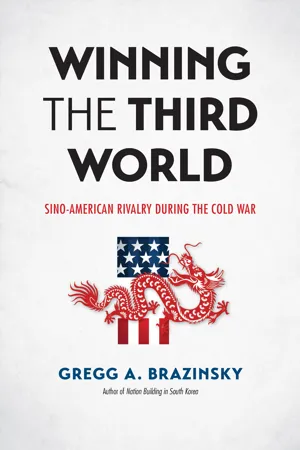
Winning the Third World examines afresh the intense and enduring rivalry between the United States and China during the Cold War. Gregg A. Brazinsky shows how both nations fought vigorously to establish their influence in newly independent African and Asian countries. By playing a leadership role in Asia and Africa, China hoped to regain its status in world affairs, but Americans feared that China’s history as a nonwhite, anticolonial nation would make it an even more dangerous threat in the postcolonial world than the Soviet Union. Drawing on a broad array of new archival materials from China and the United States, Brazinsky demonstrates that disrupting China’s efforts to elevate its stature became an important motive behind Washington’s use of both hard and soft power in the “Global South.”
Presenting a detailed narrative of the diplomatic, economic, and cultural competition between Beijing and Washington, Brazinsky offers an important new window for understanding the impact of the Cold War on the Third World. With China’s growing involvement in Asia and Africa in the twenty-first century, this impressive new work of international history has an undeniable relevance to contemporary world affairs and policy making.
- 448 pages
- English
- ePUB (mobile friendly)
- Available on iOS & Android
eBook - ePub
About this book
Information
Table of contents
- Cover Page
- Title Page
- Copyright Page
- Dedication
- Contents
- Figures
- Acknowledgments
- A Note on Romanization
- Introduction
- Chapter 1: The Emergence of a Rivalry, 1919–1950
- Chapter 2: The Burdens of Status, 1950–1954
- Chapter 3: From Geneva to Bandung
- Chapter 4: Advancing the Peace Offensive, 1955–1958
- Chapter 5: The Cultural Competition, 1955–1964
- Chapter 6: China’s Radicalization and the American Response, 1958–1963
- Chapter 7: The Diplomatic Campaign, 1963–1966
- Chapter 8: Insurgency and Counterinsurgency, 1961–1968
- Chapter 9: The Economic Competition, 1962–1968
- Chapter 10: Competition and Cooperation, 1968–1979
- Conclusion
- Notes
- Bibliography
- Index
Trusted by 375,005 students
Access to over 1.5 million titles for a fair monthly price.
Study more efficiently using our study tools.
Frequently asked questions
Yes, you can cancel anytime from the Subscription tab in your account settings on the Perlego website. Your subscription will stay active until the end of your current billing period. Learn how to cancel your subscription
No, books cannot be downloaded as external files, such as PDFs, for use outside of Perlego. However, you can download books within the Perlego app for offline reading on mobile or tablet. Learn how to download books offline
Perlego offers two plans: Essential and Complete
- Essential is ideal for learners and professionals who enjoy exploring a wide range of subjects. Access the Essential Library with 800,000+ trusted titles and best-sellers across business, personal growth, and the humanities. Includes unlimited reading time and Standard Read Aloud voice.
- Complete: Perfect for advanced learners and researchers needing full, unrestricted access. Unlock 1.5M+ books across hundreds of subjects, including academic and specialized titles. The Complete Plan also includes advanced features like Premium Read Aloud and Research Assistant.
We are an online textbook subscription service, where you can get access to an entire online library for less than the price of a single book per month. With over 1.5 million books across 990+ topics, we’ve got you covered! Learn about our mission
Look out for the read-aloud symbol on your next book to see if you can listen to it. The read-aloud tool reads text aloud for you, highlighting the text as it is being read. You can pause it, speed it up and slow it down. Learn more about Read Aloud
Yes! You can use the Perlego app on both iOS and Android devices to read anytime, anywhere — even offline. Perfect for commutes or when you’re on the go.
Please note we cannot support devices running on iOS 13 and Android 7 or earlier. Learn more about using the app
Please note we cannot support devices running on iOS 13 and Android 7 or earlier. Learn more about using the app
Yes, you can access Winning the Third World by Gregg A. Brazinsky in PDF and/or ePUB format, as well as other popular books in History & Chinese History. We have over 1.5 million books available in our catalogue for you to explore.