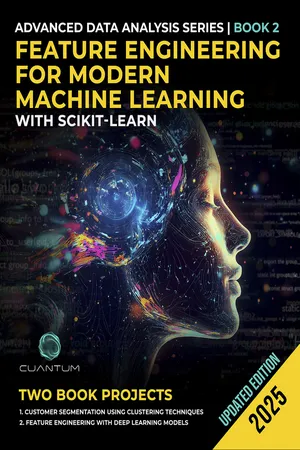
Feature Engineering for Modern Machine Learning with Scikit-Learn
eBook - ePub

Feature Engineering for Modern Machine Learning with Scikit-Learn

Mastering data preparation and transformation for robust ML models

  1. English
  2. ePUB (mobile friendly)
  3. Available on iOS & Android
eBook - ePub

Feature Engineering for Modern Machine Learning with Scikit-Learn

Mastering data preparation and transformation for robust ML models

About this book

Master feature engineering with Scikit-Learn! Learn to preprocess, transform, and automate data for machine learning. Boost predictive accuracy with pipelines, clustering, and advanced techniques for real-world projects.

Key Features

  • Comprehensive guide to feature engineering for Scikit-Learn
  • Hands-on projects for real-world applications
  • Focus on automation, pipelines, and deep learning integration

Book Description

Feature engineering is essential for building robust predictive models. This book delves into practical techniques for transforming raw data into powerful features using Scikit-Learn. You'll explore automation, deep learning integrations, and advanced topics like feature selection and model evaluation. Learn to handle real-world data challenges, enhance accuracy, and streamline your workflows. Through hands-on projects, readers will gain practical experience with techniques such as clustering, pipelines, and feature selection, applied to domains like retail and healthcare. Step-by-step instructions ensure a comprehensive learning journey, from foundational concepts to advanced automation and hybrid modeling approaches. By combining theory with real-world applications, the book equips data professionals with the tools to unlock the full potential of machine learning models. Whether working with structured datasets or integrating deep learning features, this guide provides actionable insights to tackle any data transformation challenge effectively.

What you will learn

  • Create data-driven features for better ML models
  • Apply Scikit-Learn pipelines for automation
  • Use clustering and feature selection effectively
  • Handle imbalanced datasets with advanced techniques
  • Leverage regularization for feature selection
  • Utilize deep learning for feature extraction

Who this book is for

Data scientists, machine learning engineers, and analytics professionals looking to improve predictive model performance will find this book invaluable. Prior experience with Python and basic machine learning concepts is recommended. Familiarity with Scikit-Learn is helpful but not required.

]]>

Trusted by 375,005 students

Access to over 1 million titles for a fair monthly price.

Study more efficiently using our study tools.

Information

Table of contents

  1. Who we are
  2. Our Philosophy:
  3. Our Expertise:
  4. Code Blocks Resource
  5. Premium Customer Support
  6. TABLE OF CONTENTS
  7. Introduction
  8. Part 1: Practical Applications and Case Studies
  9. Chapter 1: Real-World Data Analysis Projects
  10. 1.1 End-to-End Data Analysis: Healthcare Data
  11. 1.2 Case Study: Retail Data and Customer Segmentation
  12. 1.3 Practical Exercises for Chapter 1
  13. 1.4 What Could Go Wrong?
  14. Chapter 1 Summary
  15. Chapter 2: Feature Engineering for Predictive Models
  16. 2.1 Predicting Customer Churn: Healthcare Data
  17. 2.2 Feature Engineering for Classification and Regression Models
  18. 2.3 Practical Exercises for Chapter 2
  19. 2.4 What Could Go Wrong?
  20. Chapter 2 Summary
  21. Quiz Part 1: Practical Applications and Case Studies
  22. Answers
  23. Project 1: Customer Segmentation using Clustering Techniques
  24. 1. Understanding the K-means Clustering Algorithm
  25. 2. Advanced Clustering Techniques
  26. 3. Evaluating Clustering Results
  27. Part 2: Integration with Scikit-Learn for Model Building
  28. Chapter 3: Automating Feature Engineering with Pipelines
  29. 3.1 Pipelines in Scikit-learn: A Deep Dive
  30. 3.2 Automating Data Preprocessing with FeatureUnion
  31. 3.3 Practical Exercises for Chapter 3
  32. 3.4 What Could Go Wrong?
  33. Chapter 3 Summary
  34. Chapter 4: Feature Engineering for Model Improvement
  35. 4.1 Using Feature Importance to Guide Engineering
  36. 4.2 Recursive Feature Elimination (RFE) and Model Tuning
  37. 4.3 Practical Exercises for Chapter 4
  38. 4.4 What Could Go Wrong?
  39. Chapter 4 Summary
  40. Chapter 5: Advanced Model Evaluation Techniques
  41. 5.1 Cross-Validation Revisited: Stratified, Time-Series
  42. 5.2 Dealing with Imbalanced Data: SMOTE, Class Weighting
  43. 5.3 Practical Exercises for Chapter 5
  44. 5.4 What Could Go Wrong?
  45. Chapter 5 Summary
  46. Quiz Part 2: Integration with Scikit-Learn for Model Building
  47. Answers
  48. Part 3: Advanced Topics and Future Trends
  49. Project 2: Feature Engineering with Deep Learning Models
  50. 1.1 Leveraging Pretrained Models for Feature Extraction
  51. 1.2 Integrating Deep Learning Features with Traditional Machine Learning Models
  52. 1.3 Fine-Tuning Pretrained Models for Enhanced Feature Learning
  53. 1.4 End-to-End Feature Learning in Hybrid Architectures
  54. 1.5 Deployment Strategies for Hybrid Deep Learning Models
  55. Chapter 6: Introduction to Feature Selection with Lasso and Ridge
  56. 6.1 Regularization Techniques for Feature Selection
  57. 6.2 Hyperparameter Tuning for Feature Engineering
  58. 6.3 Practical Exercises: Chapter 6
  59. 6.4 What Could Go Wrong?
  60. Chapter 6 Summary
  61. Chapter 7: Feature Engineering for Deep Learning
  62. 7.1 Preparing Data for Neural Networks
  63. 7.2 Integrating Feature Engineering with TensorFlow/Keras
  64. 7.3 Practical Exercises: Chapter 7
  65. 7.4 What Could Go Wrong?
  66. Chapter 7 Summary
  67. Chapter 8: AutoML and Automated Feature Engineering
  68. 8.1 Exploring Automated Feature Engineering Tools
  69. 8.2 Introduction to Feature Tools and AutoML Libraries
  70. 8.3 Practical Exercises: Chapter 8
  71. 8.4 What Could Go Wrong?
  72. Chapter 8 Summary
  73. Quiz Part 3: Advanced Topics and Future Trends
  74. Conclusion
  75. Where to continue?
  76. Know more about us

Frequently asked questions

Yes, you can cancel anytime from the Subscription tab in your account settings on the Perlego website. Your subscription will stay active until the end of your current billing period. Learn how to cancel your subscription
No, books cannot be downloaded as external files, such as PDFs, for use outside of Perlego. However, you can download books within the Perlego app for offline reading on mobile or tablet. Learn how to download books offline
Perlego offers two plans: Essential and Complete
  • Essential is ideal for learners and professionals who enjoy exploring a wide range of subjects. Access the Essential Library with 800,000+ trusted titles and best-sellers across business, personal growth, and the humanities. Includes unlimited reading time and Standard Read Aloud voice.
  • Complete: Perfect for advanced learners and researchers needing full, unrestricted access. Unlock 1.4M+ books across hundreds of subjects, including academic and specialized titles. The Complete Plan also includes advanced features like Premium Read Aloud and Research Assistant.
Both plans are available with monthly, semester, or annual billing cycles.
We are an online textbook subscription service, where you can get access to an entire online library for less than the price of a single book per month. With over 1 million books across 990+ topics, we’ve got you covered! Learn about our mission
Look out for the read-aloud symbol on your next book to see if you can listen to it. The read-aloud tool reads text aloud for you, highlighting the text as it is being read. You can pause it, speed it up and slow it down. Learn more about Read Aloud
Yes! You can use the Perlego app on both iOS and Android devices to read anytime, anywhere — even offline. Perfect for commutes or when you’re on the go.
Please note we cannot support devices running on iOS 13 and Android 7 or earlier. Learn more about using the app
Yes, you can access Feature Engineering for Modern Machine Learning with Scikit-Learn by Cuantum Technologies LLC in PDF and/or ePUB format, as well as other popular books in Computer Science & Data Mining. We have over one million books available in our catalogue for you to explore.