In this comprehensive history of women’s antislavery petitions addressed to Congress, Susan Zaeske argues that by petitioning, women not only contributed significantly to the movement to abolish slavery but also made important strides toward securing their own rights and transforming their own political identity.
By analyzing the language of women’s antislavery petitions, speeches calling women to petition, congressional debates, and public reaction to women’s petitions from 1831 to 1865, Zaeske reconstructs and interprets debates over the meaning of female citizenship. At the beginning of their political campaign in 1835 women tended to disavow the political nature of their petitioning, but by the 1840s they routinely asserted women’s right to make political demands of their representatives. This rhetorical change, from a tone of humility to one of insistence, reflected an ongoing transformation in the political identity of petition signers, as they came to view themselves not as subjects but as citizens. Having encouraged women’s involvement in national politics, women’s antislavery petitioning created an appetite for further political participation that spurred countless women after the Civil War and during the first decades of the twentieth century to promote causes such as temperance, anti-lynching laws, and woman suffrage.
eBook - ePub
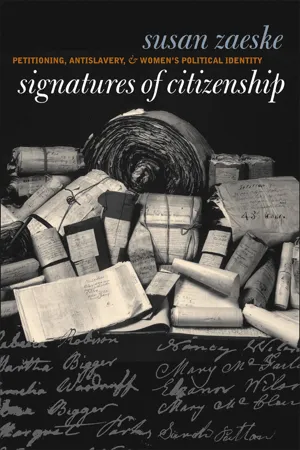
Signatures of Citizenship
Petitioning, Antislavery, and Women's Political Identity
- 272 pages
- English
- ePUB (mobile friendly)
- Available on iOS & Android
eBook - ePub
About this book
Information
CHAPTER 1
The Unfortunate Word “Petition”
“The greatest difficulty seems to arise from the unfortunate word ‘petition, ’” complained antiabolitionist northern minister Calvin Colton in his 1840 pamphlet, The Right of Petition. “Nothing could exceed the confusion into which this single word has cast the whole nation.” The particular confusion to which Colton referred was the river of antislavery petitions that had begun running into Congress in 1835. In 1836 the House had passed a temporary “gag” rule that immediately tabled all petitions on the subject of slavery. Rather than sandbagging the flow of abolition petitions or quelling the discussion of slavery, the rule had the opposite effect. Proclaiming that the gag proved that slaveholders were conspiring to undermine the rights of free Americans, abolitionists redoubled their petitioning efforts and won public sympathy for their cause. Renewal of the gag in each subsequent session of Congress sparked a highly charged national debate over the right of petition. When on January 28, 1840, the House enacted a permanent gag, public debate intensified, and Colton entered the fray with his pamphlet.1
Intending to chide the abolitionists for abusing a political privilege, Colton began by acknowledging petitioning as a time-honored right in the Anglo-American political tradition, but he emphasized instances in which it was curtailed when employed in a manner displeasing to rulers or representatives. After the right of petition became a law in England, Colton reminded, petitioners repugnant to the crown or Parliament were committed to prison. He concluded that petitioning had never been intended as a means to coerce the government but, rather, as an instrument of supplication through which individuals or groups might seek redress of personal grievances. “Not infrequently,” Colton insisted, the abuse of the right of petition led to its suspension altogether. There was precedent for curtailing improper use of the right of petition, Colton asserted, and since abolitionists were employing the right in a manner that fell outside the proper historical definition of “petition,” the imposition of the gag rule was both understandable and just.
Although Colton intended to chronicle the history of the petition as an instrument of humble supplication, the story he told hinted again and again at a rather different and more complex narrative. Colton wrote, for instance, that in the history of the United States “the popular and general mind” had changed the meaning of the First Amendment, which guaranteed the right of petition, “from its historical and true interpretations, to something else.” What particularly disturbed Colton was that petitioning was being used “under the pretense of submission, for improper and unworthy purposes, while it clothes itself with the sanction of an apparent conformity to law.” Thus he lamented, “This little word petition is, in this place, a most unfortunate one, and doing more mischief than can be told.”2
Colton’s admission that the meaning of the right of petition had changed in the minds and hands of the people from a form of submission to an instrument of mischief provides the basis for a history of the right of petition quite different from that presented in his pamphlet. In fact, long before women took up petitioning to influence national debate over slavery, other groups outside the domains of institutionalized government employed the right of petition as a wedge to enter realms of political power. These groups had seen what Colton refused to recognize: while, on one hand, the divine right of petition required use of supplicatory rhetoric due its antecedents in monarchical England, on the other hand, it was understood as carrying an incumbent obligation on the part of the receiver to read and respond to the grievance. Petitioning’s ability to place demands on rulers or representatives, even while it obscured signers’ motive of demand, gave the fundamental right of petition a deeply subversive potential. The radical potential of petitioning multiplied significantly when groups, rather than individuals (as in original practice), began to direct their grievances not only to governing bodies but also to the public. By the early nineteenth century in the United States, petitioning had emerged as a potent instrument through which minority political causes and people denied the full rights of republican citizenship could exert considerable pressure on their representatives by appealing to the power of public opinion.
Among those exerting such power were women. Female involvement in the petition campaign against slavery, which built upon previous though limited experiences of women petitioning collectively, constitutes an early instance of large numbers of women exercising their right of petition as a group to influence national policy making. Along with male abolitionists, women petitioners attempted to reshape public opinion, to pressure federal representatives, and to incite discussion of slavery both in Congress and among the public at large. Women’s antislavery petitioning capitalized on the subversive potential of the right of petition to expand significantly the ability of women to participate in politics absent the right of suffrage and at the same time provided a means of asserting citizenship, albeit a modified form of citizenship compared with that claimed by propertied white males. By firmly seizing the right of petition and redefining it from a prayer for redress of private grievances to an instrument of collective public persuasion, women not only asserted their citizenship but also created a hunger for further participation in the political process and for more rights. After the right of women to petition Congress on political issues was established by female abolitionists, the petition was employed by countless women espousing causes such as temperance, antilynching, and antipolygamy. Ultimately, petitioning served as a primary means through which women agitated to win the vote.

Upon embracing petitioning as a means of political influence, antislavery women exploited the subversive potential of that right. As early as the thirteenth century both individuals and the developing institution of Parliament employed petitioning as a tool to erode the power of the monarchy. Although the Magna Carta made no direct mention of the right of petition, such a right was understood to derive from King John’s promise that he would not deny or postpone justice to anyone. The twelfth clause of the Magna Carta, moreover, relieved knights and barons of the obligation to supply money to the king until he addressed outstanding grievances. During the late Middle Ages, written petitions, which had become the standard method to approach authorities, placed demands on rulers and tested their accountability to the people. While petitioners employed flattering adjectives such as “sage,” “haut,” and “puissant” to describe the sovereign they beseeched and referred to themselves as “humble,” “pover,” and “obeisant,” through the very act of petitioning, subjects exerted some degree of power. The people’s right of petition, after all, imposed a responsibility on the part of the ruler to hear their grievances and, whether it be positive or negative, give some response.3
By the early seventeenth century, political factions had begun to seize upon petitioning as a method of propaganda, and petitioners to Parliament assumed a more assertive tone. “Whereas, hitherto, petitions had in general been genuinely intended to bring a grievance to the notice of Parliament in some hope of a response in the shape of a redress,” Colin Leys explains, beginning in the seventeenth century, a substantial number of petitions were “presented by political activists under no sort of illusion either that the grievance was unknown or that Parliament might reasonably be expected to respond by redressing it.” During the English Civil War both men and women, especially Levelers, who sought to democratize the government, engaged in collective petitioning.4
The experience of Leveler women, who executed several well-organized petition campaigns between 1641 and 1655, illustrates the radical potential of petitioning as well as the reactions it could spark among those invested in protecting existing gendered political hierarchies. In the texts of petitions Leveler women justified their increased participation in the public sphere by emphasizing the shared origins of secular petitioning and religious praying. They urged representatives not to “withhold from us our undoubted right of petitioning, since God is ever willing and ready to receive the Petitions of all, making no difference of persons.” They also claimed the right to have their petitions heard because the “ancient laws of England are not contrary to the will of God.” Yet the Leveler women tempered assertions of their natural right to petition with assurances that they had no intention of subverting male political power. Women were “not acting out of any Self-conceit or Pride of Heart, as seeking to equal ourselves with Men, either in Authority or Wisdom,” promised a 1642 petition, but were merely “following herein the Example of the Men, which have gone . . . before us.”5
The fact remained, nevertheless, that women were intruding into public deliberation in an unprecedented manner. Guardians of male political dominance were displeased. Parliament attempted to discourage the women by answering their 1649 petition, “The matter you petition about, is of an higher concernment than you understand, that the House gave an answer to your Husbands; and therefore that you are desired to go home, and look after your own business, and meddle in your huswifery.” Likewise, a newspaper warned the women, “It is fitter for you to be washing your dishes, and meddle with the wheele and distaffe.” Another predicted, “We shall have things brought to a fine passe, if women come to teach the Parliament how to make Lawes.” And yet another declared, “It can never be a good world, when women meddle in States matters . . . and their Husbands are to blame, that they have no fitter employment for them.” Questioning the rationality, femininity, morality, and social status of female supplicants, newspapers derided women petitioners as “oyster-wives,” “dirty and tattered sluts,” and “mealy-mouth’d mutton mongers wives.” Attacks such as these demonstrate that the right of petition offered women a tool to expand their public influence, but when men recognized its potential for compromising male political dominance, they cast aspersions in hopes of checking burgeoning female activism.6
Despite efforts to discourage women from petitioning and to regulate the “tumultuous” use of petitioning by crowds who stormed Parliament, in 1669 the House of Commons restated that all commoners possessed an inherent right to petition and that the House was obligated to receive their petitions. By the eighteenth century petitioning had emerged as a well-protected right used most often to exert pressure on Parliament in matters of public policy. Leys notes that conditions during this era such as rapid economic change that led to working-class organization resulted in an unprecedented upsurge in the use of petitions as a political instrument. The widespread propagandistic use of petitioning during this period was noted by Dr. Samuel Johnson, who wrote, “This petitioning is a new mode of distressing government, and a mighty easy one.”7

As in England, in America from the colonial to the Jacksonian period petitioning was transformed from a tool for airing individual grievances to an instrument for collective political action. Petitioning was the primary means through which citizens communicated with colonial assemblies, and information conveyed in petitions was particularly crucial in providing for needy inhabitants. Reflecting the fact that colonial assemblies functioned as quasi-judicial bodies, the petitions dealt primarily with local disputes, including alleged misbehavior of servants, regulation of tobacco packaging, and failure to pay wages. Responses to petitions often led to broader legislation, rendering petitioning a means by which individuals could shape the legislative agenda of colonial assemblies.8
Petitioning provided not only a means through which the people influenced colonial assemblies; it was also an instrument through which colonial bodies expressed grievances against England and, eventually, justified revolution. In eighteenth-century British constitutional law petitioning was understood as the appropriate means to seek redress for infringements upon rights, and failure by the king or Parliament to respond to repeated petitioning constituted acceptable grounds for revolution. Thus when colonists perceived various duties and taxes imposed by Britain as violating their constitutional rights, they turned to the petition as a means to demand redress and articulate their growing alienation from British rule. Ultimately, the failure of George III to fulfill his obligation to respond to his subjects’ petitions provided a major justification for the colonists’ revolution against England. Although not itself a petition, the Declaration of Independence drew much of its rhetorical and political power from its function as a history of failed petitions submitted by colonial bodies to the king in 1774 and 1775. “In every stage of these oppressions,” the Declaration stated, “we have petitioned for redress in the most humble terms: our repeated petitions have been answered only by repeated injuries.” In the face of this tyranny the colonists could justifiably declare themselves free and independent of Great Britain. In this important sense, as Garry Wills explains, the Declaration established itself in the direct line of those earlier petitions: “The Congress declared its independence in terms not basically at odds with its ‘dutiful petitions’—in fact, as a logical culmination of them.”9
Excluded from office holding, women were not among the signers of petitions to England that effected the Revolution. Yet in at least one case women elected petitioning as a means of political participation. In 1774 the women of Edenton, North Carolina, moved beyond boycotting tea to the more public action of forming a patriotic organization. Members of the organization composed a petition to the public in which they pledged to follow the colony’s nonimportation resolves. Signed by fifty-one women, it was published in colonial and English newspapers. While the patriot women stressed that they petitioned out of duty to country and family, their tone was remarkably assertive. Their collective effort aimed at generating publicity for the patriot cause marked a significant departure from women’s customary petitioning, constituted of private pleas for personal grievances.10 It is not surprising, then, that the character of women who undertook this bold public act was called into question. Englishman Arthur Iredell wrote his relatives in North Carolina sardonically, “Is there a Female Congress at Edenton too?” He hoped not, “for we Englishmen are afraid of the Male Congress, but if the Ladies, who have ever, since the Amazonian Era, been esteemed the most formidable Enemies, if they, I say, should attack us, the most fatal consequences are dreaded.” Undoubtedly Iredell’s criticism was motivated in part by political differences, but the publicness of the women’s petition rendered the signers vulnerable to gendered aspersions. The Edenton petition, after all, demonstrated that women were capable of political organization and that they possessed the right to enter public deliberation to declare their political allegiances and influence public opinion.11
Although after the Revolution most women petitioned for personal redress as they had previously, even in these more customary practices they employed petitions to articulate new political identities. In her analysis of divorce requests in Massachusetts from 1692 to 1786, Nancy Cott found that from 1775 to 1784, a period coinciding with the War for Independence, the number of divorce petitions sent to the legislature increased 61 percent compared with the decade before the Revolution. Cott argues that the correlation between the increased number of divorce petitions and the war might have been due to “a certain personal outlook” that accompanied the Revolution, “one that implied self-assertion and regard for the future, one that we might label more ‘modern’ than ‘traditional.’” This greater self-assertion conveyed in petitions, Cott suggests, was fostered by republican claims to citizenship. As Linda Kerber explains, “The rhetoric of the Revolution, which emphasized the right to separate from dictatorial masters, implicitly offered an ideological validation for divorce, though few in power recognized it.” Petitions for divorce provided women a means to assert this newly forged republican identity to their state representatives. 12
In addition to petitioning for divorce, women suffering from the hardships of war were forced to petition state legislatures and Congress, resulting in a significant increase in female petitioning. In the Carolinas, for example, Cynthia Kierner has found that women sent 349 petitions to their state legislatures between 1776 and 1800, compared with only 32 in the entire preceding quarter-century. Kerber estimates that 5 percent of the petitions received by the Continental Congress emanated from women. The vast majority of women’s petitions came from individuals, especially soldier’s widows requesting pensions, while others sought compensation for war losses. Denied rights general...
Table of contents
- Table of Contents
- GENDER & AMERICAN CULTURE
- Title Page
- Copyright Page
- Dedication
- Acknowledgements
- Introduction
- CHAPTER 1 - The Unfortunate Word “Petition”
- CHAPTER 2 - What Can Women Do?
- CHAPTER 3 - A Departure from Their Place
- CHAPTER 4 - A Firebrand in Our Hands
- CHAPTER 5 - It’s None of Your Business, Gals
- CHAPTER 6 - Discreditable to the National Character
- CHAPTER 7 - To Shut against Them This Door
- AFTERWORD
- NOTES
- BIBLIOGRAPHY
- GENDER & AMERICAN CULTURE
Trusted by 375,005 students
Access to over 1.5 million titles for a fair monthly price.
Study more efficiently using our study tools.
Frequently asked questions
Yes, you can cancel anytime from the Subscription tab in your account settings on the Perlego website. Your subscription will stay active until the end of your current billing period. Learn how to cancel your subscription
No, books cannot be downloaded as external files, such as PDFs, for use outside of Perlego. However, you can download books within the Perlego app for offline reading on mobile or tablet. Learn how to download books offline
Perlego offers two plans: Essential and Complete
- Essential is ideal for learners and professionals who enjoy exploring a wide range of subjects. Access the Essential Library with 800,000+ trusted titles and best-sellers across business, personal growth, and the humanities. Includes unlimited reading time and Standard Read Aloud voice.
- Complete: Perfect for advanced learners and researchers needing full, unrestricted access. Unlock 1.5M+ books across hundreds of subjects, including academic and specialized titles. The Complete Plan also includes advanced features like Premium Read Aloud and Research Assistant.
We are an online textbook subscription service, where you can get access to an entire online library for less than the price of a single book per month. With over 1.5 million books across 990+ topics, we’ve got you covered! Learn about our mission
Look out for the read-aloud symbol on your next book to see if you can listen to it. The read-aloud tool reads text aloud for you, highlighting the text as it is being read. You can pause it, speed it up and slow it down. Learn more about Read Aloud
Yes! You can use the Perlego app on both iOS and Android devices to read anytime, anywhere — even offline. Perfect for commutes or when you’re on the go.
Please note we cannot support devices running on iOS 13 and Android 7 or earlier. Learn more about using the app
Please note we cannot support devices running on iOS 13 and Android 7 or earlier. Learn more about using the app
Yes, you can access Signatures of Citizenship by Susan Zaeske in PDF and/or ePUB format, as well as other popular books in History & North American History. We have over 1.5 million books available in our catalogue for you to explore.