In the years immediately following the Civil War — the formative years for an emerging society of freed African Americans in Mississippi — there was much debate over the general purpose of black schools and who would control them. From Cotton Field to Schoolhouse is the first comprehensive examination of Mississippi’s politics and policies of postwar racial education.
The primary debate centered on whether schools for African Americans (mostly freedpeople) should seek to develop blacks as citizens, train them to be free but subordinate laborers, or produce some other outcome. African Americans envisioned schools established by and for themselves as a primary means of achieving independence, equality, political empowerment, and some degree of social and economic mobility — in essence, full citizenship. Most northerners assisting freedpeople regarded such expectations as unrealistic and expected African Americans to labor under contract for those who had previously enslaved them and their families. Meanwhile, many white Mississippians objected to any educational opportunities for the former slaves. Christopher Span finds that newly freed slaves made heroic efforts to participate in their own education, but too often the schooling was used to control and redirect the aspirations of the newly freed.
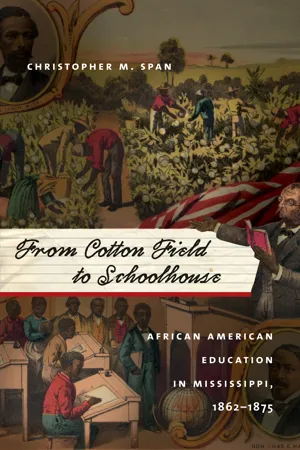
eBook - ePub
From Cotton Field to Schoolhouse
African American Education in Mississippi, 1862-1875
- 272 pages
- English
- ePUB (mobile friendly)
- Available on iOS & Android
eBook - ePub
From Cotton Field to Schoolhouse
African American Education in Mississippi, 1862-1875
About this book
Information
1862–1870
1. LIBERATION THROUGH LITERACY
Only those who have watched and guided the faltering feet the misty minds, the dull understandings of the dark pupils of these schools know how faithfully, how piteously, this people strove to learn.
—W. E. B. DU BOIS, Atlantic Monthly, 1897
If I nebber does do nothing more while I live, I shall give my children a chance to go to school, for I considers edecation next best ting to liberty.
—MISSISSIPPI FREEDMAN, 1869
Our job was to go to school and learn all we could.
—IDA B. WELLS, native of Holly Springs, Mississippi
Freedom and education for African Americans begin in and around Holly Springs. In a symbolic sense, they begin around the birth of one slave child in particular. Amid the devastation of a nation at war and a turbulent Mississippi society, a future crusader for justice and the rights of African Americans was born a slave on a cotton plantation in Holly Springs; her name was Ida Bell Wells. The timing of Wells’s birth—July 16, 1862—with regard to the rise of emancipation in Mississippi was without question coincidental, but, given the times, it was significant. Ida, the future crusader for the rights and advancement of African Americans in the late nineteenth and early twentieth centuries, was born at the crossroads of American history, at a time when enslaved African Americans throughout the South were suddenly realizing their freedom. She was born in the dawn of a new era when black men and women could at last raise their children to be free and upstanding citizens rather than deferential slaves.
Around the time of Wells’s birth, the benefits and frustrations of freedom were just weeks away for enslaved African Americans in Holly Springs. Not until two weeks prior to her birth, around the Fourth of July, had Holly Springs seen its first noteworthy skirmish between Union and Confederate soldiers. Shortly afterward, Union General Ulysses S. Grant would oust the Confederate armies from northern Mississippi and place the region under military rule. He would make Holly Springs his temporary headquarters and have his army chaplain, John Eaton Jr., establish a camp specifically for the countless enslaved African Americans who opted to emancipate themselves and flee to Union lines. “Eaton chose Grand Junction, Tennessee, as the camp’s location—just across the state line from Holly Springs.”1 For the Mississippi, Alabama, and Tennessee blacks who entered the camp, freedom had finally arrived, and most seemed determined to take full advantage of it. Some, for example, enlisted as soldiers and nurses in the army, many worked within the camp for the betterment of themselves and others, and the vast majority attempted to attend the makeshift school established by northern-born missionaries following the Union army into Mississippi. Despite the immediate advantages to be enjoyed at Grand Junction, Ida’s parents chose to stay in Holly Springs. To them, Holly Springs was home. But as the war continued, freedom in Holly Springs always seemed to be in jeopardy. The city would be “captured and recaptured by the two armies, changing hands at least fifty-nine times during the war.”2 The challenges Holly Springs faced during the war foreshadow the struggles that awaited most African Americans in search of freedom and its rewards after the war. Even so, it was in and around Holly Springs that freedom first came to enslaved African Americans in Mississippi; it was here that Ida B. Wells, born a slave, would begin her remarkable life and career; and it was here that one of the earliest schools for formerly enslaved African Americans would take root.
William Edward Burghardt Du Bois was also born at this turning point in American history, and much like Wells, he too would devote his entire career to advocating civil rights and social equality for black people through his research and activism. This noted sociologist and historian was one of the first to chronicle the rise of freedom and education for formerly enslaved African Americans in the South. In his seminal 1935 publication, Black Reconstruction, Du Bois, at age sixty-seven, would reiterate a point he had contended for more than thirty years, that “the first educational efforts” for formerly enslaved African Americans “came from Negroes.”3 Few scholars—then or now—understood better than Du Bois the yearnings freed black men and women had for learning and the steps they took to acquire an education in the earliest years of emancipation. His perceptiveness was due in part to his firsthand experiences with former slaves and their teachers. As a young college student at Fisk University, an eighteen-year-old Du Bois eked out part of his college tuition as a teacher for former slaves and their children in the summertime in rural Tennessee.4 This early experience shaped his research pursuits and gave him an appreciation for and understanding of the expectations and uses formerly enslaved African Americans had for schools and knowledge. Black folk, Du Bois steadfastly contended, equated knowledge with power; they recognized that literacy and education could transform lives and society, that they were vehicles for social change and uplift, and that they created opportunities. The collective determination and regard formerly enslaved African Americans had for education thoroughly impressed Du Bois. He was certain that no oppressed people in the history of mankind had made greater strides to educate themselves in the dawn of emancipation than the freedpeople in the post–Civil War South.
The enthusiasm and initiative that freedpeople in Mississippi had for education epitomized Du Bois’s assessment. These qualities are illustrated by the fact that the state’s first schools for African Americans originated with ex-slaves. As with liberated blacks throughout the South, African Americans in Mississippi, both during and after the Civil War, demonstrated their lifelong desire for acquiring an education by building and attending schools as soon as they could. Their goal was to use schooling as a means to obtain liberation and citizenship through literacy. Accordingly, before the outcome of the war was determined, before the mass migration of teachers and missionaries from the North, before the official establishment of the Freedmen’s Bureau, and before crude temporary schools would take root in Union garrisons and camps, African Americans started organizing schools and educating themselves wherever possible. Throughout the state, free and freed African Americans, as early as 1862, established churches and schoolhouses for individual and collective improvement. Literate and barely literate blacks would serve as these schools' first teachers, and freedpeople—young, old, male, and female—were their first pupils. Years later Ida B. Wells would recount childhood memories of this mass movement for liberty and literacy in Holly Springs and other parts of northern Mississippi. When she and her siblings came of age in the early years of emancipation, their “job,” she professed, “was to go to school and learn all we could.”5
To be sure, the educational activities and initiatives of Mississippi freedpeople were not isolated occurrences. Schools independently established by and for freedpeople arose in every locale. They commenced in the South’s most prominent cities, such as Charleston, Nashville, Richmond, New Orleans, Savannah, and Little Rock as well as in the backwoods and on the most secluded cotton, rice, sugar, and tobacco plantations; some even had antebellum roots. One of the first schools to open for freedpeople at the expense of southern blacks during the Civil War was in Alexandria, Virginia.6On September 1, 1861, Mary Chase and an unnamed freedwoman opened a pay school for wartime runaways. Less than a month later, one of them joined Mary Smith Peake, daughter of a white Englishman and a free black woman who had taught at an antebellum school in Hampton, Virginia. Together they opened a second school for contrabands at Fortress Monroe, Virginia.7 The actions of these three black women preceded those of northern white missionaries by nearly a year. In fact, by the time northern white teachers engaged in the education of freedpeople in Virginia, African Americans in Alexandria had already opened three other schools.
The Freedmen’s Inquiry Commission, an agency established by President Lincoln to investigate the needs of former slaves, was quick to note the activities of freed blacks in Alexandria. “One of the first acts of the negroes when they found themselves free,” the commission declared, “was to establish schools at their own expense.”8 Union army Lieutenant C. B. Wilder was astonished at the pace former slaves and their children learned in these grassroots Virginia schools. “Scarcely one could be found who could read as they came in,” Wilder admitted. “Now very few but can read some, and all are getting books and with or without teachers are striving to learn themselves and one and another.”9 By 1867, the push for schooling among Virginia freedpeople was truly a spectacle. One white Virginian promptly recognized this upon his visit of a school attended by free and freed black children in Norfolk. “We cannot express,” the observer reasoned, “our satisfaction more fully than by saying that we were literally astonished at the display of intelligence by the pupils. Abstruse questions in arithmetic were promptly answered, difficult problems solved, the reading beautifully rhetorical, and the singing charming.” Given the pace of learning among former slave children, the onlooker concluded, “More encouragement must be given by our city council to our public schools to prevent white children from being outstripped in the race for intelligence by their sable competitors.”10
Around the time schools for freedpeople taught by northerners arose in Virginia, it was reported by Union army officials that free and contraband blacks in Nashville, Tennessee, had already independently established a number of schools for more than eight hundred children. The impetus for this educational push in Nashville came from ex-slaves themselves and from Daniel Watkins, an antebellum free black, who had maintained, for nearly a decade, a school for the children of free blacks. By summer’s end 1864, several schools managed and taught by African Americans in Nashville had “sprung up,” and black children outnumbered white children in school attendance.11 By 1869, freed African Americans in Tennessee had established a total of twenty-two private schools throughout the state and were financially assisting northern benevolent societies and the Freedmen’s Bureau in maintaining fifty-nine other schools. As C. E. Compton, a brevet lieutenant colonel and the superintendent of education for Tennessee’s freedpeople, observed, the private schools established were “wholly supported by the freedmen without any aid from the bureau, State, or from benevolent societies.”12
Equally impressive private efforts were exhibited elsewhere, particularly in Baltimore, Washington, D.C., Delaware, and Little Rock, Arkansas. By the winter of 1865, the Philadelphia-based Society of Friends, or Quakers, and the New York–based American Missionary Association (AMA), in collaboration with Baltimore blacks, established sixteen schools with nearly two thousand pupils. The city’s black population, however, promoted the push for schools even further and independently established and managed seven additional schools for freedpeople, two of which had already been in existence for more than a decade. The latter schools were “supported from a legacy given by Nelson Willis, a colored man.”13 A capstone to these efforts came in January 1866, when freeborn and formerly enslaved African Americans in Maryland hosted a state convention in Baltimore to assess and address their overall needs. An advisory board convened and urged each and every Maryland black to “use every exertion to contradict the predictions of [their] enemies, which were uttered previous to the emancipation of the States that if the slaves were freed they would become a pest to society.”14They advised formerly enslaved African Americans to feel and act like they were free and independent, to be industrious, to purchase land, and to acquire an education. Specifically, the assembly advised black Marylanders to educate their children for equality, self-sufficiency, and citizenship. “Educate your children and give them trades, thereby making them equal for any position in life, for if ever we are raised to the elevated summit in life for which we strive, it must be done by our own industry and exertion…. No one can do it for us,” they concluded.15
Several schools in and around Washington, D.C., were established by and for newly emancipated blacks with similar vigor. For example, the African Civilization Society of New York, founded in 1858 to promote the colonization of African Americans to Africa, reconstituted itself during the Civil War as a freedmen’s aid society. Between 1864 and 1867, the organization, with the assistance of former slaves, opened six schools for African Americans. Freeborn African American Catholics devoted to their parish, Blessed Martin de Porras, in the nation’s capital also founded five schools for the area’s freedpeople, and an additional twenty-two African Americans “individually started private schools for contrabands” and other blacks during the 1860s.16
The same was true in Delaware. While Delaware did not have a large slave population, we still see the proactive demeanor of former slaves with regard to education. By mid-1867, there were a total of twenty schools in Delaware, of which all were sustained, either fully or in part, by the freedpeople themselves. Moreover, Delaware blacks owned eight of the twenty schoolhouses, and were sixteen of the twenty teachers.17
In Little Rock, Arkansas, freed African Americans—in addition to establishing schools for their children—formed the Freedmen’s School Society in March 1865, intent upon collecting monies for educational purposes. “By their own exertions,” reported John Eaton Jr., liberated blacks “made the city schools free for the rest of the year,” an astonishing feat considering the relative impoverishment of a people just removed from enslavement. To the best of his knowledge, Eaton estimated that “these were the first free schools in Arkansas—whether for whites or blacks—to subscribe and pay in full the compensation of the teachers.”18 By November 1865, many of these same freed blacks and others reconvened in Little Rock to demand that state legislators acknowledge them as citizens and recognize their labor as invaluable to the progress of the state, as well as to appeal to elected representatives to provide a system of schools for their children. “We do most earnestly desire and pray,” their request read,
that you clothe us with the power of self protection, by giving us our equality before the law and the right of suffrage, so we may become bona fide citizens of the State in which we live…. Believing, as we do, that we are destined in the future, as in the past, to cultivate your cotton fields, we claim for Arkansas the first to deal justly and equitably for her laborers…. That we are the substrata, the foundation on which the future power and wealth of the State of Arkansas must be built … we respectfully ask the Legislature to provide for the education of our children.19
The decree offered by freedpeople in Arkansas was solemn and straightforward, and it characterized the general understanding and feelings of emancipated African Americans throughout the South. It articulated the expectations freedpeople had of enjoying equality, th...
Table of contents
- Cover Page
- From Cotton Field to Schoolhouse
- Copyright Page
- Dedication
- Epigraph
- CONTENTS
- MAP AND TABLES
- ACKNOWLEDGMENTS
- INTRODUCTION
- PART ONE 1862–1870
- PART TWO 1870–1875
- EPILOGUE
- APPENDIX. KNOWN AFRICAN AMERICAN POLITICIANS AND LEGISLATORS IN MISSISSIPPI DURING RECONSTRUCTION, 1870–1875
- NOTES
- BIBLIOGRAPHY
- INDEX
Trusted by 375,005 students
Access to over 1.5 million titles for a fair monthly price.
Study more efficiently using our study tools.
Frequently asked questions
Yes, you can cancel anytime from the Subscription tab in your account settings on the Perlego website. Your subscription will stay active until the end of your current billing period. Learn how to cancel your subscription
No, books cannot be downloaded as external files, such as PDFs, for use outside of Perlego. However, you can download books within the Perlego app for offline reading on mobile or tablet. Learn how to download books offline
Perlego offers two plans: Essential and Complete
- Essential is ideal for learners and professionals who enjoy exploring a wide range of subjects. Access the Essential Library with 800,000+ trusted titles and best-sellers across business, personal growth, and the humanities. Includes unlimited reading time and Standard Read Aloud voice.
- Complete: Perfect for advanced learners and researchers needing full, unrestricted access. Unlock 1.5M+ books across hundreds of subjects, including academic and specialized titles. The Complete Plan also includes advanced features like Premium Read Aloud and Research Assistant.
We are an online textbook subscription service, where you can get access to an entire online library for less than the price of a single book per month. With over 1.5 million books across 990+ topics, we’ve got you covered! Learn about our mission
Look out for the read-aloud symbol on your next book to see if you can listen to it. The read-aloud tool reads text aloud for you, highlighting the text as it is being read. You can pause it, speed it up and slow it down. Learn more about Read Aloud
Yes! You can use the Perlego app on both iOS and Android devices to read anytime, anywhere — even offline. Perfect for commutes or when you’re on the go.
Please note we cannot support devices running on iOS 13 and Android 7 or earlier. Learn more about using the app
Please note we cannot support devices running on iOS 13 and Android 7 or earlier. Learn more about using the app
Yes, you can access From Cotton Field to Schoolhouse by Christopher M. Span in PDF and/or ePUB format, as well as other popular books in Social Sciences & History of Education. We have over 1.5 million books available in our catalogue for you to explore.