In the decades spanning the nineteenth century, thousands of women entered the literary marketplace. Twelve of the century’s most successful women writers provide the focus for Mary Kelley’s landmark study: Maria Cummins, Caroline Howard Gilman, Caroline Lee Hentz, Mary Jane Holmes, Maria McIntosh, Sara Parton, Catharine Maria Sedgwick, E.D.E.N. Southworth, Harriet Beecher Stowe, Mary Virginia Terhune, Susan Warner, and Augusta Evans Wilson. These women shared more than commercial success. Collectively they created fictions that Kelley terms “literary domesticity,” books that both embraced and called into question the complicated expectations shaping the lives of so many nineteenth-century women. Matured in a culture of domesticity and dismissed by a male writing establishment, they struggled to reconcile public recognition with the traditional roles of wife and mother.
Drawing on the 200 volumes of published prose and on the letters, diaries, and journals of these writers, Kelley explores the tensions that accompanied their unprecedented literary success. In a new preface, she discusses the explosion in the scholarship on writing women since the original 1984 publication of Private Woman, Public Stage and reflects on the book’s ongoing relevance.
eBook - ePub
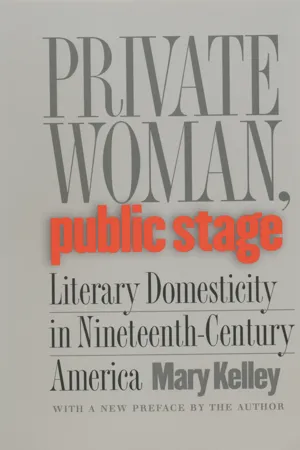
Private Woman, Public Stage
Literary Domesticity in Nineteenth-Century America
- 432 pages
- English
- ePUB (mobile friendly)
- Available on iOS & Android
eBook - ePub
About this book
Trusted by 375,005 students
Access to over 1.5 million titles for a fair monthly price.
Study more efficiently using our study tools.
Information
Part I
PECULIAR CIRCUMSTANCES
1
The Fanny Fern
A letter from a freight conductor in the 6 September 1873 issue of the New York Ledger, a weekly paper, reported the sighting a month before of a railroad parlor car pulling into Cleveland’s Union Depot. There was nothing unusual about seeing a railroad car in the American countryside, which signified in itself that the economic and physical face of the land had been transformed in a few decades. But the freight conductor’s parlor car indicated other changes in America, in the nation’s social and cultural fabric. This was no ordinary railroad car. Rather, this was a “magnificent parlor car” and, wrote the conductor, it “thrilled me as I read” the name it bore, “fanny fern,” encircled by a golden wreath. As unlikely as the name was, even more strange was the fact that the railroad car heralded a writer, and a female writer at that. Oddly enough, “Fanny Fern” had died not long before, and there yet remained three months until the first anniversary of her death. Whether or not the conductor was surprised by this apparently unexplained appearance, he did not say. But he did write that “as I looked at it, the many truths she has written came to my mind, and I said to myself, fanny fern’s name is one that will be remembered long as memory lasts.”1 It is possible that the parlor car was touring the country not as a memorial to “Fanny Fern” but in celebration of her birth, which had been in July 1811, and had only just arrived in Cleveland when the freight conductor saw it. In any case, it was appropriate that he wrote to the New York Ledger, for the Ledger had issued most of “Fanny Fern’s” prose for almost two decades, and it was the Ledgers editor and proprietor, Robert Bonner, who had promoted “Fanny Fern” from an early stage in her literary career.
Any history of American business inventiveness, commercial gimmickery, or just plain corn would do well to include the story of Bonner, who knew much more about celebrating life than mourning death. A Scotch-Irish immigrant who had come to this country in 1839 at the age of fifteen, the ambitious Robert Bonner quickly learned everything he could about journalism and publishing. Beginning with a position as a printer’s devil for the Hartford Courant, Bonner moved from there to the American Republican, where he worked as an assistant foreman and proofreader, and thence to the New York Evening Mirror. It was at the Mirror that Bonner’s apprenticeship blossomed into a career, as he filled the roles of printer, subeditor, and writer. By 1851, when he was twenty-seven, he had also accumulated the money to purchase the Merchant’s Ledger, a weekly business sheet begun in 1846. Made up of four pages measuring twenty-two by fourteen inches, with five columns to the page, the Merchant’s Ledger printed a little news, classified advertisements, and financial and business information. Only a small portion of its space was devoted to stories and poetry for the family.2
After Bonner’s purchase the sheet was never the same. By 1855 he claimed to have increased the number of copies sold twenty times. But Bonner’s pioneering of America’s first successful family story paper had only just begun. Only a year later the Ledger reached a circulation of 180,000, the highest of the time, and eventually climbed to 350,000. When Bonner retired in 1887 and transferred the operation of the Ledger to his three sons, it was estimated that he handed them property valued at $2 million, some $1 million in the Ledger alone, for which he had originally paid $500.3
Bonner accomplished his remarkable feat through basic changes in the Ledger’s content and extensive advertising of his paper. “New York” was substituted for “Merchant’s” in the title in 1855, and business columns and advertising space were gradually made less prominent, until by 1856 the paper was filled almost exclusively with fictional serials, stories, sketches, poetry, editorials, correspondence, and miscellaneous items. Supposedly guided by the policy of printing nothing that “the most pious old lady in a Presbyterian church” would find objectionable, Bonner proclaimed that his paper “was meant for the family” and was “neither sectarian nor political.” “Abolitionist” and even “Democrat” were forbidden words. His ploy was to recruit the services of famous writers by paying them liberally. Eventually included in his entourage were William Cullen Bryant, Henry Wadsworth Longfellow, Henry Ward Beecher, George Bancroft, James Parton, and, with an eye to a female audience, Harriet Beecher Stowe, Mary Virginia Terhune, and E.D.E.N. Southworth. Bonner had little difficulty recruiting writers when he paid such munificent sums as the $30,000 advanced to Beecher for his novel Norwood or the $3,000 paid Longfellow for a single poem. Five thousand was presented to Dickens for “Hunted Down,” the only story the novelist wrote for an American publication, and another $5,000 was paid to Tennyson, again for a single poem.4
From the outset Bonner’s stock-in-trade was advertising. One day he took a full page in the New York Tribune, and in one week he bought so much advertising space in the New York Herald that the size of the paper was doubled. The promotional sums spent were phenomenal for the period. In one particular year Bonner spent $100,000. Twenty-five thousand was lavished on Southworth’s “The Island Princess,” a novel that ran serially in the Ledger’s columns before it was reprinted in book form as The Lady of the Isle. “It pays to advertise when you’ve got a good thing and want people to know it,” said Bonner upon his retirement. One way he made people “know it” was to have printed on the page of a newspaper just a few lines heralding an author’s story, stating that the complete tale could be found in the Ledger’s pages. He is credited as well with being the first to resort to the stratagem of printing a few chapters of a tale in another publication, only to end it suddenly with the information that an interested reader would have to buy the latest issue of the Ledger in order to complete the adventure.5
Bonner’s policy of combining famous writers with innovative advertising was probably never employed more ingeniously than with “Fanny Fern.” “Fanny Fern” was the pseudonym of Sara Parton, and it was a pen name already known to thousands of American readers by the time Bonner obtained her services. Short sketches by Parton had appeared in many of the nation’s newspapers in the early 1850s, and in 1854 the house of Derby and Miller had published her first volume of sketches, titled Fern Leaves from Fanny’s Portfolio. In less than a year from the date of publication over 80,000 copies were sold. A second series of sketches followed shortly after, along with a juvenile volume whose title, Little Fern Leaves for Fanny’s Little Friends, once more displayed Parton’s delight in alliteration. The combined sale of the latter two volumes was 62,000.6
Bonner was not the first to conduct a huge campaign to promote Parton’s work. The same year that the volumes of sketches addressed to adults and children appeared, Parton signed a contract with Mason Brothers for her first novel, Ruth Hall. Noteworthy among the clauses was the firm’s agreement “to use extraordinary exertions” in publicizing the novel with the hope that it might “exceed the sale of any previous work.” While Mason Brothers did not succeed in reaching that goal with their three-stage campaign, it cannot be said that their venture was a failure: Ruth Hall sold more than 50,000 copies within eight months. Mounted toward the end of 1854, stage one concentrated upon prepublication publicity announcing the forthcoming appearance of the novel and predicting great success for it. Utilizing favorable comments from critics, stage two involved repeated claims that the forecast was proving truer than expected. And in stage three the publisher ran six daily advertisements in February 1855 proclaiming “the most successful american book: ruth hall.” The same technique was employed again in April of that year.7
Thus when Bonner recruited Parton for the Ledger in 1855 he was, in typically shrewd fashion, benefiting from an already successful show. But it would not have been in character for Bonner merely to climb aboard Parton’s bandwagon for the ride. After all, he had a good thing and he wanted people to know it. Accordingly, the 19 May 1855 issue of the Ledger printed an editorial with banner headlines: “great attraction: New Story for the Ledger, by fanny fern: Great Plans for the Future!” It had been four years, began the editorial, since the Ledger had come under new management, four years since it had stated in its very first issue the determination “to devote the strength and vigor of the morning of our manhood to the upbuilding and advancement of the ledger.” No one could doubt, it stated proudly, recalling the increase in circulation already achieved, that that effort had proved to be “eminently successful?” But if others were satisfied with the Ledger’s progress, “we confess, we are not.” The editorial continued, “We are ambitious—perhaps a little too much so—and have an ardent desire to extend our influence,” to become the weekly paper with the highest circulation in the United States. The paper was already “cheap,” it noted, selling for three cents a copy and one dollar a year, so that “the poor as well as the wealthy, can buy it.”
The intention was to provide a “great feature by combining the highest order of attraction and excellence with our cheapness, and in that way make a paper that would be universally sought for and read.” Efforts had already been made in that regard through the initiation of correspondence with some of America’s most prominent writers in order to recruit them for the Ledger “without any regard to price!” And now, it announced, with trumpets blaring and banners waving, “the most popular authoress in this or in any other country—fanny fern, is now engaged in writing a Tale for the Ledger.” In order to bring the woman writer to the Ledger, “we have to pay by far the highest price that has ever been paid by any newspaper publisher to any author.” The price, of course, went unmentioned; said the editorial, “if we mentioned the amount, we presume some people would consider us ’half-cracked’ for paying such an enormous price to any author.” But that was no matter, for “we know that something cannot be obtained for nothing; and that a Good Article is worth a Good Price.” Thus was stated what was probably Bonner’s own personal logo as well as his policy for the Ledger.
Appearing on the first page under the leadline “Great Original Tale by Fanny Fern,” the serial began running in the Ledger in the 9 June 1855 issue. It was titled “Fanny Ford: A Story of Everyday Life,” and, said the Ledger, it was “Written expressly for the New-York Ledger, at a greater expense than was ever before incurred by a newspaper publisher, and will not be issued as a book.” Sara Parton was paid $1,000 for the story. In 1856 she began writing a column exclusively for the Ledger and continued doing so until her death in 1872.8
Robert Bonner gave Parton’s literary bandwagon his own vigorous push in 1855. In 1873 the freight conductor spotted the parlor car Fanny Fern. However, neither Parton’s career nor the Fanny Fern would have rolled had the nation and the economy not experienced massive growth and expansion since 1820. Those changes made possible and provided the structure for the creation of a national publishing industry. Two of the more striking results were the commercialization and democratization of literature. In fact, literary economics had roughly paralleled the economic development of the nation. In a sense the appearance of the railroad parlor car symbolized those developments. Moreover, the Fanny Fern in its own right announced to the nation that the literary domestics, who believed in the dictum that woman’s place was in the home as wife and mother, nevertheless had stepped into a public arena traditionally ruled by men and had achieved a distinctive measure of success there.
By the time that the literary domestics had exited the public stage they knew they had been noticed. Starting with Catharine Maria Sedgwick’s first few efforts in the 1820s, followed by Caroline Howard Gilman and Caroline Lee Hentz in the 1830s, Maria McIntosh, E.D.E.N. Southworth, and Harriet Beecher Stowe in the 1840s, and Maria Cummins, Mary Jane Holmes, Sara Parton, Mary Virginia Terhune, Susan Warner, and Augusta Evans Wilson in the 1850s, these twelve, who were among the most commercially successful of the literary domestics, came to dominate a substantial literary marketplace.
The degree of the literary domestics’ popularity was unique and staggering. It was only in the 1820s that changes in the publishing world made it possible for a writer—male or female—to contemplate reaching a national audience. There was little to compare between what existed before that time and what came after. There had been neither a national publishing industry nor what legitimately could have been called a profession of authorship in the United States before the third decade of the nineteenth century. Numerous factors had hindered the growth of American publishing before that time. A lack of capital typical for an underdeveloped country, high production costs, an inefficient system of distribution, poor transportation, and an absence of a predictable market were among the obstacles. But once those difficulties had begun to be solved a new publishing empire emerged in the United States, grew with the nation, and provided for women in America an opportunity such as they had never confronted before. Given their private domestic heritage, it truly could be said that these women were in strange company in a strange public world.9
Until well into the nineteenth century, publishing in America had been a provincial, risky business. Mathew Carey’s firm, founded in 1785, was the only eighteenth-century venture that lasted long into the nineteenth century. Of those houses established before 1820 only Harper flourished beyond midcentury. Lacking its own commercially viable publishing, the young republic revealed its cultural dependence upon England as American booksellers welcomed reprints of British fiction. It was an advantageous arrangement for England, as it gave British publishers a profitable dumping ground for their remainders, and the market on this side of the Atlantic was flooded with imports. But it was hardly a situation designed to encourage the promotion of American fiction. There was little incentive for a publisher to share the profits with an author, to pay for the copyright of a work, or, for that matter, to undertake the gamble of an expensive and cumbersome process of manufacturing when cheap imported reprints were available. The situation was not ideal for the American publisher either. In the absence of international copyright laws, pirated editions of foreign works also inundated the American scene, and publishers engaged in a frantic struggle with one another to reach the marketplace first with competing reprints of the same work.10 But the one who suffered the greatest loss was the American author. Before 1820 common practice compelled the author to pay manufacturing costs, with the publisher or bookseller acting as distributor on a commission basis. If nothing else, it could be said that the British aristocratic tradition of writing for neither money nor a vulgar public but as a demonstration of learning and genteel status was being sustained. A significant profit for a writer and a large reading audience for a book were highly unlikely.
A combination of circumstances changed that situation dramatically. The need to import most materials and tools for the production of books began to lessen at the opening of the nineteenth century. The chronic lack of capital from which most publishers still suffered in 1800 was gradually overcome by midcentury. There were also revolutionary developments in strictly mechanical factors such as presses, typecasting and typesetting, and paper. In fact, the technological explosion in printing in the second quarter of the century represented the greatest advance in that field since the fifteenth century. Whereas in the eighteenth century books had cost at least two and a half to more than three times as much as they do today, American publishers in the nineteenth century developed the ability to produce large quantities of books cheaply.
Economic growth and technological advancement also enhanced publishers’ ability to market books. Specialization had been all but unheard of in the eighteenth century, and a variety of confused and inefficient relationships existed among printers, publishers, and booksellers well into the next century. Prior to the third decade of the nineteenth century, publishing was generally decentralized and local in nature. Writers employed the services offered by the printer in their own town, and sales were thereby confined to limited localities. This was transformed by the transportation revolution and the emergence of publishing centers distinguished by large houses with sophisticated methods of distribution and promotion. Enjoying access to river and ocean transportation, Philadelphia and New York City emerged as the dominant centers, and were joined by Boston after the introduction of the railroad obviated its geographical disadvantage. By the 1840s more than 90 percent of the fiction published in this country issued from one of these three centers.
Along with the trend toward centralization and improvements in methods of distribution, there were important developments in the promotion of books. Publishers began offering generous discounts to booksellers as an inducement to rapid movement of their stocks. They also entered upon campaigns which featured covert as well as overt advertising of their products in magazines. Publishers sent review copies—and handy notices for use by the harassed editor who did not have the time to read and evaluate the work himself. “Puffing,” favorable or exaggerated publicity, was simply a technique of advertising, and publishers had their own stables of puffers, those less-than-critics hired to write laudatory reviews or blurbs for their publisher’s books. With the growth of the industry the practice was not of minor consequence. In Mary Virginia Terhune’s novel Phemie’s Temptation, published in 1869, the heroine, Phemie Hart, learns of the practice in painful fashion...
Table of contents
- Cover Page
- Title Page
- Copyright Page
- Contents
- Preface
- Part I Peculiar Circumstances
- Part II The Notice of The World
- Part III Warfare Within
- Epilogue
- Abbreviations
- Notes
- Bibliographical Note
- Index
Frequently asked questions
Yes, you can cancel anytime from the Subscription tab in your account settings on the Perlego website. Your subscription will stay active until the end of your current billing period. Learn how to cancel your subscription
No, books cannot be downloaded as external files, such as PDFs, for use outside of Perlego. However, you can download books within the Perlego app for offline reading on mobile or tablet. Learn how to download books offline
Perlego offers two plans: Essential and Complete
- Essential is ideal for learners and professionals who enjoy exploring a wide range of subjects. Access the Essential Library with 800,000+ trusted titles and best-sellers across business, personal growth, and the humanities. Includes unlimited reading time and Standard Read Aloud voice.
- Complete: Perfect for advanced learners and researchers needing full, unrestricted access. Unlock 1.5M+ books across hundreds of subjects, including academic and specialized titles. The Complete Plan also includes advanced features like Premium Read Aloud and Research Assistant.
We are an online textbook subscription service, where you can get access to an entire online library for less than the price of a single book per month. With over 1.5 million books across 990+ topics, we’ve got you covered! Learn about our mission
Look out for the read-aloud symbol on your next book to see if you can listen to it. The read-aloud tool reads text aloud for you, highlighting the text as it is being read. You can pause it, speed it up and slow it down. Learn more about Read Aloud
Yes! You can use the Perlego app on both iOS and Android devices to read anytime, anywhere — even offline. Perfect for commutes or when you’re on the go.
Please note we cannot support devices running on iOS 13 and Android 7 or earlier. Learn more about using the app
Please note we cannot support devices running on iOS 13 and Android 7 or earlier. Learn more about using the app
Yes, you can access Private Woman, Public Stage by Mary Kelley in PDF and/or ePUB format, as well as other popular books in Literature & North American History. We have over 1.5 million books available in our catalogue for you to explore.