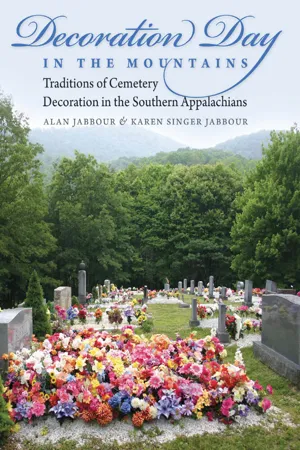
Decoration Day is a late spring or summer tradition that involves cleaning a community cemetery, decorating it with flowers, holding a religious service in the cemetery, and having dinner on the ground. These commemorations seem to predate the post–Civil War celebrations that ultimately gave us our national Memorial Day. Little has been written about this tradition, but it is still observed widely throughout the Upland South, from North Carolina to the Ozarks.
Written by internationally recognized folklorist Alan Jabbour and illustrated with more than a hundred photographs taken by Karen Singer Jabbour, Decoration Day in the Mountains is an in-depth exploration of this little-known cultural tradition. The Jabbours illuminate the meanings behind the rituals and reveal how the tradition fostered a grassroots movement to hold the federal government to its promises about cemeteries left behind when families were removed to make way for Fontana Dam and Great Smoky Mountains National Park.
Richly illustrated and vividly written, Decoration Day in the Mountains presents a compelling account of a widespread and long-standing Southern cultural practice.
eBook - ePub
Decoration Day in the Mountains
Traditions of Cemetery Decoration in the Southern Appalachians
- 256 pages
- English
- ePUB (mobile friendly)
- Available on iOS & Android
eBook - ePub
Decoration Day in the Mountains
Traditions of Cemetery Decoration in the Southern Appalachians
About this book
Information
chapter one
Two Encounters with Decoration Day
Proctor Cemetery, July 4, 2004
Our first experience with Decoration Day came on the Fourth of July in 2004. Karen and I had just arrived in western North Carolina to begin research on the custom of Decoration Day as practiced in the cemeteries scattered through a region of Great Smoky Mountains National Park known as “the North Shore.” The name refers to the northern shore of Fontana Lake, a thirty-mile-long lake created by Fontana Dam, the largest dam in the eastern United States, which dams the Little Tennessee River in Swain County, North Carolina. The lake the dam created displaced a large number of people, because the rising water both flooded homes and inundated the only road to the outside world for people living at higher elevations.
We arose early, picked up our Western Carolina University colleague Ted Coyle, and drove to Cable Cove, a boat landing on the south shore of Fontana Lake. We were going to attend the annual decorations at Proctor and Bradshaw Cemeteries, both of which are in the national park near the former town of Proctor on Hazel Creek. The event marked the beginning of documentary fieldwork for our research project.
The morning was cloudy and fog shrouded the mountains as we made our way to Cable Cove. When we arrived at about 9:00 A.M., for boarding at 9:30, a crowd had already gathered. We recognized some people who had attended the public meeting we held two days earlier announcing the research project, but there were many others of all ages. Some had bouquets, boxes, or bundles of flowers, and some carried large bags or coolers filled with food and drink. Ted, Karen, and I lost no time introducing ourselves, mixing with the people at the landing, and talking about our project. Since we would be taking photographs and making sound recordings all day, we wanted people to know who we were and what we were doing there.
One person we met was Dale Ditmanson, the new superintendent of Great Smoky Mountains National Park, who was there with his wife to take part in the decoration. Erik Kreusch, the park archeologist, had alerted us in advance that the superintendent would be attending. As we mingled, we heard much talk among the participants about what his coming might portend. The word was that till now no superintendent had ever attended a decoration at any cemetery within the park’s North Shore region. Relations over the years had sometimes been tense and testy between the park administration and local people associated with cemeteries within the park, so the new superintendent’s presence was interpreted as auspicious.
The boat that shuttles people across Fontana Lake for cemetery decorations arrived, and people started to board (Plate 5). We were not well positioned near the landing and did not want to crowd out the local participants, some of whom were elderly or disabled. By our next North Shore decoration we would shed our hesitancy; Karen came to realize how important it was to be on the first boat in order to document people arriving and decorating graves. But this time we held back.
Meanwhile, a shower began to fall. We had forgotten our umbrella, but our fellow pilgrims were well prepared and took care of us. Linda Hogue, who heads the North Shore Road Association and was an active participant in the public meeting two days earlier, produced an extra umbrella from her car, and someone else provided a plastic poncho. There was some brave talk about how infrequently it has rained over the years for these North Shore decorations, but I noticed that the musicians had come well prepared for rain—their instrument cases were wrapped in rain-shedding gear.
We finally took the third boat, that is, the third trip across Fontana Lake by the same boat. Once aboard, we chatted with neighbors on the benches rimming the boat’s interior or just silently soaked up the experience of being on the water. It was cloudy with a bit of drizzle and fog in the air, and mountain and forest views revealed themselves mysteriously and powerfully as we crossed the lake. We have been on several North Shore decorations since that first crossing, and each time crossing the lake evokes a sense of mythic transition from one world to the next, a pilgrimage from the secular to a timeless sacred world. Cemeteries always convey a sense of sacred space, as do national parks. Crossing an unimaginably deep lake from civilization to a cemetery in the wilderness of a national park is the perfect mythic journey to the sacred domain.
Arriving on the other side, the boat maneuvered into an inlet that marked the mouth of Hazel Creek. The creek is one of the major streams flowing out of the Smokies into Fontana Lake and the Little Tennessee River, and its banks were once thickly inhabited. Proctor was a boomtown during the heyday of logging in the early twentieth century, and rural settlements stretched up the creek virtually to its sources high in the Smokies. Today the area has reverted to wilderness, though the practiced eye can discover lingering evidence of earlier settlements. Helen Vance, the head of the North Shore Historical Association, told me that the creek was originally called Hazelnut Creek because of the hazelnut trees (Corylus americana) along its banks. At some point Hazelnut Creek was shortened to Hazel Creek.
As we debarked near the mouth of Hazel Creek, a number of National Park Service employees greeted us. Perhaps because of my years in Washington, D.C., a cynical question crossed my mind: Were they here because the new superintendent of the park was aboard? Subsequent North Shore decorations proved that park staff are always there to help people debark, describe and point the way for the hike that will follow, and offer rides in all-terrain vehicles for pilgrims who need help. Most of the cemeteries of the North Shore—and indeed throughout the Appalachian region—lie astride interior ridges far from rivers and boat landings. Typically, to reach a cemetery, one must hike up a creek, then perhaps along a smaller branch, and finally up to the crest of a steep ridge. Even all-terrain vehicles may not be capable of ascending that final ridge, and the lore of North Shore pilgrimages is full of stories about pilgrims on crutches or with other disabilities struggling to climb the ridge to visit family graves.
We began walking up the broad, well-kept dirt road that follows the bank of Hazel Creek. It was a comfortable walk and full of interesting things to see. I found myself walking with Harry Vance, Helen Vance’s husband, who as a Baptist minister would later contribute in various ways to the day’s events. We talked about his career as a pastor, which included a stint in the Anacostia area of Washington, D.C., during the 1950s. Karen and I have lived in Washington since 1969, so I could respond with real knowledge when he alluded to his former neighborhood. Then, as we approached the area where the town of Proctor once stood, he pointed out various less-wooded areas in the forest, sometimes punctuated by remnants of the foundations of Proctor’s public and private buildings.
Harry Vance said he would be performing two baptisms in Hazel Creek later that day, and he wanted to scout the area where baptisms had traditionally been held, just downstream from the site of Proctor. We left the path and worked our way over to the bank. The moment he saw the water, he exclaimed, “Oh good, it’s clear!” It had rained a lot in recent days, and he had worried that muddy water would make full-immersion baptisms problematic. As he surveyed the area, he seemed to be imagining the baptism in his mind, picturing just where in the deep pool near the side of the creek he would carry out his work, and how the candidates for baptism would get in and out through the weeds and bushes on the bank. Contemplating what was to come seemed to fill him with enthusiasm, and he remarked about the satisfaction he felt in being able to continue performing such rituals, even though he no longer had a congregation of his own.
Returning to the road, we met a park employee in an all-terrain vehicle who offered us a ride, which we gladly accepted. The remainder of our trip was not as easy as the stroll up Hazel Creek. We turned from the road onto a steep, muddy path up a narrow branch. Finally we reached a point where we had to leave our vehicle and climbed a steep final path to the ridge crest. One pilgrim on crutches had to work his way up the steep hill backward, securing his crutches in the muddy hillside and then lifting himself by degrees. At the top, the path opened onto a large cemetery in an open glen with a few trees and shrubs. Musicians were playing, and my initial fear that I had missed something was replaced by relief when I saw that Karen and Ted were already there and busy documenting.
Proctor Cemetery, the largest of several cemeteries along Hazel Creek and its branches, contains 192 known burials. It was established on the land of Moses and Patience Proctor, who settled in the area about 1830. Moses Proctor, the earliest known interment, was buried in 1863, reportedly in the doorway of his former cabin site. As often happens, what began as a family cemetery evolved over generations into a community cemetery. The congregants on this day came from many families, and the graves they decorated likewise bore many family names. Most of the graves were decorated by the time I arrived, but some families still clustered around graves of their kin, either cleaning or adjusting something, recounting stories about the people buried there, or simply reflecting.
The musicians continued to play, and people gradually congregated in a large, loose circle within the cemetery. I hastily unloaded my new digital recorder and connected the microphone. There were two young fiddle players (the Dills sisters, I was told), a mandolin player, and two guitar players (Figure 1-1). When the formal program began, Helen Vance first made some announcements, then read a religious-patriotic essay she had chosen in honor of the Fourth of July. She next called on Linda Hogue to read a piece (Figure 1-2) and then asked Harry Vance to make some remarks. His comments amounted to a brief sermon with patriotic and religious themes. Since it was July 4, he focused on contributions made by Americans from early times to today that have helped secure our freedom. His remarks ended with a prayer.
Helen Vance called on the musicians to play some additional selections. Then, having learned at the public meeting two days before that I play the fiddle, she asked me if I would play a patriotic song. I borrowed a fiddle from the younger of the Dills sisters, and as I wrestled to turn off my recording equipment and unharness myself from it, I heard someone request “Dixie.” Then I heard the guitar player make another suggestion—he quietly played the first few notes of “America the Beautiful.” I nodded, and we plunged in. Afterward, at Helen’s request, I briefly spoke about our project and introduced Ted and Karen. Helen then called on Superintendent Ditmanson, who made some graceful remarks about how much he enjoyed being there and appreciated having events like this in the park.
At some point a couple of men circulated through the congregation, holding out their hats, to take up an offering. The proceeds were for the North Shore Cemetery Association, also known as the North Shore Historical Association, to buy new grave markers for the North Shore cemeteries. No one has been buried in Proctor Cemetery since the early 1940s, when people were removed from the North Shore. But cemeteries are not as static as people sometimes imagine. Old and illegible headstones are replaced, and genealogical research supplies missing information. Thus a cemetery is a dynamic cultural creation, its shape and public communications constantly under revision despite the stony illusion of permanence.

FIGURE 1-1 Musicians during Proctor Cemetery Decoration, GSMNP, July 4, 2004
As the formal ceremony drew to its conclusion, people dispersed through the cemetery singly or in small groups, continuing the process of contemplation and commentary that is a critical part of Decoration Day. Proctor was our first decoration, and it had not yet dawned on us that these “interludes” were a key portion of the decoration. In time we came to realize that Decoration Day is a day of reflection and of engagement between the community above ground and the one below, and much of that reflection and engagement occurs as people walk through the cemetery alone or with a few companions.
As people left the cemetery, some, including Ted, went to Bradshaw Cemetery, a smaller cemetery decorated annually on the same Sunday as Proctor, while others drifted back down to the Proctor town site. At the Proctor site, one house, known as Calhoun House, remains standing from the old days. Not far from it and close to Hazel Creek stood two rows of picnic tables and benches, stacked with coolers, bags, and baskets people had left behind when they went to the cemetery. Now they returned and began spreading tablecloths and arranging an amazingly varied offering of food on the tables.

FIGURE 1-2 Linda Hogue of the North Shore Road Association reads a statement during Proctor Cemetery Decoration, GSMNP, July 4, 2004
This was the portion of the decoration ritual known as “dinner on the ground.” The term is consistently used for the cemetery meal on Decoration Day throughout the Upland South, from the Appalachians to the Ozarks. It is also used for the after-church outdoor meals of southern congregations. Dinner on the ground was originally a picnic-like meal, spread on blankets on the ground in the cemetery. But outdoor tables are an improvement over dining on the ground, and outdoor pavilions offer even more advantages, such as shade and shelter from the rain. All these variants of the custom exist in one place or another, but whatever the actual circumstances of the meal, people cling affectionately to the term “dinner on the ground” for the time-honored communal experience it conjures up (Plate 6).
Karen began photographing the dinner spread, while I talked to people beside the rows of tables. Presently, a young woman greeted me and asked if we would like to join her and her mother. I gladly accepted and began getting acquainted with Carolyn Kirkland and her mother, Verna Kirkland. I apologized that Karen could not join us till she finished photographing the serving of the food. Then I sat down, and we began eating and talking.
The conversation touched on many subjects, from “Why are you doing this study?” to Verna’s mentioning that she knew how to make the old-style crepe paper flowers for Decoration Day. But looking back, the point that looms largest is Verna’s suggestion that we look at the cemeteries and Decoration Day practices in an area such as Alarka, the rural community in Swain County where they live. Out of that interchange emerged a research plan that included cemeteries and decorations both on the North Shore in the national park, and on the “south shore” in areas apart from the removal, cultural dislocation, and subsequent cultural revival that occurred within the park. The cemeteries and decorations outside the park became our “control group,” providing a cultural foil against which we could better appraise what was happening within the park.
Karen finally joined us, but soon after we noticed a few drops of rain. Then a shower came up, and all along the rows of tables umbrellas sprang into action. The shower quickly evolved into a downpour, and people frantically tried to rescue the food before running to Calhoun House nearby, which was empty but was, luckily, open. Kids romped around screaming happily in the rain, while grown-ups tried to stay as dry as they could. Gradually the storm subsided to a light rain that never quite stopped. Nevertheless, someone decided that the baptisms must go forward as planned, and people started to walk down Hazel Creek toward the site that Harry Vance and I had inspected earlier.
Dorothy Gay Calhoun and Laurel Lee Calhoun, two teenagers from a local family who now live west of the Smokies in Tennessee, were to be baptized. Their grandfather and father, both of whom were present, had been baptized in Hazel Creek, so they wanted to be baptized there as well. Harry Vance waded into the pool in Hazel Creek, and another man led the young women out to him, one at a time (Figure 1-3). He prayed while supporting each of them, then immersed each one entirely in the cold stream. Meanwhile, the congregants on the bank sang hymns associated with baptism, including “Shall We Gather at the River.” After the baptisms, Harry Vance joined the two young women and their entire family on the bank, standing joyfully in the rain, for a final prayer (Figure 1-4).
People then began drifting down the long path toward the mouth of Hazel Creek and the waiting boat. Everyone was wet, but by this point it did not matter anymore. I rejoined the Kirklands as we waited for a place on the boat, and while the first and second loads went back to Cable Cove, we continued our earlier conversation. Karen, meanwhile, had a conversation with Sheila Calhoun, the mother of the two teenagers who had just been baptized, discussing family names and exploring the possibility of our interviewing family members at home. Finally we boarded as part of th...
Table of contents
- Cover Page
- Decoration Day in the Mountains
- Copyright Page
- Contents
- Introduction
- Acknowledgments
- About the Photographs
- chapter one Two Encounters with Decoration Day
- chapter two Decoration Day in Western North Carolina
- chapter three Cemetery Features in Western North Carolina
- chapter four Cemetery Features in Western North Carolina
- chapter five The North Shore: Removal and Revolution
- chapter six The Origin, Diffusion, and Range of Decoration Day
- chapter seven The North Shore and Decoration Day in Sign, Symbol, and Art
- chapter eight The Unsung Heroes of Decoration Day
- chapter nine Concluding Thoughts
- APPENDIX A: Project History
- APPENDIX B: Log of Ethnographic Events, North Shore Cemetery Decoration Project, 2004
- Notes
- Bibliography
- Index
Trusted by 375,005 students
Access to over 1.5 million titles for a fair monthly price.
Study more efficiently using our study tools.
Frequently asked questions
Yes, you can cancel anytime from the Subscription tab in your account settings on the Perlego website. Your subscription will stay active until the end of your current billing period. Learn how to cancel your subscription
No, books cannot be downloaded as external files, such as PDFs, for use outside of Perlego. However, you can download books within the Perlego app for offline reading on mobile or tablet. Learn how to download books offline
Perlego offers two plans: Essential and Complete
- Essential is ideal for learners and professionals who enjoy exploring a wide range of subjects. Access the Essential Library with 800,000+ trusted titles and best-sellers across business, personal growth, and the humanities. Includes unlimited reading time and Standard Read Aloud voice.
- Complete: Perfect for advanced learners and researchers needing full, unrestricted access. Unlock 1.5M+ books across hundreds of subjects, including academic and specialized titles. The Complete Plan also includes advanced features like Premium Read Aloud and Research Assistant.
We are an online textbook subscription service, where you can get access to an entire online library for less than the price of a single book per month. With over 1.5 million books across 990+ topics, we’ve got you covered! Learn about our mission
Look out for the read-aloud symbol on your next book to see if you can listen to it. The read-aloud tool reads text aloud for you, highlighting the text as it is being read. You can pause it, speed it up and slow it down. Learn more about Read Aloud
Yes! You can use the Perlego app on both iOS and Android devices to read anytime, anywhere — even offline. Perfect for commutes or when you’re on the go.
Please note we cannot support devices running on iOS 13 and Android 7 or earlier. Learn more about using the app
Please note we cannot support devices running on iOS 13 and Android 7 or earlier. Learn more about using the app
Yes, you can access Decoration Day in the Mountains by Alan Jabbour,Karen Singer Jabbour in PDF and/or ePUB format, as well as other popular books in Social Sciences & North American History. We have over 1.5 million books available in our catalogue for you to explore.