eBook - ePub
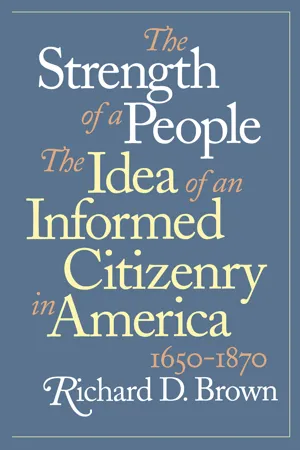
The Strength of a People
The Idea of an Informed Citizenry in America, 1650-1870
- 272 pages
- English
- ePUB (mobile friendly)
- Available on iOS & Android
eBook - ePub
About this book
Thomas Jefferson's conviction that the health of the nation's democracy would depend on the existence of an informed citizenry has been a cornerstone of our political culture since the inception of the American republic. Even today's debates over education reform and the need to be competitive in a technologically advanced, global economy are rooted in the idea that the education of rising generations is crucial to the nation's future. In this book, Richard Brown traces the development of the ideal of an informed citizenry in the seventeenth through nineteenth centuries and assesses its continuing influence and changing meaning. Although the concept had some antecedents in Europe, the full articulation of the ideal relationship between citizenship and knowledge came during the era of the American Revolution. The founding fathers believed that the First Amendment's guarantee of freedom of the press, religion, speech, and assembly would foster an informed citizenry. According to Brown, many of the fundamental institutions of American democracy and society, including political parties, public education, the media, and even the postal system, have enjoyed wide government support precisely because they have been identified as vital for the creation and maintenance of an informed populace.
Information
Chapter 1
English Subjects and Citizens from the Reformation through the Glorious Revolution
Political liberty has long been the pride of England. But if one reaches back to the reign of Henry VIII in the sixteenth century, or to the rule of his Stuart successors, one finds the same kinds of autocracy, repression, and arbitrary government that were then characteristic of Continental monarchies. The political liberty for which England became famous during the Enlightenment resulted from generations of struggle. Indeed, the “rights of Englishmen” were more the fruits of expedient compromises than the products of any deliberate constitutional scheme. Certainly political ideals mattered, and English political theory was not just retroactive rationalization for accomplished facts. But the influence of ideas was subtle, an influence exerted over decades of power struggles among the king, nobles, gentry, merchants, and lawyers who ruled England.
Achieving legitimacy was always an issue for monarchs and their challengers, and it was invariably based upon abstract principles that were more fiction than fact.1 The hereditary principle was the political legacy of the Middle Ages, a seemingly simple idea that lineage conferred legitimacy. But in reality, as the Wars of the Roses had recently demonstrated, victory on the battlefield and the alliances of magnates were at least as important as lineage in the Tudor era. Still, governance was more than the brute force of the mighty over the weak because it required acquiescence, if not a measure of consent. The divine authority of kings—which should ideally pass from the monarch to his eldest son—supplied a reason to justify the concept of political superiority and inferiority that was replicated throughout the social hierarchy, from the nobility, gentry, and commonalty down to the family of the humblest laboring patriarch.2
According to the most basic monarchical theory, only two categories of people existed: a king and his subjects. The king possessed dominion over all who dwelled in his realm, and the subjects owed allegiance to the monarch and his government. Every subject was bound by the laws of the kingdom, laws that also supplied every subject with protection. In this restricted sense, all subjects were equal. Yet at the same time, the principle of hierarchy, which divided the king from his subjects, extended throughout society, dividing and ranking the king’s subjects according to lineage, property, and privilege as well as age and sex. Some subjects ruled over others and enjoyed powers and immunities known as rights and liberties. In the House of Lords and the House of Commons, the greatest and most privileged of the king’s subjects collaborated with the monarch’s own appointees to rule over the realm. Because the principle of heredity lay at the foundation of all legitimacy, those who enjoyed such liberties, immunities, and privileges tended to view them as rights, as being their permanent possessions until such time as they should either forfeit them voluntarily or according to due process of law.
The idea of rights and guaranteed privileges modified the status of a subject powerfully, diminishing the subordinate and submissive character of being a subject. By the Renaissance, it was common to speak of some subjects as citizens, a term that implied the possession of civil and political rights and privileges. In medieval times, the term “citizen” had been applied to townsmen particularly, but during the Tudor era, a more enlarged view of “citizen” came to prevail. This larger view was rooted in the ideas of classical authorities like Aristotle, who recognized the nobility and gentry as citizens, even preferring them as citizens to the merchants and master craftsmen of the towns. According to Aristotle, citizens with landed wealth possessed the leisure needed to fulfill their public roles.3
The public role of these neoclassical Renaissance citizens contrasted with the narrow, self-interested, medieval citizenship of the freemen of a town, who were concerned primarily with the preservation of their own particular chartered privileges. The nobility and gentry as well as merchants and lawyers were corulers of the English state—not merely the king’s subjects. It was their duty to promote the general public interest, beyond their personal concerns. This public citizenship role was in many respects no more than new language for old political roles. As subjects of the king, the nobility and gentry had always been responsible for taking arms to defend the realm and for ruling it, whether they used the new Renaissance language of citizens or the feudal language of liege lords and subjects. But until the Renaissance, their preparation for these responsibilities was the mostly practical method of learning by observation and apprenticeship in great men’s houses. Not much book-learning was needed to perform with a sword or even to render judgments in county courts, where oral traditions sustained local customs. Churchmen needed to master Latin, but otherwise literacy was not a crucial requisite for nobles and their vassals.
It was Renaissance culture and the advent of printing that produced such works as Baldassare Castiglione’s Book of the Courtier and created new expectations for learning among the English laity in the sixteenth century. Mastery of classical languages—Latin at least—became an emblem of gentility, culture, civilization. The ruling classes joined learning to military prowess in defining the new concept of citizenship as they deliberately and emphatically made themselves the educated classes.4 Almost simultaneously, the Protestant Reformation gave a further impetus to the growth of literacy and learning.
Because England was one of the first Protestant kingdoms, it might be assumed that the English church and state were generally committed to popular as well as elite learning so as to promote Bible reading, piety, and salvation. But the division between elite “citizen” subjects and “mere” subjects remained powerful in Tudor England. The uniform church and autocratic state that Henry VIII tried to establish rejected popular engagement in religious and public discussion and was hostile to all dissent, popular or elite. Faced with a Catholic insurrection, Henry’s 1537 Parliament passed a law for “abolishing diversity in opinions.”5 In the following decade, when various Protestants posed different challenges to the Henrician establishment, the king signed a statute “for the Advancement of true Religion and for the Abolishment of the Contrary.” Now king and Parliament prohibited the reading of the Bible in English in every church in the realm. Further, “mere” subjects, including most commoners—according to the law, all artificers, apprentices, journeymen, yeomen, lesser serving men, laborers, husbandmen, and women—were explicitly forbidden to read the New Testament in English, the only language in which they might be literate.6
Maintaining order among the “citizen” subjects who composed England’s ruling elites was the regime’s first challenge, and it would not tolerate any disagreement from its “mere” subjects. In his Remedy for Sedition ([1536]), a government spokesman declared “it is no part of the people’s play to discuss acts made in parliament.” Drawing the line as firmly as he could, he pronounced: “It far passeth the Cobbler’s craft to discuss, what lords, what bishops, what councilors, what acts and statutes and laws are most meet for a commonwealth, and whose judgement should be best or worst concerning matters of religion.”7 Such public matters were exclusively the province of rulers, not ordinary subjects. This was the established political orthodoxy.
But if this view had been universally accepted, the ruling elite would not have needed to assert it so vigorously in statutes and declamations. In fact, some commoners were reading the Bible and discussing the tumultuous politics of Henry’s reign. After Henry’s death in 1547, when Lord Somerset governed under the authority of young Edward VI, the “Act of Words” was abolished and pamphlet controversy flourished.8 Now one anonymous writer articulated a belief that had long been repressed and that pointed to the Anglo-American future. In the Discourse of the Commonweal of this Realm of England ([1549]), every man was invited to express his views, not only “learned men (whose judgments I would wish to be chiefly esteemed) herein, but also merchant men, husbandmen, and artificers.” In the body of this Discourse, members of these groups spoke their minds, in addition to a knight, a physician, and an artisan.9
The radicalism of this viewpoint is underlined by the contemporary words of John Cheke, who in The Hurt of Sedition (1549) denounced the idea that “every subject should busily intermeddle with” public matters.10 Still, the terms of the debate were shifting away from the uniformity of Henry VIII’s act for “abolishing diversity in opinions.” While it was still generally believed that the first responsibility of ordinary subjects (variously defined) was obedience, not political expression, the idea that a class of “citizen” subjects should be allowed to voice their ideas, even if they disagreed, was accepted. In 1548, for example, the preacher and printer Robert Crowley published a pamphlet called An Information and Petition against the Oppressors of the Poor Commons of this Realm, in which he argued that because good government depends on information, men who were literate and learned should speak out publicly. It was all very well, he said, for members of Parliament and the Privy Council to supply information to the king, but other subjects should do so as well. Some Tudor clergymen even saw themselves as social and moral critics, duty-bound to “speak against the faults of all degrees without exception.”11 The elite of educated, experienced, and virtuous men recognized by Plato and Aristotle ought to be allowed, even encouraged, to engage in the discussion of public affairs. Indeed, one authoritative historian maintains that, like Enlightenment theorists two centuries later, the midcentury Tudor pamphlet writers generally believed “in the educability of men for the duties of active citizenship, and in the efficacy of reason.”12
During Queen Elizabeth’s reign, such ideas gained a foothold in England as a clandestine printing trade developed. In politics, both civil and religious, the expectation of absolute conformity was modified by a more flexible, pragmatic acceptance of disagreement. Elizabeth secured civil peace by pursuing a de facto policy of toleration toward Catholics and Protestant sectarians. Moreover, in contrast to her older half sister, Queen Mary, Elizabeth sought the counsel of a variety of learned “citizen” subjects in her Privy Council, and she listened carefully to the elite citizens who spoke both in Parliament and outside its chambers. Indeed, one could argue that the anti-Spanish policy of the last twenty years of Elizabeth’s reign was influenced powerfully by this elite Protestant opinion. Such royal attention, conciliation, and pragmatism brought a new luster to the monarchy after the ruinously divisive reign of Queen Mary. By the time that the first Stuart, James I, peacefully ascended the throne after Elizabeth’s death in 1603, the idea that the educated, informed, and sometimes conflicting voices of gentlemen, merchants, lawyers, and clergymen should be expressed had been sanctioned by decades of experience.
Although James VI of Scotland, who became James I of England, was even more learned than his predecessor Elizabeth, by temperament and experience he was less inclined to accept discordant voices. Indeed, when in 1604 James told Puritans, after they had requested his assistance at Hampton Court, that they must “conforme” or he would “harrie them out of the land, or else doe worse,” he set the direction for the Stuart dynasty.13 Coming to power during an era when monarchs throughout Europe were basing their claims to authority over their subjects on a theory of absolute and divine royal right, the Stuarts were much more comfortable with dispensing privileges, monopolies, and indulgences to favored subjects than they were with recognizing their subjects’ claims to rights. The ideal of uniformity in both the state and the church appealed powerfully to seventeenth-century rulers in aesthetic and ideological terms while also serving as a justification for raw political dominion. In the Europe of the Reformation and the Counter Reformation, where religious warfare was protracted, the doctrine that the religion of the monarch must also be the religion of his subjects and of the state (“Cujus est regio, illius est religio”) generally prevailed, notwithstanding its enormous cost in blood and misery.14 It was in this unfriendly setting, in which James I himself repeated the motto “No Bishop, no King,” that Puritans pressed their claims to exercise their particular forms of religious expression as part of a larger effort to reform the Church of England.15
Within the Puritan movement, whose members ranged from Baptists and Brownists to Presbyterians and Quakers, many strands of religious and political opinion existed. The largest and, from the perspective of the Stuart kings, most dangerous group were Puritans who sought not to reject and repudiate the Church of England but to remodel it by taking over its parishes, its colleges, and its hierarchy. Viewing the existing Anglican Church as corrupt but redeemable, these Puritans worked within the system to reform it. Between the coronation of James I and the advent of civil war nearly forty years later, they worked incessantly to undermine orthodox churchmen and their teachings.
In place of the established centralized, hierarchical, ceremonial religion that focused on sacramental rituals and prescribed prayers, Puritans developed a critical stance in which the Bible—interpreted line-by-line in the sermons of learned divines—became the foundation of religious observance instead of the Book of Common Prayer. Believers, they asserted, must not be docile, formalistic captives of ritual; they must examine their own behavior rigorously and search their own souls in order to prepare for the gift of God’s grace. Although this religious agenda was always most important to Puritans, it was more than coincidental that the informed, Bible-reading, sermon-going, disputatious, activist laity they encouraged also provided an impetus for the development of an informed citizenry in secular politics. The secular implications of Puritanism were so generally understood in court circles that King James remarked that a presbytery “as wel agreeth with a Monarchy, as God and the Devill.” In the king’s view, an informed citizenry meant unruly subjects. If Puritans gained power, he warned, “then Jack & Tom, Will, & Dick, shall meete, and at their pleasures censure me and my Councell and all our proceedinges: Then Will shall stand up and say, it must be thus; and Dick shall reply and say nay, mary [to be sure], but we will have it thus.”16 Monarchs had no use for uninvited advice.
During the reigns of James I and his son Charles I, criticism of royal administration mounted inside Parliament and in the manor houses and guildhalls throughout the country as Puritan reformers found allies among the secular critics of the regime. Citizen subjects were becoming alienated from Charles I and his archbishop, William Laud, and therefore the urgency of being informed and being able to inform others mounted. Since 1557 the Stationers’ guild of London had provided a substantial measure of censorship through its monopoly on printing, but illicit and imported imprints circumvented this control. Charles I understood that clandestine publications were nourishing his opposition, so in 1637 his royal Court of Star Chamber decreed that all publications must be licensed and registered before being printed. All imported books must also be approved before they could be offered for sale, and all printed matter was required to carry the names of the author, printer, and publisher. Every printing press in England must now be registered with Crown authorities and a bond of £300 given as surety that it would only be used to publish officially approved texts.17 In seeking to control the flow of information and opinion, Charles I’s government reasserted censorship with a vigor and comprehensiveness that had not been seen before in England. No public call for free speech and press had yet been made, but educated, propertied subjects displayed a growing restive-ness toward government restraints. Men whose rank and property entitled them to extensive rights and privileges were profoundly interested in public policy, both secular and religious, and they were often resentful of these restrictions.
For a few years, the Star Chamber policy and the outlook that supported it held; but once the civil war began, censorship became unenforceable and the dam burst, releasing a flood of diverse opinions, printed in tracts and broadsides as well as books. The idea of censorship did not die—it was still widely acc...
Table of contents
- Cover Page
- The Strength of a People
- Copyright Page
- Dedication
- Contents
- Illustrations
- Acknowledgments
- Introduction
- Chapter 1 English Subjects and Citizens from the Reformation through the Glorious Revolution
- Chapter 2 Freedom and Citizenship in Britain and Its American Colonies
- Chapter 3 Bulwark of Revolutionary Liberty: The Recognition of the Informed Citizen
- Chapter 4 Shaping an Informed Citizenry for a Republican Future
- Chapter 5 The Idea of an Informed Citizenry and the Mobilization of Institutions, 1820–1850
- Chapter 6 Testing the Meaning of an Informed Citizenry, 1820–1870
- Epilogue Looking Backward: The Idea of an Informed Citizenry at the End of the Twentieth Century
- Notes
- index
Trusted by 375,005 students
Access to over 1.5 million titles for a fair monthly price.
Study more efficiently using our study tools.
Frequently asked questions
Yes, you can cancel anytime from the Subscription tab in your account settings on the Perlego website. Your subscription will stay active until the end of your current billing period. Learn how to cancel your subscription
No, books cannot be downloaded as external files, such as PDFs, for use outside of Perlego. However, you can download books within the Perlego app for offline reading on mobile or tablet. Learn how to download books offline
Perlego offers two plans: Essential and Complete
- Essential is ideal for learners and professionals who enjoy exploring a wide range of subjects. Access the Essential Library with 800,000+ trusted titles and best-sellers across business, personal growth, and the humanities. Includes unlimited reading time and Standard Read Aloud voice.
- Complete: Perfect for advanced learners and researchers needing full, unrestricted access. Unlock 1.5M+ books across hundreds of subjects, including academic and specialized titles. The Complete Plan also includes advanced features like Premium Read Aloud and Research Assistant.
We are an online textbook subscription service, where you can get access to an entire online library for less than the price of a single book per month. With over 1.5 million books across 990+ topics, we’ve got you covered! Learn about our mission
Look out for the read-aloud symbol on your next book to see if you can listen to it. The read-aloud tool reads text aloud for you, highlighting the text as it is being read. You can pause it, speed it up and slow it down. Learn more about Read Aloud
Yes! You can use the Perlego app on both iOS and Android devices to read anytime, anywhere — even offline. Perfect for commutes or when you’re on the go.
Please note we cannot support devices running on iOS 13 and Android 7 or earlier. Learn more about using the app
Please note we cannot support devices running on iOS 13 and Android 7 or earlier. Learn more about using the app
Yes, you can access The Strength of a People by Richard D. Brown in PDF and/or ePUB format, as well as other popular books in History & Early American History. We have over 1.5 million books available in our catalogue for you to explore.