Precise connections between race, poverty, and the condition of America’s cities are drawn in this collection of seventeen essays. Policymakers and scholars from a variety of disciplines analyze the plight of the urban poor since the riots of the 1960s and the resulting 1968 Kerner Commission Report on the status of African Americans. In essays addressing health care, education, welfare, and housing policies, the contributors reassess the findings of the report in light of developments over the last thirty years, including the Los Angeles riots of 1992. Some argue that the long-standing obstacles faced by the urban poor cannot be removed without revitalizing inner-city neighborhoods; others emphasize strategies to break down racial and economic isolation and promote residential desegregation throughout metropolitan areas.
Guided by a historical perspective, the contributors propose a new combination of economic and social policies to transform cities while at the same time improving opportunities and outcomes for inner-city residents. This approach highlights the close links between progress for racial minorities and the overall health of cities and the nation as a whole.
The volume, which began as a special issue of the North Carolina Law Review, has been significantly revised and expanded for publication as a book. The contributors are John Charles Boger, Alison Brett, John O. Calmore, Peter Dreier, Susan F. Fainstein, Walter C. Farrell Jr., Nancy Fishman, George C. Galster, Chester Hartman, James H. Johnson Jr., Ann Markusen, Patricia Meaden, James E. Rosenbaum, Peter W. Salsich Jr., Michael A. Stegman, David Stoesz, Charles Sumner Stone Jr., William L. Taylor, Sidney D. Watson, and Judith Welch Wegner.
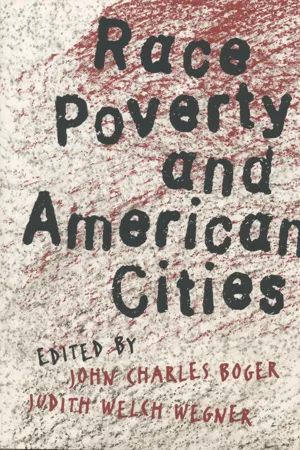
eBook - ePub
Race, Poverty, and American Cities
- 614 pages
- English
- ePUB (mobile friendly)
- Available on iOS & Android
eBook - ePub
Race, Poverty, and American Cities
About this book
Information
Part One
Looking Backward and Looking Ahead
Lessons and Questions from the Kerner Commission Report
Race and the American City
The Kerner Commission Report in Retrospect
During the early 1960s, America’s cities, especially the racial minorities and poor within them, became a national focus of political, social, and intellectual concern. One major social force contributing to this rediscovery of urban problems was the civil rights movement, which had moved the nation’s conscience during the decade between 1954 and 1964 by its struggle against segregation in the South, and which in 1965 began to redirect its energies northward, toward the “dark ghettos” of the industrial East and Midwest.1
At almost the same moment, American concern about poverty—concern that largely had abated following World War II—began to rekindle, sparked in part by the passionate writings of Michael Harrington2 and the speeches of the nation’s young president, John F. Kennedy.3 Among the many powerful images evoked by Harrington’s writings, two stood out: impoverished, white mining families in rural Appalachia and desperate African American families languishing in the nation’s central cities.
There is a new type of slum. Its citizens are the internal migrants, the Negroes, the poor whites from the farms, the Puerto Ricans. They join the failures from the old ethnic culture and form an entirely different kind of neighborhood. For many of them, the crucial problem is color, and this makes the ghetto walls higher than they have ever been. All of them arrive at a time of housing shortage . . . and thus it is harder to escape even when income rises. But, above all, these people do not participate in the culture of aspiration that was the vitality of the ethnic slum.4
At the same time, leading sociologists who were studying “juvenile delinquency” began in the early 1960s to develop explanatory theories that focused less on the personal moral failings of juveniles and their families and more on the dysfunctionality of urban neighborhoods:5 “Cloward, Ohlin, and Harrington emphasized that juvenile delinquency reflected a broader deterioration in slum conditions. Their writings, in fact, helped rediscover urban poverty. The older ethnic slum, they said, had been crowded and unsanitary, but the people had a vital community life and, most important, aspirations. . . . Most modern slums were populated by ’dregs’ who could not get out and by ill-prepared migrants from the South, many of whom carried the added burden of racial discrimination.”6
These social and intellectual currents emerged at a time when Democratic Party leaders were pondering how best to solidify political allegiance among southern black migrants who had streamed to northern cities after World War II; collectively these new urban immigrants promised to become a crucial political constituency in key industrial states by the mid-1960s.7
For different reasons, then, each of these related developments—the evolving civil rights movement, the reawakened national concern over poverty, revised theories on the cause of juvenile delinquency, and the Democratic Party’s effort to consolidate its urban political base—focused attention on American cities, especially on their African American poor, among whom, Daniel Patrick Moynihan warned, a “tangle of pathologies” lay largely unaddressed.8
In response to these perceived challenges, President Kennedy directed his brother, Attorney General Robert Kennedy, to assemble a task force and charged it to develop a coordinated program to alleviate poverty.9 This legislative program, ultimately completed after President Kennedy’s assassination in 1963, became a declared War on Poverty. It was fully embraced by President Lyndon Johnson as a centerpiece of his Great Society initiative.10 Principally an urban strategy, the War on Poverty took direct aim at the racial ghettos of the nation’s cities. The legislative program included passage of (1) the Equal Opportunity Act of 1964, (2) the Housing and Urban Development Act of 1965, (3) the “Model Cities” program, formally known as the Demonstration Cities and Metropolitan Development Act of 1966, and (4) the Elementary and Secondary Education Act of 1965.11 (Ironically, some of the most effective long-term weapons against poverty came not from the legislation originally designed as central to the War on Poverty, but from key components of Johnson’s larger Great Society legislation, especially Medicare and Medicaid, inaugurated via the Social Security Amendment of 1965 and the subsequent expansion of Social Security benefits.)12
In his effort to implement the War on Poverty, President Johnson commissioned two major, interdisciplinary examinations of housing and urban policy: the National Commission on Urban Problems (the Douglas Commission) 13 and the President’s Committee on Urban Housing (the Kaiser Committee).14 When major racial riots tore across the urban landscape during the spring of 1967, President Johnson appointed a third commission, explicitly charged to explore the links between racial discrimination and urban policy: the Kerner Commission.
Nearly three decades have passed since the Kerner Commission issued its final report in March 1968, a searing indictment of America’s urban and racial policies.15 Even if the nation had somehow managed in the intervening decades to resolve its urban and racial challenges, this extraordinary document would invite historical reflection. Yet the problems outlined by the Kerner Commission continue to defy solution by the nation’s policymakers, and reflections on the Kerner Commission Report have keen contemporary significance. As the 1992 Los Angeles rebellion emphasized,16 millions of the urban poor still find themselves without full-time employment, adequate education, affordable health care, decent housing, or social welfare programs that meet their basic needs. Moreover, the black-white racial divisions that dominated the Kerner Commission’s vision of urban life in 1968 remain sharp, although they have been complicated by the emergence of other ethnic groups—Cubans, Puerto Ricans, Mexican Americans, Latinos from Central and South America, Japanese, Chinese, Vietnamese, Cambodians, Thais, Koreans, and others—whose legitimate claims for participation in American urban life make political, social, and economic relationships more challenging.17
Meanwhile, America’s cities in 1995 continue to face serious, burgeoning social ills, many of which are closely intertwined with race and ethnicity: a decline in manufacturing and other blue-collar jobs, inadequate public schools, an explosion of gang- and drug-related violence and crime among the young, the AIDS epidemic and other looming public health challenges, an increasingly impoverished citizenry, an inadequate tax base, and private disinvestment in urban projects. Many urban mayors today find themselves with less money than in 1968 and fewer clear ideas about what can be done.
To be sure, the urban scene has changed significantly since 1968, and in some respects, as we document below, conditions have improved. Yet the principal theme of this essay is that the fundamental social and economic diagnoses of the Kerner Commission remain pertinent nearly three decades later, while its policy prescriptions remain largely ignored. Whether the Kerner Commission was correct and, if so, whether the policies proposed in 1968 have continuing relevance for the nation in 1995 are fundamental questions that the contributors to this volume must address in the pages to follow.
In this essay I undertake two preliminary tasks: first, to review the Kerner Commission’s principal findings and recommendations; second, to provide readers with a statistical snapshot of the altered circumstances that face African Americans and America’s cities in 1995. With these data in mind, readers can move on to the essays of other contributors to this volume, probing their ideas and asking what policy prescriptions appear most promising for the decades to come.18
In a separate essay I summarize and address both the public policy changes proposed by the Republicans, who entered Congress after the 1994 midterm election promising a new “Contract with America,” as well as the more modest changes proposed (and in a few instances, enacted) by the Clinton administration between 1993 and 1995. Although issues of race and urban policy have been conspicuously absent as express themes in these policy debates, few doubt that race and the cities form a major (though implicit) subtext behind the proposed Republican changes in national direction.
The Urban Crisis of the Mid-1960s and the Kerner Commission Report
During the mid-1960s the nation witnessed five consecutive summers of racial unrest in its cities.19 These riots followed a decade of mounting white violence, targeted especially against African Americans who had challenged the South’s system of legalized segregation. During the decade between 1954 and 1964 scores of southern black churches had been fire-bombed, and dozens of blacks had been killed in the civil rights struggle.20 In July 1967, following the especially deadly and destructive riots by African Americans that spring and early summer, President Lyndon B. Johnson issued Executive Order No. 11,365,21 creating the National Advisory Commission on Civil Disorders. The president charged the commission to investigate “the origins of the recent major civil disorders in our cities, includ[ing] the basic causes and factors leading to such disorders,” and to propose “methods and techniques for averting or controlling such disorders,” including “the appropriate role of the local, state and Federal authorities.”22 Nine months later, in March 1968, the commission, chaired by then-governor Otto Kerner of Illinois, delivered a comprehensive report to the American nation. The report began with a memorable warning:
Our nation is moving toward two societies, one black, one white—separate and unequal. . . . Reaction to last summer’s disorders has quickened the movement and deepened the division. Discrimination and segregation have long permeated much of American life; they now threaten the future of every American.
This deepening racial division is not inevitable. The movement apart can be reversed. Choice is still possible. Our principal task is to define that choice and to press for a national resolution.
To pursue our present course will involve the continuing polarization of the American community and, ultimately, the destruction of basic democratic values.23
At first glance this warning of a deepening racial division seemed to point to a racial pattern as old as American history. From colonial times, America’s white majority had insisted on and legally enforced the separate and unequal status of blacks.24 The Constitution itself implicitly recognized chattel slavery,25 ensuring the growth of a nation “half slave and half free.” Even in the nonslaveholding areas outside the South prior to 1861, most free blacks endured intense social segregation and legally enforced discrimination.26 The Civil War ended chattel slavery as an institution but brought no real end to the legal subordination of blacks. Instead, less than a decade after adoption of the Fourteenth and Fifteenth Amendments— garlanded with promises of equal protection under the laws, full citizenship, and political enfranchisement—national political and judicial leaders abandoned their short-lived experiment in racial equality, acquiesced in renewed racial discrimination, and collaborated to block further participation in the democratic process by millions of African American voters.27 The white majority, in effect, repudiated the legal promises crafted during Reconstruction and chose instead to shape twentieth-century American life and law in the image of Jim Crow.28
Yet the Kerner Commission Report, in retelling this history,29 made clear that its alarm in 1968 proceeded not merely from the perpetuation of these old racial divisions but from a dangerous new form of separation that was unfolding in the mid-1960s, one that would “threaten the future of every American.” Some critics objected that the commission had failed to appreciate new and positive trends in America’s racial relations. After centuries of oppression, African Americans appeared poised to achieve the equal rights denied them for 350 year...
Table of contents
- Cover Page
- Title Page
- Copyright Page
- Dedication
- Contents
- Preface
- Part One Looking Backward and Looking Ahead: Lessons and Questions from the Kerner Commission Report
- Part Two An Urban Policy for America: Is Such a Framework Feasible?
- Part Three Residential Mobility: Effects on Education, Employment, and Racial Integration
- Part Four America’s Social Policy: How Race Matters in Developing Health, Education, and Welfare Policies
- Part Five The Dual Racial Reality of the Media’s Message
- Contributors
- Index of Statutes
- General Index
Trusted by 375,005 students
Access to over 1.5 million titles for a fair monthly price.
Study more efficiently using our study tools.
Frequently asked questions
Yes, you can cancel anytime from the Subscription tab in your account settings on the Perlego website. Your subscription will stay active until the end of your current billing period. Learn how to cancel your subscription
No, books cannot be downloaded as external files, such as PDFs, for use outside of Perlego. However, you can download books within the Perlego app for offline reading on mobile or tablet. Learn how to download books offline
Perlego offers two plans: Essential and Complete
- Essential is ideal for learners and professionals who enjoy exploring a wide range of subjects. Access the Essential Library with 800,000+ trusted titles and best-sellers across business, personal growth, and the humanities. Includes unlimited reading time and Standard Read Aloud voice.
- Complete: Perfect for advanced learners and researchers needing full, unrestricted access. Unlock 1.5M+ books across hundreds of subjects, including academic and specialized titles. The Complete Plan also includes advanced features like Premium Read Aloud and Research Assistant.
We are an online textbook subscription service, where you can get access to an entire online library for less than the price of a single book per month. With over 1.5 million books across 990+ topics, we’ve got you covered! Learn about our mission
Look out for the read-aloud symbol on your next book to see if you can listen to it. The read-aloud tool reads text aloud for you, highlighting the text as it is being read. You can pause it, speed it up and slow it down. Learn more about Read Aloud
Yes! You can use the Perlego app on both iOS and Android devices to read anytime, anywhere — even offline. Perfect for commutes or when you’re on the go.
Please note we cannot support devices running on iOS 13 and Android 7 or earlier. Learn more about using the app
Please note we cannot support devices running on iOS 13 and Android 7 or earlier. Learn more about using the app
Yes, you can access Race, Poverty, and American Cities by John Charles Boger, Judith Welch Wegner, John Charles Boger,Judith Welch Wegner in PDF and/or ePUB format, as well as other popular books in Politik & Internationale Beziehungen & Öffentliche Ordnung. We have over 1.5 million books available in our catalogue for you to explore.