George Sand’s The Seven Strings of the Lyre is a philosophical play written in poetic prose and never intended for perfomance on stage. Completed in 1838 during the early stages of Sand’s romantic involvement with Frédéric Chopin, it is one of the very few treatments of the Faust legend by a woman. George Kennedy offers the first English translation of this work, along with an introduction that places the play in its philosophical and literary context.
The Seven Strings of the Lyre is Sand’s response to Goethe’s Faust and a reflection of her views of music as developed in conversations with Chopin and Franz Liszt. Sand, unlike so many of her contemporaries, saw Goethe as a less-than-ideal poet. She criticized him for lacking “enthusiasm, belief, and passion,” and she faulted him for being a proponent of the art-for-art’s-sake movement, which Sand deplored for its lack of social conscience.
Sand’s play describes the efforts of Mephistopheles to win the soul of Albertus, a teacher of philosophy and descendant of Faust. Regarding Goethe’s Mephistopheles as insufficiently wicked, Sand conjures up a devil truly worthy of the epithet. For Faust, whom she considered too cold, Sand substitues the more emotional Albertus, whose despair that life and love have passed him by in his devotion to philosophy makes him vulnerable to the machinations of the devil. And in place of Goethe’s village girl, Marguerite, or the dangerous Helen of the earlier Faust legend, Sand creates the angelic Helen, who awakens Albertus’s love and teaches him the emotional and spiritual truths he had never learned from books.
Richly philosophical and deeply romantic, the play is a reaction against eighteenth-century rationalism. It asserts the existence of some higher truth to be foud in music, poetry, and a sympathetic response to nature, but it also, contrary to the doctrine of art for art’s sake, demands social responsibility from the artist. Sand believed that the arts should lead society to an awareness of truth, freedom, and the meaning of life, and The Seven Strings of the Lyre is an attempt to dramatize this belief.
Originally published in 1989.
A UNC Press Enduring Edition — UNC Press Enduring Editions use the latest in digital technology to make available again books from our distinguished backlist that were previously out of print. These editions are published unaltered from the original, and are presented in affordable paperback formats, bringing readers both historical and cultural value.
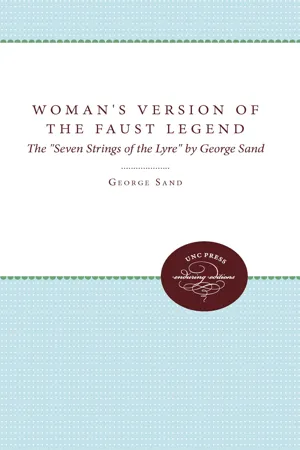
eBook - ePub
A Woman's Version of the Faust Legend
The Seven Strings of the Lyre
- 200 pages
- English
- ePUB (mobile friendly)
- Available on iOS & Android
eBook - ePub
About this book
Information
Topic
LetteraturaSubtopic
Critica letterariaAct One: The Lyre
Scene One
In the study of Master Albertus. He is writing. Wilhelm enters on tip-toe. It is night. In the distance is heard the noise of holiday-makers. [Master Albertus’s study is a large room, lined with books. On one wall, a large, full-length window, opening onto a balcony. Against the opposite wall stands a socle, or pedestal, on which rests a highly decorated lyre. Toward the front, a door opening onto a corridor gives access to the rest of the house and to the street; at the back, a fireplace and a small, low bed. In center stage, a large table or desk, covered with books and papers and holding an oil lamp. On each side of the table, chairs.]
ALBERTUS, without turning his head: Who is there? Is that you, Helen?
WILHELM, aside: Helen! Does she sometimes come to the philosopher’s study at midnight?
(Aloud) It’s me, Wilhelm. [He enters; not being invited to sit, he remains standing through the scene.]
ALBERTUS: I thought you were at the festival?
WILHELM: I’ve just come from there. I’ve tried, unsuccessfully, to take up my mind. Usually all I have to do to make my heart thrill with youth and good feeling is to breathe the air of a festival, but today it’s different.
ALBERTUS: Don’t tell me old age has chilled your blood! That’s the fashion everywhere. All young men regard themselves as blasé. Still, I wouldn’t mind if they were giving up pleasure for study, but it’s not a question of that. Their amusement consists in making themselves sad and believing they are unfortunate. Fashion is truly a strange thing.
WILHELM: Master, I admire you. You’re never sad or gay. You are always alone and always calm. Public celebration never draws you into its excitement, doesn’t make you feel the loneliness of your isolation. You hear the bands pass, you see the buildings illuminated, you even observe the country dancing, with its rainbow colors and the graceful rockets that fall in a shower of gold on the green dome of the big chestnut trees. And there you are, engaged in philosophical speculation on the hypothetical relationship between your peaceful subjectivity and the mad objectivity of all those little feet dancing below on the grass. I don’t understand why the white dresses passing and repassing, like ghosts through the greenery, don’t give you a thrill, and why your pen runs along the paper as though it were a watchman on his rounds that interrupts the silence of the night.
ALBERTUS: What I feel on seeing a festival can only slightly interest you. But how is it that you, who reproach me with indifference, are come home so early?
WILHELM: Dear Master, I will tell you the truth: I am bored wherever I know I’m not going to meet Helen.
ALBERTUS, startled: Do you continue to love her so much?
WILHELM: More all the time. Ever since she recovered her reason through your care she is more appealing than ever. Her past sufferings have left a mark of indescribable languor on her brow; and her melancholy, which discourages Carl and disconcerts even Hanz, is for me a greater attraction. Oh, she is charming! You don’t notice that, Master Albertus. You see her growing and blooming before your eyes, but you don’t know that she is a young woman. You look at her as always a child. You don’t even know if she is a blonde or brunette, if she’s tall or short!
ALBERTUS: In fact, I think she’s neither short nor tall, neither blonde nor brunette.
WILHELM: You’ve looked at her carefully then!
ALBERTUS: I have seen her often without thinking about looking at her.
WILHELM: Well then, what does she seem to you?
ALBERTUS: Beautiful as a pure and perfect Harmony. If the color of her eyes has not struck me, if I haven’t noticed her height, that doesn’t mean I am incapable of seeing and comprehending beauty. It is because her beauty is so harmonious, because there is so much accord between her character and her figure, so much unity in all her being, that I experience the charm of her presence without analyzing the qualities of her person.
WILHELM, a little troubled: Well said, for a philosopher. I would never have believed you were susceptible …
ALBERTUS: Go ahead and make fun of me, my boy. I know you think a philosopher is an offensive and disagreeable animal!
WILHELM: Don’t say that, my dear Master. Mon dieu, I wouldn’t make fun of you!—you, the best and greatest among the best and greatest of men! But if you only knew how happy I am that you don’t feel passion for women! — If by some chance you were to perceive too well the graces of Helen, what would become of a poor, beardless student with no brains like myself in competition with a man of your distinction?
ALBERTUS: Dear child, I’m not going to compete with you or anybody. I have too just an estimate of myself. I’ve passed the age of pleasing and loving.
WILHELM: What are you saying, Master? You’re hardly middle-aged! Despite the way you burn the midnight oil in studying, you still don’t have a single wrinkle. And when the fire of some noble enthusiasm animates your eyes, young as we are, we lower our gaze as at the appearance of a being superior to us, as at a ray of celestial light!
ALBERTUS: Don’t say that, Wilhelm. It distresses me without accomplishing anything. Grace and charm belong exclusively to youth. The beauty of mature age is like an autumn fruit that rots on the branch because the fruits of summer have appeased thirst. (He pauses.) To tell the truth, Wilhelm, I never had any youth, and the dried fruit will fall without having attracted the eye or hand of any passersby.
WILHELM: So they have told me, Master, and I haven’t been able to believe it. Could it really be true that you have never been loved?
ALBERTUS: Only too true, my friend. But all regret would be vain and useless today.
WILHELM: Never been loved! Poor Master! — But you have known so many other sublimities of which we have no idea.
ALBERTUS, brusquely: Yes, doubtless, doubtless. — Wilhelm, do you then want to marry Helen?
WILHELM: Dear Master, you well know it has been my one wish for the last two years.
ALBERTUS: And would you quit your studies to take a job? For eventually you would have to find a way to raise a family. Philosophy is not a lucrative career.
WILHELM: I don’t care what I might have to do. As you know, when the question of my marriage to Helen arose, the old lutemaker Meinbaker, her father, demanded that I leave school for his workshop, leave the study of science for instruments of toil, the books of history and metaphysics for the account books of business. The good man wanted as son-in-law only somebody who could work a file and a plane like the most humble artisan and direct his business like himself. Well, I would have signed up for all that: no cost would have been too great to obtain his daughter. I was already capable of assembling the best harp that had left his shop. With the violins, I feared no rival. With God’s help, and my little talent and small capital, I could still buy an interest in a business and set up a modest shop in musical instruments.
ALBERTUS: Would you renounce, without regret, the cultivation of your intelligence, the enlargement of the circle of your ideas, the raising of your soul toward the ideal?
WILHELM: You see, Master, I am in love. That’s the sum of it. If, back when he was rich, Meinbaker had offered me his immense fortune instead of his charming daughter, and with it the honors which are decreed only to kings, I wouldn’t have hesitated to remain faithful to the worship of science, and I would have crushed under foot all material goods to raise myself toward the sky. But for me, Helen is the ideal. She is the sky, or more, she is the harmony that governs celestial things. I have no more need of intelligence. All I need do is see Helen, and right away I understand all the marvels that patient study and the exercise of reason would have revealed to me only one by one. Dear Master, I know you can’t understand this, but it’s really quite simple. What I believe is that through love I will arrive more quickly at faith, virtue, divinity, than you will by study and abstinence. Otherwise I would not again be resolved to lose my intelligence for the sake of living by my heart.
ALBERTUS: Perhaps your feelings govern you without your knowing it and suggest to you some ingenious sophisms that I don’t dare combat for fear you may become infatuated with philosophical pride. Dear child, be happy in your abilities and give in to the force of your youthful impetuosity. A day will certainly come when you will look back, angry at having let your intelligence slumber in these delights …
WILHELM: Still, Master, after a career dedicated to scientific speculation, it happens that an austere man looks into the past, angry at having let his passions flicker out in abstinence.
ALBERTUS: You speak too truly, Wilhelm. — Enough, look at this lyre. Do you know what it is?
WILHELM: It is the famous lyre of ivory, invented and assembled by the celebrated lyremaker Adelsfreit, worthy ancestor of Helen Meinbaker. They say he finished it the very day of his death, about a hundred years ago. The good Meinbaker preserved it as a relic, without allowing his own daughter even to breathe on it. It’s a precious instrument, Master, and its like is not to be found anywhere. The ornamentation is in such exquisite taste, and the ivory figures all around it of such wonderful workmanship, that admirers have offered immense sums for it. But though financially ruined, Meinbaker preferred to die of starvation rather than to let this incomparable instrument leave his house.
ALBERTUS: Yet this incomparable instrument is mute. It is a work of patience and an object of art which serves no purpose and from which it is impossible to draw any sound. Its strings are loose or rusty, and not even the greatest artist could make it play.
WILHELM: What are you getting at, Master?
ALBERTUS: At this: the soul is a lyre on which all the strings should be played, sometimes together, sometimes one by one, following the laws of harmony and melody. But if you let the strings rust or go slack, though they were once delicate and powerful, it is in vain that you care for the external beauty of the instrument, in vain for the gold and ivory of the lyre to remain pure and bright. The voice of heaven no longer lives in it, and this corpse without a soul is nothing more than a useless piece of furniture.
WILHELM: That can be applied to you and me, dear Master. You have played too much on the golden strings of the lyre, and while you shut yourself up in your favorite subject, the brazen strings are broken. For me the opposite is true. I willingly break the celestial strings that you have touched for the sake of playing with impetuous intoxication on the passionate strings which you hold in too great contempt.
ALBERTUS: And both of us are unskilled, incomplete, blind. One should know how to play with both hands and in all the scales …
WILHELM, without hearing him: Master Albertus, you have so much influence on Helen’s mind! Will you undertake to renew to her my proposals so that she may accept me for her husband?
ALBERTUS: My child, I shall work to that end with all my heart and all my power, for I am persuaded that she could not make a better choice.
WILHELM: Blessings on you, and may heaven crown your efforts with success. Good night, my good Master. Forgive me for being so little philosophical. Forget the ungrateful student who is abandoning you, but remember your devoted friend who will remain always faithful.
Scene Two
ALBERTUS, alone: Oh sublime Philosophy! Is it thus that a man deserts thy altars? With what ease thou art forsaken for the first passion that seizes the senses! Is thy empire then really nothing, and thy ascendance really absurd? Alas, how feeble the bonds with which thou enchainest us, since, after years of sacrifice, after half a lifetime consecrated to heroic perseverance, we feel again, with so great bitterness, the horror of solitude and the anguish of ennui!
Sovereign Spirit, Source of all Light and Perfection, thou whom I wished to know, to feel, and to see closer than other men do, thou knowest that I have sacrificed all, and myself more than anything, to relate myself to thee, while purifying myself. Since thou alone knowest the greatness of my sacrifices and the immensity of my suffering, how is it that thou dost not help me more effectively in my hours of distress? How does it happen that, caught in a dull agony, I consume myself within like a lamp whose light casts a more ardent brilliance at the moment when the oil is about to give out? How does it happen that instead of being the sage, the stoic, whose serenity everyone admires and envies, I am the most uncertain, the most devoured, the most miserable of men?
(Moving to the balcony) Eternal First Principle, Soul of the Universe, O Great Spirit, O God! Thou who art resplendent in the sublime firmament and who livest in the infinity of these shining suns and other worlds, thou knowest that it is not love of vain glory or pride in futile knowledge that led me along this path of renouncing earthly things. Thou knowest that, if I have wished to raise myself above other men by virtue, my goal has not been to think more highly of myself than of them, but to bring myself closer to thee, source of all light and of all perfection. I preferred the delights of the soul to the enjoyment of perishable matter; and thou knowest, thou who readest men’s hearts, how mine was pure and sincere!
Why then this mortal weakness that seizes me? Why these cruel doubts that tear me? Is the road of wisdom then so rough that the more one advances, the more one meets obstacles and perils? Why, when I have passed victoriously through the passionate years of youth, am I, in my middle age, exposed to more and more terrible trials? Should I then regret, at a time when it is too late, what I scorned when there was still time to possess it? Is the heart of man made so that only pride maintains its force, and the heart would not know how to accept grief if...
Table of contents
- Cover Page
- A Woman’s Version of the Faust Legend
- Copyright Page
- Dedication
- Contents
- Introduction
- Translator’s Note
- The Seven Strings of the Lyre
- Act One: The Lyre
- Act Two: The Strings of Gold
- Act Three: The Strings of Silver
- Act Four: The Strings of Steel
- Act Five: The Brazen String
- Select Bibliography
- Index
Trusted by 375,005 students
Access to over 1.5 million titles for a fair monthly price.
Study more efficiently using our study tools.
Frequently asked questions
Yes, you can cancel anytime from the Subscription tab in your account settings on the Perlego website. Your subscription will stay active until the end of your current billing period. Learn how to cancel your subscription
No, books cannot be downloaded as external files, such as PDFs, for use outside of Perlego. However, you can download books within the Perlego app for offline reading on mobile or tablet. Learn how to download books offline
Perlego offers two plans: Essential and Complete
- Essential is ideal for learners and professionals who enjoy exploring a wide range of subjects. Access the Essential Library with 800,000+ trusted titles and best-sellers across business, personal growth, and the humanities. Includes unlimited reading time and Standard Read Aloud voice.
- Complete: Perfect for advanced learners and researchers needing full, unrestricted access. Unlock 1.5M+ books across hundreds of subjects, including academic and specialized titles. The Complete Plan also includes advanced features like Premium Read Aloud and Research Assistant.
We are an online textbook subscription service, where you can get access to an entire online library for less than the price of a single book per month. With over 1.5 million books across 990+ topics, we’ve got you covered! Learn about our mission
Look out for the read-aloud symbol on your next book to see if you can listen to it. The read-aloud tool reads text aloud for you, highlighting the text as it is being read. You can pause it, speed it up and slow it down. Learn more about Read Aloud
Yes! You can use the Perlego app on both iOS and Android devices to read anytime, anywhere — even offline. Perfect for commutes or when you’re on the go.
Please note we cannot support devices running on iOS 13 and Android 7 or earlier. Learn more about using the app
Please note we cannot support devices running on iOS 13 and Android 7 or earlier. Learn more about using the app
Yes, you can access A Woman's Version of the Faust Legend by George Sand, George A. Kennedy in PDF and/or ePUB format, as well as other popular books in Letteratura & Critica letteraria. We have over 1.5 million books available in our catalogue for you to explore.