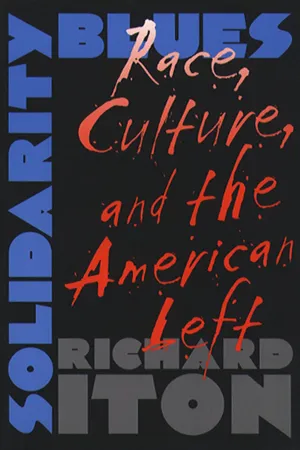
A number of arguments have been made to explain the relative weakness of the American Left. A preference for individualism, the effects of prosperity, and the miscalculations of different components of the Left, including the labor movement, have been cited, among other factors, as possible explanations for this puzzling aspect of American exceptionalism. But these arguments, says Richard Iton, overlook a crucial factor — the powerful influence of race upon American life.
Iton argues that the failure of the American Left lies in its inability to come to grips with the centrality of race in the American experience. Placing the history of the American Left in an illuminating comparative context, he also broadens our definition of the Left to include not just political parties and labor unions but also public policy and popular culture — an important source for the kind of cultural consensus needed to sustain broad social and collectivist efforts, Iton says.
In short, by exposing the impact of race on the development of the American Left, Iton offers a provocative new way of understanding the unique orientation of American politics.
- 360 pages
- English
- ePUB (mobile friendly)
- Available on iOS & Android
eBook - ePub
About this book
Information
Chapter One: Gateway Blues
In the United States of North America, every independent movement of the workers was paralyzed so long as slavery disfigured a part of the Republic. Labour cannot emancipate itself in the white skin when in the black it is branded.—Karl Marx, Capital
I think America is growing more and more complicated, and it seems to me that our conversation is not keeping up with that complexity. This … dialogue began [with the suggestion] … that the unfinished business of America is black and white, but it strikes me that… what we really need to do is understand how complex this country is, with Samoan rap groups and Filipinos and Pakistani cab drivers, and the racial relationships now in America are so complex and so rich that it seems to me that we don’t have a language even to keep up with that complexity.—Richard Rodriguez, in “A Dialogue on Race with President Clinton”
Why is there no “real” American left? How has the United States managed to avoid the degree of class-based social conflict characteristic of the politics of most Western societies? Although various arguments have been offered to explain American exceptionalism and the failure of socialism to establish a foothold in the United States as it has elsewhere in the West, my discussion will focus on the significance of one factor—race—and its role in the unmaking of the American left. I will argue that the particular demographic circumstances that have existed throughout American history, along with the way in which these circumstances have been interpreted and processed and, in particular, racialized, have contributed significantly to the unique pattern of social relations one finds in the United States.
To understand the relationship between race and American exceptionalism properly requires reexamination of the concepts and approaches that are commonly used to explain the absence of the American left. Unfortunately, investigations into the exceptionalism phenomenon have often employed methodologies and conceptual strategies that have guaranteed a misunderstanding of the real reasons why there is no American left. Indeed, procedural choices and disciplinary limitations have encouraged some analysts to underrate the significance of the issue itself.
For instance, the historian Sean Wilentz suggests that the exceptionalism debate has resulted from a basic misreading of American labor history and an overstatement of the pace and significance of events in European labor history. Consequently, he argues, “there is a history of class consciousness in the United States comparable to that of working-class movements in Britain and on the Continent.”1 Indeed, Wilentz concludes that the exceptionalism issue is a “colossal non-problem” and that the predominance of the exceptionalism perspective has warped the analyses of American social historians.2 Similarly, the historian George M. Fredrickson suggests, “The notion that the United States has exhibited radical peculiarities that have made its experience categorically different from that of other modern or modernizing countries has encouraged an oversimplified and often idealized view of the American past.”3 Whether accepting or rejecting Wilentz’s and Fredrickson’s arguments about the significance of the issue, many American labor and social historians have approached the question in these same terms: the degree of working-class consciousness, and the relative strength of leftist parties and labor union solidarity.4
Yet limiting the study of the American left and the exceptionalism issue to the examination of attitudes, events, and movements without considering results and achievements has arguably resulted in a less accurate and nuanced understanding of the significance and derivation of the peculiar nature of the American political culture. Very few analysts approach the study of the left in a comprehensive manner. A “search for” the American left—or any left—should work from the understanding that a left is a means to the creation of a certain kind of society and a certain set of public goods. Beyond the lack of a leftist political party and a “radicalized” working class, the most striking feature of the American political culture is its inability to produce and maintain some basic public goods: comprehensive health care, sufficient housing provisions, effective worker organization and protection, and consistent police protection. To this list one could add gun control legislation, quality elementary and secondary education, public transportation, and inclusive voter registration procedures. In other words, the search for “the American left” might not be, as Wilentz suggests, a “colossal non-problem” but an attempt to understand how and why the American political culture has failed to manifest the collective will to produce a set of public goods.5
At another level, any search for the missing American left must make the effort to study the phenomenon in the wider (political) cultural context. Perhaps because American leftists have often been perceived to function as extracultural aliens within the context of their society, able to look into but unable to lock onto the popular imagination as an organic expression of the culture’s collective psyche, historians and political scientists have tended to approach the historical development of the left outside the context of American society. In significant contrast, in the other Western societies leftist movements have arisen as organic grassroots expressions of their respective political cultures.6 The study of the American left, then, needs to proceed beyond the cataloguing of words and sentiments to some understanding of the movement’s function—specifically, to create and maintain the provision of a certain set of public goods. These studies must also entail investigation of the social roots of leftist movements, as well as identification of the basic cultural sensibilities and conditions that lead to the development or nondevelopment of a leftist movement. Culture needs to be addressed in the study of the left as a potential source or medium of leftist sentiment and also as a text that can be read in order to expose a society’s underlying structure.
Overall, a reorganization of the manner in which the “missing” American left is examined will do much to change the nature of the conclusions that are drawn concerning the causes and sources of its weakness. In other words, a thorough and comprehensive analysis of the history of the American left—including considerations of public policy and popular culture, as well as class consciousness, labor movements, and leftist parties—will clarify that its marginalization has been, to a significant degree, a function of the popular fascination with race.
This preoccupation with race has affected the prospects of American leftist movements in various ways. At the most basic level, the strength of the popular attachment to racial categories has reduced the appeal of class-based movements. Leftist organizations, consequently, have been marginalized because their efforts to mobilize members of the working classes conflicted with the more deeply rooted and developed racial identifications of these constituencies to such an extent that even those leftist campaigns which did not seek to challenge racial norms were still perceived as threats to the racial status quo (e.g., the American Federation of Labor [AFL] before the civil rights era). Thus challenges to the economic status quo have been interpreted, legitimately I might add, as potential or implicit challenges to prevailing racial understandings. In this context those movements of the left which questioned social conventions regarding race explicitly were even less appealing to crucial working-class constituencies (e.g., the American Communist Party after 1928).
The left’s ability to organize effectively has also been restricted because of conflicts within and between different organizations over whether antiracist and antinativist principles should be adopted and promoted. The energies consumed by debates between nativist and racist elements and those actors advocating inclusive mobilization strategies reduced the left’s capacity to launch coordinated campaigns (e.g., the battles that took place within the AFL and the labor movement as a whole). The expression of nativist and racist sentiments by leftists also, of course, alienated immigrant and black workers from leftist causes, an alienation that employers and the left’s opponents could exploit for their own purposes to weaken unions and other leftist organizations. This distrust and mutual hostility also resulted in separate labor and political organizations, as those groups excluded from the mainstream left established their own institutions to pursue their own agendas.
Last, with regard to the general ways in which racial dynamics have affected leftist outcomes, leftist organizations (and indeed many analysts of the. left) have underestimated the importance of the issues of race and ethnicity and their effects on the left’s chances. Even th...
Table of contents
- Cover Page
- Solidarity Blues: Race, Culture, and the American Left
- Copyright Page
- Dedication
- Contents
- Tables
- Acknowledgments
- Chapter One: Gateway Blues
- Chapter Two: Race, Ethnicity, and the Cooperative Commonwealth
- Chapter Three: Southern Politics and the Unmaking of the American Left
- Chapter Four: Beyond the Left I
- Chapter Five: Beyond the Left II
- Chapter Six: Memphis Diversities
- Chapter Seven: Making Love in America
- Notes
- Bibliography
- Index
Trusted by 375,005 students
Access to over 1.5 million titles for a fair monthly price.
Study more efficiently using our study tools.
Frequently asked questions
Yes, you can cancel anytime from the Subscription tab in your account settings on the Perlego website. Your subscription will stay active until the end of your current billing period. Learn how to cancel your subscription
No, books cannot be downloaded as external files, such as PDFs, for use outside of Perlego. However, you can download books within the Perlego app for offline reading on mobile or tablet. Learn how to download books offline
Perlego offers two plans: Essential and Complete
- Essential is ideal for learners and professionals who enjoy exploring a wide range of subjects. Access the Essential Library with 800,000+ trusted titles and best-sellers across business, personal growth, and the humanities. Includes unlimited reading time and Standard Read Aloud voice.
- Complete: Perfect for advanced learners and researchers needing full, unrestricted access. Unlock 1.5M+ books across hundreds of subjects, including academic and specialized titles. The Complete Plan also includes advanced features like Premium Read Aloud and Research Assistant.
We are an online textbook subscription service, where you can get access to an entire online library for less than the price of a single book per month. With over 1.5 million books across 990+ topics, we’ve got you covered! Learn about our mission
Look out for the read-aloud symbol on your next book to see if you can listen to it. The read-aloud tool reads text aloud for you, highlighting the text as it is being read. You can pause it, speed it up and slow it down. Learn more about Read Aloud
Yes! You can use the Perlego app on both iOS and Android devices to read anytime, anywhere — even offline. Perfect for commutes or when you’re on the go.
Please note we cannot support devices running on iOS 13 and Android 7 or earlier. Learn more about using the app
Please note we cannot support devices running on iOS 13 and Android 7 or earlier. Learn more about using the app
Yes, you can access Solidarity Blues by Richard Iton in PDF and/or ePUB format, as well as other popular books in History & North American History. We have over 1.5 million books available in our catalogue for you to explore.