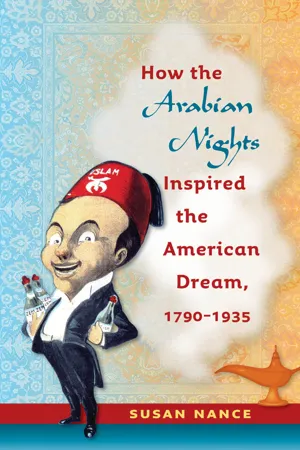
Americans have always shown a fascination with the people, customs, and legends of the “East” — witness the popularity of the stories of the Arabian Nights, the performances of Arab belly dancers and acrobats, the feats of turban-wearing vaudeville magicians, and even the antics of fez-topped Shriners. In this captivating volume, Susan Nance provides a social and cultural history of this highly popular genre of Easternized performance in America up to the Great Depression.
According to Nance, these traditions reveal how a broad spectrum of Americans, including recent immigrants and impersonators, behaved as producers and consumers in a rapidly developing capitalist economy. In admiration of the Arabian Nights, people creatively reenacted Eastern life, but these performances were also demonstrations of Americans' own identities, Nance argues. The story of Aladdin, made suddenly rich by rubbing an old lamp, stood as a particularly apt metaphor for how consumer capitalism might benefit each person. The leisure, abundance, and contentment that many imagined were typical of Eastern life were the same characteristics used to define “the American dream.”
The recent success of Disney’s Aladdin movies suggests that many Americans still welcome an interpretation of the East as a site of incredible riches, romance, and happy endings. This abundantly illustrated account is the first by a historian to explain why and how so many Americans sought out such cultural engagement with the Eastern world long before geopolitical concerns became paramount.
- 360 pages
- English
- ePUB (mobile friendly)
- Available on iOS & Android
eBook - ePub
How the Arabian Nights Inspired the American Dream, 1790-1935
About this book
Information
Chapter 1: Capitalism and the Arabian Nights, 1790–1892
The population of the United States has always embraced a consumer ethic of one sort or another. Even before the market revolution of the early nineteenth century, historians tell of colonial subjects mobilized politically in a “revolutionary marketplace” in which their shared experiences as consumers helped a diverse population decide to support rebellion against Britain so as to protect consumer choice and domestic production.1 Once the dust had settled, with the Revolutionary Wars resolved and the Constitution in place, shoppers in one Virginia town made a translation of the Arabian Nights the single most popular work of fiction sold by the local bookseller.2 Years later, when those and other Anglo-American readers remembered the hours of enjoyment they had with the Nights when they and the Republic were still young, they always said basically the same thing: the Nights had “highly excited” their imaginations with vivid scenes of magical events and incredible wealth, “houses of gold and streets paved with diamonds.”3
The collection of short stories known as the One Thousand and One Nights or Arabian Nights’ Entertainments would continue to be in steady demand in urban, rural, and frontier parts of the United States throughout the nineteenth century.4 The translations Americans read shared a famous frame tale in which a Persian woman named Scheherezade each night recounted to her husband, King Shahriyar, a gripping story. Fearing he would kill her the next morning, every evening she refused to reveal the resolution of her story in order to persuade her husband to leave her alive for one more day. The next night, she would finally end the previous story only to begin another right away. As the frame tale went, Scheherezade saved herself for one thousand and one nights through her stories, most famously the tales of Aladdin and the magic lamp, Ali Baba and the Forty Thieves, the Seven Voyages of Sinbad the Sailor, and tales of the venerable Haroun al-Raschid, powerful but generous “governor of old Baghdad.”
The mind-boggling luxuries described in the Nights contrasted sharply with the modest, hard-working lives of those readers. For citizens who had just fought a war for economic and political independence, the Nights provided colorful metaphors of the potential contentment and plenty they might enjoy as consumers in a nation that, by 1840, was becoming a global powerhouse rivaled only by Britain. Here was a nation undergoing dramatic cultural and economic changes, especially in cities crowded with foreign and domestic rural immigrants, and open to expanding global trade. Increasing access to the world’s cultures, products, and people also meant that Americans increasingly had more ways by which to consider and display personal identity.5 Many took to heart the antebellum consumer ethic of individuation by which people strove for self-improvement and economic autonomy displayed through the appropriate clothing or household reading materials, for instance, while endorsing the perceived democracy inherent in a market society that promised prosperity for all citizens.6
In the beginning, Americans looked specifically to the Muslim world and the Arabian Nights for prototypes of luxurious consumption and transformation that served as metaphors for democratic capitalism. Americans gained access to Eastern literature as translated adaptations of the Nights and stories created in imitation of the Nights known as Oriental tales or “tales of the East.” Between the Revolution and 1892, middle-class and upper-class Anglo-Americans would use these sources and forms to construct an Orientana of the “ultra-artificial” that endorsed capitalism through compelling modes of consumption that allowed anyone to play Eastern. These Eastern characters endorsed hedonistic consumption and a consumer’s Oriental tale to help people think about the romantic promise of magical self-transformation, repose, and contentment to be found in the market.
The consumer possibilities Americans would see in the Nights and other Oriental tales are an important part of the answer to the question of “how ‘the consumer’ arose,” as Frank Trentmann asks of why people chose to think of themselves as consumers in the nineteenth century.7 Americans saw their acquisitive desires brought to life in the Arabian Nights and developed a consumer’s Oriental tale to enact fantasies of contented, leisured consumption that was useful in both modes of market participation: as producers of goods and services that made the United States a capitalist power and as consumers seeking self-fulfillment and personal expression in a society of abundance. The consumer’s Oriental tale was not in effect a protest against materialism or industrialization or capitalism but a way of participating in these developments in ways that seemed creative and authentic to the emerging identities of many individuals. As Colin Campbell and others explain, the romantic consumer ethic that emerged beginning in the nineteenth century was no anomaly but a tool Americans needed in order to internalize both a productive “Protestant work ethic” and a romantically expressive, hedonistic consumerism.8
Consequently, this chapter is about a couple of firsts in American history, the first opportunities Americans made to play Eastern by writing Oriental tales that imitated the Arabian Nights and the first opportunities Americans took to play Eastern as consumers by enacting the scenes of ease and plenty they found in the Nights in their own lives and houses. Between 1790 and the 1890s, Anglo-Americans cherished the Arabian Nights deeply, seeing it as a literary classic that coexisted with the Bible in helping people interpret West Asia. Though the politics over who can use what to express himself or herself have changed in many respects today, Americans coping with capitalism in 1830 or 1880 did not often worry about whether they should draw inspiration from the Nights or some other cultural product from the East but rather how to do so in authentic and meaningful ways. They sorted these values out first by writing Oriental tales, stories in imitation of the Arabian Nights through which they talked about material abundance, leisure, and self-renovation. People used the Oriental-tale style as a “creative notion” and artistic practice that they could carry over into mutually promoting forms directed at middling consumers including poetry, travel narratives, parade decoration, advertising, retail space design, and common colloquialism.9
For most Anglo-Americans who were not professional writers, painters, or travelers, amateur attempts at replicating what they read about usually took place through consumption of goods that carried similar retellings of the consumer’s Oriental tale. People would try the tale on for size by playing Eastern at home in order to make the most of the vast material transformation of the United States, casting themselves in the role of an incredulous Aladdin made wealthy in an instant. The metaphor of American capitalism as Oriental tale would not be without its critics, but it carried on throughout the nineteenth century nonetheless because so many people found it specifically useful for coping with the market revolution, western expansion, and the industrial revolution, all of which seemed to promise great riches and happiness but so often supplied financial panics, disappointment, and personal obscurity.
THE ARABIAN NIGHTS IN TRANSLATION AND ADAPTATION
To understand how the Nights became useful to Americans, we need first to explode the myth that Western adaptations of the Nights were crude appropriations of some pristine Arab cultural tradition. Instead we can see Americans who played Eastern as part of the global story of the Nights as a shared tradition.10 The land depicted in the Arabian Nights—from Egypt through Persia to India and China—had always been a global trade and travel crossroads. As artists and storytellers transmitted the root stories behind the Nights through this network of societies, the tales were never a static text. In every place and time, borrowing, plagiarism, and recycling of material have been at the heart of the creative process, a reality the Nights could not escape. Often orally transmitted, thousands of people reworked and adapted the tales to suit their particular language, audience, and time. Only in the hands of Arab storytellers and European compilers would the tales take the form of the Thousand and One Nights as Americans knew them.11
The Western part of this story began during the “Age of Discovery” in the seventeenth and eighteenth centuries. It was a period marked by new global travel and trade between Europeans, Americans, and the Muslim world, resulting in what Schwab calls an “Oriental Renaissance” that reinvigorated Western art and literature.12 By the late eighteenth century, a new generation of writers on both sides of the Atlantic were rejecting the conventional “pietistic Calvinism” of sixteenth-century and seventeenth-century sermons and miracle stories, which made up the bulk of reading material then. Instead they wrote “gay stories and splendid impieties of the traveller and the novelist,” Royall Tyler, author of famed American antislavery novel The Algerian Captive (1797), explained of his cohort.13 The Arabian Nights was a great inspiration to these authors, a global masterpiece of imagination so complex and varied that one could find characters, plot lines, or narrative styles to suit any conceivable situation of adaptation. Thus, some early American reviewers pronounced the Nights superior even to Shakespeare in literary importance.14
Anglo-American interest in adapting the Nights to domestic audiences was also a product of plain logistics. The United States had the highest literacy rates in the world and a changing economy that allowed more and more people free time for reading.15 A burgeoning publishing industry served and expanded this readership, giving more people access to aspects of Asia’s creative arts by way of books, lectures, magazines, newspapers, and inexpensively replicated portraits and landscape images. The prices of such printed materials came down between 1750 and 1850, creating an “explosion of printed matter” and markets for authors that were never before possible.16
In the midst of the publishing boom in the United States, Edward W. Lane’s highly praised English translation, The Thousand and One Nights, commonly called in England, The Arabian Nights’ Entertainments (1839–41), emerged as the state of the art.17 Lane’s edition exposed the open secret that the Arabian Nights could be made locally relevant because the stories existed at the intersection of history and artistic license. Indeed, for Western translators even to make the Nights available to non-Arabic consumers in the first place required the stories to be reworked and adapted to a substantial degree, defying even the possibility of a culturally neutral translation in any language, and some contemporary readers talked openly about this. American fans appreciated Edward Lane’s translation because it surpassed the first translated adaptation most Anglo-Americans might have seen (if they could read French), Antoine Galland’s Les Mille et Une Nuits (1704). Galland had attempted the difficult task of translating the stories into French prose that was not mechanical and literal but rather, like all good translations, attempted to convey the narratives in French prose that appealed to his early eighteenth-century audience. Translated into English, reprinted and bootlegged for decades thereafter, Galland’s rendition came across as burdened with French idioms and sounded to Americans more French than anything else.18
By contrast, Lane created an English-language adaptation for a broad middle-class and upper-class readership that was more literally translated to capture and celebrate, he hoped, the creative agency of Middle Eastern artists. It came with ample footnotes that described the stories as the performance art of actual Egyptian storytellers and sought to engender the reader’s sympathy toward a part of the world routinely criticized by Europeans.19 “Public taste has changed since [Galland’s day]; we prefer to preserve the Oriental coloring of manner and style,” Atlantic Monthly said of the contemporary standards of evaluation and Lane’s timeliness.20 Lane’s edition seemed more Middle Eastern because it restored “the spirit and style of the original,” one early review explained.21 That is, Lane used prose that endorsed the important artistic assumption that, in contrast to plain-speaking Americans, real Easterners past and present used flowery and pompous language that expressed their heightened love of beauty, leisure, and ceremony.
Of course, non-Arabic speakers with no access to the Arabic manuscripts or contemporary Egyptian popular culture could not have verified whether this was true, but the belief prevailed that Lane’s version was most accurate, nonetheless, in communicating the “truth” of the Nights as art. Other copiously footnoted, scholarly looking editions, “With an Explanatory and Historical Introduction by G. M. Bussey. Carefully Revised and Corrected, with some Additions,” for instance, extended historical and documentary claims for the stories, which gave them an appealing authenticity despite the artistic license involved in their production.22 Moreover, all American authors routinely applied scholarly historical pretenses to their fiction for one very simple reason: history sold better than any other genre of published material because it could come across to readers as entertaining and educational, and it had earned men like Washington Irving great fortunes.23
Thereafter, translated adaptations of the stories continued to emerge throughout the nineteenth century, some serialized in newspapers and magazines, some sold as inexpensive cha...
Table of contents
- Cover Page
- Title Page
- Copyright Page
- Contents
- Illustrations
- Preface
- Introduction: Playing Eastern
- Chapter 1: Capitalism and the Arabian Nights, 1790–1892
- Chapter 2: Ex Oriente Lux: Playing Eastern for a Living, 1838–1875
- Chapter 3: Wise Men of the East and the Market for American Fraternalism, 1850–1892
- Chapter 4: Arab Athleticism and the Exoticization of the American Dream, 1870–1920
- Chapter 5:Making the Familiar Strange: The Racial Politics of Eastern Exotic, 1893–1929
- Chapter 6: Eastern Femininities for Modern Women, 1893–1930
- Chapter 7: Turbans and Capitalism, 1893–1930
- Chapter 8: Sign of Promise: African Americans and Eastern Personae in the Great Depression
- Notes
- Bibliography
- Index
Trusted by 375,005 students
Access to over 1.5 million titles for a fair monthly price.
Study more efficiently using our study tools.
Frequently asked questions
Yes, you can cancel anytime from the Subscription tab in your account settings on the Perlego website. Your subscription will stay active until the end of your current billing period. Learn how to cancel your subscription
No, books cannot be downloaded as external files, such as PDFs, for use outside of Perlego. However, you can download books within the Perlego app for offline reading on mobile or tablet. Learn how to download books offline
Perlego offers two plans: Essential and Complete
- Essential is ideal for learners and professionals who enjoy exploring a wide range of subjects. Access the Essential Library with 800,000+ trusted titles and best-sellers across business, personal growth, and the humanities. Includes unlimited reading time and Standard Read Aloud voice.
- Complete: Perfect for advanced learners and researchers needing full, unrestricted access. Unlock 1.5M+ books across hundreds of subjects, including academic and specialized titles. The Complete Plan also includes advanced features like Premium Read Aloud and Research Assistant.
We are an online textbook subscription service, where you can get access to an entire online library for less than the price of a single book per month. With over 1.5 million books across 990+ topics, we’ve got you covered! Learn about our mission
Look out for the read-aloud symbol on your next book to see if you can listen to it. The read-aloud tool reads text aloud for you, highlighting the text as it is being read. You can pause it, speed it up and slow it down. Learn more about Read Aloud
Yes! You can use the Perlego app on both iOS and Android devices to read anytime, anywhere — even offline. Perfect for commutes or when you’re on the go.
Please note we cannot support devices running on iOS 13 and Android 7 or earlier. Learn more about using the app
Please note we cannot support devices running on iOS 13 and Android 7 or earlier. Learn more about using the app
Yes, you can access How the Arabian Nights Inspired the American Dream, 1790-1935 by Susan Nance in PDF and/or ePUB format, as well as other popular books in History & North American History. We have over 1.5 million books available in our catalogue for you to explore.