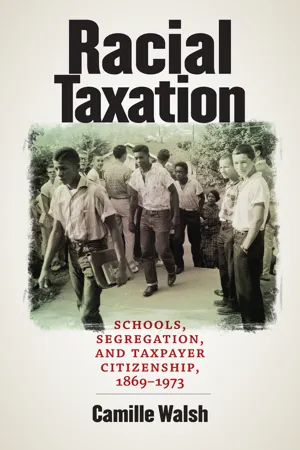
In the United States, it is quite common to lay claim to the benefits of society by appealing to “taxpayer citizenship” — the idea that, as taxpayers, we deserve access to certain social services like a public education. Tracing the genealogy of this concept, Camille Walsh shows how tax policy and taxpayer identity were built on the foundations of white supremacy and intertwined with ideas of whiteness. From the origins of unequal public school funding after the Civil War through school desegregation cases from Brown v. Board of Education to San Antonio v. Rodriguez in the 1970s, this study spans over a century of racial injustice, dramatic courtroom clashes, and white supremacist backlash to collective justice claims.
Incorporating letters from everyday individuals as well as the private notes of Supreme Court justices as they deliberated, Walsh reveals how the idea of a “taxpayer” identity contributed to the contemporary crises of public education, racial disparity, and income inequality.
- 250 pages
- English
- ePUB (mobile friendly)
- Available on iOS & Android
eBook - ePub
About this book
Information
CHAPTER ONE
A Shabby Meanness
Origins of Unequal Taxation
In the decades after the Civil War, black education was frequently deployed as a political tool by white elites to rally poor and working-class whites away from potential coalitions by implying that tax funding for education was really “white” funding for black schooling, and that it would only encourage black resistance and rebellion. In her famous analysis of Southern lynch law in 1892, Ida B. Wells traced the classic excuses offered by the Memphis Evening Scimitar newspaper to justify lynchings, beginning with the narrative about protecting white women and moving very quickly to “the chief cause of trouble between the races,” which the paper described as “the Negro’s lack of manners.” The Scimitar defended the violence in the city’s history by blaming it on the black population and calling it “a remarkable and discouraging fact that the majority of such scoundrels are Negroes who have received educational advantages at the hands of the white taxpayers.”1 This belief in white taxpayer “generosity” and the “ingratitude” exhibited through African American resistance to structures of inequality and oppression helped crystallize a deeply entrenched sense of white entitlement to public school funding and spaces that would span generations to come.
This chapter introduces the origins of property-tax-based school financing and identifies the racialized nature of this funding system during the late nineteenth century. In addition, it traces the history of litigation against segregated and unequal education from the post–Civil War era until the turn of the twentieth century. Many of the cases on segregated and unequal education, which set the stage for the struggles of the NAACP and other organizations in the next century, were fought in Northern and midwestern local and state courts. One analysis has found eighty-two cases concerned with racial discrimination in schools filed from 1834 to 1903 in twenty states—almost all outside the South—and has concluded that blacks won in 55 percent of the cases in which a decision was rendered.2 In examining the judicial reasoning employed in these decisions, the long-term effects of these cases, and the concrete remedies offered to litigants, my research indicates that the formal victory that appears in many of these lawsuits was in fact largely illusory and failed to either desegregate schools or, of more direct relevance to the nature of many of the lawsuits, obtain equitable tax funding through practical remedies.
One predominant aspect of litigation in this period was the assertion of a legal identity as taxpayers by families of color; taxpayer citizenship consequently became linked to the idea of a right to education, a trend that would continue to have ramifications in the next century. As taxpayers, these individuals and groups were asserting an identity that precariously balanced democratic and antidemocratic potential. Though there were more formal victories in taxpayer lawsuits than direct segregation attacks, the middle-class aspirational rights framework this legal strategy envisioned is illustrated by the cases discussed in the next chapter that were brought at the height of the Jim Crow era, invariably on behalf of wealthy, propertied people of color. Ultimately, this framework of taxpayer citizenship would redound to the detriment of low-income people of color seeking educational equality. But in this era, even in the cases in which parents and families won small victories against school authorities, courts were unwilling to grant broad forms of relief or effective remedies, thereby enabling local authorities to find additional or marginally varied avenues toward protecting inequality and a white supremacist educational funding structure.
The Origins of Local School Taxation
Tax support for education has been cobbled together somewhat haphazardly since the earliest days of the common school movement. Connecticut used proceeds from liquor licenses to fund schools starting in 1774. New Orleans licensed theaters in 1826 on the condition that they pay an annual amount toward school support. And New York began using state lotteries to raise large amounts for its schools in 1799, as did Kentucky, Delaware, North Carolina, Mississippi, Michigan, Louisiana, and Maryland in the ensuing decades.3 Bank taxes were also used as a popular means to finance schools, which had the added bonus of helping to accustom people to the concept of public schools “without appearing to tax them for their support.”4
This late eighteenth- and early nineteenth-century idea that a system of common schools could be maintained through license fees and other funds from land sales and lotteries was abandoned when it was seen how little they actually produced and how rapidly the population of most states was increasing.5 This funding challenge led Northern states to begin to fight for direct local and county taxation for schools by 1830, carrying out “campaigns of education” to win over those who thought tax-supported schools might be dangerous and undemocratic.6 A national system of educational financing was even briefly considered, and then abandoned, after the Panic of 1837.7 One ongoing battle throughout the nineteenth century was over the elimination of pauper schools and the opening of public schools as free to all.8 Even then, however, most schools in the North were segregated. The South was far behind the North in developing common schools—by the time of the Civil War, North Carolina alone had a stable system of public education—but the schools that did exist were solely for white students.9 Southern educational exclusion would begin to change only during Reconstruction.
During the early period of Radical Reconstruction, Charles Sumner and other Republican allies founded the Department of Education in 1867, sought to enact a civil rights bill to outlaw school segregation, proposed massive federal aid to eliminate illiteracy, and attempted to amend the first Reconstruction Act to require Confederate states to create free and open public schools as a precondition to readmission to statehood.10 Sumner argued that “you cannot give the colored child any equivalent for equality.”11 Though the Radical Republicans were ultimately unsuccessful on most of these fronts, they did add their voices to pressure for educational equality. Their main victory was in the establishment of the Department of Education, which was demoted and then promoted again in the coming decades to stand for a federal interest in education. In the language proposing and supporting the department’s creation, the “natural right” to education for all the nation’s children was invoked by many supporters.12 In the end, however, it was in courts that much of the tension between white supremacy and black pursuit of educational equality and funding would receive a hearing, though with similarly mixed results.
The struggle over education in the late nineteenth century was primarily focused on the basic needs of building and obtaining any funding for schools for black children, after their categorical exclusion from education in the South for much of the century. One strategy used to circumvent straightforward equal funding by Kentucky, Maryland, Delaware, and Washington, D.C., after the Civil War was to apportion the school fund according to the real estate or poll taxes paid by blacks and whites. This creation of a racially distinct tax base was then emulated by other states and funds were assigned to white local officials to allocate as they wished, leading to large disparities in the funding of white and black schools.13 By constructing a school financing system dependent on both property ownership and race that was centered in the hands of local officials, these Northern and Southern states set up a structure that continues today in which educational services are treated as something that could and should be directly indexed to the amount of taxes paid, and therefore property and (at this time) race. This created what one historian has called “a double irony: expecting education to provide a meaningful substitute for power and then putting that education in the hands of the enemies of the powerless.”14 The system that directly linked taxation with education rights also, however, generated a legal consciousness that would manifest in the litigation discussed in the rest of this chapter, emerging out of the “resentment” felt by many African Americans toward the unequal distribution of school taxes.15
Some states did formally require equal expenditures for black and white schools for a time. Only in the South, however, where blacks were a significant voting bloc during Reconstruction, was anything close to formally equal expenditure ever achieved. Even then, this partial equality lasted only briefly during the 1870s and was often the combined result of Northern aid and “self-taxation” by the African American community.16 South Carolina, for example, spent nearly three times as much per pupil in white schools as it did in black schools by 1895.17 Similarly, Alabama went from spending $3.14 for a white pupil and $3.10 for a black pupil in 1890 to spending $10.07 per white pupil and $2.69 per black pupil on teacher salaries in 1910.18 These statistics show how states chose to classify the expenditures, but they do not capture the entire picture of racially distributed school funds and the inequalities they represented.
Even within a framework of facially “equal” state expenditure, funding was regularly diverted to white schools by school board and county officials, who were almost uniformly white. Historians of school finance in the nineteenth century have argued that one of the key educational funding developments after Reconstruction was the appropriation by white schools of local black taxes and state funds formally earmarked for black schools.19 Both of these techniques, Robert A. Margo argues, had the effect of increasing white school expenditures and lowering white school taxes, creating a particularly strong incentive to minimize spending on black schools where the black population was especially large in comparison.20 Margo also suggests that whites may have felt an entitlement to appropriate these funds based on their perception of racial tax differentials, as exemplified by the popular antitax slogan at the time, “The whites pay the taxes and the Negroes go to school.”21
Additionally, however, the history of the slave tax in many antebellum Southern states may have created a legacy of entitlement even among nonslaveholding whites, who had benefited from a system in which property taxes were very low thanks to the heavy subsidies provided from the slave taxes paid by the wealthiest third of the white population.22
As we will see in more detail in the next chapter, however, many wealthy blacks viewed their property and tax payments as linked to the right to education at least as much as whites did. Leslie Brown’s examination of Durham, North Carolina, indicates that for many middle-class African Americans with property, they felt more entitled to education than whites since they were essentially under a double tax burden to disproportionately subsidize white schools while still providing resources for black schools.23 Entitlement to education and to adequate funding was therefore cast in both racial and economic terms from the earliest public school taxation structures, and it was treated, sometimes on both sides, as a commodity that should be allocated on the basis of the amount of taxes paid.
Several attempts at federal aid to education were made after the Civil War. The Freedmen’s Bureau was the first national organization that focused on the education of former slaves. Between 1866 and 1870 the bureau spent two-thirds of its funds on education, and it came under criticism from many in Congress for its “racial exclusivity” at a time when illiteracy among poor whites was also high. Supporters responded that the education provided by the bureau was, in a sense, compensation for the wages lost to African Americans through slavery, indicating the beginnings of a combined racial and economic right to education.24 In fact, demand for education outpaced the ability of the bureau to build schools, locate teachers, and provide Northern aid—many freedmen in Virginia and Maryland were raising their own private funds even while paying taxes for white schools and in some cases were “building schoolhouses before teachers were available.”25
In 1870, as the bureau ran out of funds, Representative George Hoar of Massachusetts introduced the Hoar Bill, which would have created a national system of education for white and black children alike, something that Hoar believed was an essential component of Reconstruction policy.26 The system was to be funded by a federal tax and distributed according to population. After the Hoar Bill died, Mississippi representative Legrand Perce in 1872 introduced another bill for federal funding of education, this time from the proceeds of public land sales.27 Though the Perce Bill passed the House and had the president’s support, it failed to reach a vote in the Senate. Even after Democrats had regained control of much of the South by the 1880s, the Blair Bill to provide federal aid for education directly from the government treasury by taxing wealthier states to help support poorer states won passage in the Senate repeatedly be...
Table of contents
- Cover
- Title Page
- Copyright
- Dedication
- Contents
- Acknowledgments
- Introduction: Taxpayer Citizenship and the Right to Education
- Chapter One. A Shabby Meanness: Origins of Unequal Taxation
- Chapter Two. Let Them Plow: Beyond the Black-White Paradigm
- Chapter Three. We Are Taxpaying Citizens: Separate and Color-Blind
- Chapter Four. A Drain on Taxpayers: Graduate School Segregation and the Road to Brown
- Chapter Five. The White Man’s Tax Dollar: Segregationists and Backlash
- Chapter Six. Taxpayers and Taxeaters: Poverty and the Constitution
- Chapter Seven. The Rich Richer and the Poor Poorer: Intersectional Claims
- Conclusion: Education, Inequality, and the Hidden Power of Taxes
- Notes
- Bibliography
- Index
Trusted by 375,005 students
Access to over 1.5 million titles for a fair monthly price.
Study more efficiently using our study tools.
Frequently asked questions
Yes, you can cancel anytime from the Subscription tab in your account settings on the Perlego website. Your subscription will stay active until the end of your current billing period. Learn how to cancel your subscription
No, books cannot be downloaded as external files, such as PDFs, for use outside of Perlego. However, you can download books within the Perlego app for offline reading on mobile or tablet. Learn how to download books offline
We are an online textbook subscription service, where you can get access to an entire online library for less than the price of a single book per month. With over 1.5 million books across 990+ topics, we’ve got you covered! Learn about our mission
Look out for the read-aloud symbol on your next book to see if you can listen to it. The read-aloud tool reads text aloud for you, highlighting the text as it is being read. You can pause it, speed it up and slow it down. Learn more about Read Aloud
Yes! You can use the Perlego app on both iOS and Android devices to read anytime, anywhere — even offline. Perfect for commutes or when you’re on the go.
Please note we cannot support devices running on iOS 13 and Android 7 or earlier. Learn more about using the app
Please note we cannot support devices running on iOS 13 and Android 7 or earlier. Learn more about using the app
Yes, you can access Racial Taxation by Camille Walsh in PDF and/or ePUB format, as well as other popular books in Social Sciences & Educational Policy. We have over 1.5 million books available in our catalogue for you to explore.