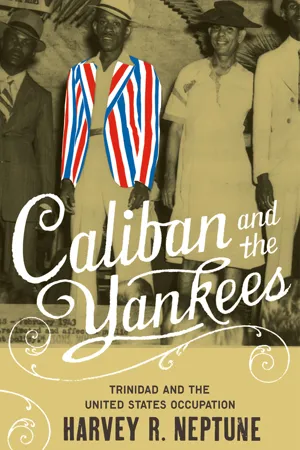
In a compelling story of the installation and operation of U.S. bases in the Caribbean colony of Trinidad during World War II, Harvey Neptune examines how the people of this British island contended with the colossal force of American empire-building at a critical time in the island’s history.
The U.S. military occupation between 1941 and 1947 came at the same time that Trinidadian nationalist politics sought to project an image of a distinct, independent, and particularly un-British cultural landscape.
The American intervention, Neptune shows, contributed to a tempestuous scene as Trinidadians deliberately engaged Yankee personnel, paychecks, and practices flooding the island. He explores the military-based economy, relationships between U.S. servicemen and Trinidadian women, and the influence of American culture on local music (especially calypso), fashion, labor practices, and everyday racial politics.
Tracing the debates about change among ordinary and privileged Trinidadians, he argues that it was the poor, the women, and the youth who found the most utility in and moved most avidly to make something new out of the American presence.
Neptune also places this history of Trinidad’s modern times into a wider Caribbean and Latin American perspective, highlighting how Caribbean peoples sometimes wield “America” and “American ways” as part of their localized struggles.
- 288 pages
- English
- ePUB (mobile friendly)
- Available on iOS & Android
eBook - ePub
About this book
Information
1
The Turbulent Thirties Shaking Empire, Making Nation
At the present time there is a wave of nationalism sweeping over the civilized world and the West Indies cannot fail to be caught in its vortex.
—Labor Leader, March 30, 1929
A new turbulence is at work everywhere[,] and Caliban is wide awake.
—George Lamming
The U.S. occupation of Trinidad coincided with what George Lamming would have characterized as the Age of Caliban. The ink had barely dried on the bases-for-destroyers deal when a local journal announced in its debut issue that its mission was to move the island’s “toilers” to “crash empires” and to “shape their own destiny.” 1 Inaugurated in November 1940, New Dawn was a document of the times, a bellwether of the nationalist current that swept across the British West Indies and, indeed, the rest of the colonized world.
A cultural projection no less than a political project, nationalism consolidated itself in Trinidad during the 1930s. In that decade there emerged a feisty young cadre of critics who insisted that the island community possessed its own distinguished culture and thus ought to reject a British identity. In advancing this line of advocacy, these dissidents stood on decisively new ideological ground; more than protesting Great Britain’s autocratic Crown Colony rule and pleading for self-government, they were arguing for the existence of a collective Trinidadian self that deserved self-government. Previous generations of dissidents had merely petitioned for “home rule,” all the while retaining allegiance to the British Empire; for them, existing West Indian problems were indictments of incompetent administrators—not of the imperial idea itself. The Trinidadian patriots who came of age after the Great War began bidding goodbye to all that.
This crucial transformation of the colony’s political culture in the 1930s is the subject of this chapter.2 The story offered here defies straightforward or simple telling, for Trinidad in that decade did not offer one of those famously unambiguous “revolutionary circumstances” (like Haiti and France at the turn of the eighteenth century or Cuba at the turn of the nineteenth).3 The island presented neither dramatic images of the “world turned upside down” nor triumphant claims of a clean break with the past. It featured no sustained scenes of insurgent subalterns armed against their legitimate rulers; opposition, moreover, did not climax in the displacement of an old regime. By the decade’s close, British rule was embattled but hardly defeated.
What Trinidad underwent during the thirties might be best approached as a “passive revolution” that was simultaneously fought on two fronts.4 In one instance, patriot agitators campaigned against the precepts that sustained the belief in Great Britain’s greatness, constantly throwing Anglocentrism and the necessarily interrelated notions of white supremacy and respectability on the defensive. This attack on Britishness helped fuel the period’s key political conflicts, from the controversy over divorce to debates over literary clubs and race-thinking, to exchanges on the history of emancipation. In the other, and tightly twinned to all this adamant anticolonial rhetoric, was the heady affir-mation of indigenous peoplehood, in other words, the construction of nationality. Ardently over the course of the decade, the island’s patriotic intelligentsia proposed the existence of a distinctly Trinidadian culture, claiming that its most eloquent expression was a musical form. These years thus witnessed the rechristening of Trinidad from the “Land of the Humming Bird” to the “Land of the Calypso.”
Yet, for all its force, nationalist mobilization in this British Caribbean possession (as elsewhere in the colonial world) possessed neither absolute integrity nor resoluteness. It was strategic, uneven, and at times ambiguous. Illustrative was the controversy over divorce, a crucial and, indeed, an inaugurating event for the 1930s generation of patriots. Examining the affair, this chapter not only traces the emergence of Trinidad’s defining set of patriots but also underscores their willingness to calculatedly collaborate with ostensible enemies in the British colonial administration. These agitators, it will also become clear, wielded an antiracism vulnerable to claims of white cultural—rather than biological—supremacy. Moreover, as they embraced the calypso as a national art, patriots proved guilty of romanticizing blackness in a manner that flirted troublingly with metropolitan primitivism. Far from pure and constant, these were figures compromised by both the particulars of their biography and the limits of their milieu.
The political potency of patriots did not simply inhere in the subversiveness of their ideas and activities. Essays, speeches, and poems penned by men (and a few women) for the most part schooled, relatively well off, and in many cases neither Afro- nor Indo-Trinidadian tell only part—the better-archived part—of the decade’s turbulence. Indeed, only when set alongside strikes, demonstrations, and so-called disturbances authored by the predominantly darker and dispossessed laboring classes does the power of patriots’ rhetoric register. Arresting, articulate, and occasionally violent episodes of grassroots protests played a pivotal part in delegitimizing British claims to an exceptional competence at government. The degree to which the imaginations of these “common people” were captured by the nationalist intelligentsia remains largely unknown and cannot be assumed. What is undeniable is that minus these popular attacks on the colonial order, the railings of dissident intellectuals against the demerits of Britishness would have lost considerable resonance. On the eve of the arrival of the Americans, the new dawn for which many labored and of which many dreamed was the product not only of enlightened patriot leaders but also of embattled laboring people.
THE DIVORCE BOMBSHELL
The decade began with a portentous political explosion. In February 1931 the colonial government served public notice of its intention to legalize divorce; a “bombshell,” as one newspaper warned, was about to hit Trinidad.5 Debated for a year, the proposed bill precipitated contention that reverberated throughout the society. From Catholic churches, where priests damned the colonial state for trespassing on sacred matrimonial ground, to the Legislative Council, where one antidivorce legislator literally took the fight into his hands, to the walls of Port of Spain, where engaged intellectuals plastered their support for the government, the colony convulsed with unprecedented conflict. This affair, improbably ignored by most historians (guilty perhaps of hastily divorcing the legislative from the political and cultural), was nothing short of historic.6 Established over the course of the controversy were the political character and commitments of a “rising intelligentsia,” a dissident crew that imagined itself to be tearing down the old social order and founding the new.7 In retrospect, the dispute over divorce marked the political baptism of the defining generation of Trinidadian nationalists.
When colonial officials in London and their allies in the local Legislative Council concluded in 1930 that a “civilized” Trinidad would require legal divorce, they expected “a storm of opposition” from the powerful local Roman Catholic church.8 They did not, however, anticipate the kind of tempest that led the acting colonial secretary to remark that “nothing in the political history of this colony has excited more controversy than this divorce bill.” 9 And, perhaps, they could not. The introduction of divorce legislation on March 6, 1931, flared into such a fiery conflict largely because of the unexpected opposition put up by the most crucial elected member in the Legislative Council: Arthur Andrew Cipriani. Cipriani, as biographer C. L. R. James observed, possessed at the time political power that was rare for being so “real.” 10 Cipriani was born into Trinidad’s largely Catholic “French Creole” elite in 1875. He fell into the swirl of political dissent while seeing combat in Europe during the Great War. Upon returning to Trinidad, Captain Cipriani assumed the presidency of the colony’s sole effective political organization, the Trinidad Workingmen’s Association (TWA). With the introduction of elections (with qualified suffrage) for the legislature soon thereafter (1925), Cipriani sailed into a seat in the council, where he burnished his reputation as the “beloved rebel,” the remarkable aristocrat who stood up for the colony’s “barefooted man.” 11 On the eve of the introduction of divorce legislation, the Captain was the undisputed champion of the people and hero of Trinidadian politics.12
Once Cipriani shocked onlookers by mobilizing against the bill (he had expressed support for it five years earlier) and, moreover, by joining forces with fellow Roman Catholics, the proposed legislation assumed dramatically new political proportions and meaning. What started essentially as a sectarian struggle between elites (Catholic Creole “aristocracy” versus Protestant British officialdom) developed into a wider Kulturkampf that opened an irreparable ideological breach within Trinidad’s dissident camp, alienating the Captain from the young radicals who had hitherto revered him. Unlike Cipriani, who phrased his opposition to the bill in constitutional terms, as legislative evidence of the tyranny of Crown Colony rule, the emerging generation of agitators supported divorce as conducive to the secular, emancipated antiracist community they imagined for Trinidad. They thus deserted the Captain and entered a marriage of convenience—so to speak—with official supporters of the legislation.13 Few might have foreseen it then, but a new phase in the colony’s antiestablishment politics had begun.
A new organ heralded this era, and, instructively, it functioned as the de facto base for the prodivorce activism. Debuting just as the controversy detonated in March 1931, the Beacon would offer the defining forum for the increasingly assured nationalist voice. Insofar as the 1930s marked the critical decade for the imagining of Trinidadianness, this journal provided the critical domain. To be sure, its core contributors have been recognized as authors of a “Trinidad Renaissance.” Underappreciated, however, is the fact that they were more than mere litterateurs. The figures affiliated with this monthly were also authors of political opposition; indeed, their twinning of politics and culture, their deliberate braiding of critiques of both state and society, underscores the centrality of the Beacon to the island’s nationalist movement. 14 The bold contemporary claim that the coterie around the journal “criticize and question everything” contained more than a kernel of truth. The divorce controversy is instructive in this regard. For these dissidents, it was an opportunity to contest at once the religious, gendered, and racial authority that underwrote the colonial status quo.15
The Beacon’s founder and most visible figure was the young Albert Gomes, a famously mercurial and larger-than-life Portuguese Creole (he weighed more than 300 pounds) who came up from the “anonymous and underprivileged” shopkeeping class.16 Recently returned from studying philosophy at New York’s City University, Gomes attracted a remarkably diverse and gifted group of writers, artists, and critics, some of whom had already been making literary names for themselves. The journal’s list of contributors included pedigreed names such as Alfred Mendes (Portuguese Creole), Jean De Boissiere (French Creole), and Hugh Stollmeyer (German Creole). At the same time, individuals from humble backgrounds also counted among its inner circle. Making up in talent what they lacked in family prestige, fine, versatile minds like Ralph De Boissiere (Jean’s near-white French Creole nephew), C. L. R. James, and Ralph Mentor (both of whom were black) whetted the monthly’s critical appetite. James, of course, would go on to international renown, but virtually all these figures would assume prominent roles on the local artistic and political scene over the next decade and a half.
Defiantly modernist, the Beacon set made anticlericalism or, at the very least, a certain secular insouciance central to their oppositional politics. For them, divorce advocacy was wrapped up in this disregard for church authority. This motivation manifested quite early in a piece by Alfred Mendes, a promising young writer who had earlier offended local Catholic leadership with a short story that appeared in Trinidad (a short-lived journal that in a sense anticipated the Beacon). On the heels of the first round of legislative debates in mid-March, Mendes submitted to the Sunday Guardian an essay on divorce that virtually begged further accusations of blasphemy. Titled “Revolt,” it drew the Divinity recoiling at the introduction of divorce in Trinidad and thinking to himself, “Good God, I have my work cut out to do.” Alongside such mischief, though, Mendes issued a serious call for pragmatism over piousness. Only people ignorant of real family life, the piece asserted, could oppose the proposal to legalize divorce. The legislation, it contended, was a worldly matter for the state and not the church to arbitrate.17 Predictably, Mendes scandalized Christians (presumably Catholics, in particular) and provoked several outraged correspondences—one of which cleverly dismissed the op-ed as “mendacity.” Even the pro-government and primarily Protestant Sunday Guardian (hence its willingness to publish the piece) subsequently carried a conciliatory editorial admitting that Mendes’s writing should have been “toned down.” 18
Contrary and confrontational, Mendes and his Beacon confreres raised the tenor of their protests in the following months. They roamed the streets at night and clandestinely plastered posters on private and public property across Port of Spain. Their graffiti-like messages urged official bravery in the face of Catholics’ increasingly militant opposition. “Stand Firm Your Excellency!” proclaimed an exemplary poster. Vigilance notwithstanding (they always had a lookout), Mendes and his peers were found out. The governor, in fact, warned Alfred’s wealthy planter father that unless he got his trouble-making son out of the colony, the youngster would land in jail. Alfred Jr. did leave the island for a few weeks; his peers, though, persisted with the campaign. Trinidad’s secularist patriots refused to surrender to the biblical zeal of the antidivorce crusaders.19
Prodivorce mobilization also illuminated that the era’s emerging generation of agitators, though not quite bona fide feminists, stood ready to question the existing gender system. Insofar as they wielded their critical pens broadly, these dissidents routinely indicted female subordination, suggesting the need to modify the now-unquestioned scholarly wisdom about the “patriarchal politics of nationalism.” 20 Telling in this regard is the short story, “Divorce and Mr. Jerningham,” that appeared in the journal in the midst of the controversy. Its author was Percival Maynard, a young, black, primary-school teacher and regular Beacon contributor. Having previously come out in favor of divorce, he now penned a cautionary tale in which a cheating white husband corrects his ways only when faced with his wife’s threat of divorce. The story climaxes with a frightened Mr. Jerningham paying off his content colored mistress and then reconciling with his wife. “Divorce,” the narrator happily concludes, can “work wonders.” The debated legislation, Maynard’s piece of fiction was meant to imply, held the promise of moralizing men’s patriarchal sexuality and meliorating women’s impossible predicaments.21
One of the clearest links between Beacon patriotism and feminism was embodied in Beatrice Greig, a financier and contributor to the journal who, not surprisingly, strongly favored legalized divorce. A middle-aged, Canadian-born theosophist, Greig had earned a reputation as a tireless advocate of women’s rights; within radical quarters, indeed, she was lionized as Trinidad’s “leading theoretical suffragette.”22 (Greig, of course, might not have been unique in her opposition to a patriarchal system; whiteness and wealth, however, gave her exceptional space to articulate dissent.) In the days leading up to the final legislative vote (December 11, 1931), Beatrice Greig was one of three elite women (Audrey Jeffers and Alice Pashley completed the trio) who had prodivorce letters published in the Labor Leader (a strong supporter of the bill).23 Promoting the legislation as an unambiguous “blessing” for unhappy wives whose marriages had gone “sour,” she, like many advocates of divorce across the hemisphere, believed t...
Table of contents
- Title Page
- Copyright Page
- Table of Contents
- Dedication
- Acknowledgements
- Introduction
- 1 - The Turbulent Thirties Shaking Empire, Making Nation
- 2 - The American Preoccupation Assessing the United States before the War
- 3 - Laboring over the Yankee Dollar Work in Occupied Trinidad
- 4 - From Barefooted Men to Saga Boys Gender, Class, and Clothes in Occupied Trinidad
- 5 - Yankees in the Land of the Calypso Promoting and Patronizing Trinidadian Nationality
- 6 - Love American Style Race, Gender, and Sexuality in Occupied Trinidad
- Coda
- Notes
- Bibliography
Trusted by 375,005 students
Access to over 1.5 million titles for a fair monthly price.
Study more efficiently using our study tools.
Frequently asked questions
Yes, you can cancel anytime from the Subscription tab in your account settings on the Perlego website. Your subscription will stay active until the end of your current billing period. Learn how to cancel your subscription
No, books cannot be downloaded as external files, such as PDFs, for use outside of Perlego. However, you can download books within the Perlego app for offline reading on mobile or tablet. Learn how to download books offline
Perlego offers two plans: Essential and Complete
- Essential is ideal for learners and professionals who enjoy exploring a wide range of subjects. Access the Essential Library with 800,000+ trusted titles and best-sellers across business, personal growth, and the humanities. Includes unlimited reading time and Standard Read Aloud voice.
- Complete: Perfect for advanced learners and researchers needing full, unrestricted access. Unlock 1.5M+ books across hundreds of subjects, including academic and specialized titles. The Complete Plan also includes advanced features like Premium Read Aloud and Research Assistant.
We are an online textbook subscription service, where you can get access to an entire online library for less than the price of a single book per month. With over 1.5 million books across 990+ topics, we’ve got you covered! Learn about our mission
Look out for the read-aloud symbol on your next book to see if you can listen to it. The read-aloud tool reads text aloud for you, highlighting the text as it is being read. You can pause it, speed it up and slow it down. Learn more about Read Aloud
Yes! You can use the Perlego app on both iOS and Android devices to read anytime, anywhere — even offline. Perfect for commutes or when you’re on the go.
Please note we cannot support devices running on iOS 13 and Android 7 or earlier. Learn more about using the app
Please note we cannot support devices running on iOS 13 and Android 7 or earlier. Learn more about using the app
Yes, you can access Caliban and the Yankees by Harvey R. Neptune in PDF and/or ePUB format, as well as other popular books in History & Latin American & Caribbean History. We have over 1.5 million books available in our catalogue for you to explore.