The current controversy over teaching evolution in the public schools has grabbed front-page headlines and topped news broadcasts all across the United States. In the Beginning investigates the movement that has ignited debate in state legislatures and at school board meetings. Reaching back to the origins of antievolutionism in the 1920s, and continuing to the promotion of intelligent design today, Michael Lienesch skillfully analyzes one of the most formidable political movements of the twentieth century.
Applying extensive original sources and social movement theory, Lienesch begins with fundamentalism, describing how early twentieth-century fundamentalists worked to form a collective identity, to develop their own institutions, and to turn evolution from an idea into an issue. He traces the emerging antievolution movement through the 1920s, examining debates over Darwinism that took place on college campuses and in state legislatures throughout the country. With fresh insights and analysis, Lienesch retells the story of the 1925 Scopes “monkey” trial and reinterprets its meaning. In tracking the movement from that time to today, he explores the rise of creation science in the 1960s, the alliance with the New Christian Right in the 1980s, and the development of the theory of intelligent design in our own time. He concludes by speculating on its place in the politics of the twenty-first century. In the Beginning is essential for understanding the past, present, and future debates over the teaching of evolution.
eBook - ePub
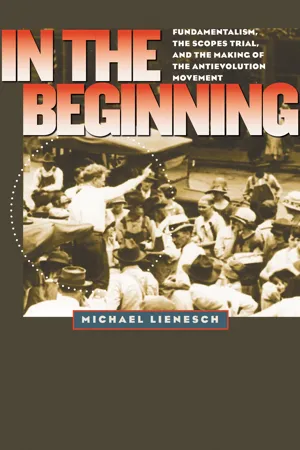
In the Beginning
Fundamentalism, the Scopes Trial, and the Making of the Antievolution Movement
- 352 pages
- English
- ePUB (mobile friendly)
- Available on iOS & Android
eBook - ePub
In the Beginning
Fundamentalism, the Scopes Trial, and the Making of the Antievolution Movement
About this book
Information
Topic
HistoireSubtopic
Histoire de l'Amérique du NordChapter 1: Identity
Fundamentalist Foundations
It began with a sermon. A. C. Dixon was a powerful speaker, whose soul-stirring preaching often drew audiences of up to ten thousand at Chicago’s Moody Church. But his message must have been particularly moving on the warm Sunday afternoon in August 1909, when he brought his Southern California revival campaign to Los Angeles. In the audience that day at the art nouveau Temple Auditorium were many of the city’s most prominent conservative evangelicals, among them millionaire oilman Lyman Stewart, who had come with the growing conviction that something had to be done to bring the Bible’s true message to its most faithful believers. As he listened to Dixon, Stewart realized that he was being called to carry out that mission. Within days, aided by his brother and business partner Milton, he had laid out plans to publish a series of inexpensive paperback books containing the best teachings of the best (meaning the most conservative) Bible teachers in the world. Dixon would serve as editor of the series. The volumes would be distributed free of charge to church people across the country. They would be called The Fundamentals.1
To the extent that it is possible to locate a single moment when the anti-evolution movement could be said to have been born, it was then, because anti-evolutionism arose out of fundamentalism, and because fundamentalism became possible only because of The Fundamentals. As a set of ideas and even as an ill-formed ideology, antievolutionism had existed ever since the time of Charles Darwin (1809–82), and critics of evolutionary theory had flourished on and off throughout the late nineteenth century in the United States, especially in its most conservative churches. But as a movement, antievolutionism appeared much later, in the 1920s, as a product of the religious and political protest that would come to be called fundamentalism. For decades, conservative evangelicals had been growing restive, alarmed at the liberalizing tendencies in their churches and in the larger culture around them. Their concerns went mostly unnoticed, however, primarily because their protests tended to be localized and sporadic. Divided by denomination, fragmented into countless church congregations, these disillusioned conservatives lacked any real sense that they shared similar views, let alone that they constituted a common cause. What brought them together for the first time was not a leader or an organization, but Stewart’s set of twelve paperback books. Appearing between 1910 and 1915, The Fundamentals did more than give fundamentalists their name. Announcing articles of belief, communicating a distinct style of discourse, defining differences between themselves and others, the project gave them a common identity, a shared conception of themselves that told them who they were and what they were about. That identity formed the fundamentalist foundations on which creationism would be built.
Although the idea of identity is a relatively recent addition to social movement theory, it has become a central concept in the study of contemporary political movements. Inspired by the appearance in the late twentieth century of groups committed to cultural change and personal transformation, some social movement scholars have suggested that many movements exist almost exclusively to provide their members with a sense of belonging, along with an image of themselves as part of a larger community of common purpose. Among these scholars, Alberto Melucci was one of the first to argue that the chief characteristic of many contemporary movements is that instead of providing economic benefits for their members, they offer them the cultural tools to give meaning to their everyday lives—what he called “the right to realize their own identity.”2 According to Alain Touraine, Jean Cohen, and others, this identity is consciously constructed and communicated as movement members come together to arrive at an understanding of who they are, what they have in common, and how they differ from others in the dominant or mainstream culture.3 Sociologists Verta Taylor and Nancy Whittier have analyzed the process by which such collective identities are constructed, arguing that it consists of three separate but related steps: (1) the active creation of collective consciousness, or a shared sense of self; (2) the development of social and psychological boundaries between movement members and others; and (3) the insistence on negotiation (or what Karen Cerulo has called politicization), in which members move from the personal to the political in order to define differences between themselves and those they depict as their political enemies or opponents.4
For as long as scholars have been studying fundamentalism, they have been describing it as being based on ideology rather than identity. The first histories of the movement, written by Norman Furniss and Stewart G. Cole, portrayed it as the product of a set of basic beliefs, the famous “five points,” consisting (with some variation) of belief in (1) the Bible’s infallibility, (2) Christ’s divinity (or virgin birth), (3) his atonement, (4) resurrection, and (5) second coming. Adapted from a 1910 declaration of the Presbyterian General Assembly, these five points would assume something like creedal status over time, eventually coming to be seen as the essential articles of fundamentalist faith.5 But in the years leading up to World War I, before fundamentalism had emerged as a full-fledged political movement or even found a name for itself (the term would not become popular until the early 1920s), its advocates were less concerned with creating creeds than with constructing community, and less interested in developing a doctrine or ideology than in establishing a sense of identity for themselves. With the publication of The Fundamentals, they began to create that identity.
Consciousness
Movements begin by creating collective consciousness. Informing individuals of their common interests, attributing discontent to structural rather than personal reasons, collective consciousness allows people to see that they are not alone and that their problems are not entirely the result of their own failings. Although commonly conceived in class terms, consciousness can be created whenever individuals and groups feel marginalized as a result of domination by an established order. Its character is dynamic, changing over time as groups reevaluate their roles and expectations. But in its inception, as Taylor and Whittier argue, collective consciousness tends to be imparted canonically through a formal body of documents, speeches, or writings.6
For early fundamentalists, The Fundamentals was this canon, a body of writings designed to create a collective consciousness, a shared sense of themselves, among the most orthodox and traditional of America’s evangelicals. Throughout the early twentieth century, conservative discontent had been building in Protestant churches, primarily as a reaction to the liberal theology that was making its way into many major church denominations. Yet while widespread, the discontent was diffuse, in large part because conservatives were deeply divided among themselves along theological and denominational lines. It was Lyman Stewart, a businessman rather than a church leader, who proposed to transcend the doctrinal and denominational divisions by making use of modern communication and marketing methods. Inspired by Dixon’s sermon, he developed plans to not only publish but also directly distribute the twelve volumes that would eventually comprise The Fundamentals. To underwrite the project, which would require the printing and mailing of almost three million copies over the next five years, he established a fund of about $300,000, a substantial sum at the time, even for the president of the Union Oil Company. Nevertheless, Stewart was certain of his calling. “It is for us to send out the ‘testimony,’” he wrote to his brother Milton, who agreed to share half of the expense, “and leave the results to God.”7
In planning The Fundamentals, Stewart was determined to avoid the differences that had divided conservatives in the past. As editor he had chosen the widely respected Dixon, who proceeded to recruit an editorial committee of clergy and lay leaders that included prominent Baptists, Presbyterians, and independent evangelicals. The committee, in turn, selected a diverse group of sixty-four authors to write the ninety essays that would comprise the twelve volumes. Among the American, British, and Canadian authors were some of the leading orthodox theologians and scholars of the time, along with well-known evangelists, ministers, and lay leaders. Although affiliated with numerous denominations (and in a few cases with none), their chief ties tended to be nondenominational in that most were closely associated with independent Bible conferences, revival ministries, and missionary organizations. Theologically they represented a broad spectrum of evangelical thought, ranging from conventional Calvinists to esoteric dispensational premillennialists. At Dixon’s urging, the authors were asked to avoid doctrinal arguments, emphasizing instead commonly held articles of faith and shared religious values. The books were distributed in the same inclusive spirit, with the intention of reaching as many readers as possible. Copies were to be sent out by the tens of thousands, free of charge, “to every pastor, evangelist, missionary, theological professor, theological student, Sunday school superintendent, Y.M.C.A. and Y.W.C.A. secretary in the English speaking world, as far as the addresses of all these can be obtained.”8
Appropriately enough, The Fundamentals began with the Word, as scriptural text provided the primary source and principal topic of most of the early essays. Throughout the first volumes, many articles consisted of biblical exegesis, including commentaries on various books of the Bible. Almost all quoted Scripture frequently and on occasion extensively, and a few were little more than strings of Bible verses. Although the Gospels and Paul appeared frequently, citations came from almost every Book including on occasion the Apocrypha. In citing the Bible, all of the authors took it to be true, accepting it as both inspired and inerrant. (In keeping with this assumption, The Fundamentals was subtitled “A Testimony to the Truth.”) Believers in inerrancy, an idea they had adopted from nineteenth-century Princeton theology, and in particular from the commonsense realism of Princeton theologian Charles Hodge, they assumed that Scripture consisted entirely of words whose meanings were clear and unchanging. Thus they supposed that by reading the same text all sincere believers would arrive at the same conclusions, those being the accepted and customary ones. It followed that the primary role of biblical scholarship was to authenticate the Scripture, ensuring that passages were contained in the original texts and that they had not been tainted by later human interpreters.9
In the opening essay of the first volume, Scottish theologian James Orr of Glasgow College demonstrated this approach to the text, using it to defend Christ’s divinity, which he took to be the central tenet of the Christian faith. Turning to “the Scripture itself,” Orr worked his way from the Old to the New Testament, making sure that the narratives were truthful by testing to see that they were original parts and not “late and untrustworthy additions” to the Bible. He described the process:
The narratives of the nativity in Matthew and Luke are undoubtedly genuine parts of their respective Gospels. They have been there since ever the Gospels themselves had an existence. The proof of this is convincing. The chapters in question are found in every manuscript and version of the Gospels known to exist. There are hundreds of manuscripts, some of them very old, belonging to different parts of the world, and many versions in different languages (Latin, Syriac, Egyptian, etc.), but these narratives of the virgin birth are found in all.
Comparing the sources for content and style, and finding them to be consistent, Orr confidently declared them to be definitive texts, bearing “the stamp of truth, honesty, and purity,” and therefore providing proof of Christ’s divinity.10 In another essay in the first volume, the highly respected Princeton theologian Benjamin B. Warfield acknowledged that Scripture was not the only source for proving that Christ was divine, and that “proof texts and passages” should be supplemented with other kinds of evidence, including “the impression Jesus has left upon the world.”11 Nevertheless, all of the authors of The Fundamentals would have agreed with Canadian pastor and professor of theology Dyson Hague when he announced in the opening volume that the Bible “does not merely contain the Word of God; it is the Word of God.” Assuming inerrancy, they took it as axiomatic that the Scriptures contained, as Hague put it, “the truth, the whole truth, and nothing but the truth.” Moreover, because the Bible was authentic and true, they saw it as providing absolute authority, along with an assurance of certainty about the correctness of traditional Christian teachings. All that believers had to do was accept it, “receiving the Scriptures,” explained Hague, as “the Word of God, without objection and without a doubt.”12
While many of the early essays were built around biblical exegesis, others consisted of personal testimonies, written in the style of contemporary sermons. Among the authors chosen to contribute to The Fundamentals were some of the best-known revivalists of the day, including Reuben A. Torrey, Arthur Pierson, and James M. Gray, all of whom were protégés of Dwight L. Moody, the revered founding father of the evangelical urban revival movement of the late nineteenth century.13 Writing in the high Victorian style of the big-city revival sermon, and seasoning their essays with healthy doses of sentimentality, these authors told stories of lost and troubled souls rescued by the loving hand of the Holy Spirit. Torrey, for one, dusted off the tried-and-true revivalist trope of the wandering boy lost in the sinful city, introducing it into his essay “The Personality and Deity of the Holy Spirit”:
How many a young man, who has gone from a holy, Christian home to the great city with its many temptations, has been kept back from doing things that he would otherwise do by the thought that if he did them his mother might hear of it and that it would grieve her beyond description. But there is One who dwells in our hearts, if we are believers in Christ, who goes with us wherever we go, sees everything that we do, hears everything that we say, observes every thought, even the most fleeting fancy, and this One is purer than the holiest mother that ever lived.
As conversion narratives go, Torrey’s testimony was fairly conventional, save for the fact that sin did not seem particularly prominent in it. Instead of sin, secularity and the allure of success and worldly wealth loomed large as motivating factors in his salvation. Torrey’s story was already well known to American evangelicals: how as a student at Yale he had lived a life of dancing, gambling, and religious skepticism, only to find himself depressed at the emptiness of his existence and on the verge of suicide. As his mother, miles away, prayed fervently for her son at her bedside, Torrey fumbled with his razor only to collapse in prayer, begging to be saved and promising to dedicate his life to preaching. For the authors of The Fundamentals, his conversion was a model, a modern narrative in which salvation was less an absolution of sin than a release from the alienation of mass society, a “cure for loneliness,” as Torrey described it in his essay, that would “save us from all anxiety and worry.”14
Throughout the early volumes of The Fundamentals, other testimonies followed the same pattern in depicting conversion as a cure for the discontent that was endemic in modern secular society. Among the most striking of these stories was that of Philip Mauro, a wealthy New York City patent attorney, who described how social and professional success had led him to doubt and depression, “becoming more and more an easy prey to being plagued by gloomy thoughts and vague, undefinable apprehensions.” Attempting to allay his discontent by attending a Broadway play, Mauro found himself being led “by an unseen hand” from the lobby of the theater, crowded with well-dressed playgoers, toward a drab urban mission where a prayer meeting was taking place among “exceedingly plain, humble people, of little education” who were “not in the social grade to which I had been accustomed.” Put off by the poverty of the place and its people, and unwilling to give up anything in the way of wealth or worldly sophistication, Mauro left the meeting unmoved, only to be drawn back time after time until he finally came forward to kneel at the front of the room, where he confessed his need for the grace of God. At that moment, a complete and unexpected change took place, as “all my doubts, questionings, skepticism and criticism” were “swept away completely.” For Mauro, conversion brought absolute assurance. It also provided a cure for the stresses and strains of modern life, “what is called ‘nervous prostration,’” as he put it, “from which so many are suffering in these times of high pressure.”15
In ...
Table of contents
- Cover Page
- In the Beginning
- Copyright Page
- Dedication
- Contents
- Illustrations
- Acknowledgments
- Introduction
- Chapter 1: Identity: Fundamentalist Foundations
- Chapter 2: Mobilization: Activists and Organizations
- Chapter 3: Framing: The Campaign against the Colleges
- Chapter 4: Alignment: Debating Darwinism
- Chapter 5: Opportunities: Storming the State Legislatures
- Chapter 6: Staging: The Drama at Dayton
- Chapter 7: Climax: Completing the Cycle of Contention
- Chapter 8: Renewal: The Continuing Re-creation of Creationism
- Conclusion
- Notes
- Index
Trusted by 375,005 students
Access to over 1.5 million titles for a fair monthly price.
Study more efficiently using our study tools.
Frequently asked questions
Yes, you can cancel anytime from the Subscription tab in your account settings on the Perlego website. Your subscription will stay active until the end of your current billing period. Learn how to cancel your subscription
No, books cannot be downloaded as external files, such as PDFs, for use outside of Perlego. However, you can download books within the Perlego app for offline reading on mobile or tablet. Learn how to download books offline
Perlego offers two plans: Essential and Complete
- Essential is ideal for learners and professionals who enjoy exploring a wide range of subjects. Access the Essential Library with 800,000+ trusted titles and best-sellers across business, personal growth, and the humanities. Includes unlimited reading time and Standard Read Aloud voice.
- Complete: Perfect for advanced learners and researchers needing full, unrestricted access. Unlock 1.5M+ books across hundreds of subjects, including academic and specialized titles. The Complete Plan also includes advanced features like Premium Read Aloud and Research Assistant.
We are an online textbook subscription service, where you can get access to an entire online library for less than the price of a single book per month. With over 1.5 million books across 990+ topics, we’ve got you covered! Learn about our mission
Look out for the read-aloud symbol on your next book to see if you can listen to it. The read-aloud tool reads text aloud for you, highlighting the text as it is being read. You can pause it, speed it up and slow it down. Learn more about Read Aloud
Yes! You can use the Perlego app on both iOS and Android devices to read anytime, anywhere — even offline. Perfect for commutes or when you’re on the go.
Please note we cannot support devices running on iOS 13 and Android 7 or earlier. Learn more about using the app
Please note we cannot support devices running on iOS 13 and Android 7 or earlier. Learn more about using the app
Yes, you can access In the Beginning by Michael Lienesch in PDF and/or ePUB format, as well as other popular books in Histoire & Histoire de l'Amérique du Nord. We have over 1.5 million books available in our catalogue for you to explore.