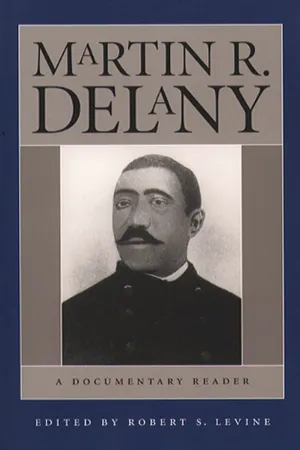
Martin R. Delany (1812–85) has been called the “Father of Black Nationalism,” but his extraordinary career also encompassed the roles of abolitionist, physician, editor, explorer, politician, army officer, novelist, and political theorist. Despite his enormous influence in the nineteenth century, and his continuing influence on black nationalist thought in the twentieth century, Delany has remained a relatively obscure figure in U.S. culture, generally portrayed as a radical separatist at odds with the more integrationist Frederick Douglass.
This pioneering documentary collection offers readers a chance to discover, or rediscover, Delany in all his complexity. Through nearly 100 documents — approximately two-thirds of which have not been reprinted since their initial nineteenth-century publications — it traces the full sweep of his fascinating career. Included are selections from Delany’s early journalism, his emigrationist writings of the 1850s, his 1859-62 novel, Blake (one of the first African American novels published in the United States), and his later writings on Reconstruction. Incisive and shrewd, angry and witty, Delany’s words influenced key nineteenth-century debates on race and nation, addressing issues that remain pressing in our own time.
- 520 pages
- English
- ePUB (mobile friendly)
- Available on iOS & Android
eBook - ePub
About this book
Information
Part One
Pittsburgh, the Mystery, Freemasonry
On 29 july 1831, Martin Delany, in search of education and economic opportunities, left his family in Chambersburg, Pennsylvania, and walked the winding 150-mile route through the Alleghenies to Pittsburgh. He arrived in a city that included among its burgeoning population approximately 450 African Americans. Though small in number, Pittsburgh’s African American community, led by Lewis Woodson, John B. Vashon, and John C. Peck, had made significant progress in organizing mutual aid societies, churches, and schools and would continue those efforts, with Delany’s help, during the 1830s and 1840s. Shortly after arriving in Pittsburgh, Delany began studying with Lewis Woodson at the Bethel African Methodist Episcopal Church and meeting with John Vashon and others for literary and political discussions. From those discussions emerged the African Education Society, which proclaimed in its constitution “that ignorance is the sole cause of the present degradation and bondage of the people of color in these United States; that the intellectual capacity of the black man is equal to that of the white, and that he is equally susceptible of improvement.”1
The commitment to black pride, racial egalitarianism, education, and uplift central to the African Education Society informed Delany’s other activities of the period as well. In 1832 he and his roommate Molliston M. Clark founded the Theban Literary Society (modeled on Benjamin Franklin’s Junto), and two years later Delany helped to found a temperance society. He also participated in the formation of the Pittsburgh Anti-Slavery Society and a philanthropic society that aided fugitive slaves. The Colored American, the most influential African American newspaper of the time, printed a number of notices of Delany’s activities in Pittsburgh. The issue of 2 September 1837 listed Delany as one of eleven cofounders (and the librarian) of the Young Men’s Literary and Moral Reform Society of the City of Pittsburgh and Vicinity; the issue of 12 April 1838 listed Delany as having attending a meeting of Pittsburgh’s African Americans protesting Pennsylvania’s recent disenfranchisement of its black citizens; and the issue of 3 July 1841 listed Delany as among those calling for a black state convention in Pennsylvania (noting that Delany was the secretary of the committee organizing the convention).2 Meanwhile, even as he was involved with numerous literary and political initiatives in the black community, Delany managed to begin a medical education, apprenticing with local physicians Andrew M. McDowell, William Elder, and several others, all of whom would continue to support him through the 1840s. In 1836 Delany set up his own office as a cupper and leecher, and it was through this medical work that he was able to earn the money that would sustain his career as an abolitionist and civil rights leader. He was also sustained, from 1843 to his death in 1885, by the seamstress work of his wife, Catherine A. Richards, the daughter of a wealthy black butcher and a white Irish immigrant, whom he married in Pittsburgh in 1843.
As this overview of Delany’s first decade or so in Pittsburgh should suggest, the move to Pittsburgh was absolutely central to Delany’s career. The documents in this section reveal a young black man of Pittsburgh in the process of emerging as a national leader and reveal as well how that emergence was indebted to his work and associations in Pittsburgh. During the 1830s Delany was nurtured by black and white leaders alike; during the 1840s he himself emerged as a leader, founding and editing an African American newspaper, the Mystery. In addition to his significant editorial career, Delany had a major role in establishing and promoting Pittsburgh’s first black Freemasonry organization, which he conceived of as an organization that further contributed to black pride, black (male) community, and racial justice. This section prints six documents related to Delany’s work on the Mystery and two documents related to his connections with black Freemasonry.
Delany no doubt wrote a great deal during the 1830s, but his first extant publications come from the Mystery, the African American newspaper that he founded in 1843 and edited (and basically wrote) through 1847. The newspaper had its origins in the State Convention of the Colored Freemen of Pennsylvania, held in Pittsburgh, 23–25 August 1841, which Delany had helped to organize. At the convention, the delegates resoundingly approved Resolution 11: “That in the opinion of this Convention, a newspaper conducted by the colored people, and adapted to their wants, is much needed in this state; and that we request their general co-operation, especially in the east, in establishing such a paper.”3 Two years later, with Pennsylvania still lacking an African American newspaper, Delany decided himself to establish such a newspaper without the help of the “east” and began publishing the Mystery in September 1843. Hoping for a wide readership, he recruited subscription agents to circulate the paper throughout Pennsylvania, as well as in Ohio, Iowa, and New York, and he reported to his biographer Frances Rollin (in what was probably an overstatement) that the typical run was 1,000 copies.4 Though he encountered economic problems along the way, which necessitated the formation of a publishing committee in 1844, Delany managed to keep the paper in print until late 1847. During this time he was sued for libel by Thomas “Fiddler” Johnson, an African American whom Delany had accused of collaborating with fugitive slave catchers (a white jury found Delany guilty in 1846, but Governor Francis R. Shunk remitted the fine and the Mystery publishing committee paid his court costs). He also inspired the white philanthropist Charles Avery of Allegheny, Pennsylvania, who donated funds to establish a school for black men and women, the Allegheny Institute and Mission Church.
Delany’s Mystery was a four-page paper committed to abolition and the development of black pride. Only the issues of 16 April 1845 and 16 December 1845 remain extant, and even those issues are heavily damaged. Nevertheless, it is clear from the surviving issues that the Mystery printed antislavery news, letters and editorials, and various announcements of events and meetings, along with advertisements of Pittsburgh’s black laborers and professionals, including Delany, who regularly ran an ad for his medical services on page one: “LEECHING, CUPPING AND BLEEDING.” Indicative of Delany’s activist perspective on abolition and black self-help, beginning in 1845 he used as the epigraph to the paper the same passage from Lord Byron’s Childe Harold’s Pilgrimage (1818) that had inspired Henry Highland Garnet’s militant “Address to the Slaves of the United States” (1843): “HEREDITARY BONDSMEN! KNOW YE NOT WHO WOULD BE FREE, THEMSELVES MUST STRIKE THE FIRST BLOW!” He printed the epigraph in the upper left corner of page one, and he printed his statement of principles in the upper left corner of page two: “I have determined never to be governed by the frivolous rules of formality but by PRINCIPLE, suggested by conscience, and guided by the light of REASON. I LOVE ADVICE, I’ll seek COUNSEL, but detest dictation.”5 The “Prospectus of THE MYSTERY” appeared on page four, and it is included in this section, along with four of Delany’s editorial columns. Only one of those columns is from a surviving copy of the Mystery; the other three come from the Liberator and Palladium of Liberty, which reprinted Delany’s columns. The fact that there was some reprinting of Delany’s columns suggests that the Mystery had an influence beyond Pittsburgh’s African American community. But it would be a mistake to overemphasize the influence of this local journal,6 and presumably it was precisely because Delany sought a more national and diverse audience that he chose to leave the Mystery in late 1847 to assume the coeditorship of the North Star with Frederick Douglass (see Part 2). Delany’s rationale for the move, his “Farewell to Readers of the Mystery,” is also included in this section.
The epigraph of the Mystery during its first two years of publication, before Delany adopted the quote from Byron, was “AND MOSES WAS LEARNED IN ALL THE WISDOM OF THE EGYPTIANS.”7 For Delany, Egypt was a crucial marker of the African origins of Western civilization and thus of blacks’ potentially regenerative role in the culture in terms of the Ethiopianism of Psalms 68:31: “Ethiopia shall soon stretch out her hands unto God.” Celebrating black Africa at a time when many white racial “scientists” were arguing for the non-African sources of Western civilization, and for the “whiteness” of Egypt itself, Delany sought to challenge the new notions of polygenesis (separate creations of the races) that, according to many whites, legitimated blacks’ lower place in the social hierarchy. Crucial to his efforts to contest the racist ethnology and practices of the time was his advocacy of black Freemasonry in the tradition of Prince Hall, who had established the first black Masonic lodges in Boston, Philadelphia, and other northern cities in the late eighteenth century.
Like Prince Hall, Delany regarded Freemasonry as a progressive and properly elitist organization that had crucial origins in African knowledge, rituals, religions, and practices. In 1847 Delany helped to form a black Freemason lodge in Pittsburgh, the St. Cyprian Lodge, and over the next six years delivered at least two major addresses to the St. Cyprians, both of which were printed as pamphlets and are reprinted in this section. The first, a eulogy for a fellow Freemason, the Reverend Fayette Davis, celebrates the model life of a black religious leader; the second, The Origin and Objects of Ancient Freemasonry, explores the black origins of the craft. Delany was attracted to Masonry’s secrecy, hierarchy, and ritual, and he was inspired by the ways in which black Masonry in particular offered its members a shared sense of sacred history and holy bond. Masonry made Delany feel that he was one of the elect at a time in which the dominant culture taught that he was one of the damned; its fraternalism and hierarchy nurtured Delany’s conception of a black masculine ideal of leadership. Pittsburgh, the Mystery, and black Freemasonry launched Delany onto the national scene, providing him with a sense of mission and community that would empower his work over the coming decades.
Notes
1. Dorothy Sterling, The Making of an Afro-American: Martin Robison Delany, 1812–1885 (Garden City, New York: Doubleday, 1971), pp. 41–42.
2. See “Communication for the Colored American,”Colored American, 2 September 1837, p. 2; “Public Meetings in Pittsburgh,” ibid., 12 April 1838, p. 2; “A Call for a State Convention in Pennsylvania,” ibid., 3 July 1841, p. 2.
3. Proceedings of the Black State Conventions, 1840–1865, ed. Philip S. Foner and George E. Walker (Philadelphia: Temple University Press, 1979), p. 110.
4. Frank [Frances] A. Rollin, Life and Public Services of Martin R. Delany (Boston: Lee and Shepard, 1868), p. 48.
5. The quotations are from the issue of 16 December 1845, the extant issue in the best condition. My thanks to the Carnegie Library for providing me with access to the Mystery . For a good discussion of Delany’s newspaper, see Mike Sajna, “The Mystery of Martin Delany,”Carnegie Magazine, July/August 1990, pp. 36–40.
6. In their respective biographies of Delany, both Victor Ullman and Dorothy Sterling assert that Delany’s columns in the Mystery were widely reprinted in abolitionist journals and local newspapers. But the only evidence they offer for their claims are the two well-known editorials that were reprinted in the 20 October 1843 issue of the Liberator. After reading the over 100 issues of Pittsburgh newspapers circa 1843–47 in the Library of Congress’s collection, and after examining the Liberator and other abolitionist newspapers of the same period, I discovered only two columns in the Palladium of Liberty, the most interesting of which is included in this section. (See also “Kidnapping in Virginia,” Palladium of Liberty, 21 February 1844, p. 1, which is for the most part a redaction of a fugitive slave case as reported in a Winchester, Virginia, newspaper.) There were no doubt other reprintings of Delany’s editorials that I missed, but I think it is a mistake to make excessive claims for the national (eastern) influence of Delany’s paper. It does seem to have been read widely among Pittsburgh’s black community and no doubt had readers in other cities in Pennsylvania, New York, and Ohio. But the North Star offered Delany a considerably larger, and more racially and geographically diverse, readership.
7. Victor Ullman, Martin R. Delany: The Beginnings of Black Nationalism (Boston: Beacon Press, 1971), p. 60.
Prospectus of the Mystery
Delany married Catherine A. Richards on 15 March 1843 and around the same time begin editing and publishing the Mystery, an abolitionist newspaper committed to black elevation, even as he kept on with his medical practice and apprenticing. A prospectus for Delany’s Pittsburgh-based newspaper no doubt appeared in the inaugural issue, which is no longer extant. The “Prospectus,” printed below, appeared in...
Table of contents
- Cover Page
- Martin R. Delany
- Copyright Page
- Contents
- Acknowledgments
- Introduction
- A Note on the Texts
- Part One Pittsburgh, the Mystery, Freemasonry
- Part Two The North Star
- Part Three Debating Black Emigration
- Part Four Africa
- Part Five Civil War and Reconstruction
- Part Six The Republic of Liberia
- Chronology
- Selected Bibliography
- Index
Trusted by 375,005 students
Access to over 1.5 million titles for a fair monthly price.
Study more efficiently using our study tools.
Frequently asked questions
Yes, you can cancel anytime from the Subscription tab in your account settings on the Perlego website. Your subscription will stay active until the end of your current billing period. Learn how to cancel your subscription
No, books cannot be downloaded as external files, such as PDFs, for use outside of Perlego. However, you can download books within the Perlego app for offline reading on mobile or tablet. Learn how to download books offline
Perlego offers two plans: Essential and Complete
- Essential is ideal for learners and professionals who enjoy exploring a wide range of subjects. Access the Essential Library with 800,000+ trusted titles and best-sellers across business, personal growth, and the humanities. Includes unlimited reading time and Standard Read Aloud voice.
- Complete: Perfect for advanced learners and researchers needing full, unrestricted access. Unlock 1.5M+ books across hundreds of subjects, including academic and specialized titles. The Complete Plan also includes advanced features like Premium Read Aloud and Research Assistant.
We are an online textbook subscription service, where you can get access to an entire online library for less than the price of a single book per month. With over 1.5 million books across 990+ topics, we’ve got you covered! Learn about our mission
Look out for the read-aloud symbol on your next book to see if you can listen to it. The read-aloud tool reads text aloud for you, highlighting the text as it is being read. You can pause it, speed it up and slow it down. Learn more about Read Aloud
Yes! You can use the Perlego app on both iOS and Android devices to read anytime, anywhere — even offline. Perfect for commutes or when you’re on the go.
Please note we cannot support devices running on iOS 13 and Android 7 or earlier. Learn more about using the app
Please note we cannot support devices running on iOS 13 and Android 7 or earlier. Learn more about using the app
Yes, you can access Martin R. Delany by Robert S. Levine in PDF and/or ePUB format, as well as other popular books in Literature & North American History. We have over 1.5 million books available in our catalogue for you to explore.