Between 1840 and 1920, Cuba abolished slavery, fought two wars of independence, and was occupied by the United States before finally becoming an independent republic. Tiffany A. Sippial argues that during this tumultuous era, Cuba’s struggle to define itself as a modern nation found focus in the social and sexual anxieties surrounding prostitution and its regulation.
Sippial shows how prostitution became a prism through which Cuba’s hopes and fears were refracted. Widespread debate about prostitution created a forum in which issues of public morality, urbanity, modernity, and national identity were discussed with consequences not only for the capital city of Havana but also for the entire Cuban nation.
Republican social reformers ultimately recast Cuban prostitutes — and the island as a whole — as victims of colonial exploitation who could be saved only by a government committed to progressive reforms in line with other modernizing nations of the world. By 1913, Cuba had abolished the official regulation of prostitution, embracing a public health program that targeted the entire population, not just prostitutes. Sippial thus demonstrates the central role the debate about prostitution played in defining republican ideals in independent Cuba.
eBook - ePub
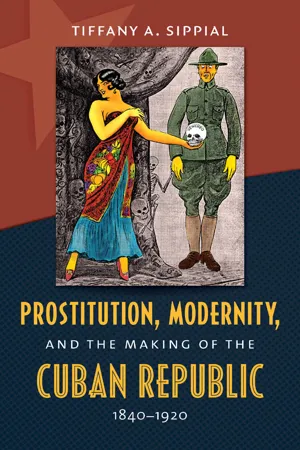
Prostitution, Modernity, and the Making of the Cuban Republic, 1840-1920
- 256 pages
- English
- ePUB (mobile friendly)
- Available on iOS & Android
eBook - ePub
Prostitution, Modernity, and the Making of the Cuban Republic, 1840-1920
About this book
Information
Chapter One
Zones of Delinquency, Zones of Desire
Locating Public Women in the Walled City, 1840–1868
The city is a map of the hierarchy of desire, from the valorized to the stigmatized. It is divided into zones dictated by the way its citizens value or denigrate their needs. Separating the city into areas of specialization makes it possible to meet some needs more efficiently; it is also an attempt to reduce conflict between opposing sets of desires and the roles people adopt to try and fulfill those desires. In part because of these zones, the city has become a sign of desire: promiscuity, perversity, prostitution, sex across the lines of age, gender, class, and race.
Prostitution is not now, nor shall it be, permitted by the Government, as it is prohibited by current legislation. Special circumstances have, however, made necessary a tacit tolerance [of prostitution], which is quite distinct from authorizing the continuation of a social evil in the face of public reclamations and complaints against it.
As a booming tobacco industry swelled Havana’s urban population during the 1840s, local residents expressed increased apprehension about the influx of unruly masses—immigrants, ex-slaves, migrant workers, and prostitutes—into honorable neighborhoods. The demolition of the city wall in 1853 signaled Havana’s transformation from a colonial port to a modern metropolis but also increased popular concern with public order. State responses to these broader physical and demographic changes occurring in the capital city were essentially a mapping exercise. Colonial officials profoundly reimagined Havana’s sociospatial landscape by reformulating existing legislation in order to geographically segregate undesirable social groups to the margins of the city. Included in this administrative mapping exercise was a mid-century shift from prohibiting prostitution to establishing a legally sanctioned tolerance zone. Hoping that the creation of this circumscribed zone for prostitution would facilitate greater state surveillance and assuage angry residents, authorities were instead forced to deal with the various methods prostitutes employed to exploit the inherent weaknesses and contradictions of colonial tolerance policy. Court cases, social legislation, quejas (filed grievances), and interdepartmental police memos reveal the multivalent tensions between elite residents, local police officers, colonial officials, and prostitutes as they battled over space and meaning in mid-nineteenth-century Havana.
THE CASE OF A PROSTITUTE, A PIMP, AND A ROBBERY
On the morning of 17 August 1853, three individuals sat at Havana’s police headquarters: a twenty-two-year-old prostitute from the Canary Islands named Antonia Armas, an Italian cook from Cárdenas named don Gaspar Amoretti, and a French traveling businessman named don Bernardo Pujibet.1 At midnight the previous evening, a police officer patrolling Havana’s Third District had responded to a call concerning a scandal occurring at the La Pajarera (Birdcage) tenement house. Arriving at the scene of the scandal, the officer found Armas, Amoretti, and Pujibet in the middle of a violent confrontation. All three individuals were consequently arrested and escorted to police headquarters for questioning. Responding to initial interrogation, Pujibet claimed that Armas and Amoretti had robbed him. Acting as Armas’s pimp, Amoretti had apparently offered her sexual services to Pujibet and then convinced him to finance several days of dining and drinking in the capital city. According to Pujibet’s testimony, the robbery occurred when, “after dining sumptuously,” he decided to “take doña Antonia up on her offer.” Pujibet alleged that his departure to Armas’s private room at the tenement house provided Amoretti the opportunity to execute his plan to “make off with the eight gold coins in his pocket.” With this formal accusation of robbery, authorities launched an investigation into each accused individual’s background and character.
Authorities would not have to look hard to find evidence concerning Armas’s history. In the six years since migrating to Havana from the Canary Islands, she had already tangled with colonial authorities on more than one occasion. In addition to multiple arrests for public intoxication, Armas had been charged with public nudity, evading authorities by moving to Cárdenas, failure to pay fines, and three counts of verbal assault—one of which led to her expulsion from the barrio Santa Clara. Furthermore, when questioned about Armas’s background and character, a police officer from the barrio Tacón, don José Quirós, declared that “doña Antonia’s scheming and corrupt behavior [was] most reproachable.” To substantiate this statement, Quirós claimed that Armas spent her evenings traveling between “boarding houses, restaurants, and [other] nocturnal establishments with men engaging in serenades and bacchanals.” Police possessed considerably less information on Amoretti. Officials in Cárdenas sent word that Amoretti was married with children and had a reputation as an alcoholic who “passed his time in a drunken stupor with (prostitutes).” After first meeting Armas in Cárdenas—where she was evading authorities in Havana—Amoretti had apparently convinced her to return to the capital city as his consort.
With this evidence of a lengthy history of reprehensible conduct in both cases, authorities were able to avoid a court trial and proceed directly to sentencing. One week after their arrest, Amoretti was sentenced to two months forced labor and Armas was sentenced to six months internment at the Casa de Recogidas. In an unexpected twist, Armas was released from the Casa de Recogidas just one week later. Within days of Armas’s imprisonment, Pujibet appeared before authorities declaring his intent to marry her. Believing marriage to be the best means for reforming the incorrigible Armas, authorities ordered both parties to sign an official document declaring their mutual consent and then authorized Armas’s release into Pujibet’s care. By mid-September, neither party had appeared to formalize the marriage, nor could either be located for questioning. After weeks of searching the city, officials finally found Armas living at 79 Habana in the Second District. When questioned by officials as to her marital plans, Armas declared that she “never had any intention to marry.” This act of defiance resulted in the immediate reinstatement of her original six-month sentence. Within one month, however, Armas successfully petitioned for clemency in honor of the birthday of the Princess of Asturias and was released from the Casa de Recogidas. Inexplicably, Pujibet proved unwilling to forfeit his dream of marrying Armas and requested an official intervention to finalize their commitment. Upon questioning, Armas declared that she had been forced to contract marriage with Pujibet and that he physically abused her. A physical examination did, in fact, reveal the presence of two wounds (equimosis)—one on Armas’s abdomen and one on her chest. Thus, on 3 January 1854, the political governor of Havana charged Pujibet with physical battery and ordered him never to interfere in Armas’s life again.
A criminal case involving a prostitute, a pimp, a robbery, two rejected marriage proposals, an acquitted accomplice, and a plaintiff-turned-convicted-criminal may appear too sensational to serve as the kind of representative case typically found in an opening chapter. Full of drama, public scandal, and intrigue, this was precisely the kind of situation likely to elicit a police response in 1853. The motivations for this official interest may be surprising in light of the subject of this study. While authorities were certainly eager to punish crimes such as robbery, they were not particularly concerned that both defendants had ties to prostitution. By 1853, colonial officials had shifted their policy on prostitution from outright prohibition to permitting prostitution within an officially sanctioned tolerance zone. Consequently, Armas’s incarceration resulted not from her status as a prostitute, but because she had solicited a client outside of the established tolerance zone. The two factors that mattered most in this case were, thus, the address where the crime occurred and the year in which it took place.
In many ways, Armas and Amoretti were the victims of bad timing. Prior to 1853, the area that became Havana’s Third District was not an official district at all but rather a set of loosely defined and overpopulated neighborhoods lying outside the city wall. Considered geographically, socially, and economically marginal, this area was of relatively little concern to colonial authorities and thus was patrolled by a mere handful of police officers. By 1853, however, Havana’s urban physiognomy had begun changing dramatically. The city wall was being dismantled, and areas once considered outside the administrative purview of local law enforcement officials were now considered an integral part of the city and worthy of police surveillance. By 1853, the La Pajarera tenement house was situated within an official administrative district with an on-duty police officer stationed nearby. The kind of violent public scandal perpetrated by Armas, Amoretti, and Pujibet was, therefore, likely to provoke a police response. The case against Armas and Amoretti thus illustrates an important theme running throughout this discussion of prostitution in mid-nineteenth-century Havana—timing and location mattered.
A TALE OF TWO CITIES (WITHIN A CITY)
To speak of Havana in the mid-nineteenth century is to speak of two cities within a city. Prompted by rising concerns with city defense during the 1650s, colonial officials began exploring a number of potential measures to secure Havana, including turning the city into an island by digging a large moat around its perimeter. Governor Juan Montaño Blásquez (1656–58) offered an alternative—the construction of a fortified wall.2 The construction of Havana’s city wall was a massive undertaking nearly seventy years in the making (1674–1740) that required the mobilization of a substantial slave labor force and considerable economic resources.3 The final wall measured 10 meters high and 1.4 meters wide.4 Though initially intended as a military defense mechanism—a purpose it never had to serve—Havana’s city wall succeeded rather to create two spatially differentiated populations.
In his study of mid-nineteenth-century Havana, Francisco González del Valle claims that in order to understand life in Cuba’s capital city, one must “take an imaginary stroll through the two Havanas, the one within the city walls and the one outside of them.”5 Likewise, Emilio Roig de Leuchsenring posits that “the oldest and most permanent division in Havana has been that produced by the wall, [which divides the city] into two large zones: inner-city and outer-city.”6 The division between the two Havanas implied by the city wall was not, however, as absolute as these statements might seem to suggest. A steady flow of carriages and commodities in and out of the city fostered social and economic connections between the two communities, making the wall increasingly anachronistic as a physical barrier over the course of the nineteenth century. Yet the wall nonetheless served as a powerful symbolic line dividing the inner sanctum of the city center—defined as decidedly civilized, honorable, orderly, and progressive—and the urbanizing areas—defined as dangerous, dishonorable, unruly, and backward—lying beyond.
The area lying within Havana’s city wall measured a mere 1,931 square varas, or approximately 660 acres,7 and was divided into sixteen neighborhoods.8 This circumscribed area was the core of not only the city but also the entire island. As the hub of Havana’s economic activity, the city port and its environs served as the preferred location for the capital city’s businesses, plazas, and aristocratic residences.9 Boasting the city’s principal commercial establishments—boutiques, confectioners, amusement arcades, cafes, and stores—Obispo and O’Reilly streets were considered among the most important of Havana’s nineteenth-century urban thoroughfares.10 Elaborate colonial mansions lined the bustling streets of Cuba, San Ignacio, Mercaderes, Inquisidor, Oficios, Baratillo, San...
Table of contents
- Cover Page
- Prostitution, Modernity, and the Making of the Cuban Republic, 1840–1920
- Copyright Page
- Dedication
- Epigraph
- Contents
- Illustrations and Tables
- Acknowledgments
- Introduction
- Chapter One Zones of Delinquency, Zones of Desire
- Chapter Two Sex, War, and Disease in the Tropics
- Chapter Three We the Horizontals
- Chapter Four A Pearl in the Mud
- Chapter Five On the Road to Moral Progress
- Conclusion
- Notes
- Bibliography
- Index
- Series
Trusted by 375,005 students
Access to over 1.5 million titles for a fair monthly price.
Study more efficiently using our study tools.
Frequently asked questions
Yes, you can cancel anytime from the Subscription tab in your account settings on the Perlego website. Your subscription will stay active until the end of your current billing period. Learn how to cancel your subscription
No, books cannot be downloaded as external files, such as PDFs, for use outside of Perlego. However, you can download books within the Perlego app for offline reading on mobile or tablet. Learn how to download books offline
Perlego offers two plans: Essential and Complete
- Essential is ideal for learners and professionals who enjoy exploring a wide range of subjects. Access the Essential Library with 800,000+ trusted titles and best-sellers across business, personal growth, and the humanities. Includes unlimited reading time and Standard Read Aloud voice.
- Complete: Perfect for advanced learners and researchers needing full, unrestricted access. Unlock 1.5M+ books across hundreds of subjects, including academic and specialized titles. The Complete Plan also includes advanced features like Premium Read Aloud and Research Assistant.
We are an online textbook subscription service, where you can get access to an entire online library for less than the price of a single book per month. With over 1.5 million books across 990+ topics, we’ve got you covered! Learn about our mission
Look out for the read-aloud symbol on your next book to see if you can listen to it. The read-aloud tool reads text aloud for you, highlighting the text as it is being read. You can pause it, speed it up and slow it down. Learn more about Read Aloud
Yes! You can use the Perlego app on both iOS and Android devices to read anytime, anywhere — even offline. Perfect for commutes or when you’re on the go.
Please note we cannot support devices running on iOS 13 and Android 7 or earlier. Learn more about using the app
Please note we cannot support devices running on iOS 13 and Android 7 or earlier. Learn more about using the app
Yes, you can access Prostitution, Modernity, and the Making of the Cuban Republic, 1840-1920 by Tiffany A. Sippial in PDF and/or ePUB format, as well as other popular books in History & Latin American & Caribbean History. We have over 1.5 million books available in our catalogue for you to explore.