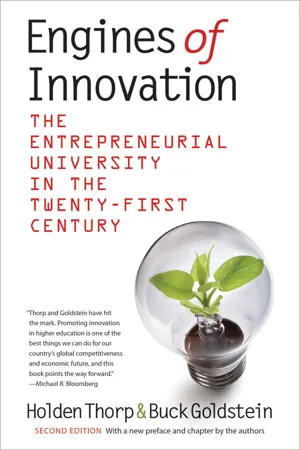
In Engines of Innovation, Holden Thorp and Buck Goldstein make the case for the pivotal role of research universities as agents of societal change. They argue that universities must use their vast intellectual and financial resources to confront global challenges such as climate change, extreme poverty, childhood diseases, and an impending worldwide shortage of clean water. They provide not only an urgent call to action but also a practical guide for our nation’s leading institutions to make the most of the opportunities available to be major players in solving the world’s biggest problems.
A preface and a new chapter by the authors address recent developments, including innovative licensing strategies, developments in online education, and the value of arts and sciences in an entrepreneurial society.
eBook - ePub
Engines of Innovation
The Entrepreneurial University in the Twenty-First Century
- 200 pages
- English
- ePUB (mobile friendly)
- Available on iOS & Android
eBook - ePub
Engines of Innovation
The Entrepreneurial University in the Twenty-First Century
About this book
Information
1 The Entrepreneurial Opportunity
Events have conspired to place our great universities in an either enviable or terrifying position, depending on your point of view. They are collectively among the most affluent institutions in our society.1 They are populated with the best minds in the world and have created a culture that encourages new knowledge and puts it to practical use. But such a wealth of resources comes with an imposing responsibility. Donors, grant makers, and the public at large expect big things from what can reasonably be characterized as one of the crown jewels of our society. Having accumulated such significant resources in the name of advancing society, universities have no choice but to embrace the challenge, but those of us inside the academy know it will be no easy task to meet the high expectations we have created. We believe this moment in history makes unlocking the innovative potential of our research universities a national imperative, and an entrepreneurial mindset is key to achieving this objective.
Five historical trends support our conclusion. First, the problems of the twenty-first century are big and complex. Attacking them will require unprecedented resources and nontraditional approaches that complement traditional academic disciplines. Second, information-based tools at the disposal of individuals and small groups undermine the authority of large bureaucratic institutions and empower those with an entrepreneurial mindset. Third, the students who are the heart and soul of all great universities approach their education and the world with a new and different mindset—one that values results over process and is comfortable with the accumulation of knowledge through complex forms of social networking. Fourth, traditional sources of expendable funds are decreasing, and funders of all forms have performance-based expectations that are best addressed by an entrepreneurial approach. Finally, it has become increasingly obvious that new ways of problem solving that combine traditional rationality with creative solutions will be required to address the world’s great problems. Entrepreneurial thinking is central to this new approach.
Big Problems Require a New Approach to Innovation
A research university attacking a small problem is like a brain surgeon performing an appendectomy. With unprecedented resources available to our great American universities and an academic culture built for discovering novel approaches, the public has thrust upon these institutions the challenge of solving what professor John Kao, in his book Innovation Nation, calls “wicked problems”: climate change, environmental degradation, communicable diseases, and extreme poverty, among others; and a meaningful response is expected.2 Wicked problems, in Kao’s view, have a good deal in common: they rarely have clear-cut solutions that can be unlocked by a single discipline; they are complex and ambiguous; and they require fundamentally new approaches to the status quo.
Wicked problems are fundamentally different from big challenges the United States has tackled in the recent past. For example, the Manhattan Project was created in 1941 to address the belief that Nazi Germany was on the brink of building an atomic bomb that that would lead to an Allied defeat in World War II. Founded upon a series of breakthroughs in theoretical physics, the effort employed 125,000 people at its peak in three key sites under the leadership of one great scientist, Robert Oppenheimer. This vast project had clearly defined goals: to meet an impossible deadline, produce the first nuclear weapon, and ultimately result in an Allied victory. They were achieved with the detonation of two bombs at Hiroshima and Nagasaki and the subsequent surrender of the Japanese forces. All of this was accomplished in three years after the project was authorized by the highest levels of the U.S. government and was successfully kept secret.
The mission to “put a man on the moon” has a similar history. In this case the impetus to innovate came in 1957 from the Russians’ launching of an unmanned satellite, Sputnik. Coming at the height of the Cold War, Sputnik’s ascent ignited a furor in the United States over the perceived diminution of American scientific and military leadership. With the help of a group of German scientists led by Wernher von Braun, the United States matched the Russian feat of orbit within a year. The National Aeronautics and Space Administration (NASA) was founded soon after with the goal of achieving American preeminence in space travel and eventually placing a man on the moon. Three years later, NASA achieved a fifteen-minute suborbital flight piloted by Alan Shepard, and less than a year later John Glenn orbited the earth. Project Apollo and the race to the moon had begun in earnest, and after a series of difficulties and tragedies, including the death of three astronauts in a training exercise in June of 1969, Apollo 11 landed the first man on the moon. NASA, like the Manhattan Project, achieved rapid success by sticking to a proven approach: combine a strong leader with a clear mission, high-level government commitment, and massive amounts of government funds.
As difficult as it was to build an atomic bomb in three years or to put a man on the moon in twelve, it is tempting to wish that today’s wicked problems were more like those earlier challenges, with a clear beginning and end—and a mission that can be clearly stated in a few words. Compare those earlier missions with what must be done to attack twenty-first-century challenges. Their complexity requires cooperation from a variety of disciplines. In fact, these problems are of such magnitude that no single institution can adequately take them on. These problems cross national borders and require international consensus. Their international nature makes funding complex; unlike the Manhattan Project or the NASA mission, no single government or source of funds can achieve success. Most important, these problems are not ones merely of theory or scientific innovation; in fact they are largely impervious to traditional academic problem solving. Addressing complex problems requires diverse points of view, a deep level of practical implementation, and openness to fundamental change. At bottom, they require, in the words of Professor Kao, “integrative approaches that blend necessary perspectives into a new way of doing the actual work of innovation.”3
The challenge posed by climate change illustrates the need for this new, more entrepreneurial approach. Rising gas prices have accomplished what Al Gore’s movie and thousands of scientific articles failed to do in terms of public education, and the world is now aware that its approach to consuming energy must change and a vast array of disciplines must participate in mapping a sustainable course of action. New knowledge is needed in many areas: fuel-cell technology, biofuels, and heat absorption, to name a few. Process improvements in construction and waste removal are essential. Architectural innovations that make green buildings practical and breakthroughs in city planning that reduce or eliminate the need for cars will need to correspond with research in economics, public policy, psychology, sociology, anthropology, and political science. Coordination of these diverse disciplines, and the diverse funding sources that accompany them, will be needed to address the problem, and all these efforts must ultimately have global applicability. Ultimately, solutions must be validated by market forces and consumer behavior.
As tough as they are to solve, our current problems can be viewed as opportunities. To address them, universities must break out of the traditional, hierarchical model that worked so well for the Manhattan Project and the manned space initiative and actually change the way they approach the process of innovation. Accepting the challenges posed by wicked problems will force universities to rethink the way they approach many of their most basic functions.
New Tools Are Empowering Individuals
The complexity of wicked problems is partially offset by the remarkable information-based tools available to virtually anyone on the planet with a computer (or a mobile telecommunications device) and high-speed Internet access. In the United States, some estimate that two-thirds of the population has Internet access and 50 percent has a high-speed line.4 Sixteen million South Koreans, one out of three, have web pages, and it is estimated that approximately half the world has cell phone access.5 With a dramatic drop projected in the cost of computers and mobile devices and the expectation that up to 90 percent of the world’s population will soon have access to high-speed telecommunications, universal connectivity is no longer a pipe dream.
At the same time that information appliances are proliferating at an astounding rate, the world’s knowledge is being digitized, making it accessible to anyone with a cell phone or a laptop computer. Google is spending billions on efforts to put the world’s great libraries online, and hundreds of other efforts are aiming to include not only text but audio and video in the new electronic canon—and all of this will be updated in real time. At the most basic level, access to the world’s knowledge is being democratized. Although the economics have yet to be worked out (fertile ground for entrepreneurial thinking), what only a few years ago seemed to be a futurist’s musings is now happening, and anyone who doubts the new reality should have a look at Google Scholar, the forerunner of the promise of universal knowledge access.
This kind of access is inherently empowering and democratizing. Physical and economic barriers to the free flow of knowledge are going away. What will that mean? A look outside academia provides some hints. A home buyer about to “lock in” a financing option has access to information on the direction of interest rates, including detailed charts, analysis, and predictions previously available only to bankers and traders. A farmer in a small village in India has cell phone access to global crop prices as well as short- and long-term weather reports that make his land more productive and profitable. That same farmer can use a cell phone to determine whether the local health clinic will be open the next day and save a lost day of work if the doctor is not available. The list goes on and on and the message is clear: information that was formerly available only to large institutions is now in the hands of virtually everyone, giving individuals and small groups the power and influence previously reserved for the very few. It is much too early to assess the impact of this “knowledge proliferation,” but it has the potential to engage the individual innovator and a band of followers in dialogue that was previously closed to them. Since entrepreneurship almost always starts with an individual and not some committee or institution, the promise of universal access to knowledge creates unprecedented opportunity for anyone with a better idea. If knowledge is the energy that runs the academy’s innovation engine, that energy is now essentially free and available to all, 24/7.
The Internet is creating an even more fundamental change in the way knowledge is created, and it points to a central role for entrepreneurship as a catalyst for university-based innovation. All of the examples given so far involve top-down information flows. Those seeking information turn to scholarly experts, professionally prepared databases, or reported market information in order to make decisions or draw conclusions. This is the traditional student-teacher approach that Plato and Socrates canonized and that has remained essentially unchanged ever since—that is, until now. In the last five years, as so much of the world has become digitally literate, information flows have become multidirectional. Wikipedia is the quintessential example: with 1.8 million entries (as compared to 120,000 in the Encyclopedia Britannica) and growing at a rate of 1,500 entries a day in English alone, it is by far the world’s largest encyclopedia. And entries are constantly updated. When leading television news commentator Tim Russert died unexpectedly of a heart attack, the first public notice of his death (even before it was announced by NBC—his own network) appeared in an update of his Wikipedia entry. Collaborative websites known as wikis are now everywhere, demonstrating the ethic of collaboration John Kao suggests in describing “systems without a center that nevertheless exhibit forceful and creative behaviors.” Kao calls these virtual entities the “digital nervous systems of innovation.”6
The power of these systems is only now beginning to be understood. In retrospect, the U.S. presidential campaign of 2008 may be seen as the coming-out party of the digital nervous system. The most important news scoops of the primaries came not from established newspapers or cable news but from networks of part-time bloggers—many of whom followed the candidates on their own nickel. One, Mayhew Fowler, revealed disparaging remarks Senator Obama made about Pennsylvania voters. Websites such as the Huffington Post, which is essentially an amalgam of blogs, became a cited source for mainstream media outlets as the process of gathering political news was turned on its head. The placement of homemade video clips of candidate appearances on the popular website YouTube confronted candidates with the prospect that their every word might be made available to a worldwide audience.
At the same time, the process of financing political campaigns was being revolutionized. Political action committees such as ActBlue, a conduit for the Democratic Party that has raised nearly $100 million from 420,000 donors, are buoyed by small-dollar donations.7 In his campaign for the Republican nomination, Ron Paul raised nearly $4 million online in a single day.8 Obama supporters were routinely reminded through social networking sites to participate in campaign events and to make additional donations. In February of 2008 alone, the Obama campaign raised $45 million online—from large and small donors alike. Over the course of the campaign, Obama’s online operation raised more than $500 million from 3 million donors; the average donation was $80; of the 6.5 million donations given, 6 million were of $100 or less.9 Now the Obama administration has put in place the same multidirectional informational tools as a means of improving the efficiency and transparency of government. Groups in opposition to the current administration, such as the Tea Party movement, employ similar techniques. New bills, directives, and initiatives appear routinely on the president’s website for study and comment. Always on, multidirectional communication has permeated our political discourse, and it promises to result in dramatic change to the way we govern ourselves.
It is too early to predict the full impact of these vast new flows of multidirectional information. It is clear that new and powerful collaborative tools will emerge to aid those seeking to attack the world’s great problems. Individuals and small groups in the field can beta test approaches pioneered in the lab with the results reported in real time. Continuous feedback loops can be built into virtually every experiment or initiative. Full-motion video will become an important communication tool. Complex webs of relationships will take the place of hierarchical one-way information flows—and there is even a new word for the phenomenon, “crowdsourcing.” Entrepreneurial thinking will be required to make sense of it all.
Millennial Students Are Transforming the Academy
Great teachers often say that they learn more from their students than their students learn from them, and the current crop of students are emerging as advocates for innovative approaches to modern problems. The demographic diversity of what has come to be known as the “millennial generation,” as well as their standards of intellectual achievement, technological facility, social commitment, and entrepreneurial outlook, make them ideal partners in attacking great problems in a practical and timely manner. Their strong idealism combines with an increasing interest in what has come to be known as social entrepreneurship to create an important and influential constituency ready to engage the world’s most challenging and exciting issues.
So who are these millennial students? They were born between 1981 and 1993, and they are the largest demographic cohort since the 75 million Baby Boomers. Approximately 40 percent of millennials in America are nonwhite, and 20 percent have a parent who is an immigrant. Eighty percent have participated in some form of community service, and they are generally optimistic about the future. Almost half have an interest in starting their own business, and they generally think of themselves as entrepreneurial.10 Most significantly, they have integrated into their lives technology that even the most imaginative futurist could not have anticipated a decade ago. A 2007 study found that 97 percent of millennials own a computer and 94 percent own a cell phone; 76 percent use instant messaging to stay connected 24/7. A third of millennials use the Web as their primary source of news, and an equal number author a blog. Half of them download their music using peer-to-peer file-sharing applications, and 60 percent own a portable music player such as an iPod. Seventy-five percent of those in college have a Facebook account.11
This new generation profoundly impacts the classroom and the campus. Classroom discussions are more incisive when laptops are present as fact-checking and information-gathering tools. The phrase “go home and look it up” has been replaced with “someone look it up now.” And “looking it up” is no longer confined to print media, with YouTube screening 3 billion videos a month on its site. With social networking sites such as Facebook and Twitter, all members of the campus community have access not only to traditional facts but late-breaking news, local events, unsubstantiated rumors, and more. Being up to date takes on a whole new meaning. Constant communication has an even more profound impact on the campus milieu. Students’ time horizons are shorter when messages, music, photos, and information are all instantaneous. What used to take weeks or days now gets done in seconds, and this new reality permeates every aspect of millennials’ lives. They expect to get things done quickly and are fully capable of assembling complex teams and significant human and even financial resources to solve problems that are important to them. The tools millennials have at their disposal make them willing to attack tough problems. Jeffrey Sachs’s Millennium Project aims at el...
Table of contents
- Cover Page
- Engines of Innovation
- Copyright Page
- Dedication
- Contents
- Preface to the Second Edition
- Introduction
- 1 The Entrepreneurial Opportunity
- 2 Entrepreneurial Science
- 3 Enterprise Creation
- 4 Social Entrepreneurship
- 5 Multidisciplinary Centers
- 6 Leadership
- 7 Academic Roles
- 8 Culture and Structure
- 9 Teaching Entrepreneurship
- 10 Accountability
- 11 The New Donors and University Development
- Conclusion
- Engines Revisited—A Three-Year Tune-Up
- Notes
- Acknowledgments
- Index
Trusted by 375,005 students
Access to over 1.5 million titles for a fair monthly price.
Study more efficiently using our study tools.
Frequently asked questions
Yes, you can cancel anytime from the Subscription tab in your account settings on the Perlego website. Your subscription will stay active until the end of your current billing period. Learn how to cancel your subscription
No, books cannot be downloaded as external files, such as PDFs, for use outside of Perlego. However, you can download books within the Perlego app for offline reading on mobile or tablet. Learn how to download books offline
Perlego offers two plans: Essential and Complete
- Essential is ideal for learners and professionals who enjoy exploring a wide range of subjects. Access the Essential Library with 800,000+ trusted titles and best-sellers across business, personal growth, and the humanities. Includes unlimited reading time and Standard Read Aloud voice.
- Complete: Perfect for advanced learners and researchers needing full, unrestricted access. Unlock 1.5M+ books across hundreds of subjects, including academic and specialized titles. The Complete Plan also includes advanced features like Premium Read Aloud and Research Assistant.
We are an online textbook subscription service, where you can get access to an entire online library for less than the price of a single book per month. With over 1.5 million books across 990+ topics, we’ve got you covered! Learn about our mission
Look out for the read-aloud symbol on your next book to see if you can listen to it. The read-aloud tool reads text aloud for you, highlighting the text as it is being read. You can pause it, speed it up and slow it down. Learn more about Read Aloud
Yes! You can use the Perlego app on both iOS and Android devices to read anytime, anywhere — even offline. Perfect for commutes or when you’re on the go.
Please note we cannot support devices running on iOS 13 and Android 7 or earlier. Learn more about using the app
Please note we cannot support devices running on iOS 13 and Android 7 or earlier. Learn more about using the app
Yes, you can access Engines of Innovation by Holden Thorp,Buck Goldstein in PDF and/or ePUB format, as well as other popular books in Pedagogía & Emprendimiento. We have over 1.5 million books available in our catalogue for you to explore.