This engaging collection surveys and clarifies the complex issue of federal and state recognition for Native American tribal nations in the United States. Den Ouden and O'Brien gather focused and teachable essays on key topics, debates, and case studies. Written by leading scholars in the field, including historians, anthropologists, legal scholars, and political scientists, the essays cover the history of recognition, focus on recent legal and cultural processes, and examine contemporary recognition struggles nationwide.
Contributors are Joanne Barker (Lenape), Kathleen A. Brown-Perez (Brothertown), Rosemary Cambra (Muwekma Ohlone), Amy E. Den Ouden, Timothy Q. Evans (Haliwa-Saponi), Les W. Field, Angela A. Gonzales (Hopi), Rae Gould (Nipmuc), J. Kehaulani Kauanui (Kanaka Maoli), K. Alexa Koenig, Alan Leventhal, Malinda Maynor Lowery (Lumbee), Jean M. O'Brien (White Earth Ojibwe), John Robinson, Jonathan Stein, Ruth Garby Torres (Schaghticoke), and David E. Wilkins (Lumbee).
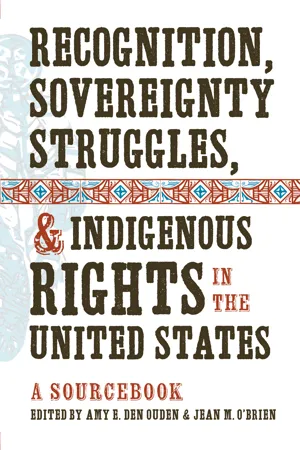
eBook - ePub
Recognition, Sovereignty Struggles, and Indigenous Rights in the United States
A Sourcebook
- 376 pages
- English
- ePUB (mobile friendly)
- Available on iOS & Android
eBook - ePub
Recognition, Sovereignty Struggles, and Indigenous Rights in the United States
A Sourcebook
About this book
Information
Part I
Race, Identity, and Recognition
The Imposition of Law
The Federal Acknowledgment Process and the Legal De/Construction of Tribal Identity
The European is to the other races of mankind what man himself is to the lower animals; he makes them subservient to his use and when he cannot subdue he destroys them.
Society must be remade before it can be the object of quantification. Categories of people and things must be defined, measures must be interchangeable; land and commodities must be conceived as represented by an equivalent in money. There is much of what Weber called rationalization in this, and also a good deal of centralization.
This chapter considers how American Indian identity is ensconced in federal law through the Federal Acknowledgment Process (FAP). As the primary way by which groups can become legally recognized as a tribe, the FAP relies on evidence of “Indianness” and “tribalness” that is rendered legible through legal and social scientific analyses. Through an examination of the Ramapough Mountain Indians’ petition for federal acknowledgment—a petition ultimately denied by the Secretary of the Interior—we consider some important questions: What are the effects of requiring groups to provide evidence of their social, cultural, and political organization as an Indian tribe, historically and continuously, to prove their “authenticity” in a legal arena? To what extent do the dicta of federal regulations in the acknowledgment process allow for or accommodate conflicting perspectives of native self-understanding, identity, and group life? And how can the adjudication of such matters be deemed unbiased when the evidence itself is the product of historical policies and practices aimed at the diminution of native existence?
Introduction
A problem calls for a solution. The problem: Beginning in the 1970s, an increasing number of Indian groups not formally recognized by the federal government sought legal recognition as tribes. Requests from groups seeking federal recognition previously had been handled on an ad hoc basis, based mostly on or through treaties, legislative and executive agency action, or judicial decree. In 1977, the American Indian Policy Review Commission reported that hundreds of Indian tribes had been left out of the federal trust relationship because of the lack of a single, formal acknowledgment process and the sometimes arbitrary actions and omissions of the federal bureaucracy.1 The solution, according to the secretary of the interior: Delegate authority to the assistant secretary of Indian affairs to establish a formal process by which the U.S. government acknowledges an Indian tribe. Such authority, intended to provide the assistant secretary with an informed and well-researched basis for making any decision to acknowledge an Indian tribe, culminated in the establishment of the FAP in 1978.2
In the United States, with ultimate power and authority residing at the federal level, officials created and codified into law a standardized and synoptic view of what the federal government believes to constitute an Indian tribe. In so doing, the FAP has supplanted the diverse tribal histories, cultures, and customs of Indian groups seeking legal recognition with a simplified and standardized process and criteria to make these groups legible as Indian tribes.3 Through its authoritarian power and practical logic and form necessary for the categorization of Indian groups, the FAP encodes and enforces an understanding of tribal identity both homogeneous and absolute. Such categories, writes James C. Scott, “begun as the artificial inventions of [federal officials,] end by becoming categories that organize people’s daily experiences precisely because they are embedded in state-created institutions that structure that experience.”4 Charted historically, the categorization of Indian groups as “federally recognized” or “non–federally recognized” acquires its force from the fact that these categories reflect federal officials’ perception of what they believe (or believed) to be the characteristics and qualities constituting Indian tribes. Given the centrality and importance of the federal government in the lives of American Indians, the FAP has had the power not only to transform American Indian self-understanding and identity but also to reinforce boundaries of difference between Indians and non-Indians and among tribal groups.5
For the 566 federally acknowledged Indian tribes and Alaska Native villages, the term “federal acknowledgment” (used interchangeably with “federal recognition”) signifies a trust relationship by the federal government toward an Indian tribe that is legally acknowledged, or recognized, by both parties.6 A foundational concept necessary for understanding this relationship is that American Indian tribes have historically been governmental entities with inherent group political authority over their lands and people.7 Culturally unique and territorially distinct, each Indian nation exercised its sovereign political authority relatively freely, limited only internally by the amount of authority conferred on the group by individual tribal members and externally by the boundaries set by other Indian nations.
After contact with European nations, the external limitations on and the nature of tribal sovereignty changed. These outside European powers assumed the roles of proscribing and supplanting tribal political authority. Europeans rooted their assertions of absolute authority and sovereignty over the indigenous peoples of the Americas in a theological-political viewpoint built on a “divine right” to take and colonize the lands of non-Christian peoples. This imposition of paramount external authority conflicted with the history and practice of Indian nations governing themselves. Soon after contact, conflict between native nations and European powers began to grow, and Europeans sought a way to manage the situation. They often did so through treaties, wherein natives conceded land and resources in exchange for rights in other reserved lands, weapons, commodities, and other promises by European nations. However, the physical and economic power of the European nations in the New World eventually left little doubt as to their ability to impose their political and legal will over the Indian tribal nations. Vestiges of tribal self-rule continued, but as a later U.S. Supreme Court ruling rationalized, “The rights of the original inhabitants were, in no instance, entirely disregarded; but were, necessarily, to a considerable extent, impaired. They were admitted to be the rightful occupants of the soil . . . but their rights to complete sovereignty, as independent nations, were necessarily diminished, and their power to dispose of the soil, at their own will, to whomsoever they pleased, was denied by the original fundamental principle, that discovery gave exclusive title to those who made it.”8
Still, the survival of tribal nations and their treaties with European powers necessarily required each side to acknowledge both the existence and the continuing political authority of the other, whatever its extent. Over time, this recognition of tribal nations by outside powers would be handed from the European powers to their colonies in the New World and eventually to the U.S. federal government. In theory, the federal government and tribes today recognize each other as mutual sovereigns; in practice, however, the plenary power granted by the U.S. Constitution to Congress over Indian affairs and confirmed by the Supreme Court enables the federal government to limit tribal sovereignty and circumscribe the meaning of tribal identity. One of the foundational tools for circumscribing tribal identity is federal acknowledgment—the ability of the federal government to deem as an American Indian tribe a particular group to whom it will extend an official political and legal relationship.
Historically, federal recognition has had two distinct meanings and uses, the intrinsic and the jurisdictional.9 Prior to 1870, federal officials and the general public used and understood “recognition” as an intrinsic and self-evident quality and characteristic of Indian tribes that required no additional explanation. Marked by territorial boundaries and differences in physiognomy, language, culture, and lifestyle, Indian tribes existed as identifiable and distinct entities. But by the early 1800s, federal policy became increasingly concerned with delimitating boundaries between natives and nonnatives and more specifically among tribal groups.
Beginning in the 1870s, “recognition” began to be used in a more formal, jurisdictional sense and found its legal underpinnings in a series of three Supreme Court opinions—Johnson v. M’Intosh (1823), Cherokee Nation v. Georgia (1831), and Worcester v. Georgia (1832)—originally written by Chief Justice John Marshall a half century earlier to clarify the relationship among Indian tribes, states, and the federal government.10 Most relevant for the concept of recognition, in Worcester v. Georgia, Marshall argued that under treaties made with the Cherokee, the United States had “assum[ed] the duty of protection.”11 Using a historical account of tribes as independent entities with special status, Marshall opined, “The Indian nations had always been considered as distinct, independent political communities, retaining their original natural rights as the undisputed possessors of the soil from time immemorial, with the single exception of that imposed by irresistible power [of the European nations]. The very term ‘nation,’ so generally applied to them, means ‘a people distinct from others.’”12 Known as the Marshall Trilogy, these three cases establish the legal foundation for the special political status of Indian tribes as sovereign albeit “domestic dependent nations” whose relationship to the United States resembles that “of a ward to his guardian.”13
As a conceptual category, federally recognized tribes were formally decreed in 1934 with the passage of the Indian Reorganization Act (IRA).14 In defining the term “Indian” as “persons of Indian descent who are members of any recognized Indian tribe now under Federal jurisdiction,”15 the IRA introduced the concept of nonrecognized tribes, to which its provisions and a plethora of subsequent legislation would not apply.16
To determine the application of the IRA and subsequent legislation aimed at recognized tribes, it became increasingly necessary to delineate the differences between federally recognized and nonrecognized tribes. This necessity culminated in the establishment of the FAP by executive agency action in 1978 and officially titled Procedures for Establishing That an American Indian Group Exists as an Indian Tribe.
In circumscribing the procedures to be used and criteria to be met by groups petitioning for federal acknowledgment, the FAP is a legal process for establishing a political relationship between the group as a tribe and the federal government. It takes into account but is distinct from and not wholly dependent on answers to the related questions of whether the group’s individual members are “racially” or ethnically American Indian or whether the group exists as a tribe independent of the federal relationship. To illustrate this distinction, the foremost treatise on American Indian law, Felix Cohen’s Handbook of Federal Indian Law, notes that the definition of “Indian” under federal law varies based on context, but in the most general terms a person must meet two requirements: (1) have Indian ancestry, and (2) be regarded as an Indian by his or her tribe or community.17 The U.S. Census Bureau requires even less, relying solely on an individual’s self-identification as Indian. Neither means of establishing individual Indianness is determinative of collective tribalness.
Through its authoritarian power and administrative need to identify those groups with whom it has a government-to-government relationship, the FAP distinguishes federally recognized tribes from the two other categories of American Indian tribes in the United States: state-recognized and nonrecognized tribes. State-recognized tribes lack federal acknowledgment but have been recognized pursuant to state law and may have certain rights recognized by the federal government by virtue of such tribal status. Nonrecognized tribes are groups with neither federal nor state recognition but that nonetheless assert a self-ascribed American Indian tribal identity. The impo...
Table of contents
- Cover Page
- Recognition, Sovereignty Struggles, and Indigenous Rights in the United States
- Copyright Page
- Dedication
- Contents
- Introduction
- Part I Race, Identity, and Recognition
- Part II State and Federal Recognition in New England
- Part III Contemporary Recognition Controversies
- Afterword
- Contributors
- Index
Trusted by 375,005 students
Access to over 1.5 million titles for a fair monthly price.
Study more efficiently using our study tools.
Frequently asked questions
Yes, you can cancel anytime from the Subscription tab in your account settings on the Perlego website. Your subscription will stay active until the end of your current billing period. Learn how to cancel your subscription
No, books cannot be downloaded as external files, such as PDFs, for use outside of Perlego. However, you can download books within the Perlego app for offline reading on mobile or tablet. Learn how to download books offline
Perlego offers two plans: Essential and Complete
- Essential is ideal for learners and professionals who enjoy exploring a wide range of subjects. Access the Essential Library with 800,000+ trusted titles and best-sellers across business, personal growth, and the humanities. Includes unlimited reading time and Standard Read Aloud voice.
- Complete: Perfect for advanced learners and researchers needing full, unrestricted access. Unlock 1.5M+ books across hundreds of subjects, including academic and specialized titles. The Complete Plan also includes advanced features like Premium Read Aloud and Research Assistant.
We are an online textbook subscription service, where you can get access to an entire online library for less than the price of a single book per month. With over 1.5 million books across 990+ topics, we’ve got you covered! Learn about our mission
Look out for the read-aloud symbol on your next book to see if you can listen to it. The read-aloud tool reads text aloud for you, highlighting the text as it is being read. You can pause it, speed it up and slow it down. Learn more about Read Aloud
Yes! You can use the Perlego app on both iOS and Android devices to read anytime, anywhere — even offline. Perfect for commutes or when you’re on the go.
Please note we cannot support devices running on iOS 13 and Android 7 or earlier. Learn more about using the app
Please note we cannot support devices running on iOS 13 and Android 7 or earlier. Learn more about using the app
Yes, you can access Recognition, Sovereignty Struggles, and Indigenous Rights in the United States by Amy E. Den Ouden, Jean M. O'Brien, Amy E. Den Ouden,Jean M. O'Brien in PDF and/or ePUB format, as well as other popular books in Social Sciences & North American History. We have over 1.5 million books available in our catalogue for you to explore.