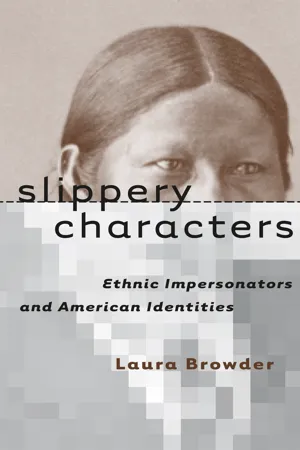
In the 1920s, black janitor Sylvester Long reinvented himself as Chief Buffalo Child Long Lance, and Elizabeth Stern, the native-born daughter of a German Lutheran and a Welsh Baptist, authored the immigrant’s narrative I Am a Woman — and a Jew; in the 1990s, Asa Carter, George Wallace’s former speechwriter, produced the fake Cherokee autobiography, The Education of Little Tree. While striking, these examples of what Laura Browder calls ethnic impersonator autobiographies are by no means singular. Over the past 150 years, a number of American authors have left behind unwanted identities by writing themselves into new ethnicities.
Significantly, notes Browder, these ersatz autobiographies have tended to appear at flashpoints in American history: in the decades before the Civil War, when immigration laws and laws regarding Native Americans were changing in the 1920s, and during the civil rights era, for example. Examining the creation and reception of such works from the 1830s through the 1990s — against a background ranging from the abolition movement and Wild West shows to more recent controversies surrounding blackface performance and jazz music — Browder uncovers their surprising influence in shaping American notions of identity.
- 328 pages
- English
- ePUB (mobile friendly)
- Available on iOS & Android
eBook - ePub
About this book
Information
chapter one
Slave Narratives and the Problem of Authenticity
In the history of the United States, slavery most clearly illustrated the clash between the American precept that all men are born free and equal and the reality that race determined class status. Southern apologists for slavery in the antebellum period employed a variety of pseudo-scientific and religious theories to point to Africans’ suitability as slaves and their inability to hold equal status with whites. On the other hand, many of the horror stories published in abolitionist newspapers centered around cases when the link between blackness and slave status was threatened—when white people were enslaved. I have chosen to start with slave narratives because slavery was, after all, a condition in which race and class status were inextricably linked. In the United States, as Werner Sollors points out, from Puritan times to the present the notion of consent rather than descent has been instrumental in defining Americanness. And yet “the concepts of the self-made man and of Jim Crow had their origins in the same culture at about the same time, whereas aristocratic societies had no need for either…. It was not the hereditary privilege of blue blood but the culturally constructed cultural liability of black blood that mattered most in the United States.”1
Slave narratives were among the first American ethnic autobiographies to be widely produced and widely read. They, more than any group of such texts, illustrate the problems and pitfalls of the autobiographer who must employ a representative rather than an individual voice for what is a fairly pointed political goal: to alter the dominant culture’s perception of his or her people. Slave narratives were produced within the context of the abolitionist movement and were elicited and edited by white editors. They were texts marked by the collusion and, sometimes, the struggle between the purposes of the writer and his or her amanuensis. In slave narratives some of the difficulties that subsequent ethnic autobiographers have faced in telling their stories are highlighted: former slaves, for their narratives to have potency, needed to appear authentic. Yet in doing so they had to squeeze their stories into the tightest of narrative fits in order to adhere scrupulously to their audience’s idea of what the authentic slave experience entailed. Authenticity required predictability. There was little room for individual experience that fell outside the expected rubric of what everyone—that is, an abolitionist audience—knew to be true about slavery. Yet within the straitjacket of authenticity, former slaves struggled to write themselves into existence, to show that, after all, being African American was no guarantee of object status and that the former slave narrator had just as much claim to humanity as his or her white reader.
In their collaborations with former slaves, abolitionists struggled to create what they saw as a believable version of the slave experience. They worked in their publications to deracialize slavery by insisting that enslavement could happen as easily to a white person as to a black one, and that white skin was no protection against commodification. Ironically, however, in doing so they made it possible for just about any spokesperson to learn what an ex-slave was supposed to have experienced, and they witnessed a rash of fugitive slave impostors, con artists who preyed on credulous abolitionist sympathizers. Finally, despite the lip service abolitionists paid to the power of the stories told by former slaves, some of the literature most highly touted in abolitionist journals was created by white abolitionists speaking in the voice of slaves. In a world where anyone could learn the language of authenticity, the obvious fake was better than the spurious authentic document.
For a brief history of the slave narrative and its reception in nineteenth-century America, there is no better place to start than with the new introduction to the 1855 reissue of Archy Moore, the White Slave; or, Memoirs of a Fugitive (1836), in which its author, Richard Hildreth, traced the history of his work’s publication and reception. A novel written in the form of a slave narrative, Archy Moore centers around a slave, the product of two generations of miscegenation and to all appearances white, as he marries his half-sister and then tries to rescue her from the sexual advances of their father and master.
In his introduction Hildreth explained that when he first sought a publisher in 1836, “neither in New York nor Boston was it very easy to find one. No bookseller dared to publish anything of the sort, and so complete was the reign of terror, that printers were almost afraid to set up the types” (ix). The publication of Appeal to the Coloured Citizens of the World (1829), by David Walker, a free black man in Boston, had sparked an angry debate over abolition. Walker’s urging of his named audience of all African Americans, including southern slaves, to recognize white slaveholders as their enemy led to a crackdown on persons suspected of abolitionist tendencies as well as slaves. Within a year of publishing his pamphlet Walker himself was found dead under mysterious circumstances. The following year, 1831, Nat Turner’s rebellion, the most extensive slave revolt in America until this point, provoked further reprisals by white southerners. In 1835, the year before Archy Moore was published, a mob in South Carolina broke into a post office in Charleston and, in a move later applauded by President Andrew Jackson, confiscated and burned abolitionist materials sent from the North. In 1836 proslavery forces successfully passed a gag order preventing Congress from considering antislavery petitions. Antiabolition riots broke out in several cities between 1834 and 1838.
Thus it was not surprising that Hildreth had problems getting his book published. Until 1831 the abolition movement had been quiescent in the North, even as slavery grew stronger in the South. However, Turner’s insurrection changed the cry of antislavery activists from a plea for colonization to a call for immediate emancipation. These abolitionists were so successful in mobilizing support in the post-Turner years that they managed to gather more than 400,000 signatures on a petition they sent to Congress in 1838 demanding the end of slavery. By that year the American Anti-Slavery Society claimed a quarter of a million members.2 Hildreth entered the fray as the debate over slavery was dramatically heating up. Indeed, the few reviews that appeared discussed the book’s inflammatory nature, and the editor of the Boston Daily Advocate, one of the few pro-abolitionist newspapers in Boston, predicted that “the booksellers won’t dare sell it, and a copy will never get into a southern latitude” (xii).
As a sales tactic, the editor of the 1836 edition presented the text as a slave narrative, writing in the advertising copy, “As to the conduct of the author, as he has himself described it, there are several occasions on which it is impossible to approve it. But he has written memoirs—not an apology nor a vindication. No man who writes his own life, will gain much credit by painting himself as faultless, and few have better claims to indulgence than Archy Moore” (x). Although this advertisement linked the value of the text to its supposed veracity as a slave autobiography, reviews of the book referred to it as a pseudonymous novel, albeit a “fiction woven apparently out of terrible truths.”
It was unclear in 1836 that authenticity was much of a draw. In one of only two Boston reviews, in the abolitionist Liberator, Lydia Maria Child, herself a novelist (and, many thought, the true author of The White Slave), compared the book to the recently published memoirs of Charles Ball, a former slave:
It is said in your paper that some think Charles Ball equal to Archy Moore. The extracts I have seen from Charles Ball are certainly highly interesting; and they have a peculiar interest, because an actual living man tells us what he has seen and experienced; while Archy Moore is a skillful grouping of incidents which, we all know, are constantly happening in the lives of slaves. But it cannot be equal to Archy Moore! Why, it does not belong to the same year, scarcely to the same age, to produce two such books. If I were a man, I would rather be the author of that work, than of anything ever published in America. (xiv)
The “peculiar interest” occasioned by the authenticity of Ball’s narrative could not match the skillful fictionality of Hildreth’s. In 1861 Child acted as the editor for Harriet Jacobs’s Incidents in the Life of a Slave Girl. In doing so she brought one of the most powerful examples of the genre to the attention of the reading public.3 She came to value the slave narrative’s authenticity as much as did other abolitionists. But in 1836 authenticity was not yet at a premium. Nor did abolitionist fiction or slave autobiography have the power in the marketplace that it would soon attain. Although the first edition of Archy Moore sold out and a new one appeared in 1839, the advertisement for the second edition complained, “No review, or magazine, or hardly a newspaper, took any notice of [the first edition]—a silence caused quite as much by not knowing what to say, as by any indifference to the subject or contents of the book, both of which were certainly in some respect, well calculated to elicit criticism” (xvi). There was as yet no real place for the voice of the slave in the debate over slavery, and as Hildreth complained, even the second edition did not attract much attention.
Some of what notice the book did garner was negative, as evidenced by this paragraph from the (Boston) Christian Examiner, which criticized the language of the first-person narrator: “In its present form it is in this respect a constant violation of probability. We read, in what professes to be the language of a slave, that which we feel a slave could not have written” (xvii). At this review Hildreth took umbrage in his introduction to the 1855 edition: “To have been bred a slave, was in the estimation of this critic, (and he no doubt expressed to the sentiment current about him,) to have grown up destitute of intellect and feeling. When the book and the criticism were written, there were yet no Fred Douglasses. The author foresaw them; the critic did not” (xx). Douglass’s 1845 autobiography, which sold five thousand copies in its first four months of publication, brought slave narratives to a much wider audience. Narrative of the Life of Frederick Douglass was a tale of self-fashioning in the tradition of Ben Franklin—the story of how a man was made a slave, “a man transformed into a brute.”4 Created by a master rhetorician, it was also compelling evidence of the slave’s humanity.
Finally, however, it was Harriet Beecher Stowe as much as Frederick Douglass who helped ensure success for Archy Moore. “So matters stood, when the publication and great success of Uncle Tom’s Cabin gave a new impulse to anti-slavery literature” (Hildreth, xxi). Within a year of its publication in 1852, Uncle Tom’s Cabin had sold 305,000 copies in America and 2.5 million copies in translation and in English all over the world. Not only did Stowe find it possible to capture a wide and relatively heterogeneous readership with Uncle Tom’s Cabin (subsequent dramatic productions of the novel would extend the work’s audience even further, in terms of both class and political sympathies). Her work also had a widely acknowledged effect on public policy, as witnessed by Abraham Lincoln’s comment upon her visit to the White House: “So this is the little lady who made this big war.”5
The story of Archy Moore had a happy ending for Hildreth. A new American edition soon appeared, and it was republished in England and translated into French, Italian, and German. Hildreth closed his 1856 introduction by claiming as his invention the antislavery novel. While lauding the writers who came after him, he refused to relinquish his own position within the field. Writing of himself in the third person, he noted that “their achievements are, in a certain sense, his; he has in them the natural pride of paternity; but while fully admitting their merits, he claims, at the same time, the respect and honor due to the father of them all” (xxii).
Between Frederick Douglass and Harriet Beecher Stowe lies the uneasy territory in which slaves wrote themselves into public consciousness. While Lydia Maria Child may have preferred the fictional version of the slave narrative in 1836, by the 1850s authenticity had become a sought-after commodity in the slave narrative.
As Hildreth attested in his somewhat backhanded compliment to Douglass, slave narratives were an emotionally powerful, politically effective, and extremely popular form of literature. Slave narratives provide perhaps the best example of ethnic autobiographies that mattered, that could “speak truth to power” and effect social change. Through the act of writing, former slaves could present themselves to white readers as recognizably human rather than as human chattel. As an anonymous review in the Anti-Slavery Bugle put it in 1849, “This fugitive slave literature is destined to be a powerful lever. We have the most profound conviction of its potency. We see in it the easy and infallible means of abolitionizing the free States.”6 As Philip Abbott notes, slave narratives provided the most vivid and compelling illustration of the abolitionist tracts on natural rights.7
The authenticity of the narrative gave weight to the claim it made on the reader’s moral attention. These narratives, suffused with moral purpose, implicitly or explicitly demanded activism of their readers. They were weapons to be used in the struggle for freedom. For that reason some editors enjoined against reading the narratives as literature, even as they introduced texts that were rife with torture, sexual bondage, and thrilling escape. As Charles Stearns wrote in the preface to Narrative of Henry Box Brown, Who Escaped from Slavery Enclosed in a Box 3 Feet Long and 2 Wide, “Not for the purpose of administering to a prurient desire to ‘hear and see some new thing,’ nor to gratify any inclination on the part of the hero of the following story to be honored by man, is this simple and touching narrative of the perils of a seeker after the ‘boon of liberty,’ introduced to the public eye; but that the people of this country may be made acquainted with the horrid sufferings endured by [Henry Box Brown]” (v). Even as Stearns cautioned against titillation and prurient interest on the part of the reader, he offered a preview of the wonders that lay in the pages to come: “horrid sufferings” on a “fearful journey.” Some advertisements were less coy about their purpose. One notice in the Anti-Slavery Bugle advertised and excerpted the narrative of Rev. J. W. Loguen, “that our readers may have a foretaste of the entertainment to which they are invited, we copy from the advance sheets the following sketch of infernal violence and murder.”8
Slave narratives were gripping and often sensational in that they encouraged readers to experience a range of powerfully felt emotions. Yet any emotion aroused by the narrative was meant to be for a higher purpose. As Stearns continued in his preface to Narrative of Henry Box Brown, “O reader, as you peruse this heart-rending tale, let the tear of sympathy roll freely from your eyes, and let the deep fountains of human feeling, which God has implanted in the breast of every son and daughter of Adam, burst forth from their enclosure, until a stream shall flow therefrom on to the surrounding world, of so invigorating and purifying a nature, as to arouse from the ‘death of the sin’ of slavery, and cleanse from the pollutions thereof, all with whom you may be connected” (1). In this construct the mere act of reading the narrative with rapt attention and of being drawn into the story would help to end slavery. Every tear on a reader’s part would have a morally cleansing effect on others; private emotion would lead to public change.
Although advertised as titillating, slave narratives had perhaps the most clearly useful function of any category of American ethnic autobiographies. They were written and read with a clear purpose: to end slavery. They are thus the most transparently didactic American ethnic autobiographies. Their contradictions, disguises, and ambiguities existed for a reason. When a slave wrote about his or her disguise, it was always in the context of gaining freedom. Reader and writer colluded for a straightforward purpose, and the compact they made, although designed to lead to change in the public arena, was fashioned within a private context. It was unspectacular.
Slave narratives were read not just in a political but in a literary context. The antebellum slave narrative was seen not only as politically effective but as the great literature of its time. One reviewer, minister Ephraim Peabody, offering a Homeric comparison, suggested that “if the Iliad should be thought not to present a parallel case, we know not where one who wished to write a modern Odyssey could find a better subject than in the adventures of a fugitive slave.”9 Slave narratives were seen to have the strength not merely of epic but of a peculiarly American form of epic. Theodore Parker, a prominent Transcendentalist, spoke of the slave narrative as the only form of literary production unique to America: “All the original romance of Americans is in them, not in the white man’s novel.”10 Slaves did not have the legal privileges of Americans born free and equal, but within their narratives they made claims for their Americanness. Stearns, in introducing Henry Box Brown’s narrative, lauded Brown’s “endurance, worthy of a Spartan” and claimed that “no one can doubt, when they recollect that if the records of all nations, from the time when Adam and Eve first placed their free feet upon the soil of Eden, until the conclusion of the scenes depicted by Hildreth and Macauley, should be diligently searched, a parallel instance of heroism, in behalf of personal liberty, could not be found” (vi). The stress that so many editors and critics laid on the epic quality of the slave narrative was yet another guide for readers. Slave narratives were not treated as other autobiographies by readers. They were prized not for their individuality but for their representative value.
Like other ethnic autobiographers, but more so, the slave autobiographer needed to tell a gripping personal tale from which could be extrapolated the story of his or her people, and he or she had to do so for a polemical reason. The conditions of literacy in antebellum America ensured that black autobiographies of the period, like...
Table of contents
- Cover Page
- Halftitle Page
- Title Page
- Copyright Page
- Dedication
- Contents
- Acknowledgments
- Introduction
- chapter one Slave Narratives and the Problem of Authenticity
- chapter two Staged Ethnicities: Laying the Groundwork for Ethnic Impersonator Autobiographies
- chapter three Writing American: California Novels of Brown People and White Nationhood
- chapter four One Hundred Percent American: How a Slave, a Janitor, and a Former Klansman Escaped Racial Categories by Becoming Indians
- chapter five The Immigrant’s Answer to Horatio Alger
- chapter six Passing As Poor: Class Imposture in Depression America
- chapter seven Postwar Blackface: How Middle-Class White Americans Became Authentic through Blackness
- chapter eight To Pass Is To Survive: Danny Santiago’s Famous All Over Town
- Conclusion. Rewriting the Ethnic Autobiography
- Notes
- Bibliography
- Index
Trusted by 375,005 students
Access to over 1.5 million titles for a fair monthly price.
Study more efficiently using our study tools.
Frequently asked questions
Yes, you can cancel anytime from the Subscription tab in your account settings on the Perlego website. Your subscription will stay active until the end of your current billing period. Learn how to cancel your subscription
No, books cannot be downloaded as external files, such as PDFs, for use outside of Perlego. However, you can download books within the Perlego app for offline reading on mobile or tablet. Learn how to download books offline
Perlego offers two plans: Essential and Complete
- Essential is ideal for learners and professionals who enjoy exploring a wide range of subjects. Access the Essential Library with 800,000+ trusted titles and best-sellers across business, personal growth, and the humanities. Includes unlimited reading time and Standard Read Aloud voice.
- Complete: Perfect for advanced learners and researchers needing full, unrestricted access. Unlock 1.5M+ books across hundreds of subjects, including academic and specialized titles. The Complete Plan also includes advanced features like Premium Read Aloud and Research Assistant.
We are an online textbook subscription service, where you can get access to an entire online library for less than the price of a single book per month. With over 1.5 million books across 990+ topics, we’ve got you covered! Learn about our mission
Look out for the read-aloud symbol on your next book to see if you can listen to it. The read-aloud tool reads text aloud for you, highlighting the text as it is being read. You can pause it, speed it up and slow it down. Learn more about Read Aloud
Yes! You can use the Perlego app on both iOS and Android devices to read anytime, anywhere — even offline. Perfect for commutes or when you’re on the go.
Please note we cannot support devices running on iOS 13 and Android 7 or earlier. Learn more about using the app
Please note we cannot support devices running on iOS 13 and Android 7 or earlier. Learn more about using the app
Yes, you can access Slippery Characters by Laura Browder in PDF and/or ePUB format, as well as other popular books in Literature & North American Literary Criticism. We have over 1.5 million books available in our catalogue for you to explore.