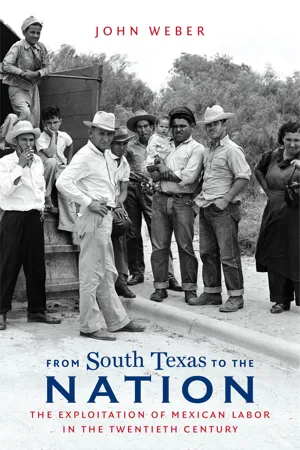
In the early years of the twentieth century, newcomer farmers and migrant Mexicans forged a new world in South Texas. In just a decade, this vast region, previously considered too isolated and desolate for large-scale agriculture, became one of the United States' most lucrative farming regions and one of its worst places to work. By encouraging mass migration from Mexico, paying low wages, selectively enforcing immigration restrictions, toppling older political arrangements, and periodically immobilizing the workforce, growers created a system of labor controls unique in its levels of exploitation.
Ethnic Mexican residents of South Texas fought back by organizing and by leaving, migrating to destinations around the United States where employers eagerly hired them — and continued to exploit them. In From South Texas to the Nation, John Weber reinterprets the United States' record on human and labor rights. This important book illuminates the way in which South Texas pioneered the low-wage, insecure, migration-dependent labor system on which so many industries continue to depend.
eBook - ePub
From South Texas to the Nation
The Exploitation of Mexican Labor in the Twentieth Century
- 336 pages
- English
- ePUB (mobile friendly)
- Available on iOS & Android
eBook - ePub
About this book
Information
Topic
HistoriaSubtopic
Historia de NorteaméricaPart I: Revolutions
In 1907 and 1908 the Laguna region of northern Mexico, straddling the states of Coahuila and Durango, resembled an armed camp. Unemployed workers filled towns such as Torreón and Gómez Palacio, camping in public places and erecting tent settlements on the outskirts. Migrant workers, once lured to the region’s towns and farms by advertisements and contractors, were now threatened with arrest if they did not leave the area. Pitched battles between police and gangs of the unemployed—termed bandits by the upper and middle classes—violently punctuated increasingly monotonous stories of crime and general social menace. Reports of endemic banditry in the countryside and organized attacks on haciendas mixed in with this general cacophony of fear. Growers and factory owners armed tenants, overseers, and supervisors against an amorphous threat posed by the rootless population that flowed seasonally through the Laguna. The governor of Coahuila warned local officials throughout his state that an ill-defined but violent disturbance was imminent. Centrifugal forces seemed to tear at the fabric of social and economic life.1
Just a few years earlier, however, the Laguna had been the shining example of Mexican economic development and modernization, a booming agricultural, industrial, and mining region built out of the desert. The arrival of two major rail lines in the 1880s, connecting Mexico City to the Texas border, made the Laguna’s primary city, Torreón, an important transportation hub. The arrival of the railroads spurred the growth of irrigation, which allowed for cultivation beyond the immediate vicinity of the Nazas River, the Laguna’s only source of water.2 Domestic and foreign capital flooded the region. The production of irrigated cotton and the rubber-bearing shrub guayule grew exponentially and led to the construction of textile mills and rubber-processing plants in Torreón and other towns. Improved transportation facilities allowed mines to ship more raw material than ever, but they also led to the construction of smelters in Torreón to process ore locally. The area of cultivated land quadrupled and cotton output quintupled between 1880 and 1890, then each doubled again from 1890 to 1910. Over the same period, silver, copper, and coal mining witnessed similar growth. By the turn of the century, the Laguna had become “the most highly capitalized and well-communicated area in Mexico.”3
The wage laborers who came to the Laguna for work in the fields, mines, and factories made this economic growth possible. In the thirty years from 1880 to 1910 the population of the Laguna grew from 20,000 to 200,000, with an additional 40,000 annually living in the region during the harvest season, which lasted from July to October.4 Those who came to the Laguna during the cotton harvest in 1910 received wages as high as six to eight pesos per day, compared to half a peso per day further south.5 Decades of land consolidation in central Mexico, which only accelerated during the reign of Porfirio Díaz (1876–1911), created a massive population stripped of connection to the land and forced into wage labor.6 These systemic changes in the nature of land tenure caused enormous demographic shifts, as many began to leave the crowded central rural regions for cities and the rapidly developing northern states. The steady flow of migrants leaving central Mexico and settling in the north, often as one step in a longer chain of migration, was the most important effect of this economic recentering.
These demographic changes signified a complete overturning of the normal agricultural and labor patterns of Mexico. Migrants to the Laguna came not for free land but for high wages and seasonal employment.7 The developmental pattern of the Laguna signaled the creation in Mexico of a substantial pool of highly mobile wage laborers, attuned to seasonal labor demands and alienated from the land. By the beginning of the twentieth century, this meant that Laguna employers competed with agricultural, mining, and railroad interests in northern Mexico, Texas, Arizona, New Mexico, California, Colorado, and elsewhere for a growing but increasingly mobile workforce inured to seasonal wage relations.8 In fact, many growers so feared the increased migration to the United States that they demanded that the Díaz government provide them with Chinese laborers to fill what they believed were imminent holes in the labor force.9 Laguna growers hired enganchistas to scour central and northern Mexico for seasonal labor and passed antienticement laws to keep these same labor contractors from sending workers further north.10 While this emerging economic system provided employment opportunities for many, the economic modernization of the late nineteenth and early twentieth centuries uprooted the population and propelled people into an unstable environment dependent on the vagaries of the world market economy and the decisions of foreign investors.
The global depression of 1907, which began with the collapse of several New York banks and expanded into a global credit crisis, occurred at the same time as a devastating drought in northern Mexico and the U.S. Southwest.11 These combined pressures brought economic growth to a screeching halt.12 The fragile labor peace disappeared with it.13 Food prices in the Laguna skyrocketed throughout 1907 and 1908, while opportunities for wage labor disappeared. Even worse, the economic downturn led employers in the U.S. Southwest to send their workers back to Mexico, many of them into the worsening situation in the Laguna.14 Employers in the region performed an about-face. They ignored their previous antienticement pleas and instead, joining with industrial and mining interests, forcibly demanded that migrant workers leave northern Mexico and go to the United States.15 Thus the workers confronted a drastic reversal of the situation prior to the depression of 1907. They were not wanted by either the United States or the Laguna. As the economic and employment outlooks continued to deteriorate into the summer of 1908, tensions rose.
Reports of a group called the Mexican Cotton Pickers, supposedly militant unemployed workers ready to cross from Texas to Coahuila to begin an uprising, spread throughout the farms and towns of the Laguna in June 1908. While the Mexican Cotton Pickers never materialized, a band of armed men, likely drawn from the plentiful supply of hungry and unemployed that filled the region’s towns, did attack the town of Viesca, near Torreón, at dawn on June 25.16 The previous night rebels had seized the nearby Hacienda Los Hornos and used it as the base for their attack. Police put up little resistance as the armed band took over Viesca, cleaned out the local bank, released all prisoners from the jail, destroyed the jefe político’s home, and destroyed telegraph wires and railroad bridges. They maintained control of the town for a day and a half before they left one step ahead of federal troops from Torreón.17 While this attack had little lasting significance, it served as the most violent proof yet that the social peace of previous decades in the Laguna had disappeared.18
The world that the Laguna’s economic elites had built on the backs of a mobile labor force seemed to collapse in on them in 1907 and 1908, foreshadowing the implosion of the Porfirian state. More than simply a catalyst for the Mexican Revolution, however, the development and collapse of the Laguna and the Porfirian regime that it came to symbolize would have profound importance on both sides of the Rio Grande. As Friedrich Katz has argued, economic and infrastructural development in the Laguna and the rest of northern Mexico “illustrated in the most palpable way possible that what had once been a frontier was being transformed into ‘the border’ and what had once been largely beyond the reach of any country was now within the reach of two countries at once.”19 The same was true of the growing, mobile population that made up the seasonal workforce of the Laguna. They not only found themselves pushed into annual labor migrations in Mexico and the United States by their alienation from the land and reliance on wage labor, but they also helped drag these previously peripheral regions into the international market and into the orbits of each federal government through their labor power. The paths of capital and development followed the migrant trail, just as migrant workers followed the paths of economic opportunity. Though the international boundary separated northern Mexico and South Texas politically, economic development and modernization in each flowed from the same general forces, as the effects of demographic shifts in Mexico and outside capital drastically altered the border region. These paths for development and migration would only broaden with the outbreak of the Mexican Revolution. At the same time, the tensions created by the collapse of the Porfiriato would not remain bottled up within Mexico.
These workers would help inaugurate two very different revolutions in the coming years. The first, the Mexican Revolution, emerged from their demands for social justice amid the crumbling of the Porfirian regime. The violence and instability of the revolutionary years would send many of these workers, and many other Mexicans, into the United States. These workers then helped launch a second, economic revolution in Texas through their labor power, dragging the desolate lands of South Texas through a rapid transition to a thoroughly modern and profitable, though deeply unjust and exploitative, agricultural economy. The first two chapters—“The Wages of Development in South Texas and Northern Mexico” and “The Revolution in Texas: International Migration, Capitalist Agriculture, and the Interstate Migrant Stream”—will explore the development and immediate effects of these two separate but related revolutions.
Chapter One: The Wages of Development in South Texas and Northern Mexico
The economic and demographic development of South Texas from 1876–1910 resembled Porfirian Mexico to a striking degree. As in Mexico, peace and relative stability in South Texas attracted outside capital in unprecedented amounts. In fact, one of Díaz’s priorities on taking control in Mexico was the pacification of the northern border to end the frequent cross-border raids that plagued the region. The year before Díaz launched his Tuxtepec rebellion from Brownsville, Texas, an episode known as the Skinning War broke out in South Texas. In March 1875, a group of thirty armed Mexicans rode through the vicinity of Corpus Christi attacking stores and homes, killing five people in the process. This attack began a series of raids from Mexico, and an even greater number of counterattacks by vigilantes who swept through the Nueces Strip (the area between the Nueces River and the Rio Grande) attacking Mexican ranchers and stealing their land.1 Díaz put an end to these attacks and counterattacks by cracking down on his side of the border, something military and law enforcement officials north of the border had been unable to do. Cross-border raids would not resume in any substantial way until the early years of the Mexican Revolution, when Díaz’s grip on northern Mexico finally collapsed.2
Further, the burgeoning market of northern Mexico helped fuel much of the economic change in South Texas. San Antonio and Brownsville had long survived economically as transshipment points for goods (both legal and illegal) moving to and from northern Mexico. For example, in 1850, one-quarter of the labor force of Bexar County (of which San Antonio is the county seat) were carreteros, arrieros, or some other variety of teamster working in the extensive trade network that extended beyond the border into the interior of Mexico.3 When Anglo newcomers began to drift into the region from the north in the late nineteenth century, they sought to take control of these important trade links to Mexico and expropriate lands belonging to Mexican Americans in the still underdeveloped region. Economic development in places like the Laguna and Monterey, in other words, was essential to development north of the Rio Grande.
This chapter will examine how these larger trends in Porfirian and revolutionary Mexico affected migration flows and economic modernization in South Texas, laying the groundwork for the creation of one of the most productive and prosperous agricultural regions in the United States. Driven by these events in Mexico and the untapped economic potential of desolate South Texas, two simultaneous migrations met in the region north of the Rio Grande. Land speculators and prospective farmers from the Southeast and Midwest United States arrived at the same time as migrants, exiles, and refugees from Mexico and in a few years completely altered the region’s economic and social structure. These two simultaneous migrations not only recreated and expanded the scale of economic expansion previously seen in the Laguna but also pushed South Texas through years of intense change and near apocalyptic violence, creating a new society that would have been unthinkable just a few years earlier.
THE FIRST RAIL connection to South Texas was completed by the Southern Pacific at San Antonio in 1877, though this only served the far northern portion of the region. Although it eliminated the need for long trail drives to the Midwest for ranchers looking to send their livestock to market, it remained too distant to catalyze agricultural growth in the Rio Grande Valley. Nevertheless, the arrival of the railroad in San Antonio, and its spread through the rest of South Texas over the coming decades, resulted in widespread dispossession of landholders in the region.
This dispossession was uneven, occurring at different times in different parts of South Texas, but some aspects of the process remained constant regardless of when or where land transfers took place. A combination of economic pressure and physical compulsion, the invisible hand aided by the trigger finger, forced many off their land in ways that make differentiating legal and illegal methods almost impossible.4 Threats of violence, armed confiscation, cold-blooded murder, and fraud coexisted and often intertwined with market pressures to gradually displace Mexican and Mexican American landowners in the region. The increased capitalization that came with the railroads, at the same time that the U.S. economy entered the tumultuous boom-and-bust cycle of the late nineteenth century, meant that poorly capitalized Mexican American landowners had to secure credit in order to ...
Table of contents
- Cover Page
- From South Texas to the Nation
- Copyright Page
- Contents
- Figures and Maps
- Acknowledgments
- Introduction
- Part I: Revolutions
- Part II: Securing the Revolution
- Part III: Challenging the Revolution
- Part IV: The Shadow of the Revolution
- Epilogue
- Notes
- Bibliography
- Index
Trusted by 375,005 students
Access to over 1.5 million titles for a fair monthly price.
Study more efficiently using our study tools.
Frequently asked questions
Yes, you can cancel anytime from the Subscription tab in your account settings on the Perlego website. Your subscription will stay active until the end of your current billing period. Learn how to cancel your subscription
No, books cannot be downloaded as external files, such as PDFs, for use outside of Perlego. However, you can download books within the Perlego app for offline reading on mobile or tablet. Learn how to download books offline
Perlego offers two plans: Essential and Complete
- Essential is ideal for learners and professionals who enjoy exploring a wide range of subjects. Access the Essential Library with 800,000+ trusted titles and best-sellers across business, personal growth, and the humanities. Includes unlimited reading time and Standard Read Aloud voice.
- Complete: Perfect for advanced learners and researchers needing full, unrestricted access. Unlock 1.5M+ books across hundreds of subjects, including academic and specialized titles. The Complete Plan also includes advanced features like Premium Read Aloud and Research Assistant.
We are an online textbook subscription service, where you can get access to an entire online library for less than the price of a single book per month. With over 1.5 million books across 990+ topics, we’ve got you covered! Learn about our mission
Look out for the read-aloud symbol on your next book to see if you can listen to it. The read-aloud tool reads text aloud for you, highlighting the text as it is being read. You can pause it, speed it up and slow it down. Learn more about Read Aloud
Yes! You can use the Perlego app on both iOS and Android devices to read anytime, anywhere — even offline. Perfect for commutes or when you’re on the go.
Please note we cannot support devices running on iOS 13 and Android 7 or earlier. Learn more about using the app
Please note we cannot support devices running on iOS 13 and Android 7 or earlier. Learn more about using the app
Yes, you can access From South Texas to the Nation by John Weber in PDF and/or ePUB format, as well as other popular books in Historia & Historia de Norteamérica. We have over 1.5 million books available in our catalogue for you to explore.