Anne M. Blankenship’s study of Christianity in the infamous camps where Japanese Americans were incarcerated during World War II yields insights both far-reaching and timely. While most Japanese Americans maintained their traditional identities as Buddhists, a sizeable minority identified as Christian, and a number of church leaders sought to minister to them in the camps. Blankenship shows how church leaders were forced to assess the ethics and pragmatism of fighting against or acquiescing to what they clearly perceived, even in the midst of a national crisis, as an unjust social system. These religious activists became acutely aware of the impact of government, as well as church, policies that targeted ordinary Americans of diverse ethnicities.
Going through the doors of the camp churches and delving deeply into the religious experiences of the incarcerated and the faithful who aided them, Blankenship argues that the incarceration period introduced new social and legal approaches for Christians of all stripes to challenge the constitutionality of government policies on race and civil rights. She also shows how the camp experience nourished the roots of an Asian American liberation theology that sprouted in the sixties and seventies.
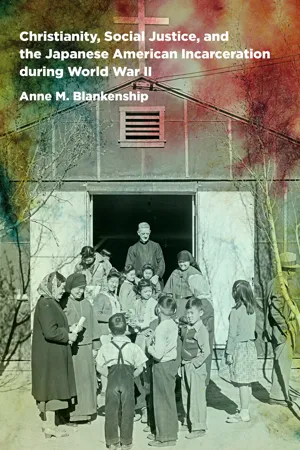
eBook - ePub
Christianity, Social Justice, and the Japanese American Incarceration during World War II
- 296 pages
- English
- ePUB (mobile friendly)
- Available on iOS & Android
eBook - ePub
Christianity, Social Justice, and the Japanese American Incarceration during World War II
About this book
Information
Topic
HistoriaSubtopic
Historia de Norteamérica1 The Attack on Pearl Harbor and Executive Order 9066
On a peaceful Sunday morning, December 7, 1941, Henry, Sumi and I were at choir rehearsal singing ourselves hoarse in preparation for the annual Christmas recital of Handel’s “Messiah.” Suddenly Chuck Mizuno … burst into the chapel, gasping as if he had sprinted all the way up the stairs.
“Listen, everybody!” he shouted. “Japan just bombed Pearl Harbor … ! It’s war!”
The terrible words hit like a blockbuster, paralyzing us. Then we smiled feebly at each other, hoping this was one of Chuck’s practical jokes. Miss Hara, our music director, rapped her baton impatiently on the music stand and chided him, “Now Chuck, fun’s fun, but we have work to do.”
But Chuck strode vehemently back to the door, “I mean it, folks, honest! I just heard the news over my car radio. Reporters are talking a blue streak. Come on down and hear it for yourselves.”
With that, Chuck swept out of the room, a swirl of young men following in his wake.… The rest of us stayed, rooted to our places like a row of marionettes. I felt as if a fist had smashed my pleasant little existence, breaking it into jigsaw puzzle pieces.… I knew instinctively that the fact that I was an American by birthright was not going to help me escape the consequences of this unhappy war.
—Monica (née Itoi) Sone, Nisei Daughter
Once news of the attack on Pearl Harbor sunk in, Monica Itoi and her siblings careened home from the Seattle Japanese Methodist Church to be with their parents. They found their mother “sitting limp in the huge armchair as if she had collapsed there, listening dazedly to the turbulent radio,… her face … frozen still.” Their father deemed the story false propaganda until he heard the news on both American and Japanese radio broadcasts. Knowing that other Americans would associate Japanese immigrants with their homeland, Nikkei rushed to burn, bury, or otherwise destroy items from Japan: Buddhist shrines, texts, and statues, language textbooks, Japanese flags, kimonos, photographs, and anything else with Japanese writing or obvious ties to Japan. Some Japanese Christians congregated at home like the Itois, while others gathered in their churches, waiting to learn their fate within the global calamity.1
The news shocked the white men and women who worked with Seattle’s Nikkei community as well. Several miles north of Nihonmachi, Floyd Schmoe, a botany professor at the University of Washington, hurried home from his Quaker meeting house to find five Nisei women “huddled in the basement listening to the radio; they were frightened beyond tears.” His family regularly hosted university students, and their current boarders feared leaving the protection of the Schmoe house. Soon after the Reverend Emery Andrews’s Sunday morning benediction at the Seattle Japanese Baptist Church, members of his congregation returned to the church with news of the attack. Father Leopold Tibesar, the priest of the city’s Japanese Catholic community, heard the news over the radio as he waited for breakfast after the morning’s Missa Cantata in honor of the Immaculate Conception.2
Andrews, Tibesar, and Everett Thompson, the Itois’ Methodist pastor, quickly set to work calling and visiting their parishioners. White missionaries all along the coast translated instructions and interrogations as the police and FBI agents raided Japanese homes that evening. Seizo Itoi packed a bag in anticipation, but he was not arrested. By 9 December, 116 of Seattle’s Japanese citizens, including Buddhists priests, Japanese language school teachers, and other community leaders, sat behind bars. Tibesar met with officers of the Japanese American Citizens League, led by James Sakamoto, a Nisei under instruction for baptism. The priest helped them arrange meetings with the FBI and organize an Emergency Defense Council.3
Nikkei faced increasing, unpredictable government restrictions. Closure of Japanese banks and the frozen accounts of all Issei caused chaos in Nihonmachi as businesses could not function without funds or access to their accounts. On 29 December, federal agents and local law enforcement confiscated “contraband” material, including shortwave radios, hunting rifles, cameras, ceremonial swords, binoculars, and dynamite used for clearing land.4 A curfew for Issei instituted on 4 February 1942 expanded to include Nisei on 27 March. It forbade Nikkei from traveling more than five miles beyond their homes or staying out past eight P.M.5 Nikkei truck farmers ignored the law or employed non-Nikkei to bring their produce to market. Doctors and midwives received special passes from city officials, and many others risked arrest to visit patients or parishioners. The University Friends Meeting moved gatherings to the house of their one Japanese member because the curfew made it impossible for him to attend otherwise.6 With the belief that Christians would face less discrimination, an unknown number of Nikkei began attending Catholic and Protestant services.7 Protestant pastors reported that most of these visitors soon returned to their Buddhist temples.8
Anti-Japanese voices grew in January, pressuring the government to expel people of Japanese descent from the West Coast, if not the entire country. The majority of newspaper editorials calling for eviction came from politicians, many seeking reelection, but labor unions and nativist groups like the Native Sons and Daughters of the Golden West also made their voices heard.9 Many white farmers hoped to physically excise their greatest competition from the marketplace. The Salinas Grower-Shipper Vegetable Association bluntly stated, “We’re charged with wanting to get rid of the Japs for selfish reasons. We might as well be honest. We do. It’s a question of whether the white man lives on the Pacific Coast or the brown man.… We don’t want them back when the war ends, either.”10 Aggressors based their claims on nearly a century of anti-Asian sentiments. William Randolph Hearst’s yellow journalism fanned the flames of prejudice, inventing stories of sabotage, fabricating interviews, and distorting the reality of wartime America. Even the typically progressive children’s author Theodor Geisel, better known as Dr. Seuss, drew cartoons criticizing the government’s naive lack of action that allowed fifth column Japanese plots to grow.11
On 19 February 1942, President Roosevelt signed Executive Order 9066, which permitted military officials to exclude whomever they deemed a threat from sensitive security zones. Lieutenant General John DeWitt made immediate plans to evict men, women, and children—anyone with one-sixteenth or greater Japanese ancestry—from the West Coast and Alaska.12 The War Relocation Authority (WRA), the civilian agency established to manage the incarceration, obtained land and hastily built two incarceration centers in California (Tule Lake and Manzanar), Arizona (Poston and Gila River), and Arkansas (Jerome and Rohwer) and one each in Idaho, Wyoming, Utah, and Colorado (Minidoka, Heart Mountain, Topaz, and Granada, respectively). From March to June 1942, Nikkei families packed their bags—only what they could carry—and sold or rented their houses, businesses, farms, and belongings at immense financial and personal loss. Nearly 115,000 people moved to fairgrounds or race tracks converted into temporary “assembly centers” or directly to one of ten large “relocation centers” in the western deserts or Arkansas’s poverty-ridden deltas. Another 6,000 Japanese Americans were born in the camps.13 Despite their proximity to Pearl Harbor, the government did not incarcerate Nikkei living in Hawaii. In Seattle, Nikkei moved into the ironically named Camp Harmony at the Puyallup fairgrounds, forty minutes southeast of the city.
Having attempted to alleviate the tensions between Japan and America for decades, progressive Christian leaders leapt to the defense of Japanese Americans, but mainline Protestant and Catholic leaders hesitated to challenge the authority of the president or military at a time of war.
Quaker Responses
Quaker leaders publically recognized the pending threat to Nikkei well before the United States entered the war. Seven months before the bombing of Pearl Harbor, the West Coast section of the American Friends Service Committee circulated a letter warning of the domestic emergency that would follow the United States’ entry into a Pacific war. At this early date, Quakers predicted that all Japanese Americans will become “ ‘Japs’ and … find it impossible to avoid the caustic backwash of war hysteria.”14 Under the auspices of the Fellowship of Reconciliation (FOR), an interfaith pacifist group committed to social justice, Floyd Schmoe organized conferences in Seattle, Los Angeles, San Francisco, and Honolulu to bring attention to the challenges facing Nikkei in the spring of 1941.15
Quakers’ definitive condemnation of the incarceration, frequent admissions of responsibility, commitment to action, and requests for forgiveness set them apart from other Christian denominations. Quaker leaders never accepted the excuses of military necessity or the need to protect Nikkei from angry mobs, swearing, “We cannot concede the right of a government for such arbitrary mass action against a group as a whole.”16 The AFSC warned of the incarceration’s ramifications for American democracy and the future world.
Despite having fought discriminatory legislation, Quaker publications never suggested they bore less guilt than other Americans: “The fault rests squarely upon us as a people who have permitted prejudice, fear, and hatred to flower into intolerance and violence.” The AFSC’s May 1941 letter listed the things “we” have denied them, such as “full freedom in a free land,” equal social and economic opportunities, legal rights to naturalize and own property, and “chiefly … our friendship and willingness to understand.” Acknowledging a tendency to believe they innocently assumed the guilt of other, notices cautioned Friends to examine their own prejudices. As the war stretched into years, internal correspondence reminded AFSC workers, “Let us never forget that we threw these people behind barbed wire. We wiped out their savings, and their means of livelihood. We destroyed their financial security.… For the sake of our own integrity, we still have a debt to pay.” Another proclaimed, “We have failed as a society because we have failed as individuals. As individuals we must begin to make amends.” Taking full responsibility, Quakers exhorted readers that aid was an obligation, not simply charity.17
Pledges to remedy the situation always accompanied Quaker confessions: “The forced mass evacuation … creates a special responsibility for us to help preserve the ideal of brotherhood and of political and religious freedom in our country.” AFSC workers promised to “share in the sufferings and sacrifices of the evacuees.” These vows professed the inadequacy of “simply making life as comfortable as possible … in the detention camps,” perhaps an allusion to mainline Protestant aid. They promised to restore Nikkei’s full rights and status in all American communities. Consistent with their historical approach, Quakers sought to remedy the source of the problem rather than just alleviate its symptoms.18
The AFSC addressed letters to Nikkei communities conveying their regret and disagreement with the government. One such letter confessed, “Had there been real understanding [the incarceration] would not have come about and it is to our shame and regret that we failed to build that understanding in time to avert this tragedy.” They “acknowledge[d] this mistake and [took their] share of the blame” for the incarceration. The AFSC sent these apologies to community leaders and printed them in publications read by the Nikkei community to “humbly ask forgiveness.”19
Quakers began working to sustain Nikkei’s civil rights immediately after the Pearl Harbor attack. AFSC executive secretary Clarence Pickett declared their commitment to “breaking the force of this calamity which has come upon the Japanese population.” Within two weeks of the attack, the AFSC had commissioned a new branch office in Seattle, Washington and hired Floyd Schmoe to lead it.20
Individuals working for mainline Protestant and Catholic aid organizations had established careers within the church, but Quaker aid workers came from diverse occupations. The University of Washington granted leaves of absence to several Quaker faculty members who decided to spend the war helping Japanese American students and other Nikkei. Schmoe’s work exemplified that of many Friends who coordinated their efforts through the AFSC. Raised in a Quaker family on the Kansas prairie, Schmoe’s love of natural beauty led him to the Pacific Northwest. He and his family lived in Mount Rainier National Park for years after he became the park’s first naturalist and spent summers on a sailboat in the San Juan Islands, where he studied underwater ecology. His work at the University of Washington ended when Japan bombed Pearl Harbor. Foreseeing the magnitude of challenges Nikkei would face, Schmoe took a temporary leave of absence without delay. Schmoe’s detailed survey of the Pacific Northwest’s Japanese population in 1941 gave him valuable contacts within the imperiled communities. These connections led dozens of Nikkei to seek his advice as many knew no other sympathetic white people. Members of the Seattle Friends Center mentioned this experience in their request to hire Schmoe. AFSC headquarters in Philadelphia consented and augmented their offer to include Thomas Bodine, a young worker on the East Coast. The Social Industrial Section of the AFSC funded offices to work with Nikkei in Southern and Northern California and Hawaii that December as well. Esther Rhoads, a Quaker missionary in Japan, arrived in California on 11 February 1942 to lead the AFSC’s efforts in that region. Beginning that month, bulletins updated American Quakers on current developments and recommended specific actions that individuals could take to help Nikkei.21
In the early weeks of the war, Schmoe worried about the amorphous nature of the AFSC’s support because it had no precise agenda beyond managing the rising crisis. Schmoe prioritized efforts to calm public fears and squelch rumors before they did serious damage. He described this as “paddling a canoe against Niagara” as the roar of incriminations against Japanese Americans rose. When Canada began removing Nikkei from British Columbia in January 1942, Schmoe wondered whether Seattle’s AFSC workers should remove themselves to this greater emergency to arrange housing and be with the persecuted Canadians. But the financial quandaries of Issei in America soon filled Schmoe’s schedule. AFSC workers organized food deliveries, arranged legal assistance, and met with state attorneys general to reactivate bank accounts....
Table of contents
- Cover
- Title Page
- Copyright
- Dedication
- Contents
- List of Figures
- Acknowledgments
- Introduction
- 1: The Attack on Pearl Harbor and Executive Order 9066
- 2: The Organization of Christian Aid
- 3: Building Churches behind Barbed Wire
- 4: Experiences of Christianity in the Camps
- 5: The End of Japanese Ethnic Churches?
- Epilogue
- Notes
- Index
Trusted by 375,005 students
Access to over 1.5 million titles for a fair monthly price.
Study more efficiently using our study tools.
Frequently asked questions
Yes, you can cancel anytime from the Subscription tab in your account settings on the Perlego website. Your subscription will stay active until the end of your current billing period. Learn how to cancel your subscription
No, books cannot be downloaded as external files, such as PDFs, for use outside of Perlego. However, you can download books within the Perlego app for offline reading on mobile or tablet. Learn how to download books offline
Perlego offers two plans: Essential and Complete
- Essential is ideal for learners and professionals who enjoy exploring a wide range of subjects. Access the Essential Library with 800,000+ trusted titles and best-sellers across business, personal growth, and the humanities. Includes unlimited reading time and Standard Read Aloud voice.
- Complete: Perfect for advanced learners and researchers needing full, unrestricted access. Unlock 1.5M+ books across hundreds of subjects, including academic and specialized titles. The Complete Plan also includes advanced features like Premium Read Aloud and Research Assistant.
We are an online textbook subscription service, where you can get access to an entire online library for less than the price of a single book per month. With over 1.5 million books across 990+ topics, we’ve got you covered! Learn about our mission
Look out for the read-aloud symbol on your next book to see if you can listen to it. The read-aloud tool reads text aloud for you, highlighting the text as it is being read. You can pause it, speed it up and slow it down. Learn more about Read Aloud
Yes! You can use the Perlego app on both iOS and Android devices to read anytime, anywhere — even offline. Perfect for commutes or when you’re on the go.
Please note we cannot support devices running on iOS 13 and Android 7 or earlier. Learn more about using the app
Please note we cannot support devices running on iOS 13 and Android 7 or earlier. Learn more about using the app
Yes, you can access Christianity, Social Justice, and the Japanese American Incarceration during World War II by Anne M. Blankenship in PDF and/or ePUB format, as well as other popular books in Historia & Historia de Norteamérica. We have over 1.5 million books available in our catalogue for you to explore.