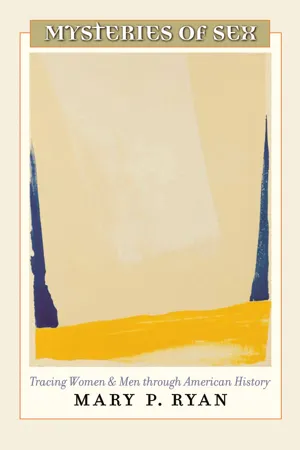
In a sweeping synthesis of American history, Mary Ryan demonstrates how the meaning of male and female has evolved, changed, and varied over a span of 500 years and across major social and ethnic boundaries. She traces how, at select moments in history, perceptions of sex difference were translated into complex and mutable patterns for differentiating women and men. How those distinctions were drawn and redrawn affected the course of American history more generally.
Ryan recounts the construction of a modern gender regime that sharply divided male from female and created modes of exclusion and inequity. The divide between male and female blurred in the twentieth century, as women entered the public domain, massed in the labor force, and revolutionized private life. This transformation in gender history serves as a backdrop for seven chronological chapters, each of which presents a different problem in American history as a quandary of sex. Ryan’s bold analysis raises the possibility that perhaps, if understood in their variety and mutability, the differences of sex might lose the sting of inequality.
- 448 pages
- English
- ePUB (mobile friendly)
- Available on iOS & Android
eBook - ePub
About this book
Information
Part I: Making Sex in America 1500–1900
Chapter 1: Where Have the Corn Mothers Gone?
Americans Encounter the Europeans
In 1540 a party of Spaniards led by Hernando De Soto came upon a band of Indians in a place that is now called South Carolina. The European leader called for an audience with his local counterpart and set out “rest seats” for the headmen of the two peoples. The natives obliged, and soon a canopied boat appeared, bearing the leader of the nation of Catawba. The European explorers were startled to discover that the authoritative personage seated on that New World throne was a woman. She was designated in the colonial record as the “mistress of the town.”1 Just two years later and over three thousand miles away, emissaries of the Spanish Crown disembarked near Point Concepción in a land they would call Alta California. They were greeted and fêted by an elderly female chief of the Chumash tribe, said to command the loyalty of sixteen Indian villages. The tiny band of Iberian sailors may have been prepared for this reception for they had doubtless heard tell that the land mass to the west of North America was an island ruled by an Amazon queen named Calafia.2 When Englishmen decamped along the Chesapeake nearly a century later, they conferred the title “queen” on the leaders of several Algonquian villages.3
Scraps of evidence such as these suggest that the first encounter of the peoples separated for millennia by the Atlantic Ocean was an epochal crossroads of gender. The encounter might even be imagined as a face-off between the dominant men of Europe against powerful women native to America. Scholarly prudence would dictate a retreat from such sensationalistic readings of the past, with a warning that such reports are scarce, partial, biased, and forever shrouded in mystery. Yet ethnohistorians, archaeologists, and Indian scholars have assiduously uncovered abundant evidence with which to demonstrate that the cultures native to America in the sixteenth century “did gender” in ways that would mystify European explorers. The first objective of this chapter is to describe how each axis of gender differentiation—asymmetry, the relations of the sexes, and hierarchy—was performed in myriad, unique ways across the wide landscape of North America five hundred years ago. Although not sufficient to create an exact and uniform model of primordial American gender, this fragmentary record is revealing enough to dispel the assumption that the differences between the sexes are timeless, predictable, and universal. The account of native gender practices that occupies the first half of this chapter will also serve as the background for a second investigation: how did mutual misunderstanding about the meaning of male and female affect the outcome of the confrontation between Europeans and American Indians? Not the least of these miscues concerned the distribution of power between the sexes: where Europeans saw kings and their subjects, Native Americans saw clan mothers and clan fathers. Though this chapter does not pretend to solve the quandaries of gender on the eve of European colonization, it will demonstrate that the differentiation of man from woman is a mystery of great consequence, something to wonder about and learn from as we strain to make sense of our history and our lives.
Just the first order of business is an impossibly tall one: to distill from the multiple and diverse cultures of pre-Columbian America some coherent representation of their highly complex and varied gender practices. Contrary to European imaginings of a virgin land inhabited by only a few brave young warriors and nubile Indian princesses, gender in America was a dense and wizened structure, acted out by as many as two thousand different language groups and up to eighteen million people. Together they put a human mark on virtually all the hunting and fishing grounds of North America. With roots in the hemisphere dating back twenty thousand years, Homo sapiens had a tumultuous if unwritten history in North America. Powerful civilizations, particularly in the Mississippi Valley and in the Southwest, had come and gone before the Europeans arrived on the scene. Tribes spread across much of the continent had been cultivating crops, especially maize, for some five thousand years.4 Had De Soto arrived just a few centuries earlier, he might have come upon cities of up to thirty thousand residents in the lower midwest of the continent and discovered the mysteries of massive earthworks in animal shapes near the great rivers of the Mississippi Valley. Had the Spanish entourage arrived more promptly in the Southwest they might have wondered at vast systems of irrigation and high-rise dwelling units, which mounted several stories through a labyrinth of rooms.5 But even in the year 1492, a wide range of civilizations and economies held tenacious claim to the American landscape.
Only a few blurry snapshots of this rich ethnohistory can be reproduced in this short chapter. Occasional reference will be made to the densest area of settlement, the small tribes of California, who lived in what seems like almost Edenic simplicity, camped along a web of creeks fed by the gentlest of climates and rich in easily accessible flora and fauna. There will also be occasional mention of tribes who worked out a more complex accommodation with a less generous nature. In the more hostile climates like the great midland of the north country, the Plains tribes such as the Blackfoot reshaped thousands of miles of the landscape by their expert techniques of hunting bison. Over a century after the Spanish arrival, the natives of New Mexico revolted and drove the conquistadores from their homelands, holding off full colonial domination until 1692.6 The most intensive focus of attention in this chapter will be on tribes of the eastern part of the continent who had developed complex societies. Hundreds of years before Columbus set sail, American Indians had mastered the arts of domesticating plants and building sedentary cultures. Groups such as the Iroquois in the Northeast and another five Indian nations in the Southeast who would earn the name “Civilized Tribes” (the Creek, Cherokee, Seminole, Chickasaw, and Choctaw) boasted particularly elaborate trade networks and would develop extensive political systems—not quite states, but systems of political authority that the English translated into terms like “chiefdoms,” “nations,” “leagues,” and “confederacies.”
Before drawing a composite portrait of male and female in these multiple and intricate cultures, a fundamental question must be raised: Is gender always a salient aspect of human society, worthy of the intense scrutiny that is about to commence? When this question is posed for Native America in 1500, the answer is “yes,” with only minor qualifications. It is indisputable that the humans who walked the American lands in the sixteenth century made important distinctions equivalent to the English categories, man and woman. Sex, however, may not have been the primary cultural differences among Native Americans. Age and kinship relations may have been preeminent in many native groups, just as noble and serf may have been more prominent distinctions among Europeans. It has been argued that some native groups, such as the Inuit of Alaska, saw gender as a rather fleeting distinction among humankind. For them, every living person was custodian of a soul that migrated across generations and could inhabit a male body at one time, a female’s at another. This mutability of gender obviated the necessity of naming individuals according to male or female signs. Within the Algonquian languages, the dichotomy of male and female has been said to dissolve in the more powerful distinction between the animate and the inanimate. Both the weight and importance of gender difference, as well as the specific meanings attached to the male and female sides of that divide, varied markedly in 1500. Still, everywhere the distinction was recognized and acted upon. Gender dimorphism, however mysterious its ways, and whatever its rigidity or weight relative to other cultural differences, was clearly operative in pre-Columbian America. It made its power known in the discoveries of archaeologists, memories of descendants, and records of Europeans. By all these testimonies, a division between women and men was apparent in what native peoples did, where they went, and what they honored.7
Before proceeding to detail these gender productions, we must entertain one last preliminary question: How many genders were there, or as posed by some theorists, was there a third sex? North America was in fact quite hospitable to the species of gender versatility that went by such names as the man-woman, the manly woman, the woman warrior, and the berdache (a French term for cross-dressing Indians). By one estimate, Amerindian languages contain two hundred terms for alternative gender designations.8 Especially in the Plains, the Southwest, and the Southeast, it was common to find a physiological male or female who adopted the attire, the work roles, and the ceremonial position of the opposite sex. It was most often the case that a male took on a woman’s gender status, but sometimes females assumed the heroic status of “women warriors.” The “manly-hearted woman” found in many Plains tribes has been described not as a deviant but as “one of several alternative roles” available to females, one that granted them such male privileges as the active role in choosing dance partners and the superior position in sexual intercourse.9 Among the Algonquian the female who assumed a man’s role acquired the chiefly status of the “sunksquaw.”10 The members of the third sex also commonly practiced what we now call homosexuality. By acknowledging a third or fourth gender, Amerindian cultures accepted and often honored those who lived in contradiction of conventional European definitions of sex difference.
Anthropologists have hypothesized that this flexibility within Native American cultures was due to the ease of lateral transfer between male and female roles, that is, their relative gender symmetry. The most fundamental characteristic of the man-woman or the woman warrior was the adoption of the work roles of the opposite sex. By this logic, a male who grew corn became a man-woman, for example, and the female who hunted was classified as a man. Because the third sex reversed rather than denied gender roles, however, this practice might have had the effect of underscoring the bipolar gender distinction to which it was a clearly marked exception.11 Still, these variations on the theme of male and female present fascinating possibilities lurking in the mystery of sex. The Spanish translated the Indian term for the third sex in positive and pleasurable terms, simply as “joyas,” meaning jewels.12
The Coordinates of Gender
Asymmetry, the Relations of the Sexes, and Hierarchy
Such jewels were set, nonetheless, in a solid and prosaic chain of gender dualism. The most fundamental divide between the sexes was written with the sweat on the brows of women and men. The fact that gender served as a rubric for dividing up the work of subsistence was so obvious that it can be described with but a few examples. Gender was ascribed to Native American infants at the very moment of birth, when a newborn male was presented with the tools of the hunt and a female child was given the implements of both gathering and planting. The Plateau tribe of the Northwest celebrated a boy’s first catch of salmon and his sister’s first harvest of berries. The skeletons of ancient Plainsmen were buried beside their bows, and matrons with their weaving tools. Among the Pueblo of the Southwest, males who performed cooking chores were ridiculed as women, the same epithet that was hurled at gender reversals among Huron warriors.13 To picture the sexual division of labor in the Americas requires a depth of field that can take in the fine detail that separates the tasks of men and women and then brings them together on the same landscape of survival. In the Northwest men caught the salmon, but the women helped construct the weirs. In most horticultural tribes women may have planted, but men cleared the land and helped prepare the fields for planting. In many tribes men hunted large game, and women small.14 Still, one slash of contrast overshadowed all these shades and mutings of the sexual division of native labor: that of man, the hunter and warrior, and woman, the gatherer and planter. The Cherokee origin myth spoke for many other cultures when it paired a first man, called Kana’ti, with a first woman named Selu. Kana’ti held the secret of providing meat from game, which he hid in a hole in the earth, and Selu produced the corn by rubbing her armpits and belly. Among their descendants men wielded the bow and women the hoe, but only together could they support the human clan. Both sexes shared a world of work; both produced subsistence goods; and no one, most certainly not women, was excused from making a hefty contribution to the material survival of the tribe.15
Should one want to draw an invidious distinction between male and female providers, we would have to call woman the worker and man the lord of leisure. This was in fact the recurrent complaint that European observers made about the Indian division of labor. An early English observer sighting the Amerindian farmers in the vicinity of Jamestown noted that women performed all the labor save hunting. A report similar to this English account of the mores of the Dakota might be found in almost every European American archive of Indian lore: “The men hunt a little in summer, go to war, kill an enemy, dance, lounge, sleep and smoke. The women do everything—nurse, chop wood, carry it on their back for half to a whole mile; hoe the ground for planting, plant, hoe the corn, gather wild fruit, carry the lodge, and in winter cut and carry the poles to pitch it with ... and the men often sit and look on.”16 The familiar slander against the Indian “squaw,” connoting a slavelike drudge, speaks more of the Englishman’s own gender expectations than of Indian practices. The research techniques of these amateur anthropologists can also be faulted. For example, the observer cited above seems to have missed the seasonal bias of his evidence: had he visited the Dakota in winter, he might find the men on a grueling hunt and the women in relative leisure. But even these tainted observations offer important clues for solving the gender puzzles of Native America. The men of the tribe often concurred in this assessment of women’s value. A Chippewa chief was quoted as saying, “women were made for labor. One of them can carry or haul as much as two men can.”17
Regardless of invidious distinctions, be they drawn in contrast to native men or European ladies, the term “squaw” signified woman’s critical contribution to the sustenance of Native America. As the cultivators and gatherers of vegetables, women provided the major sources of calories. Among Algonquians, they supplied the staple of the Indian diet, the corn that purportedly accounted for 75 percent of the tribe’s nutrients.18 Women farmers have been credited with one of the greatest inventions of human history, the domestication of plant life, which occurred in the Americas some five thousand years ago. Among the Cherokee, women added squash and beans to the local diet. Even allowing for the higher protein value of the large prey captured by hunters and fishermen, women’s contribution to the native diet has been estimated as three times that of the men’s. Be it Woman the Gatherer, represented by the Costanoan acorn harvester of Northern California, or Woman the Farmer, whose planting grounds nearly spanned the continent, females provided a substantial, essential, and justly recognized part of native sustenance.
Much of the meaning of gender difference was grounded in these economic imperatives, which determined not just what women and men did but where they did it. On any given day in the life of pre-Columbian Indians, women’s work was likely to take them to the fields or forests, while men ventured off to the hunt...
Table of contents
- Cover Page
- Title Page
- Copyright Page
- Dedication
- Contents
- Illustrations
- Introduction
- Part I: Making Sex in America: 1500–1900
- Part II: Dividing the Public Realm
- Part III: Women Remake Gender in the Twentieth Century
- Notes
- Bibliography
- Acknowledgments
- Index
Trusted by 375,005 students
Access to over 1.5 million titles for a fair monthly price.
Study more efficiently using our study tools.
Frequently asked questions
Yes, you can cancel anytime from the Subscription tab in your account settings on the Perlego website. Your subscription will stay active until the end of your current billing period. Learn how to cancel your subscription
No, books cannot be downloaded as external files, such as PDFs, for use outside of Perlego. However, you can download books within the Perlego app for offline reading on mobile or tablet. Learn how to download books offline
Perlego offers two plans: Essential and Complete
- Essential is ideal for learners and professionals who enjoy exploring a wide range of subjects. Access the Essential Library with 800,000+ trusted titles and best-sellers across business, personal growth, and the humanities. Includes unlimited reading time and Standard Read Aloud voice.
- Complete: Perfect for advanced learners and researchers needing full, unrestricted access. Unlock 1.5M+ books across hundreds of subjects, including academic and specialized titles. The Complete Plan also includes advanced features like Premium Read Aloud and Research Assistant.
We are an online textbook subscription service, where you can get access to an entire online library for less than the price of a single book per month. With over 1.5 million books across 990+ topics, we’ve got you covered! Learn about our mission
Look out for the read-aloud symbol on your next book to see if you can listen to it. The read-aloud tool reads text aloud for you, highlighting the text as it is being read. You can pause it, speed it up and slow it down. Learn more about Read Aloud
Yes! You can use the Perlego app on both iOS and Android devices to read anytime, anywhere — even offline. Perfect for commutes or when you’re on the go.
Please note we cannot support devices running on iOS 13 and Android 7 or earlier. Learn more about using the app
Please note we cannot support devices running on iOS 13 and Android 7 or earlier. Learn more about using the app
Yes, you can access Mysteries of Sex by Mary P. Ryan in PDF and/or ePUB format, as well as other popular books in History & North American History. We have over 1.5 million books available in our catalogue for you to explore.