In the 1910s, both W. E. B. Du Bois and Booker T. Washington praised the black community in Durham, North Carolina, for its exceptional race progress. Migration, urbanization, and industrialization had turned black Durham from a post–Civil War liberation community into the “capital of the black middle class.” African Americans owned and operated mills, factories, churches, schools, and an array of retail services, shops, community organizations, and race institutions. Using interviews, narratives, and family stories, Leslie Brown animates the history of this remarkable city from emancipation to the civil rights era, as freedpeople and their descendants struggled among themselves and with whites to give meaning to black freedom.
Brown paints Durham in the Jim Crow era as a place of dynamic change where despite common aspirations, gender and class conflicts emerged. Placing African American women at the center of the story, Brown describes how black Durham’s multiple constituencies experienced a range of social conditions. Shifting the historical perspective away from seeing solidarity as essential to effective struggle or viewing dissent as a measure of weakness, Brown demonstrates that friction among African Americans generated rather than depleted energy, sparking many activist initiatives on behalf of the black community.
eBook - ePub
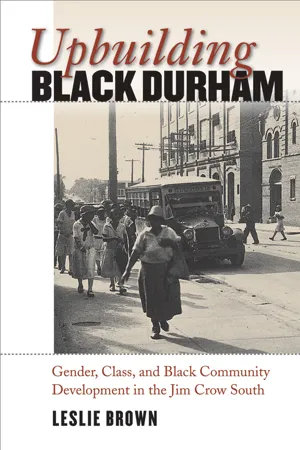
Upbuilding Black Durham
Gender, Class, and Black Community Development in the Jim Crow South
- 472 pages
- English
- ePUB (mobile friendly)
- Available on iOS & Android
eBook - ePub
Upbuilding Black Durham
Gender, Class, and Black Community Development in the Jim Crow South
About this book
Information
1: Seek Out a Good Place
Making Decisions in Freedom
You and I and all of us had better wait and see what new form this old monster will assume, in what new skin this old snake will come forth.
Frederick Douglass, 1865
For a brief moment, emancipation changed everything. Black folk declared freedom, affirmed families, and defied white authorities. Sarah Debro, who grew up on the Cain plantation just north of Durham’s Station, recalled that with “Yankees all around the place,” her mother marched to the “big house” to reclaim her child. “You took her away from me and didn’t pay no mind to my crying,” Debro’s mother told their ex-mistress, “so now I’m taking her back home. We’re free now,” she claimed, “we ain’t going to be slaves no more to nobody.”1 Surprised and dismayed that he had lost control of the people he had owned, Paul Cameron complained: “At Farintosh and Stagville all are going to the devil or dogs as fast as they can—wont work—destroying stock, outhouses, enclosures.” The owner of several large and once well-ordered plantations just north of Durham’s Station, Cameron griped in the fall of 1865 that “just now no one is at work,” as the freedpeople celebrated at “a sort of Carnival all at the marble yard and on the River banks.”2
Five men from Orange County represented African American interests at the 1865 Freedmen’s Convention in Raleigh, which set out three priorities for African Americans: education, self-protection, and civil rights. All five also served on the State Equal Rights League organized at the convention, “to secure, by political and moral means, as far as may be, the repeal of all laws and parts of laws, State and National that make distinctions on account of color” and to “encourage industry, morality, education, temperance, economy, and to promote all things that will elevate us, and build an honorable foundation for our posterity, and to use all legitimate means that are in our power to obtain our rights as citizens of our beloved State.”3 The carnivals were quashed quickly, however, and moments of joy were fleeting as freedpeople realized that freedom posed new kinds of peril and that black folks’ paths to aspirations took disparate turns.
In response to black freedom, hostile whites terrorized Orange County blacks. Freedmen’s Bureau records provide documentation of numerous cases in which African Americans charged whites with assault and battery, a half dozen in the summer of 1867 alone, including one against a white man for beating a black woman. At least five black people were murdered in the county between 1868 and 1870. When a wood-structured warehouse burned down, whites accused the Union League, an organization that encouraged black political activity, of arson, but more likely the fire was set by white insurgents.4 Martha Allen had “come free” near Durham’s Station because her master had taken his slaves inland to hide them from emancipation by the Union Army troops who controlled eastern North Carolina. Once valued as property, Allen remembered emancipation in Orange County as fearful years, when the Ku Klux Klan terrorized black people, especially “free issue” blacks who had been free before the war and who now stepped into leadership roles. The Klan raided homes to “strip all the family and whip the old folks . . . and then they accosted the pretty yellow gals,” making it clear that the old order would not fall easily if at all. Ben Johnson, who was from Hillsborough, recalled several hangings in 1869: Cy Guy’s hung over the road for four days “swinging in the wind,” when the perpetrators threatened that “any nigger who takes down the body shall be hanged too.” “Them was bad days,” Sarah Debro remembered. Freedom brought terrible suffering for her: “I’d rather been a slave than to have been hired out like I was.” Assessing the difference between emancipation and slavery, Debro pointed out that “I was hungry most of the time.” Nor was she any safer: “I had to keep fighting off Yankee men.”5
Lacking better choices or finding it advantageous, many African Americans elected to stay at the places where they had been enslaved. Assured of the Smiths’ support, Cornelia Smith stayed with her aunt and mistress Mary Ruffin Smith and worked as a seamstress in Chapel Hill until she married Robert Fitzgerald. Abner Jordan was born at Paul Cameron’s Stagville plantation north of Durham’s Station in 1832. He and his family “stayed with Marse Paul for five years after the surrender,” before moving on. Cy Hart’s family remained at Stagville until Cameron died. Horace Cameron stayed even longer; he worked for Cameron, married Patty Holman, also a freed Cameron slave, and raised his family there. Daughter Janie Cameron (Riley) and granddaughter Theresa (Lyons) were born there. He “never wanted to leave the Cameron place,” his daughter explained, and he never did: “He died and was buried there.”6
African Americans negotiated the best terms they could for their freedom, making decisions that served their economic needs as well as their aspirations. Sometimes that meant following an ex-master, as in the case of John O’Daniel, ex-slave and rumored half brother of the Confederate colonel Julian S. Carr Jr., who moved from Chapel Hill to Durham’s Station with Carr and continued to work as his servant. Tempie Herndon and Exter Durham struck out on their own. They had married when they were enslaved but had lived on plantations in different counties. Freedom meant they “could be together all the time, not just Saturday and Sunday.” Together they decided that Exter should leave his ex-master and make a try with Tempie’s ex-master, whom they concluded was the fairer man. “We rented the land for a fourth of what we made,” she recalled. They managed to buy a farm and thus their freedom once more, but surviving and saving required all nine children to work in the fields, “as soon as they could walk good.”7
Freed with nothing but themselves, black folk hoped to build capital without cash and accepted the crop lien system as one means to accomplish that goal. In a fair arrangement, a family could leverage its labor to produce crops to pay for use of the land, housing, and supplies. Typically, however, landlords—like the planters before them—stole black autonomy by controlling sharecroppers’ labor, apportioning returns, and determining the value of both. Collaborating with planters, merchants charged exorbitant interest rates for tools, seed, fertilizer, and goods, with the result that croppers owed more than they could make. The state colluded in passing the Landlord Tenant Act of 1877, which entitled property owners to set the worth of a crop at settling time. The law did not obligate them to put contracts in writing, and many did not. Nor did the act specify that tenants were to have access to ledgers or records. Sharecropping bound black farmers to an economic system that resembled slavery, which, codified in law, assured that African Americans would remain in debt and indebted to landowners. Exter and Tempie Durham made a better-than-average deal, but they were exceptions. Theresa Cameron Lyons recalled that her family was cheated out of most of its earnings. At the end of the year of hard labor, “there’d be nothing left.” Still, the black Camerons worked on the white Camerons’ land well into the 1930s.8
Seeking distance from whites and autonomy for themselves, other blacks elected to leave the farms, plantations, and towns where they had worked as slaves for the places they had heard about. Given the uncertainties of emancipation, it was an adventurous if rational move for African Americans to leave the places where they had lived in slavery, yet thousands of black migrants departed rural districts and small towns in search of family, work, and a safe place to settle. Durham’s Station was just such a place, named for the depot built on land donated by the Durham family to the railroad. Barely a settlement, it served as a crossroads on the eastern side of Orange County. It was small but central enough to be a site for official public business, such as tax collecting and voting in 1860. Only a hundred people lived there in 1865, including a wartime community of renegades, refugees, runaways, and others who lived on the margins of southern society. The railroad itself made Durham’s Station a destination. It offered a way to leave North Carolina, and plenty of African Americans selected that option. Reflecting on the novelty and persistence of black folk’s mobility, Durham’s first historian remarked in the 1880s on the “melodic strains” that echoed from “the trains on which they are always moving.” Another wrote of blacks’ departures, that “a great many have left and gone South and west—so many I believe labor will be scarce.”9
Those African Americans who decided to come to Durham’s Station after the Civil War sought out each other and work, not municipal services, the protection of Union troops, or the safety of numbers. Durham’s Station provided none of these, nor any other obvious reason to attract a large population of African Americans. A black journalist once hypothesized that a black community flourished there “because it was neutral ground.”10 The station had witnessed virtually no war activity; indeed, it was nonaligned territory in which Unionists and Confederates began to talk peace. A few black people had lived there before the Civil War as household servants, artisans, smiths, craftspeople, and factory hands residing at their places of employment.11
Those African Americans who arrived after the war mostly gathered on the muddy flats, a half-mile south of the depot, well out of the sight of the white majority population. Practicing benign neglect, white civic leaders believed that “they’ll be dead in fifty years.” Left to its own devices, the black community proved them wrong. In 1877 when John O’Daniel bought land “near the town of Durham in the settlement of colored people near the South East end of the Corporation of said town,” it was in “the section called Hayti.” Pronounced “hay-tie” and evoking the image of the independent black state Haiti, the settlement represented a flourishing liberation community of homes and institutions. Partly out of caution and partly out of choice, African Americans shaped such postemancipation communities to advance race pride, self-help, and autonomy and to distance black people from the past. Hayti, created out of the complex associational links among free and freed black people, began as a set of connections and collaborations required for mutual survival and celebration. These relationships provided the groundwork for upbuilding but more importantly generated the kind of social capital black people needed to invest in themselves. Built atop a foundation laid in slavery, Hayti signified permanence, not just a representation of freedom but a concrete product of collective decisions made in freedom to find a place where African Americans could assemble and live peaceably without much interference from whites.12
“A Natural Extension of My Home”
Durham exemplified the New South movement. Set on the Piedmont, the stretch of sandy farmland cutting diagonally through the state, Durham was built, like any number of pre-urban settlements, out of resources it created, in this case peace and the people and products that came from nearby fields. Three miles north of the railroad stop, at Bennett Place, the Confederate general Joseph Johnston and the Union general William T. Sherman met in April 1865 to begin negotiations to end the war. While celebrating the imminent end of hostilities—or so the legend goes—soldiers from both sides raided John R. Green’s little tobacco factory at Durham’s Station and shared the stash they stole. Dispersed around the country after the war, veterans sent back for more, making bright-leaf tobacco, the local strain, a wildly popular weed that linked the North and the South.13
The demand for Durham tobacco increased so much that the little settlement burst onto the international market. With no critical mass of people, however, the town could grow only by attracting capital and labor. If the tobacco industry had collapsed for lack of one or the other, Durham would have faded away like so many other New South boomtowns. Instead, the population grew. By 1889, some 8,000 people lived in and around the town. It ranked seventh among the fifteen cities of North Carolina in 1890 (behind Wilmington, Raleigh, Charlotte, Asheville, Winston, and New Bern) and sixth in the size of its black population.14
Fashioned out of the ashes of the Civil War, Durham—as the station became known—grew into the richest municipality in North Carolina by the end of the nineteenth century, one where at least some African Americans shared in the city’s success. With a steadily increasing population seeking work, black folk hoped that the political economy of freedom would yield new kinds of employment and new relationships to that work. Industries like tobacco manufacturing linked traditional agrarian economies to a modern industrialized world, attracting large numbers of black workers, who moved from rural to urban areas and who supported both white employers and black businesses. The latter, in turn, formed the financial backbone for the development and expansion of black institutions. The institutions—moderately autonomous black facilities—served as vehicles for improving the quality of life. In addition to Hayti, several promising black communities sprouted up around the center of town, including the West End, later called Lyon Park, where the Fitzgeralds built homes, the East End, where a group of black landowners settled, and Pin Hook, later known as Hickstown and more contemporarily as the Crest Street Neighborhood. These spaces provided settlers with opportunities for innovative relationships as black folk gathered legally and for the first time without white interference.
Among those African Americans seeking work, women and children migrants dominated the population, as they did in most southern cities and towns from Atlanta to Memphis. The initial prospects were discouraging. As a correspondent noted in the late 1860s, “A good number of women and children are here yet strolling about—and I don’t see any chance for them to live.” By 1880, however, industrialization caught up with the African American demand for work. In Durham, black female workers—growing in number along with pounds of tobacco produced and white homes built—produced much of the funds necessary to upbuilding. By the mid-1880s, black women could find plenty of work as hands, servants, cooks, and maids and occasionally as entrepreneurs and teachers. In turn, women provided most of the resources, tangible and intangible, to establish a black institutional life in freedom. Even those who lived in the households of white employers maintained homes in black settlements, made black friends, attended black churches, and joined black associations.
Hayti was the largest and most prosperous of Durham’s black neighborhoods, home to thousands of residents and autonomous black institutions in which they worked, worshipped, shopped, and schooled. Here, Margaret Faucette, a widow with thirteen children, started prayer meetings in her rooming house on South Railroad Street. She recruited a minister (whom she married) to start a church, White Rock Baptist, and gave the first dollar for its building. Missionaries Molly and Edian Markham founded Union Bethel African Methodist Episcopal (AME) Zion Church and its free school in 1869. Congregants upbuilt Union Bethel from a mere log cabin into a wood frame structure—and in 1891 into a handsome building renamed St. Joseph AME Zion Church and made of Fitzgerald bricks.15
It was hard to tell which came first, a church or the community surrounding that church. Mooring a mobile people to maturing neighborhoods, churches testified to increasing stability. White Rock and St. Joseph anchored Hayti with help from Mt. Vernon Baptist Church, founded in 1885 as a congregational spin-off from White Rock. New Bethel Baptist, also established in the 1880s, provided an anchor for Pin Hook, just northwest of town. The Fitzgerald families founded two different congregations in Durham. Matching the example of philanthropy (and paternalism) of his white contemporaries, Richard Fitzgerald built Emmanuel AME Zion Church on the west side of town, where his workers resided, and donated it to the congregation. Cornelia Fitzgerald’s daughters, Pauline and Sallie, convinced the Episcopal Diocese to expand its educational mission to include Durham church services. The diocese formally established St. Titus Chapel, a black Episcopal congregation in Hayti, in 1903. Fourth-generation Fitzgerald Pauli Murray remembered black institutions as “the natural extension of my home life.” Advanced by women and furthering the values of uplift and morality, the church was a central gathering place for African Americans, where congregants exchanged information. The church also provided individuals and families with connections to other places through denominational alliances and various organizations.16
Centered in the church, women’s auxiliaries, missionary societies, prayer groups, and sewing circles supported church initiatives; they also advanced racial self-help by focusing their energies on their communities’ needs. Making and collecting food, clothes, and fuel, these groups distributed assistance as lessons of morality and faith. Local women’s groups evolved into and emerged out of state and national organizations. Hattie E. Shepard was born in nearby Hillsborough in 1858 and moved to Durham in the late 1890s with her husband, Augustus Shepard, who was the pastor of White Rock Baptist Church. She had served as secretary to the women’s Baptist Missionary Circle in Raleigh, the group that in 1884 founded the statewide organization, the Baptist Woman’s Home and Foreign Missionary Convention of North Carolina (the Woman’s Convention), one of the South’s most influen-tial associations of churchwomen. Among its other founders, the Woman’s Convention counted Pattie G. Shepard, Hattie Shepard’s sister-in-law. The Woman’s Convention brought ideas developed by one group of women to a broader constituency. For instance, the organization proposed to “establish and improve Baptist Home Mission Circles in all Baptist Churches and destitute sections of the State.” The Durham Baptists established a mission beyond the north edge of the city, near the Stagville plantation. The Woman’s Convention also created projects that connected a variety of causes embraced by members—the Colored Orphan Asylum at Oxford, for example, which was founded by Hattie Shepard and headed by her husband. By sending funds to the organization’s Chicago-based headquarters in the North, the Woman’s Con...
Table of contents
- Table of Contents
- Title Page
- Copyright Page
- Dedication
- Acknowledgements
- Prologue
- Introduction
- 1: Seek Out a Good Place - Making Decisions in Freedom
- 2 : Durham’s Narrow Escape - Gendering Race Politics
- 3: Many Important Particulars - Are Far from Flattering The Gender Dimensions ...
- 4: We Have Great Faith in Luck, but Infinitely More in Pluck - Gender and the ...
- 5 : We Need to Be as Close Friends as Possible - Gender, Race, and the Politics ...
- 6 : Helping to Win This War - Gender and Class on the Home Front
- 7: Every Wise Woman Buildeth Her House - Gender and the Paradox of the Capital ...
- 8: There Should Be . . . No Discrimination - Gender, Class, and Activism in the ...
- 9: Plenty of Opposition Which Is Growing Daily - Gender, Generation, and the ...
- Conclusion
- Epilogue
- Notes
- Bibliography
Trusted by 375,005 students
Access to over 1.5 million titles for a fair monthly price.
Study more efficiently using our study tools.
Frequently asked questions
Yes, you can cancel anytime from the Subscription tab in your account settings on the Perlego website. Your subscription will stay active until the end of your current billing period. Learn how to cancel your subscription
No, books cannot be downloaded as external files, such as PDFs, for use outside of Perlego. However, you can download books within the Perlego app for offline reading on mobile or tablet. Learn how to download books offline
Perlego offers two plans: Essential and Complete
- Essential is ideal for learners and professionals who enjoy exploring a wide range of subjects. Access the Essential Library with 800,000+ trusted titles and best-sellers across business, personal growth, and the humanities. Includes unlimited reading time and Standard Read Aloud voice.
- Complete: Perfect for advanced learners and researchers needing full, unrestricted access. Unlock 1.5M+ books across hundreds of subjects, including academic and specialized titles. The Complete Plan also includes advanced features like Premium Read Aloud and Research Assistant.
We are an online textbook subscription service, where you can get access to an entire online library for less than the price of a single book per month. With over 1.5 million books across 990+ topics, we’ve got you covered! Learn about our mission
Look out for the read-aloud symbol on your next book to see if you can listen to it. The read-aloud tool reads text aloud for you, highlighting the text as it is being read. You can pause it, speed it up and slow it down. Learn more about Read Aloud
Yes! You can use the Perlego app on both iOS and Android devices to read anytime, anywhere — even offline. Perfect for commutes or when you’re on the go.
Please note we cannot support devices running on iOS 13 and Android 7 or earlier. Learn more about using the app
Please note we cannot support devices running on iOS 13 and Android 7 or earlier. Learn more about using the app
Yes, you can access Upbuilding Black Durham by Leslie Brown in PDF and/or ePUB format, as well as other popular books in Social Sciences & African American Studies. We have over 1.5 million books available in our catalogue for you to explore.