Exploring the mental worlds of the major groups interacting in a borderland setting, Cynthia Cumfer offers a broad, multiracial intellectual and cultural history of the Tennessee frontier in the Revolutionary and early national periods, leading up to the era of rapid westward expansion and Cherokee removal. Attentive to the complexities of race, gender, class, and spirituality, Cumfer offers a rare glimpse into the cultural logic of Native American, African American, and Euro-American men and women as contact with one another powerfully transformed their ideas about themselves and the territory they came to share.
The Tennessee frontier shaped both Cherokee and white assumptions about diplomacy and nationhood. After contact, both groups moved away from local and personal notions about polity to embrace nationhood. Excluded from the nationalization process, slaves revived and modified African and American premises about patronage and community, while free blacks fashioned an African American doctrine of freedom that was both communal and individual. Paying particular attention to the influence of older European concepts of civilization, Cumfer shows how Tennesseans, along with other Americans and Europeans, modified European assumptions to contribute to a discourse about civilization, one both dynamic and destructive, which has profoundly shaped world history.
eBook - ePub
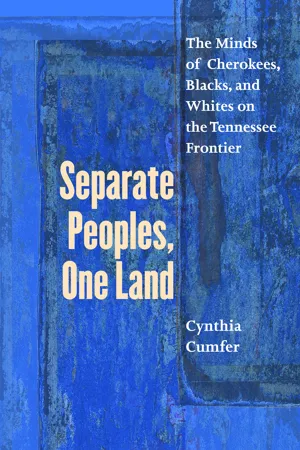
Separate Peoples, One Land
The Minds of Cherokees, Blacks, and Whites on the Tennessee Frontier
- 336 pages
- English
- ePUB (mobile friendly)
- Available on iOS & Android
eBook - ePub
Separate Peoples, One Land
The Minds of Cherokees, Blacks, and Whites on the Tennessee Frontier
About this book
Information
Part One
Diplomatic Relations
Chapter One
Kinship and Nationhood
The Construction of Relationship between Cherokees and Settlers, 1768–1788
Harbingers of spring in 1775, Onitositah and John Sevier smoked the peace pipe together to open the negotiations that culminated in the Treaty of Sycamore Shoals. Both men were poised to assume greater leadership in their communities. Onitositah was a councillor to Oconostota, one of the principal chiefs at the treaty. John Sevier was present as a representative of the settlers. Two years later, Onitositah attended the April and July peace conferences at Long Island in Overhill country as the principal peace chief. Meanwhile, Sevier led the local militia into Cherokee country, pursuing a scorched earth policy that left many Cherokee men, women, and children dead or starving. Onitositah devoted the next decade to promoting a Cherokee style of diplomacy, while Sevier, later governor of the state of Franklin and six times governor of Tennessee, gained popularity among the settlers for his military exploits against the Cherokees.1
The peace chief and war chief met again at peace talks in 1781. Addressing the younger Sevier as his “elder brother,” Onitositah put aside any sentiments he might have had about Sevier’s several invasions of Cherokee country. Instead, Onitositah expressed his hope that Sevier’s heart would be good and peaceable. Onitositah was joined by Nan-ye-hi, who urged peace on her “sons” of both races. John Sevier assured the Cherokees that he was pleased with “you and your nation.”2
The manner in which Onitositah and Nan-ye-hi fashioned their relationships to John Sevier, as elder brother and son, was a Cherokee construction. Native American historians have explored the use of kinship metaphors and treaty protocols by eastern woodland Indians in the contact period but have generally failed to examine how the concepts changed over time and have largely neglected women’s role in diplomacy.3 During the two decades after permanent white settlement, Cherokee peacemakers sought to bring all participants to a peaceful state of mind by putting past misdeeds behind them, establishing a present relationship, and creating an intent to continue peace in the future. As with most Native Americans, peace chiefs imagined that they would establish diplomatic relations with the settlers by fashioning them as fathers, elder brothers, and brothers, a metaphor of intercommunal kinship that assumed a reciprocity of obligations between the members. As the Cherokees increasingly ceded lands to the frontier people who failed to reciprocate this imagined kinship on Cherokee terms, the Cherokees began to emphasize the connection between reciprocity and justice to protect their lands. A special note in the diplomatic voice, Cherokee women drew on their matriarchal authority to declare themselves the mothers of Cherokee and white men. As such, they sought to preserve Cherokee territory by restoring balance in two domains—they pressed for peace in the face of male warfare, and they urged recognition of the common humanity and equality of the two peoples. By 1788 many Cherokees considered these intellectual approaches inadequate, undermined by violence and land losses.
John Sevier’s reply to the diplomats and their “nation” was a European response. Scholars have documented European theories about nationhood, race, and savagery but, except for beliefs about the right to vacant land, have done much less to explore how local colonists understood indigenous sovereignty.4 In the European imagination, governments characterized other political sovereignties as nations but challenged a nation’s right to occupy large tracts of land that it did not cultivate. Following this logic, early pioneers to the Tennessee region maintained political separation from the southeastern Indians by invoking the doctrine of nationhood but contested the rights of Native American nations to sovereignty over their soil. In the vocabulary of nationhood, states connected with each other through treaties —a relationship maintained by carefully defined contractual rights and duties and not by kinship obligations. In fashioning a relationship with the Cherokees, peaceful factions of frontier people recognized the Cherokees as a nation and contested the policies of extermination of the more violent segment of the community. After some of the Cherokees supported the British in the Revolution, veterans coming to Tennessee and other landholders clamored for the right to Cherokee lands by conquest. Despite considerable pressure for the extermination of the indigenous peoples, Cherokee resistance and the actions of white settlers who sought coexistence overrode these voices.
The primary inhabitants of the Tennessee Valley during the seventeenth and eighteenth centuries were people of Iroquoian descent, who identified themselves as the Ani-Yun Wiya, the Real People. The Ani-Yun Wiya, called Cherokee or cave people by the Iroquois, lived in four clusters of towns at the beginning of the eighteenth century—the Lower Towns, located in present-day South Carolina, the Middle Towns and Valley Towns in North Carolina, and the Overhill Towns, located in what is now eastern Tennessee. As the century progressed, white settlements pushed these towns west. The Overhill Towns, situated west of the Appalachians, were removed from early colonial settlements but engaged in considerable trade with South Carolina beginning in the late seventeenth century and with Virginia after 1730.5
Traditional Cherokee cosmology located the source of its norms and behavior in a spirit world, whose principles aimed toward harmony. Harmony was attained by a balance of opposite forces, such as war and peace, men and women, and plants and animals. The Cherokee worldview emphasized boundaries and the autonomy and equality of moieties, rather than hierarchies. Great power resided in the supernatural world and could be accessed by crossing boundaries and by dreams and conjurers. Witches and evil spirits could also tap into spiritual power to cause sickness and death. The corn mother, Selu, and the hunter, Kana’ti, were the first people.6
Kinship was the nucleus of Cherokee society, which was structured around seven clans. The primary identity of each Cherokee was the clan of his or her mother. The father was not related to his children, and the mother’s male kin, usually her oldest brother, instructed the children, took responsibility for them on the mother’s death, and usually formed the closest male parental relationship with them. Individuals without clan ties, whether they lived in Cherokee villages or were members of other nations, were considered strangers. Clan ties affected virtually all arrangements in Cherokee society, including marriage, politics, and social practices. One of its significant concerns was the stilling of crying blood. In Cherokee metaphysics, the spirit of one person killed by another, whether accidentally or intentionally, could not move into the spiritual universe until the kinsmen of the deceased balanced his or her death by killing the murderer, or a clan relative of that person. The Cherokees occasionally recognized exceptions to this rule by permitting sanctuary in a beloved town or by acts of forgiveness or substitution in which the murderer’s clan offered a prisoner or a payment for the life taken.7
Spiritual and communal principles dictated the material relations of the Cherokees. The Cherokees believed that a supernatural being gave them their lands. They were attached to the lands because their ancestors were buried there and the spirits of the dead lingered in some localities. They owned their land in common, with occupants having rights to tenure. Women did most of the farming and child-rearing while men hunted. Personal property was individually owned, but a strong ethic of reciprocity required that those who had goods shared with those who did not. With the growth in trade in the last half of the century, some individuals increasingly owned more property than others.8
The Cherokees had weak and amorphous notions of personal power but did believe that power could be acquired and lost and that each person possessed power in differing degrees. The Ani-Yun Wiya highly valued independence and disapproved of compulsion. Although women and men had some separate areas of authority, they generally shared governance, with the women presenting their views through a representative of the Women’s Council. Each person had a voice in decision making, with decisions made by consensus. From early childhood, they sought to nurture an autonomous will in all individuals. The Cherokees did not try to resolve controversies but to avoid them, and dissidents unable to persuade the majority typically withdrew.9 Prior to 1753, most governance was local, taking place in the towns. National councils of all Cherokee people met only in emergencies. Everyone could speak at council, and decisions made in national councils were not binding on the towns. From 1753 until 1776, Chota emerged as a mother city with the authority to conduct diplomacy and regulate trade, but all other decisions continued to be made at the town level. The English made efforts to organize the Cherokees politically, designating a national chief, a practice continued by the Americans. These chiefs also governed by influence, not compulsion, though over the course of the eighteenth century the growing importance of war and their access to treaty goods enhanced their power.10
Because clanship was central to the Cherokee understanding of social and political relations, the Cherokees conducted diplomatic relations by establishing kinship connections with non-Cherokee people. Like many Native American peoples, the Cherokees pursued kinship diplomacy through two venues. One was to incorporate foreigners into Cherokee society through marriage and adoption. In the Cherokee matriarchal society, women conducted much of this diplomacy. Women commonly integrated traders and diplomats into tribal life and into the clan system by marrying them. The husband then became a relation of his wife’s clan, giving him important connections and protections. As was true in other native communities, a woman also tapped into a source of power when she crossed a boundary to form a sexual relationship with a non-Cherokee male. By midcentury, men and women considered women’s alliances with merchants to have significance comparable to that of heroic war deeds. Women extolled their accomplishments in obtaining goods from traders whom they loved in the same councils in which warriors boasted of their exploits. Women also chose whether to adopt prisoners or to torture captives for revenge.11
To establish a diplomatic connection with peoples who remained outside the clan structure, the Cherokees reconstituted the foreign community as kin. The Delaware, for example, were their grandfathers. The English were their fathers, elder brothers, and brothers. Constructing international relations in this way meant that the conduct of foreign affairs centered on relationship and mutuality, with each party having obligations specified by their relationship. If one party disturbed the balance of reciprocity by acting contrary to the expectations of their kinship duties, those actions destroyed harmony and led to war. Because the Cherokees abhorred compulsion, peacemaking centered on good talks and rituals to bring all to the common mind of peace. From this perspective, the parties were careful to avoid blaming each other. The atmosphere, not any agreements reached, was central. Such alliances were fragile, and the parties maintained their relationship over time by conferences and frequent visits to each other.12
By midcentury if not before, peace diplomacy included women, who advanced their own diplomatic concerns rooted in their roles as mothers. Women acted in international affairs on their own initiative but primarily through the Women’s Council, composed of the most influential women in the nation. The British insistence on negotiating with men and the growing centralization of national councils that excluded women who could not travel easily restricted but did not eliminate women’s involvement in the peace process. From 1755 until at least 1819, the Women’s Council was headed by Nan-ye-hi, a Beloved Woman and a member of the Wolf Clan, the most prestigious of the clans. Nan-ye-hi had important diplomatic clan connections through her mother, whose brothers included major peace chiefs Attakullakulla and Willinawaw.13
In defiance of the English Proclamation of 1763 that forbade trans-Appalachian settlement, Virginians and North Carolinians began migrating to the region now known as Tennessee in 1768. Cherokee leaders, including the primary chiefs Oconostota and Attakullakulla and the Women’s Council headed by Nan-ye-hi, were concerned about encroachments from the beginning, but they tolerated some settlement, primarily because they desired easier access to trade. The pioneer communities presented a challenge for the Cherokees. In the past, merchants lived in the Cherokee villages, subject to Cherokee law and customs, but the new traders now lived in white communities. Acting in their private capacity, the traders responded to Cherokee uneasiness by offering financial compensation for the presence of the settlements. In accepting these payments, the Cherokees realized that they were not dealing with the British authorities, whom they saw as having the power to purchase property and to set boundary lines. They understood the offer of the merchants for goods in exchange for the presence of the settlements from the perspective of Cherokee law that included a concept of land usage in which Cherokees allowed friends to live on their lands as a courtesy. The Cherokees believed that the payments that businessmen offered were funds to cover game that their hunting destroyed, not money to purchase property rights. The white bargainers encouraged this understanding by describing the arrangements in which the Cherokees signed deeds as temporary leases. In fact, the traders deliberately misled the Cherokees. For instance, one merchant, Jacob Brown, held his treaty with about 100 Cherokees and an interpreter on John McDowell’s property with McDowell furnishing the food and goods. Although Brown characterized the transaction as a lease with the Cherokees, he had a secret agreement with McDowell to give him two tracts of land in payment, showing that Brown intended to claim ownership of the property.14
During the early period of intermixture, the Cherokees cast the settlers as their brothers—a designation that assumed equivalent strength and resources. However, this kinship had clear boundaries. In 1774 Oconostota insisted that the borderers observe the line drawn between the Cherokees and settlers in the 1770 Virginia treaty.15 As a result of growing tension, North Carolina judge Richard Henderson faced an unsympathetic audience when he sought to obtain a huge grant of land from the Cherokees in a private purchase at the Treaty of Sycamore Springs in 1775. Henderson claimed that he purchased about one-half of the Cherokee hunting grounds, constituting most of present-day Kentucky and northern Tennessee and a path through the Cumberland Gap to allow access to this vast territory. The Cherokees denied selling their hunting grounds and contended that the goods they received were payment for the game that the travelers destroyed and for a small parcel of land on the Kentucky River, not purchase money for the sale of half of their lands. Along with the chiefs, the women almost certainly did not support a land cession. Oconostota’s wife became very uneasy when a trader told her that the chiefs had signed a deed for the lands, and she went to talk to the chiefs about it.16
During the year after the conference, the pioneers made it clear that they interpreted the deeds as a land grant and new land hunters flooded into the region. In response to this cataclysmic loss, Tsi-yugunsini, a young Cherokee warrior, led many of the young men to war in 1776, an action opposed by the Women’s Council and many peace chiefs, who accepted the assurances of the British Indian agent that Britain would handle the problem. Warned by Nan-ye-hi, many settlers fled but the Cherokee dissidents were successful in killing some frontier people and forcing others off their lands. In response, the militias of Virginia, North Carolina, South Carolina, and Georgia invaded Cherokee country, killing many people, burning houses, and destroying crops. Some of the nation met at Long Island on the Holston River with commissioners from North Carolina and Virginia to agree to peace in 1777. Tsi-yugunsini and many of his warriors objected and gradually withdrew from the nation, first to towns on the Chickamauga Creek, giving rise to their characterization as Chickamaugans, and later to towns near the bend of the Tennessee River, creating settlements that became known as the Lower Towns. During the American Revolution, they allied with the British and later established connections with the Spanish.17 The Chickamaugans became the major dissenting voices to the peace faction of the Upper Towns.
Many Cherokee men and women refused to abandon their ancestral land to incoming whites and declined to join Tsi-yugunsini and the Chickamauga...
Table of contents
- Cover Page
- Separate Peoples, One Land
- Copyright Page
- Dedication
- Contents
- Illustration and Maps
- Acknowledgments
- Note on Cherokee Names
- Introduction
- Part One Diplomatic Relations
- Part Two Intracommunal Relations
- Conclusion
- Notes
- Index
Trusted by 375,005 students
Access to over 1.5 million titles for a fair monthly price.
Study more efficiently using our study tools.
Frequently asked questions
Yes, you can cancel anytime from the Subscription tab in your account settings on the Perlego website. Your subscription will stay active until the end of your current billing period. Learn how to cancel your subscription
No, books cannot be downloaded as external files, such as PDFs, for use outside of Perlego. However, you can download books within the Perlego app for offline reading on mobile or tablet. Learn how to download books offline
Perlego offers two plans: Essential and Complete
- Essential is ideal for learners and professionals who enjoy exploring a wide range of subjects. Access the Essential Library with 800,000+ trusted titles and best-sellers across business, personal growth, and the humanities. Includes unlimited reading time and Standard Read Aloud voice.
- Complete: Perfect for advanced learners and researchers needing full, unrestricted access. Unlock 1.5M+ books across hundreds of subjects, including academic and specialized titles. The Complete Plan also includes advanced features like Premium Read Aloud and Research Assistant.
We are an online textbook subscription service, where you can get access to an entire online library for less than the price of a single book per month. With over 1.5 million books across 990+ topics, we’ve got you covered! Learn about our mission
Look out for the read-aloud symbol on your next book to see if you can listen to it. The read-aloud tool reads text aloud for you, highlighting the text as it is being read. You can pause it, speed it up and slow it down. Learn more about Read Aloud
Yes! You can use the Perlego app on both iOS and Android devices to read anytime, anywhere — even offline. Perfect for commutes or when you’re on the go.
Please note we cannot support devices running on iOS 13 and Android 7 or earlier. Learn more about using the app
Please note we cannot support devices running on iOS 13 and Android 7 or earlier. Learn more about using the app
Yes, you can access Separate Peoples, One Land by Cynthia Cumfer in PDF and/or ePUB format, as well as other popular books in History & Early American History. We have over 1.5 million books available in our catalogue for you to explore.