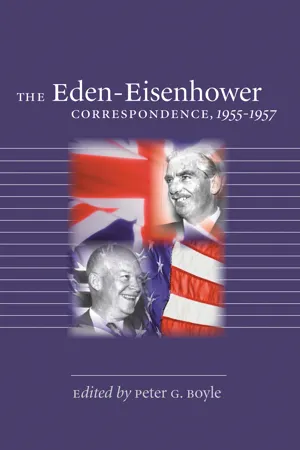
The personal correspondence between President Dwight D. Eisenhower and Prime Minister Anthony Eden during the time they were simultaneously in office tells the dramatic story of a relationship that began with great promise but ended in division and estrangement. Many of the letters have only recently been declassified, making it possible for the first time to publish this unique historic collection in its entirety.
Peter G. Boyle’s introduction, annotations, and conclusion provide context for the letters — details about the personalities and careers of Eden and Eisenhower and major issues that influenced the Anglo-American relationship up to 1955, such as relations with the Soviet Union, nuclear concerns, colonialism, the Middle and Far East, economic issues, and intelligence matters. The letters themselves offer an intimate look into the special connection between Britain and the United States through the often eloquent words of their leaders. They offer particular insight into the Suez Crisis of 1956, when Eden’s and Eisenhower’s views greatly diverged over the use of force to resolve the situation. Their personal relationship cooled from that point on and ended with Eden’s resignation in January 1957.
- 240 pages
- English
- ePUB (mobile friendly)
- Available on iOS & Android
eBook - ePub
The Eden-Eisenhower Correspondence, 1955-1957
About this book
Information
CORRESPONDENCE, PART I
From Eden's Accession to the Outbreak of the Suez Crisis, April 1955-July 1956
EDEN TO EISENHOWER _________________________________
April 7, 1955
Dear Mr. President,
I want to send this letter to thank you for the kind and generous things you said in your statement on my appointment as Prime Minister.1 They have encouraged me so much.
The memory of all the work done together with you in utter confidence and trust was always an inspiration to my great predecessor. It will be so to me as well.
I look forward to the closest co-operation with you and your administration at all times. I will do everything in my power to ensure that the good purposes which our two countries share as friends and members of the Atlantic community are steadfastly pursued.
Kindest regards.
Yours sincerely,
Anthony
1. On April 6, 1955, Eisenhower issued a public statement welcoming Eden's appointment as Churchill's successor as prime minister of Britain.
EISENHOWER TO EDEN __________________________________
April 8, 1955
Dear Anthony,
Through this note I send my salute to you as the Prime Minister of Her Majesty's Government of the United Kingdom. It gives me tremendous satisfaction to do so, a fact concerning which I am sure you have not the slightest doubt.
I most earnestly hope that your Premiership will be notable in the history of your country and of the world by the progress toward world peace that will be achieved. I know there is no one better fitted than you to seize the opportunities inherent in your new office for helping to guide the world toward the goal we all so earnestly seek.
On the more personal side, I cannot tell you how delighted I am that my old friend Winston has been succeeded by an equally valued friend in an office in which friendliness and genuine readiness to cooperate can mean so much to my own country.
With my confident belief in the brilliant career ahead of you, and my very best wishes and warm regard,
As ever,
DE
P.S. Won't you please convey my warm greetings to your Lady?
EISENHOWER TO EDEN _____________________________
April 9, 1955
Dear Anthony,
Your letter of the seventh apparently crossed in the mails with one I dispatched to you on the following day. I merely repeat that it is a tremendous satisfaction to me that you and Harold Macmillan will be the old friends with whom Foster and I will be working as we attempt to concert our actions and thinking in reaching for our common goals.1
With warm personal regard,
Sincerely,
D.E.
1. Harold Macmillan was appointed foreign secretary when Eden became prime minister. John Foster Dulles was U.S. secretary of state, 1953–59.
EDEN TO EISENHOWER ___________________________
April 11, 1955
My dear Mr. President,
It was more than kind of you to send me such a heart-warming salute. I am sure that you can have no doubt of the sincere admiration I have felt for so many years for the services you have rendered not only to your own country but to the world. More particularly I recall those dark days in Europe in the early nineteen-fifties when your name and leadership were the compelling factor in the first building of Western defence.1
You will know that I will do everything I can to help the course of the relations between our two countries run smoothly. In the many anxious problems which face me here, nothing gives me more pleasure than to know that our common friendship will help us to find the joint solutions we seek.
I hope that you will allow me from time to time to address you where there is some particular aspect of a problem which I would like to present to you and that you won't hesitate to tell me of any reflections or criticism you may have. Foster and Harold will I am sure build up a close understanding and friendship.
Clarissa joins me in warmest greetings to Mrs. Eisenhower and yourself.2
Yours ever,
Anthony
1. Eisenhower was the first supreme Allied commander, Europe, (SACEUR), 1950–52, after the formation of NATO.
2. Eden's second marriage was to Clarissa Churchill, niece of Winston Churchill, in 1952.
EDEN TO EISENHOWER ______________________________
May 5, 1955
Dear Mr. President,
You will have heard, no doubt, of our proposal to the joint meeting of officials in London that the time has come when “top level” talks, between heads of Government, could play a useful part in the reduction of world tension. This may be rather a surprise to you, but I do pray that you may give it earnest consideration. Of course we don't believe that everything can be settled in a few hours or days conversation. But I do really think that to arrange such a meeting would have great advantages.
After a full and frank review of the problems, a further programme of work could be drawn up, with a far better chance of success than by any other means, if only because the imagination of all the peoples of the world will have been stirred. Meetings of Foreign Ministers could follow, and any lines of progress explored. But to start off with such discussions may be the best hope of getting progress later. I do hope you will be willing to try this. The hopes of so many people, on both sides of the iron curtain, have been raised and a kind of mystique surrounds the idea. This may be foolish, but it is human. If our meeting was publicly represented more as a starting point than as a final solution these hopes would be kept alive. I must also tell you that much in our country depends upon it; this is not a party question here, but responds to a deep desire of our whole people.1
Of course our Foreign Secretaries could have an earlier meeting to arrange the form of our talks if you thought this necessary. In any event they would come with us. Our meeting, so far as the principals are concerned, need not last more than a very few days. A great advantage would be that it would give us time—and we need time for things to quieten, especially in the East. I do not think that anyone would precipitate trouble and try rash adventures while such a meeting was in the air.
This would help us all. Moreover, I believe if we issue the invitation promptly it may get in ahead of any tiresome Soviet approach to the Germans. Of course, if the Russians turn it down, our people and the other peoples of our alliance would feel that at least we have tried. And a fresh and much needed impulse would be given to n.a.t.o. and the efforts of each member state.
Could you consider this, and Foster could discuss it further with Harold in Paris.2
With kindest regards,
Anthony
1. A general election was due to be called in Britain within the next year. Eden was eager to seek a fresh mandate soon after his accession. A summit meeting was felt to be a popular proposal, which, at least in the short term, it was hoped, would create an atmosphere of improving the prospects for peace. This would be helpful to Eden and the Conservative Party in an election, which was held on May 26, 1955.
2. Dulles was scheduled to meet Macmillan in Paris on May 7–13, 1955, at a meeting of the North Atlantic Council and at subsequent meetings that would include French Foreign Minister Antoine Pinay.
EISENHOWER TO EDEN _______________________________
May 6, 1955
Dear Anthony,
While we are a bit surprised that you have gone so far in your thinking as to present your idea as a definite proposal, nevertheless Foster and I have together spent some hours on it, and I give you my immediate reactions as follows:—
We appreciate the importance to you of this project under existing circumstances, and are naturally disposed to do everything we can to further it. On the other hand, you will understand that we also have our local problems, including public opinion, to consider. We believe that it would be wholly impractical to have such a meeting with a previously announced specific agenda covering a global variety of subjects. At the other extreme, we think it would be most unwise to meet without giving the world some clear intimation of the generality of the subjects to be discussed. The reason for this is that almost every nation in the world will believe its interests are in some way to be affected by such a conference and would therefore be resentful at its lack of representation.
If there were to be a meeting, general subjects to be talked about might, we suppose, include some or all of the following:—
Exploration of ways and means of eliminating or minimizing atomic activity and armaments;
the general subject of disarmament by the large nations;
the limitation of forces in continental Europe that belong to nations outside that area; and, possibly,
a general limitation of armaments in the European area.
Another subject that might be added would be the reunification of Germany, but for this one the announcement should specify that Germany would be represented. To this of course could be added the perennial question of lessening of world tensions.
Even if such a procedure could prudently be followed, it would seem to us most unwise to attempt to hold a meeting without some form of preparation through our Secretaries of State. If those officials could meet informally, possibly when they are in Vienna, and discuss this matter and each suggest to his own government that these or similar subjects might be well talked about “at the summit” in order to discover whether or not there was a general willingness to proceed on an honest search for some answers, such a meeting would probably make sense even to the die-hard opponents of any contact with the Communists.1 I wonder whether such a scheme could be implemented without delaying too long the ability to issue the invitation, which delay might defeat the purposes you may be seeking.
In any event, Foster and I have discussed this at such length that he will be far more capable of clarifying our views to Macmillan and possibly to you than I can do in this hastily written cable.
With warm personal regard,
As ever,
D.E.
1. The foreign ministers of Britain, France, and the United States were scheduled to be in Vienna on May 15, 1955, for the signing of the Austrian State Treaty, which ended the Soviet occupation of the eastern zone of Austria and restored Austrian unity and independence within the framework of a neutral state.
EDEN TO EISENHOWER _________________________________
May 8, 1955
Dear Mr. President,
Thank you so much for all the trouble you have taken. I am sure that we can now leave it to Harold and Foster to work something out. Your understanding help is so valuable to me.
Yours ever,
Anthony
EISENHOWER TO EDEN _____________________________
May 27, 1955
My dear friend,
My enthusiastic congratulations.1
Dwight D. Eisenhower
1. In the British general election on May 26, the Conservatives retained power with a majority of fifty-eight seats in the House of Commons.
EDEN TO EISENHOWER _________________________________
May 29, 1955
Dear Mr. President,
Thank you so much for your kind message. These results have exceeded our expectations. But nothing in them gives me more pleasure than to know that we can go on working together.
Anthony
EDEN TO EISENHOWER _________________________________
May 29, 1955
Dear Mr. President,
I have had a personal message from Nehru giving a brief account of Krishna Menon's talks with Chou En-lai.1 He tells me that Krishna Menon will give us a detailed report when he comes to London shortly. Meanwhile Nehru makes reference ...
Table of contents
- Cover Page
- The EDEN-EISENHOWER Correspondence, 1955–1957
- Copyright Page
- CONTENTS
- ACKNOWLEDGMENTS
- ABBREVIATIONS
- INTRODUCTION
- THE PERSONALITIES
- THE ISSUES
- CORRESPONDENCE, PART I
- CORRESPONDENCE, PART II
- CONCLUSION
- BIBLIOGRAPHICAL ESSAY
- INDEX
Trusted by 375,005 students
Access to over 1.5 million titles for a fair monthly price.
Study more efficiently using our study tools.
Frequently asked questions
Yes, you can cancel anytime from the Subscription tab in your account settings on the Perlego website. Your subscription will stay active until the end of your current billing period. Learn how to cancel your subscription
No, books cannot be downloaded as external files, such as PDFs, for use outside of Perlego. However, you can download books within the Perlego app for offline reading on mobile or tablet. Learn how to download books offline
Perlego offers two plans: Essential and Complete
- Essential is ideal for learners and professionals who enjoy exploring a wide range of subjects. Access the Essential Library with 800,000+ trusted titles and best-sellers across business, personal growth, and the humanities. Includes unlimited reading time and Standard Read Aloud voice.
- Complete: Perfect for advanced learners and researchers needing full, unrestricted access. Unlock 1.5M+ books across hundreds of subjects, including academic and specialized titles. The Complete Plan also includes advanced features like Premium Read Aloud and Research Assistant.
We are an online textbook subscription service, where you can get access to an entire online library for less than the price of a single book per month. With over 1.5 million books across 990+ topics, we’ve got you covered! Learn about our mission
Look out for the read-aloud symbol on your next book to see if you can listen to it. The read-aloud tool reads text aloud for you, highlighting the text as it is being read. You can pause it, speed it up and slow it down. Learn more about Read Aloud
Yes! You can use the Perlego app on both iOS and Android devices to read anytime, anywhere — even offline. Perfect for commutes or when you’re on the go.
Please note we cannot support devices running on iOS 13 and Android 7 or earlier. Learn more about using the app
Please note we cannot support devices running on iOS 13 and Android 7 or earlier. Learn more about using the app
Yes, you can access The Eden-Eisenhower Correspondence, 1955-1957 by Peter G. Boyle in PDF and/or ePUB format, as well as other popular books in Politics & International Relations & British History. We have over 1.5 million books available in our catalogue for you to explore.