In a major revision of accepted wisdom, this book, originally published by UNC Press in 1991, demonstrates that American social Christianity played an important role in racial reform during the period between Emancipation and the civil rights movement.
As organizations created by the heirs of antislavery sentiment
foundered in the mid-1890s, Ralph Luker argues, a new generation of black and white reformers — many of them representatives of American social Christianity — explored a variety of solutions to the problem of racial
conflict. Some of them helped to organize the Federal Council of Churches in 1909, while others returned to abolitionist and home missionary strategies in organizing the NAACP in 1910 and the National Urban League in 1911. A half century later, such organizations formed the institutional core of America’s civil rights movement. Luker also shows that the black prophets of social Christianity who espoused theological personalism created an influential tradition that eventually produced Martin Luther King Jr.
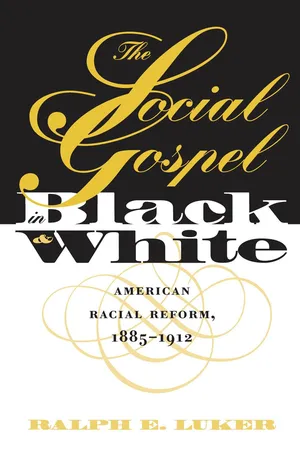
- 464 pages
- English
- ePUB (mobile friendly)
- Available on iOS & Android
eBook - ePub
About this book
Information
1: Introduction
“The fathers ate of sour grapes,” says the preacher, “and the children’s teeth are set on edge.” His graphic words suggest that no generation is left untouched by the legacy of its predecessors. Normally, we adjust to that reality—their world was what we first knew—and find much in the past to cherish. On occasion, we try to shake free of our bondage to history and, by repudiation if possible, by confession if necessary, seek to reclaim our innocence. Nowhere in the American experience is the burden of history more evident than in the painful course of its race relations. Therein is much that needs repudiation, much to be confessed, and indeed much to be cherished.
In April 1906, the Congregational pastor at Springfield, Missouri, witnessed one of the decade’s most brutal race riots. A mob of white men seized three black men, hung their bodies from an electric light post, which was surmounted by a replica of the Statue of Liberty, and burned them. Horrified by the mob action, the venality and weakness of local authorities, and his own inability to improve race relations substantially as a pastor, Harlan Paul Douglass gave up his church and devoted the next fifteen years of his life to the American Missionary Association’s work for the education of black people. His book, Christian Reconstruction in the South, was the decade’s most powerful statement of an evangelical neoabolitionism that helped to revive racial reform in the twentieth century. Douglass’s interest in race relations is noteworthy because a decade earlier, while serving as a pastor in bucolic Ames, Iowa, he was among the first to use the term the social gospel.1 It was given currency as the title of a journal published by white Christian communitarians in rural Georgia who hoped to build a school modeled on Booker T. Washington’s Tuskegee Institute.2 Referring generally to a fresh application of the insights of the Christian faith to pressing problems of the social order, it gained widespread circulation among contemporary religious reformers. In retrospect, historians have used it to describe late nineteenth- and early twentieth-century Christian efforts to address the social problems of the age, which they see as functions of urban and industrial growth.3
But if Harlan Paul Douglass’s phrase lived on, awareness of his effort to apply the “social gospel” in race relations has not. Indeed, most historians do not see the prophets of American social Christianity as having much interest in race relations. The account most widely accepted was neatly captured in Rayford Logan’s phrase, “the astigmatism of the social gospel.” It suggests that, preoccupied with the ills of the new industrial order, the prophets of social Christianity either ignored or betrayed the freedmen and left their fortunes in the hands of a hostile white South. The indictment of the social gospel on this count hinges upon the racism of Josiah Strong, the faithlessness of Lyman Abbott, and the complicity in silence of Washington Gladden, Walter Rauschenbusch, and others.4 If this is an accurate assessment, Abbott wrote his own indictment. “The selfish prejudice of indifference,” said the Christian Union’s editor, “is not one whit more holy than the selfish prejudice of open aggression.”5
This criticism of the social gospel prophets is widely shared, but there have been scattered voices of dissent. William A. Clebsch, for example, asserted that “it was the social gospelers, notably Abbott and Strong, whose theological thrusts first effectively challenged racial superiority in American Protestantism.” By focusing on the interests of particular individuals or groups, however, Clebsch and other dissenters produced no reinterpretation of the movement as a whole.6 More important, neither point of view quite comprehends both the high lights and deep shadows of American social Christianity’s record in race relations.
The many historians who emphasize the social gospel’s racial failures commonly assume the discontinuity of nineteenth-century religious reform and accept uncritically Arthur Schlesinger’s treatment of the social gospel as the response of reform-minded churchmen to the urban-industrial crises of the late nineteenth century. A skillfully crafted work of historical synthesis, Schlesinger’s study powerfully influenced more extended accounts by a generation of scholars.7 Yet, if one thinks that slavery and the consequences of emancipation were the central issues of nineteenth-century American history, or if one believes, with W. E. B. Du Bois, that “the problem of the twentieth century is the problem of the color line,” there is reason to question Schlesinger’s thesis. Substantial as his contribution was, it has been justly criticized as construing late nineteenth-century religious history too largely in terms of stimulus and response. Thus, say its critics, it neither sufficiently appreciated the continuities of nineteenth-century reform nor gave sufficient attention to the theological positions from which the social gospel was articulated. Writing within Schlesinger’s framework, Ralph Morrow treated Northern Methodist missions in the post—Civil War South as the finale to sectional crisis and Civil War. He documented at length the social mission of the Yankee Wesleyans among black people in Southern Reconstruction, but charged the missionary-minded Methodists with failing to be alert to the urban-industrial crisis on their home front.8 Assuming the blinders of the Schlesinger thesis, historians may inevitably find their subject guilty of failing to see something or other. In race relations, it produced what might be called “the astigmatism of the historians.”
The assumption of discontinuity and the a priori definition of the social gospel in terms of stimulus and response led historians to ignore its manifestations in black and Southern white churches alike.9 Thus, studies of the social gospel written under the influence of the Schlesinger thesis did not treat race relations. Finding nothing of consequence in these studies, the historians of race relations concluded that the social gospel prophets were unconcerned. To complete the cycle, the authors of the former read the works of the latter and wrote introductions to new editions of their own books in which they confirmed the lack of interest.10 The astigmatic historians sought to pluck the log from the prophets’ eye!
But there is a way to interpret that part of our past more comprehensively. Sidney Mead suggested that there is a continuing theme in nineteenth-century religious reform. The disestablishment of religion in America withheld the state’s coercive power from the church, he argued, but it did not mean the surrender of the age-old notion that “the existence and well-being of any society depends upon a body of commonly shared religious beliefs.”11 Under the conditions of disestablishment and by methods of persuasion, denominations and voluntary associations, especially home missionary societies, assumed the responsibility of inculcating those religious beliefs and values that could serve to hold the society together. Until home missions could accomplish their task of sustaining and redeeming the whole society, other voluntary associations were organized to alleviate particular social problems. Thus, while they sought to organize society by the extension of common beliefs and values, the voluntary associations promoted social reform on a wide range of public issues, including slavery and race relations.12 By 1835, however, perfectionist influences were at work to sunder the very organizations that were charged with the task of binding the nation together. Only the shedding of blood eroded the influence of perfectionism.13
This conception of the organic structure of antebellum religious reform suggests a reinterpretation of both the origins and the nature of the social gospel. Its origins are found not in the response to urban-industrial problems but in the antebellum voluntary societies whose heart was the home missions movement, and the social gospel itself was less an abstract quest for social justice than it was the proclamation of those religious beliefs and values that could serve to hold the society together. Mission stations established first at the western and then on the southern frontiers of American society developed the techniques necessary to weave a social fabric similar to that of the urban East and North.14 What Schlesinger and others have seen as an increasingly radical critique of industrial capitalism was, rather, a growing conservative awareness that industrial capitalism has been the radical force in American society, generating social change of unforeseen consequence, heedlessly disruptive of human community. Apart from this general sense of what the social gospel was, it is difficult to demonstrate that there was a cohesive “social gospel movement.” Those who imagine otherwise can do so only by taking a part of it as equivalent to the whole, and the part they make primary has never been one that includes race relations.15
Conceiving the origin and nature of the social gospel as an extension of antebellum home missions and social reform movements offers a new approach to the social gospel and race relations. Given its basis in a conservative apprehension of social values, the social gospel’s generally conservative biases in race relations come as no surprise. But to say that the social gospel prophets were largely conservative in their social views is not to say that they were indifferent to race relations. Rather, just as it moved toward its own fulfillment at the end of the nineteenth century, the social gospel movement’s conservative racial strategies were in crisis because its three surviving traditions in racial reform were in sharp decline.16
First, the social gospel prophets could no longer rely heavily upon the home missions movement. It had played a crucial role in establishing missionary institutions in black communities throughout the South and had powerful support from the social gospel prophets in doing so. But that effort was severely handicapped by the financial crisis of the 1890s and lost its initiative to a new, more secular “benevolent empire” in education after 1900.
Second, the social gospel prophets no longer considered African colonization a means of alleviating racial problems in the United States. They rejected massive migration to Africa as a cruel hoax upon black Americans in the 1890s. The social gospel prophets did see an important missionary role for a select few in the redemption of Africa, but social Christianity’s negative portrait of the “dark continent” was a taproot of both America’s racism and its cultural imperialism.
Third, American social Christianity was divided over whether the franchise was a natural right, whether education or the franchise ought to have priority, and whether federal or state action was better suited to purify Southern politics. But the postemancipation tradition of civil equity among black and white leaders in racial reform collapsed in the mid-1890s as Southern states seized the initiative to disfranchise black citizens.
By the mid-1890s, lynching became the primary issue in American race relations. Forced to confront it as an issue of life itself, American social Christianity began to focus upon the elemental insights that black people were persons, that the right to life was natural, and that the right to a trial by one’s peers was essential to American democracy. Yet, with the forces of racial reform in disarray, time seemed to be of the essence.
At the turn of the century, conservative Northern white philanthropists and Southern educators formed an alliance with Booker T Washington to promote public education in the South. Black migration to cities built a constituency for black urban reformers with institutional bases in missions, institutional churches, and settlement houses within the black community. But disfranchisement, lynching, peonage, and urban riots created a new sense of racial crisis.
Aroused by the new sense of crisis, black and white racial reformers, many of them spokesmen for American social Christianity, explored a variety of uniracial and biracial means of addressing the situation. While the denominations organized the forerunner of the National Council of Churches in 1909, the racial reformers recovered abolitionist and home missionary strategies in reorganizing as the National Association for the Advancement of Colored People in 1910 and the National Urban League in 1911. A half century later, these and allied organizations formed the institutional core of America’s civil rights movement.
Finally, the prophets of American social Christianity at the turn of the century were spread across wide spectra of thought in race relations. They often worked more at cross-purposes than toward a single end. But, at its best, mainstream American social Christianity developed a critique of both racism and cultural imperialism that built upon the rather elemental notion that black people were, after all, “persons.” Acceptance of that notion, thought young Martin Luther King, would help to create the “beloved community.” As with many of the earlier social gospel prophets, it was that conservative social value that was the capstone of his social thought.
2: Christianizing the South
On 7 March 1894, two white teachers at the black college in Talladega, Alabama, set out in a horse-drawn carriage for an afternoon drive. Nearing the railroad tracks, their horse was startled by the approach of a train. Unable to hold him back, the women were horrified as the animal plunged to his death and their carriage was thrown against the engine. Hurled forty feet across a gully by the impact, both women were seriously injured. The younger teacher, Mary Strong, who had been at Talladega only six months, was taken to the home of the college president and lingered toward death for eleven days. “As she grew weaker, her mind wandered,” a brother reported, “she spoke of flowers and of her pupils, both of which she loved.” In the shared sorrow of her death, he wrote, “every man was a brother, every woman a sister. We are thankful for her unselfish, Christian life, and that she knew how to give herself to the service of her fellow men.” At a memorial service on 20 March in the college chapel, townspeople, faculty, students, and family paid final tribute to Mary Strong. “The several pastors of Talladega participated in the service with tender words, fitly spoken,” recalled...
Table of contents
- Cover Page
- The Social Gospel in Black and White
- Copyright Page
- Dedication
- Contents
- Illustrations
- Preface
- 1: Introduction
- Part 1: The Decline of Nineteenth-Century Racial Reform
- Part 2: The Racial Mission Renewed
- Part 3: Civil Wrongs, Civil Rights, and Theological Equations
- Notes
- Bibliographical Essay
- Index
Trusted by 375,005 students
Access to over 1.5 million titles for a fair monthly price.
Study more efficiently using our study tools.
Frequently asked questions
Yes, you can cancel anytime from the Subscription tab in your account settings on the Perlego website. Your subscription will stay active until the end of your current billing period. Learn how to cancel your subscription
No, books cannot be downloaded as external files, such as PDFs, for use outside of Perlego. However, you can download books within the Perlego app for offline reading on mobile or tablet. Learn how to download books offline
Perlego offers two plans: Essential and Complete
- Essential is ideal for learners and professionals who enjoy exploring a wide range of subjects. Access the Essential Library with 800,000+ trusted titles and best-sellers across business, personal growth, and the humanities. Includes unlimited reading time and Standard Read Aloud voice.
- Complete: Perfect for advanced learners and researchers needing full, unrestricted access. Unlock 1.5M+ books across hundreds of subjects, including academic and specialized titles. The Complete Plan also includes advanced features like Premium Read Aloud and Research Assistant.
We are an online textbook subscription service, where you can get access to an entire online library for less than the price of a single book per month. With over 1.5 million books across 990+ topics, we’ve got you covered! Learn about our mission
Look out for the read-aloud symbol on your next book to see if you can listen to it. The read-aloud tool reads text aloud for you, highlighting the text as it is being read. You can pause it, speed it up and slow it down. Learn more about Read Aloud
Yes! You can use the Perlego app on both iOS and Android devices to read anytime, anywhere — even offline. Perfect for commutes or when you’re on the go.
Please note we cannot support devices running on iOS 13 and Android 7 or earlier. Learn more about using the app
Please note we cannot support devices running on iOS 13 and Android 7 or earlier. Learn more about using the app
Yes, you can access The Social Gospel in Black and White by Ralph E. Luker in PDF and/or ePUB format, as well as other popular books in History & North American History. We have over 1.5 million books available in our catalogue for you to explore.