Women in public office are often assumed to “make a difference” for women, as women — in other words, to represent their female constituents better than do their male counterparts. But is sex really an accurate predictor of a legislator’s political choices and actions? In this book, Beth Reingold compares the representational activities and attitudes of male and female members of the Arizona and California state legislatures to illuminate the broader implications of the election and integration of women into public office. In the process, she challenges many of the assumptions that underlie popular expectations of women and men in politics.
Using in-depth interviews, survey responses, and legislative records, Reingold actually uncovers more similarities between female and male politicians than differences. Moreover, the stories she presents strongly suggest that rather than assuming that who our representatives are determines what they will do in office, we must acknowledge the possibility that the influence of gender on legislative behavior can be weakened, distorted, or accentuated by powerful forces within the social and political contexts of elective office.
eBook - ePub
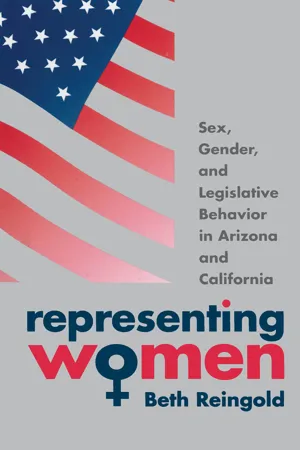
Representing Women
Sex, Gender, and Legislative Behavior in Arizona and California
- 352 pages
- English
- ePUB (mobile friendly)
- Available on iOS & Android
eBook - ePub
About this book
Information
Part I: Representing Women in Theory and in Context
Chapter One: Deconstructing Difference
Difference is “in.” Men are from Mars; women are from Venus (J. Gray 1992). Women speak in a different voice (Gilligan 1982). Women and men just don’t understand each other (Tannen 1990). Men just don’t get it. “‘Difference,’” feminist essayist Katha Pollitt (1992: 799) quips, “is where the action is.”
Women in politics “make a difference.” “Tune in to any discussion about the increasing number of women in politics,” write journalist Linda Witt, political scientist Karen Paget, and historian Glenna Matthews (1994: 265), “and you will hear” that women’s presence “makes a difference.” What Hege Skjeie (1991: 234) writes of Norwegian politics is easily applicable to American politics:
A mandate of “difference” is now attached to women politicians. It has been used by women themselves to get inside the power institutions. It is recognized by party leaderships, both men and women, as a relevant political mandate. It is the basis for new expectations as presently stated from outside the power institutions.
From the woman suffrage movement, which began 150 years ago, to the 1992 “Year of the Woman” campaign season, arguments for women’s full participation in politics have appealed not only to our sense of justice and equality but also to the promise of something new and different. “Either positively as the bearers of new values and perspectives, or more negatively as a silenced and thwarted majority, [women] have perceived themselves as bringing something new to the political stage. Their much-delayed entry will not only add to the dramatis personae, but of necessity alter the play” (Phillips 1991: 3).
The differences that women in public office are expected and purported to make are numerous and varied. First and foremost, female politicians are allegedly more willing and able than their male counterparts to deal with a number of public policy problems commonly referred to as “women’s issues.” These issues include but are not limited to those concerned strictly with equality of the sexes, women’s rights, or women’s health and safety. Issues often characterized as “soft” or compassionate (Shapiro and Mahajan 1986)—such as anything having to do with children, education, health, and social welfare—also are perceived as congruent with women’s interests and expertise. Political candidates, activists, advocacy groups, and observers have asserted that the election of women to public office is a necessary, sometimes even sufficient condition for proper and effective action on such issues.
While the contemporary women’s movement (or at least its more reform-oriented branches) has always sought to increase the number and influence of elected women (Mueller 1987a: 96–97), the defeat of the Equal Rights Amendment (ERA)—in overwhelmingly male state legislatures—provided an all-too-clear illustration of the consequences of women’s absence and exclusion from positions of political power. Moreover, the support and commitment of the female legislators who did fight for the ERA held much promise for the future. Things would be different if there were more women in office—not just the Constitution, but a whole array of issues on the feminist agenda and of importance to women in general. “The lesson of the 1970s seemed clear: representation, not entitlement, was the key to gender equality” (De Hart 1995: 224–25).
In 1971, leading members of the National Organization for Women (NOW) founded the National Women’s Political Caucus (NWPC) with the express purpose of opposing “racism, sexism, institutional violence and poverty through the election and appointment of women to public office, party reform and the support of women’s issues and feminist candidates across party lines” (Feit 1979, quoted in Mueller 1987a: 97). The NWPC continues its efforts and in a 1993 pamphlet entitled, “Why Women, Why Politics, Why You,” spells out in detail why:
Whether you’re . . .
• A woman working in or outside the home,
• A single mother, a retiree or student,
• A Republican, Democrat or Independent,
• Someone who’s actively involved in politics or whose only political activity is voting,... you deserve public officials who will make your issues a priority. As a woman, you deserve the opportunity to be equally represented by women in your government.
Today, women comprise just over 6% of the U.S. Congress and less than 20% of the state legislatures. We can’t wait another 200 years for quality child care and health care, permanent protection for our reproductive freedom, affirmative action, equal pay, affordable housing . . . and the list goes on.
To win these issues, women must be on the “inside,” exercising their political power. Only then will women and women’s issues be given the full attention and respect they deserve.
The nomination and appointment of Clarence Thomas to the U.S. Supreme Court in 1991, despite Anita Hill’s detailed account of sexual harassment under his tutelage, powerfully reinforced these lessons of women’s political representation. The image of fourteen white men of the Senate Judiciary Committee sitting in judgment of an alleged case of sexual harassment involving an African American man and woman was, for many observers, prima facie evidence of the pressing need to elect more women (and racial-ethnic minorities) to public office. But it was not simply the fact that men were presiding over and evaluating a woman’s testimony of sexual harassment; it was the way in which those men handled (or mishandled) the entire situation.
The senators were harshly criticized for being insensitive to and uninformed about the issue of sexual harassment. Beginning with accusations that they deliberately ignored and trivialized Anita Hill’s initial, confidential statements to the FBI and ending with the popular slogan, “Men just don’t get it,” the all-male Senate Judiciary Committee was on trial perhaps just as much as Clarence Thomas himself. Yet, a great deal of the criticism went beyond the Senate Judiciary Committee and the single issue of sexual harassment. The entire Thomas-Hill debacle was, for many onlookers, one particularly jarring indicator of a larger, more widespread problem: the inability of mostly male elected officials to deal effectively with any number of “women’s issues.” “If we are ever going to make a change on any of our issues—reproductive freedom, health, violence, workplace reform—we’ve got to change the faces,” NOW president Patricia Ireland declared. “If there was any object lesson out of [the] Clarence Thomas-Anita Hill [hearings], it was that we cannot rely on anybody else to represent us. We have to be there to represent ourselves. And it’s got to be now” (Carney 1992: 1399).
Female politicians themselves have certainly been known to make very similar claims about their ability to represent women. Geraldine Ferraro, for example, sees her historic 1984 vice presidential candidacy as “a statement in and of itself. My physically being there meant we would be concerned with women’s issues” (Witt, Paget, and Matthews 1994: 217). U.S. senator Nancy Kassebaum stated in a 1988 interview with Ms. that the increasing numbers of women in state legislatures “is where a lot of the initiative and vitality is today, trying out solutions for education and health care, malpractice legislation ...” [Ms. 17(4): 58]. In her 1990 California gubernatorial race, Dianne Feinstein repeatedly emphasized that she was more trustworthy on abortion rights than her pro-choice male opponents. “The best person to safeguard a woman’s right to choose,” she explained, “is another woman” (Yoachum 1990, quoted in Witt, Paget, and Matthews 1994: 168). U.S. representative Darlene Hooley recently stressed the importance of women’s involvement in congressional decision making, especially on issues of women’s health. To illustrate, she pointed out: “It was the women that said, ‘Look, mammograms should be covered’” by all health insurance policies (Hogan 1998). “When you get down to the nitty-gritty issues of dealing with children, aging, long-term care, all those are things that are a natural for women,” observed veteran Washington state senator Shirley Winsley as she and her female colleagues gained a record-breaking 41 percent of the state legislative seats in the 1998 elections. “I think, generally, men like tax-type issues, they like criminal-justice issues,” she added (Verhovek 1999).
Some of this rhetoric is wishful thinking, but the kinds of things these women envision are quite revealing. In 1984, former congresswoman Bella Abzug described her “possible dream” of a nation in which men and women shared political power equally:
Never again will we have a chief executive who reports to his “fellow” Americans on the State of the Union and refers to the state of women only once in a half-sentence or not at all. Nor will we have the insulting spectacle of a President choosing, in time of crisis, a committee of Wise Men—usually the same men who got us into the crisis in the first place—to advise him and ignoring the wisdom and recommendations of women. Nor will we have an all-male Senate debating and voting on women’s right to abortion. . . . Nor will we have budget planners who insist that an MX missile is more important than jobs for the unemployed, that low-priced meals for Pentagon generals are more necessary than nutrition supplements for mothers and infants, that tax breaks for multinational corporations are more desirable than cost-of-living adjustments for Social Security recipients, that nuclear power plants are more essential than protection of our soil, air, and water. (Abzug with Kelber 1984: 13)
Eight years later, in the midst of the heady “Year of the Woman” Democratic national convention, then-U.S. representative Patricia Schroeder had a similar vision: “We could finally have a friendly government in Washington. We could finally have a government that believed if you want to change the world, you change the world of a child. We could finally have a government that wouldn’t try to put a gag on women’s health” (Debenport 1992).
More systematic research suggests that these assertions and hopes are neither unusual nor unrepresentative of female politicians in general. For example, a study of the political advertisements of male and female candidates for the U.S. Senate between 1984 and 1986 (Kahn 1993) found significant differences in the types of issues the candidates emphasized as their particular strengths and concerns. The women spent more time talking about “social issues,” such as abortion, women’s rights, civil rights, gay rights, and the environment, while the men were more likely to discuss economic issues, such as taxes and the federal budget.
Members of the press have been no less reticent. In a special edition of Time magazine devoted to women, Margaret Carlson (1990: 17) writes: “Lots of men care about education, health care, pay equity, child care and parental leave, of course, but in a theoretical, not a life-altering, way. . . . Male politicians may not see the hundreds of Roseannes out there, or the thousands of pregnant women with no prenatal care, but female candidates do.” Cokie Roberts of ABC-Television and National Public Radio had this to say to the 1990 graduating class of Bryn Mawr College:
The women of America should basically be on their knees to the women in Congress of both political parties. . . . [For it is they who] carry the burden of the importance of issues to women and children day in and day out. They use it like Chinese water torture on their colleagues. They constantly bring those bills back to the top of the pile: child support enforcement, day care, pension reform, equal credit, domestic violence, all of these things are being brought to the floor by these women. . . . They found themselves the water carriers on women’s issues because they quickly discovered that if they didn’t do it, nobody else would. (Witt, Paget, and Matthews 1994: 96)
Little of this is lost on the voting public. Numerous surveys and a considerable amount of experimental research reveal a remarkably consistent tendency among both women and men to attribute different skills, traits, and issue competencies to male and female candidates, real or hypothetical. Put simply, voters tend to believe that men are better at dealing with foreign affairs, maintaining law and order, and formulating economic or fiscal policy and that women are better at handling issues of social welfare (especially on behalf of children or the “needy”), education, health, and the environment. The Louis Harris 1972 Virginia Slims Poll, which asked a national sample of women and men whether women in public office “could do a better job than men, a worse job than men, or just as good a job as men in public office” on a wide variety of issues, provides a more detailed account. On most of the issues covered, a plurality of respondents thought women and men could handle the task equally well. Large majorities, however, thought women could do a better job dealing with children and family problems and that men could do a better job directing the military. On issues such as consumer protection, welfare, health, education, world peace, and the environment, more respondents thought women would do a better job than thought men would do a better job. On the other side of the coin, men were more likely to be credited for strengthening the economy and dealing with big business, imposing law and order both at home and abroad, and balancing the federal budget.1 More recent research demonstrates that these gender-based attributions of issue expertise are no less prevalent today than they were twenty years ago (Alexander and Andersen 1993; Brown, Heighberger and Shocket 1993; Huddy and Terkildsen 1993; Leeper 1991; McGlen and O’Connor 1995: 63–64; Rosenwasser et al. 1987; Rosenwasser and Seale 1988; Sapiro 1981–82).2
The “special strengths” attributed to female candidates and officials (Abzug 1984) are not limited to their commitment to and leadership on “women’s issues.” A more general but no less popular appeal points to various “feminine” characteristics and values traditionally associated with women that women will bring with them to public office. Adjectives such as “caring,” “nurturing,” “compassionate,” and “cooperative” are used quite often to describe women’s distinct approach to both the substance and process of public policymaking. Additionally, female politicians are seen as more honest, trustworthy, dependable, and responsive than their male counterparts. Kate Karpilow, executive director of the California Elected Women’s Association for Education and Research, for example, believes that women have a “take-care” approach to politics. “The voter,” she asserts, “is saying, ‘Retire the back-slapping old boys. We want people who care about the people they serve’” (K. Mills 1992). When women gained a record number of nominations in the 1992 California primaries, Willie Brown, long-time Speaker of the state assembly, made a similar observation: “In this horrible election environment, women are better candidates because they have naturally better credibility. They are not normally considered corrupt. They are not normally considered crooked. They are not normally considered players. They’re not normally considered gamers” (Yoachum and Gunnison 1992: A16).
This too is a common theme espoused by a diverse and numerous group of current, former, and hopeful female officials. “Tough and caring” was another of Dianne Feinstein’s slogans in her 1990 gubernatorial campaign. “It is women,” according to former U.S. representative Shirley Chisholm, “who can bring empathy, tolerance, insight, patience and persistence to government. . . . Our country needs women’s idealism and determination” (1970; cited in Gluck 1987: 223). “I see my role here as that of a healer,” said Rose Mofford as she assumed the governorship of Arizona after the impeachment of Evan Mecham, “because women are better organized and better equipped to ask people to do things” (Dreifus 1988: 44). Making a point about the need for more women in Congress, former member Barbara Jordan stated in 1991 her belief “that women have a capacity for understanding and compassion which a man structurally does not have” (Witt, Paget, and Matthews 1994: 266). In the aftermath of settling a local labor dispute that had turned violent, Toledo mayor Donna Owens said, “I think women are capable of putting people together in ways that men can’t” (Doan and Avery 1985: 77).
Advocates have been able to point to numerous polls to support these claims as well. “For years,” maintains Tamar Raphael of the Fund for the Feminist Majority, “polls have shown that women politicians are considered to be more honest and to possess more integrity than men in politics” (Biemesderfer 1990: 23; see also Carlson 1990; Clift 1990; Doan and Avery 1985; Salholz 1992; Toner 1990). Indeed, both the 1972 Virginia Slims Poll and subsequent experimental research have found respondents more likely to regard “maintaining hone...
Table of contents
- Cover Page
- Representing Women: Sex, Gender, and Legislative Behavior in Arizona and California
- Copyright Page
- Contents
- Acknowledgments
- Introduction
- Part I: Representing Women in Theory and in Context
- Part II: Defining the Parameters of Representation
- Part III: Policymaking
- Part IV: Conclusions, Explanations, and Implications
- Appendixes
- Notes
- References
- Index
Trusted by 375,005 students
Access to over 1.5 million titles for a fair monthly price.
Study more efficiently using our study tools.
Frequently asked questions
Yes, you can cancel anytime from the Subscription tab in your account settings on the Perlego website. Your subscription will stay active until the end of your current billing period. Learn how to cancel your subscription
No, books cannot be downloaded as external files, such as PDFs, for use outside of Perlego. However, you can download books within the Perlego app for offline reading on mobile or tablet. Learn how to download books offline
Perlego offers two plans: Essential and Complete
- Essential is ideal for learners and professionals who enjoy exploring a wide range of subjects. Access the Essential Library with 800,000+ trusted titles and best-sellers across business, personal growth, and the humanities. Includes unlimited reading time and Standard Read Aloud voice.
- Complete: Perfect for advanced learners and researchers needing full, unrestricted access. Unlock 1.5M+ books across hundreds of subjects, including academic and specialized titles. The Complete Plan also includes advanced features like Premium Read Aloud and Research Assistant.
We are an online textbook subscription service, where you can get access to an entire online library for less than the price of a single book per month. With over 1.5 million books across 990+ topics, we’ve got you covered! Learn about our mission
Look out for the read-aloud symbol on your next book to see if you can listen to it. The read-aloud tool reads text aloud for you, highlighting the text as it is being read. You can pause it, speed it up and slow it down. Learn more about Read Aloud
Yes! You can use the Perlego app on both iOS and Android devices to read anytime, anywhere — even offline. Perfect for commutes or when you’re on the go.
Please note we cannot support devices running on iOS 13 and Android 7 or earlier. Learn more about using the app
Please note we cannot support devices running on iOS 13 and Android 7 or earlier. Learn more about using the app
Yes, you can access Representing Women by Beth Reingold in PDF and/or ePUB format, as well as other popular books in Politics & International Relations & American Government. We have over 1.5 million books available in our catalogue for you to explore.