In 2002 a burial box of skeletal remains purchased anonymously from the black market was identified as the ossuary of James, the brother of Jesus. Transformed by the media into a religious and historical relic overnight, the artifact made its way to the Royal Ontario Museum in Toronto, where 100,000 people congregated to experience what had been prematurely and hyperbolically billed as the closest tactile connection to Jesus yet unearthed. Within a few months, however, the ossuary was revealed to be a forgery. Resurrecting the Brother of Jesus offers a critical evaluation of the popular and scholarly reception of the James Ossuary as it emerged from the dimness of the antiquities black market to become a Protestant relic in the media’s custody.
The volume brings together experts in Jewish archaeology, early Christianity, American religious history, and pilgrimage to explore the theory and practice couched in the debate about the object’s authenticity. Contributors explore the ways in which the varying popular and scholarly responses to the ossuary phenomenon inform the presumption of religious meaning; how religious categories are created, vetted, and used for various purposes; and whether the history of pious frauds in America can help to illuminate this international episode. Resurrecting the Brother of Jesus also contributes to discussions about the construction of religious studies as an academic discipline and the role of scholars as public interpreters of discoveries with religious significance.
Contributors:
Thomas S. Bremer, Rhodes College
Ryan Byrne, Menifee, California
Byron R. McCane, Wofford College
Bernadette McNary-Zak, Rhodes College
Milton Moreland, Rhodes College
Jonathan L. Reed, University of La Verne
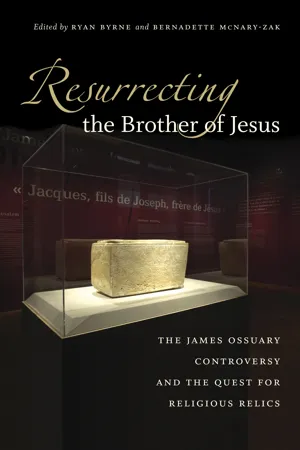
eBook - ePub
Resurrecting the Brother of Jesus
The James Ossuary Controversy and the Quest for Religious Relics
- 224 pages
- English
- ePUB (mobile friendly)
- Available on iOS & Android
eBook - ePub
Resurrecting the Brother of Jesus
The James Ossuary Controversy and the Quest for Religious Relics
About this book
Information
Topic
Theology & ReligionSubtopic
Jewish HistoryMILTON MORELAND
Christian Artifacts in Documentary Film
The Case of the James Ossuary
INTRODUCTION
On July 4, 2003, I sat in my yard watching fireworks, enjoying food and casual conversation with my neighbors. I had moved into the neighborhood only a week prior, so this block party was a prime occasion for conversations to turn to origins and occupations. “Where are you from?” and “What do you do?” were the inevitable questions. This is a precarious moment. When I answer the occupation question, the ensuing conversation often turns to recent television documentaries about the quest for Noah’s Ark, the “historical Jesus,” or the Shroud of Turin. Despite the acrimonious feelings that arise within me during these discussions of made-for-TV documentaries, on this occasion I let it be known that I am an archaeologist who is interested in the origins of Christianity and early Judaism. Immediately, the conversation turned to the James Ossuary. Some neighbors were more interested than others, but the entire adult crowd was well aware of this “discovery,” and at least two of my new neighbors were convinced that the ossuary was proof that Jesus was indeed the Son of God.
I was impressed by the fact that for a brief moment, at least on the minute scale of my personal experience, the ossuary had trumped the ark and the shroud in the public imagination (although I admit to having been asked about both of these topics before the night was through). In the world of “the top archaeological finds that confirm the Bible,” this inscribed burial box made a rapid ascent up the chart in the minds of many Christians and in the world of Christian publications and media. I will examine how some media and publishing outlets shaped the scholarly response to this artifact in order to sensationalize this story. The Discovery Channel documentary brought the greatest amount of attention to the ossuary, and thus the content of that film and the scholars who appear in it will be my primary focus.
With the instant popularity of the ossuary, the media raised a series of questions: Who was this James? Is this a reference to the Christian Jesus? Did Jesus really have a brother? Inevitably, scholars raised questions about the origins and authenticity of the ossuary and its inscription. These questions found their way to the front pages of newspapers around the globe; in North America, the New York Times, the Los Angeles Times, the Toronto Globe and Mail, the Miami Herald, and other papers in major cities gave significant coverage to the mysterious ossuary. Readers soon learned that, in fact, the New Testament Gospels mention that Jesus had brothers (and sisters). They also learned that this was likely a reference to Jesus of Nazareth of the Christian tradition, and that this James was very likely the person mentioned in the letters of Paul as a leader in the Christian movement of Jerusalem.
After the initial attention given to the ossuary subsided, a second wave of publicity arose in the spring of 2003—in the heart of the Lenten season—when a book and film about the ossuary were released. These projects had a significant impact on how the ossuary was presented to the public, and they claimed to provide a scholarly perspective on the ossuary’s authenticity (or lack thereof). The Discovery Channel’s documentary, James: Brother of Jesus, Holy Relic or Hoax?, was written, directed, and produced by Simcha Jacobovici. The film aired on Easter Sunday 2003 in America and worldwide in nearly seventy other countries, and over the course of the next month, it aired in eighty more countries.1 At about the same time, HarperSanFrancisco released The Brother of Jesus: The Dramatic Story and Meaning of the First Archaeological Link to Jesus and His Family, a popular book authored by Hershel Shanks and Ben Witherington III (75,000 hardback copies were printed in the first run).
One of the major selling points of the documentary and the book was their portrayal of the ancient ossuary as a tangible link to Jesus. The premise was that this “physical evidence” could prove that Jesus was a historical person. Promotional material for the documentary states that the ossuary is “possibly the greatest archaeological discovery of modern times,” and “if authentic, it would be the first physical evidence to prove Jesus Christ’s historical existence.”2 Similarly, the subtitle of the book makes clear its intention to use the ossuary as an “archaeological link to Jesus and his family.” This attempt to prove the existence of Jesus with appeal to an artifact has become an obsession in recent times.
Despite the fact that modern archaeologists do not have this as a goal, in some quarters the idea that archaeology can confirm the Bible’s accuracy has never been more vibrant. And documentary films have taken a leading role in promoting the idea that the Bible can be confirmed through archaeology. By the end of the twentieth century, this genre became one of the major preoccupations of nonfiction, historically oriented television programming, and the trend does not appear to be subsiding. Many of these films and television series attempt to demonstrate the accuracy of the Bible through the analysis of artifacts and archaeological research. The role that scholars play in these documentaries is usually that of the stock “talking head”—the expert who is called on to provide analysis and interpretation.
Using archaeology to prove biblical truths is a well-established feature of the Christian tradition through the ages. Seeking a “real” piece of the Christian tradition has been a preoccupation of Christians for centuries. While the biblical-archaeology TV documentary may be the most popular venue in the modern era—and possibly the most successful venue of all time—the quest to prove the Bible’s accuracy using material remains is an ancient tradition. In the history of Christianity, seeking objects that prove the truth of the Christian story has been part of the apologist’s profession since at least the fourth century.
The pursuit of artifacts that authenticate the Christian story was once the goal of figures like Saint Helena, the mother of Constantine the Great. In the late 320s, the seventy-five-year-old Helena traveled over 1,400 miles from Rome to Palestine in order to discover the real birthplace and death place of the Roman Empire’s newest deity. Tradition holds that she died at the end of that journey, but not before she had found the most sacred relic of Christendom: the true cross.3 In many respects, her incredible journey set the stage for hundreds of other Christian explorers who sought their own pieces of the “true cross.” Whether those relics came in the form of bones, wood, rocks, or mountains, Christian adventurers have been seeking physical proof of their faith for at least seventeen centuries. In what follows, I will pursue the idea that the development of the biblicalarchaeology documentary is one of several mass media projects that now functions to authenticate faith for the observant Christian. This pursuit may now be found in the comfort of your living room, as you turn on the Discovery Channel or the National Geographic Channel and see an object that may be a tangible proof of your faith. Jacobovici’s film on the James Ossuary will be placed within the history of documentary filmmaking, and his work will be taken seriously as a significant medium through which the public came to have a firsthand experience of this artifact.
A NEW MEDIUM FOR ARCHAEOLOGY AND FAITH
The rise and proliferation of the biblical-archaeology documentary reveals how powerful this film genre has become. The genre is not only powerful as a means to inform the public about the field of biblical archaeology; it also provides opportunities for viewers to associate artifacts like the ossuary with their Christian faith. In film, artifacts have a visual presence that goes beyond the experience of reading a book, often becoming props in well-choreographed reenactments. By seeing the artifact in an active role within historical reenactments, viewers are encouraged to integrate the artifact into their own ideas of Christian origins. As we will see in detail later, Jacobovici uses multiple reenactment scenes in which the ossuary plays a primary role—for example, in a fictional first-century burial cave in which it is inscribed and filled with human bones by actors playing James’s family and friends. These scenes feature the ossuary as an active part of the early Christian narrative and function to solidify the idea that the ossuary is an important early Christian relic, regardless of what the “talking head” scholars in the film might be saying. Similarly, the ability of documentaries to reenact scientific tests being performed on the artifacts, and the multiple scenes that are filmed on location in exotic and even “dangerous” places, help to confirm the legitimacy of the artifact in the minds of the faithful. While not all modern Christians yearn to touch the sacred objects and be healed by their “mystic potency,” there is still a strong desire to verify that faith is based on concrete realities. For many people of faith, archaeology is the key to that verification process, thus the popularity of the biblical-archaeology documentary.
I am not interested in judging this film genre as tasteful or tasteless, helpful or harmful, good or bad. Rather, I take this opportunity to examine the mass marketing of archaeology related to the Bible because it is high time that scholars pay attention to the most popular medium in which our work is presented. While traditional books, journals, and magazines reach thousands of interested readers, some form of a biblical-archaeology documentary is watched by millions of viewers each and every week. During the Easter season of 2006, approximately 4.1 million American television viewers tuned in to see The Tomb of Jesus, the latest version of the biblical-archaeology documentary that was produced by Jacobovici, the same person who brought us James: Brother of Jesus. Millions of other viewers across the globe watched the documentary as it played throughout that spring on Channel 4 in the United Kingdom, on Vision TV in Canada, and on over 100 other international channels.
I will also discuss the varied roles that scholars played in the making of the James Ossuary documentary. The increased involvement of scholars in televised venues is proportional to the popularity of documentary films. This genre has virtually replaced the book as the medium through which the public receives its information about the field of archaeology. Because more people watch television than read published archaeological reports, with the expansion of television documentaries, more people have access to archaeological information related to the Bible than ever before. Information about biblical archaeology is widely dispersed through the mass-marketed television networks. But as the venue has shifted, archaeologists have lost control over the medium through which the interested public receives archaeological information. Archaeology has become a handmaid to the filmmaker, through whom it is transported to the public.
While archaeologists and biblical scholars play significant roles in these films, the genre is not commensurate with traditional scholarly training. In many respects, the educational training of archaeologists and biblical scholars compels a scholar to spend much of his or her academic career in the painstaking and time-consuming task of writing books and articles. For those of us in the field of archaeology, our academic careers are often dependent upon the ability to produce books and articles, and writing is what we are trained and expected to do. Through years of experience, we learn the detailed process of writing, editing, indexing, and even illustrating books. While the literary medium remains vital to the academy, in recent decades documentaries have crept into the living rooms of the interested public. Scholars have played a significant role in the film genre; it is increasingly common to see scholars noting documentary film appearances in their curriculum vitae. Nevertheless, it is a medium that is both beyond the scholar’s training and outside the scholar’s control. Having a speaking role in a film that is edited by someone with limited background in archaeology and biblical studies is very different than writing an essay.
Filmmakers have also taken advantage of the deep divide among modern archaeologist on the issue of “archaeology and faith.” Throughout the past two centuries, archaeologists have had a complicated relationship with the apologetic quest that is often found in the documentary film genre. In certain respects, the so-called field of biblical archaeology has itself refueled the ancient fires of relic discovery. While many in the field of archaeology who excavate in Israel, Jordan, Palestine, and Lebanon have been trying to distance themselves from this relic-hunting tradition and establish the science of archaeology as separate from the “archaeology of faith,” one cannot deny that archaeologists remain prominent figures in the relic quest. From the earliest days of biblical archaeology, there is no doubt that many of the founders of the field were interested in providing concrete proof of “biblical truths.” Those apologetic aims continue in the work of some archaeologists who think of their fieldwork as a means to prove the validity of the Bible. This divide among archaeologists is easily exploited in the documentary film genre. A filmmaker can often find two archaeologists who disagree about whether an artifact proves or disproves a biblical claim. Thus, while many modern archaeologists who excavate in the southern Levant claim that their fieldwork has nothing to do with faith, few people hear that message. Several archaeologists have attempted to file “divorce papers,” claiming irreconcilable differences between scientific archaeological pursuits and theological attempts to bolster faith by appealing to artifacts.4 The divorce proceedings have never been successful. Despite the contention that archaeology has nothing to do with faith, many Christians are more convinced than ever that new archaeological discoveries are confirming the Bible’s accuracy.
The documentary film has become the major venue for attempting to prove the accuracy of the Bible. Over the past two decades, the biblical-archaeology documentary has risen quickly to the forefront of cable TV programming. Biblical archaeology is a central focus of hundreds of made-for-TV documentaries that have been featured on the History Channel, Discovery Channel, National Geographic Channel, A&E Network, Fox News Channel, PBS, CNN, CBS, NBC, and ABC. Biblical archaeology has been the major topic of three popular weekly TV documentary series: Digging for the Truth with Josh Bernstein, Science of the Bible on the National Geographic Channel, and The Naked Archaeologist with Simcha Jacobovici. It is difficult to deny that these documentaries have become the public face of Near Eastern archaeology. There is every reason to believe that this extensive genre of filmmaking will only continue to expand.5 The medium is escalating on a global level, as more and more cable TV providers see new types of documentary filmmaking and reality TV productions as potential cash cows in the broadcasting industry. There is little doubt that the use of archaeology to play on the hopes and fears of the faithful will continue to inspire new biblical-archaeology productions for many years to come.
THE DOCUMENTARY FILM GENRE
The documentary film has a very interesting and important history.6 The documentary genre was developed in the early part of the twentieth century as a counterpart to the fictionalized narrative films that were intended for entertainment. The fundamental purpose of the genre was to “document” a segment of the “real world,” providing information about real people, places, and events. The documentary was supposed to aim at the objective recording of the world; viewers were invited to see the lived experience of near and distant peoples and places in the comfort of the theater or, later, in their own homes.7 For viewers who grew up watching state-supported, professionally produced documentaries on television, there is an expectation that these films will have some social value and provide a public educational service. We assume they will weigh both sides of an issue and provide a levelheaded response. As opposed to dramas, comedies, and other entertainment shows, documentaries have a traditional high level of audience trust. We expect that documentaries are not faked, staged, acted, or fictionalized.8
This idea of the documentary was intentionally molded by the ...
Table of contents
- Title Page
- Copyright Page
- Table of Contents
- Illustrations
- Acknowledgements
- Introduction
- Archaeological Context and Controversy - The Bones of James Unpacked
- The Brother of Jesus in Toronto
- Finding True Religion in the James Ossuary - The Conundrum of Relics in Faith Narratives
- Christian Artifacts in Documentary Film - The Case of the James Ossuary
- Anatomy of a Cargo Cult - Virginity, Relic Envy, and Hallowed Boxes
- Overcoming the James Ossuary and the Legacy of Biblical Archaeology
Trusted by 375,005 students
Access to over 1.5 million titles for a fair monthly price.
Study more efficiently using our study tools.
Frequently asked questions
Yes, you can cancel anytime from the Subscription tab in your account settings on the Perlego website. Your subscription will stay active until the end of your current billing period. Learn how to cancel your subscription
No, books cannot be downloaded as external files, such as PDFs, for use outside of Perlego. However, you can download books within the Perlego app for offline reading on mobile or tablet. Learn how to download books offline
Perlego offers two plans: Essential and Complete
- Essential is ideal for learners and professionals who enjoy exploring a wide range of subjects. Access the Essential Library with 800,000+ trusted titles and best-sellers across business, personal growth, and the humanities. Includes unlimited reading time and Standard Read Aloud voice.
- Complete: Perfect for advanced learners and researchers needing full, unrestricted access. Unlock 1.5M+ books across hundreds of subjects, including academic and specialized titles. The Complete Plan also includes advanced features like Premium Read Aloud and Research Assistant.
We are an online textbook subscription service, where you can get access to an entire online library for less than the price of a single book per month. With over 1.5 million books across 990+ topics, we’ve got you covered! Learn about our mission
Look out for the read-aloud symbol on your next book to see if you can listen to it. The read-aloud tool reads text aloud for you, highlighting the text as it is being read. You can pause it, speed it up and slow it down. Learn more about Read Aloud
Yes! You can use the Perlego app on both iOS and Android devices to read anytime, anywhere — even offline. Perfect for commutes or when you’re on the go.
Please note we cannot support devices running on iOS 13 and Android 7 or earlier. Learn more about using the app
Please note we cannot support devices running on iOS 13 and Android 7 or earlier. Learn more about using the app
Yes, you can access Resurrecting the Brother of Jesus by Ryan Byrne, Bernadette McNary-Zak, Ryan Byrne,Bernadette McNary-Zak in PDF and/or ePUB format, as well as other popular books in Theology & Religion & Jewish History. We have over 1.5 million books available in our catalogue for you to explore.