- 186 pages
- English
- ePUB (mobile friendly)
- Available on iOS & Android
eBook - ePub
About this book
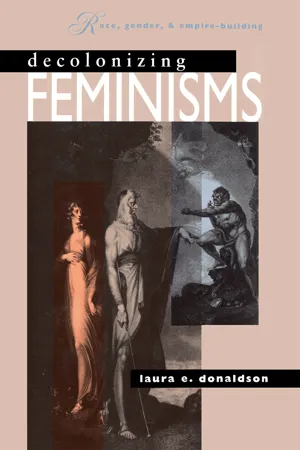
Donaldson presents new paradigms of interpretation that help to bring the often oppositional stances of First versus Third World and traditional versus postmodern feminism into a more constructive relationship. She situates contemporary theoretical debates about reading, writing, and the politics of identity within the context of historical colonialism — primarily under the English in the nineteenth century.
Information
Notes
INTRODUCTION
1. Rich, “Disloyal to Civilization,” 299.
2. Pasolini, Heretical Empiricism, 87.
3. Przybylowicz, “Feminist Cultural Criticism,” 260.
4. Mohanty, “Under Western Eyes,” 53.
5. Ibid., 52.
6. Meese, (Ex)tensions, 23.
7. Weedon, Feminist Practice, 22.
8. Rowbotham, Women, Resistance, and Revolution, 201.
9. Donovan, “Towards a Women’s Poetics,” 100.
10. French, Beyond Power, 130 (hereafter cited in text as BP).
11. Bhabha, “Articulating the Archaic,” 207.
12. Ibid.
13. Barrett, Women s Oppression Today (1988), xi.
14. Memmi, The Colonizer and the Colonized, xiii—xiv.
15. Barrett, Women’s Oppression Today (1988), xii.
16. Weedon, Feminist Practice, 27.
17. Sedgwick, Between Men, 1.
18. Ibid., 198.
19. Castoriadis, Imaginary Institution, 148.
20. Ibid.
21. Jayawardena, Feminism and Nationalism, 3.
22. Nyerere, Freedom and Socialism, 26—32, as cited in Horace B. Davis, Toward a Marxist Theory of Nationalism (New York: Monthly Review Press, 1978), 54—55.
23. Woolf, Three Guineas (hereafter cited in text as TG).
24. Spivak, Post-Colonial Critic, 9.
CHAPTER ONE
1. Ellison, Invisible Man, 458 (hereafter cited in text as IM).
2. Gilbert and Gubar, Madwoman in the Attic, xi (hereafter cited in text as MA).
3. Spivak, “Three Women’s Texts,” 245 (hereafter cited in text as TWT).
4. Spivak, In Other Worlds, 209.
5. Baker, “Caliban’s Triple Play,” 190.
6. Bulhan, Frantz Fanon, 189.
7. Feral, “The Powers of Difference,” 89.
8. Allen, Lesbian Philosophy, 49 (hereafter cited in text as LP).
9. Baker, “Caliban’s Triple Play,” 193.
10. Gates, “The Blackness of Blackness,” 287.
11. Teish, Jambalaya, 112.
12. Hurston, Mules and Men, 193.
13. Teish, “Women’s Spirituality,” 342.
14. Hurston, Mules and Men, 221.
15. Ibid., 231.
16. Fanon, Black Skin, White Masks, 217.
17. Smith, Introduction, xxxii.
18. Ogunyemi, “Womanism,” 64.
19. Chodorow, The Reproduction of Mothering, 166-67.
20. Johnston, “Feminist Film Practice,” 323.
21. Brontë, Jane Eyre, 31—32 (hereafter cited in text as JE).
22. Monaco, How to Read a Film, 164.
23. Pudovkin, “On Editing,” 87.
24. Silverman, The Subject of Semiotics, 205.
25. Ibid., 232.
26. Ibid., 130.
27. Kuhn, Women’s Pictures, 53.
28. As cited in Silverman, The Subject of Semiotics, 233.
29. Ibid.
30. Mulvey, “Visual Pleasure,” 809.
31. Kuhn, Women s Pictures, 61.
32. Belsey, Critical Practice, 75.
33. Ibid., 76.
34. Chesler, Women and Madness, 48.
35. Ibid., 49.
36. Ibid.
37. Bulhan, Frantz Fanon, 122.
38. Ibid.
CHAPTER TWO
1. French, The Women’s Room, 7 (hereafter cited in text as WR).
2. De Lauretis, Technologies of Gender, 1 (hereafter cited in text as TOG).
3. Frye, “Separatism and Power,” 103.
4. Although Americans have been taught to call Siam “Thailand,” the latter is actually a mongrel term introduced in 1939 by Luang Phibunsongskhram, a right-wing nationalist. Before the progre...
Table of contents
- Cover Page
- Title Page
- Copyright Page
- Contents
- Acknowledgments
- Introduction
- One The Miranda Complex: Colonialism and the Question of Feminist Reading
- Two The King and I in Uncle Tom’s Cabin; or, On the Borders of the Women’s Room: Race, Gender, and Sexual Difference
- Three The Con of the Text: Textualism, Contextualism, and Anticolonialist Feminist Theories
- Four Of “Piccaninnies” and Peter Pan: The Problem of Discourse in a Marxist Never-Never Land
- Five A Passage to “India”: Colonialism and Filmic Representation
- Six Rereading Moses/Rewriting Exodus: The Postcolonial Imagination of Zora Neale Hurston
- Seven (ex)Changing (wo)Man: Toward a Materialist-Feminist Semiotics
- Postscript On Women’s “Experience,”
- Notes
- Filmography
- Bibliography
- Index
Trusted by 375,005 students
Access to over 1.5 million titles for a fair monthly price.
Study more efficiently using our study tools.
Frequently asked questions
Yes, you can cancel anytime from the Subscription tab in your account settings on the Perlego website. Your subscription will stay active until the end of your current billing period. Learn how to cancel your subscription
No, books cannot be downloaded as external files, such as PDFs, for use outside of Perlego. However, you can download books within the Perlego app for offline reading on mobile or tablet. Learn how to download books offline
Perlego offers two plans: Essential and Complete
- Essential is ideal for learners and professionals who enjoy exploring a wide range of subjects. Access the Essential Library with 800,000+ trusted titles and best-sellers across business, personal growth, and the humanities. Includes unlimited reading time and Standard Read Aloud voice.
- Complete: Perfect for advanced learners and researchers needing full, unrestricted access. Unlock 1.5M+ books across hundreds of subjects, including academic and specialized titles. The Complete Plan also includes advanced features like Premium Read Aloud and Research Assistant.
We are an online textbook subscription service, where you can get access to an entire online library for less than the price of a single book per month. With over 1.5 million books across 990+ topics, we’ve got you covered! Learn about our mission
Look out for the read-aloud symbol on your next book to see if you can listen to it. The read-aloud tool reads text aloud for you, highlighting the text as it is being read. You can pause it, speed it up and slow it down. Learn more about Read Aloud
Yes! You can use the Perlego app on both iOS and Android devices to read anytime, anywhere — even offline. Perfect for commutes or when you’re on the go.
Please note we cannot support devices running on iOS 13 and Android 7 or earlier. Learn more about using the app
Please note we cannot support devices running on iOS 13 and Android 7 or earlier. Learn more about using the app
Yes, you can access Decolonizing Feminisms by Laura E. Donaldson in PDF and/or ePUB format, as well as other popular books in Social Sciences & Gender Studies. We have over 1.5 million books available in our catalogue for you to explore.