Appalachia first entered the American consciousness as a distinct region in the decades following the Civil War. The place and its people have long been seen as backwards and 'other' because of their perceived geographical, social, and economic isolation. These essays, by fourteen eminent historians and social scientists, illuminate important dimensions of early social life in diverse sections of the Appalachian mountains. The contributors seek to place the study of Appalachia within the context of comparative regional studies of the United States, maintaining that processes and patterns thought to make the region exceptional were not necessarily unique to the mountain South.
The contributors are Mary K. Anglin, Alan Banks, Dwight B. Billings, Kathleen M. Blee, Wilma A. Dunaway, John R. Finger, John C. Inscoe, Ronald L. Lewis, Ralph Mann, Gordon B. McKinney, Mary Beth Pudup, Paul Salstrom, Altina L. Waller, and John Alexander Williams
eBook - ePub
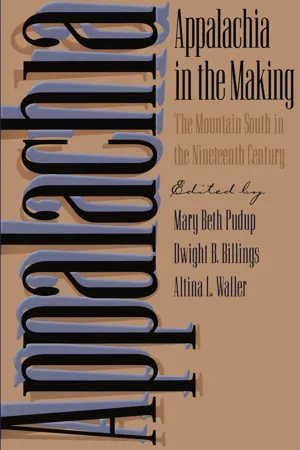
Appalachia in the Making
The Mountain South in the Nineteenth Century
- 402 pages
- English
- ePUB (mobile friendly)
- Available on iOS & Android
eBook - ePub
Appalachia in the Making
The Mountain South in the Nineteenth Century
About this book
Information
CHAPTER 1
Cherokee Accommodation and Persistence in the Southern Appalachians
JOHN R. FINGER
Cherokee Indians have lived in the southern Appalachians longer than any other people, and for them the nineteenth century represents an especially important transition. Those 100 years opened with a remarkable “civilization” program, continued in the next generation with deportation of the tribal majority, witnessed efforts by the remnant Indians to retain both their lands and their culture, and concluded with a growing accommodation to the dominant white culture and a changing economy. Throughout these experiences the Cherokees displayed a remarkable ability to adapt—indeed, to incorporate necessary changes into their society—amid a cultural continuity and self-identification separating them from whites and blacks. Their presence and cultural persistence made the southern Appalachians a truly triracial society.1
Although Cherokee military resistance to white expansion had ended less than a decade before, by 1800 the approximately 16,000 tribal members were already adjusting to the dictates of the federal government.2 A new civilization program was in effect that encouraged (even coerced) tribes to adopt white economic, social, cultural, and religious models. The Indian was to become a white person with red skin. Government agents and missionaries sponsored by various religious denominations labored to convince Indians that to survive in an expanding America it was necessary to become a Jeffersonian yeoman, to forsake the tribal identity.3
Though the civilization program had only limited success among most tribes, reformers delighted in chronicling Cherokee progress toward the normative standards of white society. Changing gender roles were one manifestation of this. Cherokee females, like middle-class white women, were encouraged to conform to a “Cult of True Womanhood” that reduced their earlier, more varied roles and exalted them as homemakers and keepers of the family hearth. They no longer had primary responsibility for agriculture and instead spent more time practicing domestic arts like spinning and weaving. Female participation in tribal politics, common in earlier days, dwindled while traditional matrilineal and matrilocal features blurred as Cherokees moved toward a patrilineal society shaped by acculturated males. These new circumstances imposed limitations and new expectations on men as well as women. Cherokee males could no longer take to the warpath, practice blood revenge, or even hunt as often as before, and the more civilized of them increasingly labored in the fields like white yeomen.4
Cherokee domiciles and patterns of landholding also changed. By the 1820s most tribal members no longer lived in well-defined villages but as nuclear families scattered along creek and river valleys in log cabins very much like those of nearby whites.5 Their agriculture was mostly at the subsistence level. In contrast, Cherokee elites, consisting of acculturated mixed-bloods and a few full-bloods, lived in large frame or stone homes comparable to those of their most prosperous white neighbors. Their dual role as Cherokees and planters offered an obvious advantage, for the tribe allowed members to occupy and cultivate as much tribal land as they wished without the irksome necessity of purchasing it. Like their white counterparts, these elites relied on black slaves to produce cotton and corn for a growing regional market. By 1835 tribal members owned more than 1,500 slaves, with a disproportionate number belonging to elites.6 Many Indians, elites and commoners alike, also raised livestock, and cattle drives from tribal lands to regional towns like Knoxville were not uncommon.7
Cherokee leaders appreciated at least the secular aspects of schools operated by various Protestant denominations, but many Indians of all ranks staunchly opposed white religious indoctrination. Methodist and Baptist missionary-teachers concentrated their efforts in the mountainous parts of North Carolina and Georgia, while other denominations chiefly ministered to the more economically advanced and acculturated Indians of Georgia and southeastern Tennessee. By the 1830s there was a growing number of converts, partly because some Christian practices correlated nicely with traditional Cherokee religious rites.8
Many Cherokees readily acknowledged the utility of reading and writing English, while others viewed such instruction as a form of cultural imperialism that threatened traditional society. After years of labor Sequoyah, a mixed-blood conservative, completed a Cherokee syllabary in 1821 that enabled many in the tribe to read and write in their own language. By 1828 there was even a tribal newspaper, the Cherokee Phoenix, published in both English and Cherokee. In an effort to turn this literacy to their own advantage, white missionaries soon published Christian texts in the syllabary. Even though the number of Cherokees who could read in their own language was still well below 20 percent in 1835, more than half of all households had a member who could read either Cherokee or English.9
The early nineteenth century also witnessed a growing trend toward centralized political authority within the tribe, culminating in 1827 with adoption of a written constitution for the Cherokee Nation; this document was modeled on that of the United States and several southern states. The principal chief, whose powers were analogous to those of a president, was John Ross, only one-eighth Cherokee in blood and the descendant of a Scottish trader.10 Legislative and judicial bodies (and a series of tribal laws) also reflected the influence of white America.
Impressive as these changes were, they hardly defined Cherokee society of the early nineteenth century and must be viewed with caution. The missionaries and other whites on whose accounts we chiefly rely were enthusiastic about tribal “progress” and generally ignored or downplayed a continuing traditionalism. As late as 1835 females still headed at least one-third of all Cherokee households, and many no doubt continued traditional functions like “farming, supervising an extended household, caring for children and kinsmen, and perhaps even exercising some power in local councils.”11 Throughout the Cherokee Nation people practiced a cultural syncretism that blended familiar ways of life with the new.12 Within the white-introduced institution of livestock raising, for example, Cherokee patterns varied widely depending on location and the persistence of traditional gender roles. Along the Tennessee River, mixed-blood male elites developed a planter/rancher form of herding derived from Spanish, British, and Creek influences that was “oriented toward extensive, commercial production of beef cattle.”13 This kind of herding incorporated certain features of the earlier hunting tradition—like intimate knowledge of the terrain and comparative freedom to roam—and thus “acted as a transition to a market-based economy.”14
In contrast, ordinary Cherokees living in more mountainous areas adopted the upland South pattern of subsistence farming-herding. Here, in areas such as western North Carolina, females easily incorporated ownership of livestock into their traditional roles as owners of the family home and fields.15 Here, “the look of the land was more traditional, and the farmstead was still to a large extent a woman’s domain.”16 Women, in fact, subtly resisted changes in their status as primary agricultural providers, and the continuing mythic story of Selu, the corn-mother, reinforced this role.17 Basketry, the most prevalent Cherokee craft, also remained a female domain and featured familiar materials, patterns, dyes, and techniques of weaving.18
The circumscribed nature of Cherokee change is apparent in other ways as well. In the mountain districts the inroads of Christianity were not so pronounced, despite the efforts of Baptist missionary Evan Jones.19 Clan identification and prohibitions against marriage within the clan continued, along with traditional ceremonies and contests like stickball. Even though these remote areas were part of the Cherokee Nation’s legislative districts, it is not clear to what extent ordinary Indians living there paid attention to tribal politics. Even among the more civilized areas of the Cherokee Nation, the transition from the autonomous village structure to a centralized government was in part simply an adoption of an Anglo-American institutional structure as a means of preserving tribal autonomy against the demands of white-dominated state and federal governments. As William G. McLoughlin and Walter H. Conser, Jr., observe, “What was taken by contemporary white observers as ‘civilization’ was simply the acquisition of sufficient skills for economic survival and for political self-government—part of a conscious strategy to resist removal and maintain autonomy.”20
The whites who came closest to understanding that Cherokee “progress” was a means of preserving tribal autonomy were the political leaders of southern states such as Georgia. Governor George R. Gilmer and others correctly perceived that Cherokee assertion of nationhood was a challenge to Georgia’s own sovere...
Table of contents
- Title Page
- Copyright Page
- Table of Contents
- Acknowledgements
- Introduction
- CHAPTER 1 - Cherokee Accommodation and Persistence in the Southern Appalachians
- CHAPTER 2 - Speculators and Settler Capitalists Unthinking the Mythology about ...
- CHAPTER 3 - Newer Appalachia as One of America’s Last Frontiers
- CHAPTER 4 - Race and Racism in Nineteenth-Century Southern Appalachia Myths, ...
- CHAPTER 5 - Diversity in the Antebellum Appalachian South Four Farm ...
- CHAPTER 6 - Economy and Community in Western North Carolina, 1860-1865
- CHAPTER 7 - Lives on the Margin Rediscovering the Women of Antebellum Western ...
- CHAPTER 8 - Class, Section, and Culture in Nineteenth-Century West Virginia Politics
- CHAPTER 9 - Agriculture and Poverty in the Kentucky Mountains Beech Creek, 1850-1910
- CHAPTER 10 - Town and Country in the Transformation of Appalachian Kentucky
- CHAPTER 11 - Railroads, Deforestation, and the Transformation of Agriculture ...
- CHAPTER 12 - Class Formation in the Southeastern Kentucky Coalfields, 1890-1920
- CHAPTER 13 - Feuding in Appalachia Evolution of a Cultural Stereotype
- CONTRIBUTORS
Trusted by 375,005 students
Access to over 1.5 million titles for a fair monthly price.
Study more efficiently using our study tools.
Frequently asked questions
Yes, you can cancel anytime from the Subscription tab in your account settings on the Perlego website. Your subscription will stay active until the end of your current billing period. Learn how to cancel your subscription
No, books cannot be downloaded as external files, such as PDFs, for use outside of Perlego. However, you can download books within the Perlego app for offline reading on mobile or tablet. Learn how to download books offline
Perlego offers two plans: Essential and Complete
- Essential is ideal for learners and professionals who enjoy exploring a wide range of subjects. Access the Essential Library with 800,000+ trusted titles and best-sellers across business, personal growth, and the humanities. Includes unlimited reading time and Standard Read Aloud voice.
- Complete: Perfect for advanced learners and researchers needing full, unrestricted access. Unlock 1.5M+ books across hundreds of subjects, including academic and specialized titles. The Complete Plan also includes advanced features like Premium Read Aloud and Research Assistant.
We are an online textbook subscription service, where you can get access to an entire online library for less than the price of a single book per month. With over 1.5 million books across 990+ topics, we’ve got you covered! Learn about our mission
Look out for the read-aloud symbol on your next book to see if you can listen to it. The read-aloud tool reads text aloud for you, highlighting the text as it is being read. You can pause it, speed it up and slow it down. Learn more about Read Aloud
Yes! You can use the Perlego app on both iOS and Android devices to read anytime, anywhere — even offline. Perfect for commutes or when you’re on the go.
Please note we cannot support devices running on iOS 13 and Android 7 or earlier. Learn more about using the app
Please note we cannot support devices running on iOS 13 and Android 7 or earlier. Learn more about using the app
Yes, you can access Appalachia in the Making by Mary Beth Pudup, Dwight B. Billings, Altina L. Waller, Mary Beth Pudup,Dwight B. Billings,Altina L. Waller in PDF and/or ePUB format, as well as other popular books in History & North American History. We have over 1.5 million books available in our catalogue for you to explore.