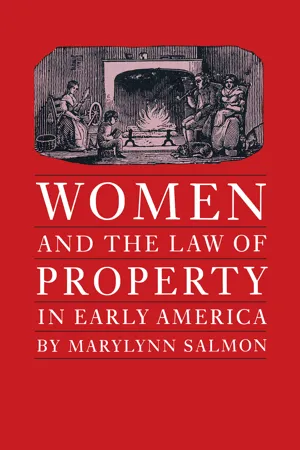
In this first comprehensive study of women’s property rights in early America, Marylynn Salmon discusses the effect of formal rules of law on women’s lives. By focusing on such areas such as conveyancing, contracts, divorce, separate estates, and widows' provisions, Salmon presents a full picture of women’s legal rights from 1750 to 1830.
Salmon shows that the law assumes women would remain dependent and subservient after marriage. She documents the legal rights of women prior to the Revolution and traces a gradual but steady extension of the ability of wives to own and control property during the decades following the Revolution. The forces of change in colonial and early national law were various, but Salmon believes ideological considerations were just as important as economic ones.
Women did not all fare equally under the law. In this illuminating survey of the jurisdictions of Connecticut, Massachusetts, New York, Pennsylvania, Maryland, Virginia, and South Carolina, Salmon shows regional variations in the law that affected women’s autonomous control over property. She demonstrates the importance of understanding the effects of formal law on women' s lives in order to analyze the wider social context of women’s experience.
- 285 pages
- English
- ePUB (mobile friendly)
- Available on iOS & Android
eBook - ePub
Women and the Law of Property in Early America
About this book
Information
Chapter One: Diversity in American Law
The most pervasive problem I encountered in studying the property rights of early American women had little to do with either women or the law of property. It was how to explain the remarkable diversity in colonial laws. No two colonies (and later, states) came to precisely the same conclusions about how to manage property under the law. Often rules varied only slightly, but sometimes the differences were major ones. Before we look closely at the specific legal areas covered in this study, it should prove useful to consider in a general way the forces behind legal diversity in the colonies. Although it is often impossible to pinpoint precisely why one unusual rule developed in a particular place, we can learn about the wider forces behind legal diversity by considering several developments together. What follows, then, are some introductory comments about the nature of legal diversity in the colonies.
First, it is important to remember that there was great variation in English law, perhaps particularly property law.1 Colonial jurists were accustomed to regional diversity. Rules on widows’ dower rights, conveyancing practices, and feme sole trader actions shifted between counties and boroughs in seventeenth- and eighteenth-century England. London had many standards all its own. When we recall in addition the tremendous variation in the reasons for settlement of the colonies, the differing English backgrounds of the settlers, dates of settlement, and the varied legal experience of early colonial lawmakers, standardization of the law in America can scarcely be expected.
Moreover, no one ever envisioned a single colonial code of laws. From the earliest days of settlement, legislative bodies in the colonies held the power to create laws suited to New World conditions. Contemporaries accepted the fact that life in America required the institution of rules unknown at home, and life everywhere in America was not the same. Chattel slavery, the need to promote clearing of wilderness lands, and the creation of a new religious leadership in New England and Pennsylvania all demanded innovation among American lawmakers. Change became not only acceptable but desirable in many areas of the law. Once a system supporting deviation from English law was in place, the colonists held a great deal of freedom to develop their own solutions to the legal problems of the day. Given the failure of the mother country to supervise colonial development to any meaningful degree throughout most of the seventeenth century, lawmakers developed systems based on their own values and needs with relative ease.2 Colonial law therefore often differed from the common law considerably. Because so little is known about English local law, it is impossible to say whether colonial rules imitated certain county or borough standards, but that possibility must be acknowledged for some developments. Others clearly arose from the specific New World needs of the settlers.
Legal historians have recognized for some time that colonial lawmakers deviated from English standards, adapting both local customs and the common law to their own circumstances. In Law and Authority in Early Massachusetts (1960), George L. Haskins debunked an older theory favoring uniformity in colonial law. His conclusion soon came to represent a new consensus: “The conditions of settlement and of development within each colony meant that each evolved its own individual legal system, just as each evolved its individual social and political system. Geographical isolation, the date and character of the several settlements, the degree of absence of outside supervision or control—all had their effect in ultimately developing thirteen separate legal systems.”3 By the early 1960s, then, historians agreed that the common law was not transported wholesale to America and that colonial legal systems diverged sharply from one another. Since that time, however, little detailed work on colonial law has appeared to demonstrate regional distinctiveness, and Haskins’s work on the evolution of the law in Massachusetts has not been imitated elsewhere.
In the following chapters, instances of regional variation in the rules governing women’s property rights appear again and again. It was the norm for each jurisdiction to develop its own standard. Diversity stemmed from several general causes and many specific ones. First and perhaps most important, in many instances there was simply no obvious solution to the problem of how to handle women’s property after marriage. When English law proved unsuitable or undesirable to colonial lawmakers, multiple solutions to any given question presented themselves. Therefore, even in colonies with similar backgrounds, different rules sometimes evolved. In Virginia, for example, slaves became defined as realty for the purpose of apportioning widows’ dower, while Maryland retained the common law rule defining all movable estate as personalty. Virginia widows therefore inherited a share of their husbands’ slaves only for life, whereas widows in Maryland gained absolute rights to some slave property. Because dower in Maryland included a share of personalty as well as the standard widow’s thirds in realty, women there had a considerable advantage. Virginia’s modification of the common law rule in this instance was not necessary, but to some lawmakers it seemed logical to attach valuable slave property to lands, since neither could be utilized fully without the other. The new rule restricted widows to a life estate in slaves as well as lands, and therefore remained consistent with the general purpose of dower. Women still received the property they needed to support themselves, but they did not gain enough for meaningful independence. Maryland lawmakers apparently were more concerned with making a clear distinction between personalty and realty, and with promoting the ready sale of slaves. Their system also worked to keep land and slaves together to a certain extent, since widows always received both as dower. If widows gained greater shares of family estates as a result of this policy, that outcome seemed relatively unimportant to Maryland officials. Both systems solved some of the problems associated with the high value of personal property in slaves and a widow’s need for laborers in a plantation economy. Neither system was ideal.
Examples like this one are common. Depending on the talents, inclinations, and prejudices of influential men in any given colony, laws developed in one direction or another. Thus Massachusetts required wives’ signatures in sales or mortgages of family lands, whereas Connecticut (until 1723) did not. Connecticut gave widows dower only in lands their husbands owned at death; widows in Massachusetts held a claim on any realty owned during the marriage. Maryland allowed widows a full dower share in personalty, while Virginia restricted the widow to a child’s share of personalty as dower. Pennsylvania had a feme sole trader statute making special provisions for deserted wives, and New York left women to cope under the few available English common law precedents designed to give relief to the families of deserters. In each of these cases, similar social conditions produced diverging rules of law, for no obvious social or economic reason.
Some variations in the rules on women’s property rights occurred as a result of the timing of settlement of different colonies. English law on issues such as dower changed in the seventeenth century, so that in following English law Maryland and South Carolina, for example, adopted different standards. Whereas Maryland followed the early seventeenth-century English rules of allowing dower in personalty, South Carolina adopted the rule established by the end of the century, that men had the right to bequeath all of their personalty to whomever they pleased.
The most startling distinctions in colonial laws appeared not within regions but between regions, and here the forces for change are more readily apparent. Connecticut and Massachusetts developed a system of laws for dealing with women’s property that differed significantly from the standards of Maryland, Virginia, and South Carolina. Although the gap between New England and the South was widest, Pennsylvania and New York also differed in several respects from both North and South.
The settlers of New England came to America determined to create a society shaped by the teachings of their faith. The law played an important role in assisting them to build their New World Utopia, as demonstrated by Haskins and others.4 It is not surprising, then, to find Puritan lawmakers in Connecticut and Massachusetts developing rules on family property that agreed with their ideological- concerns. When necessary, the Puritans readily revised the common law of England. Unlike settlers in royal or even proprietary colonies, they had charters that gave them considerable freedom to do so, and their radical bent demanded rather than discouraged reform.
New Englanders gave male heads of household more control over family property, including what wives inherited or earned, than was common elsewhere. In Connecticut, until 1723, all real property a woman brought to her husband in marriage became his absolutely, to sell or mortgage as he saw fit. Normally a husband acquired absolute rights only to his wife’s personalty. Similarly, throughout the period studied, a wife in Massachusetts had no right to a private examination at the time of a sale or mortgage of family property. The examination served to guarantee court officials that a woman entered into a conveyance voluntarily, and not because her husband was forcing her. Obviously, in Massachusetts the possibility of male coercion was not a serious concern. Widows in Connecticut fared badly compared to widows elsewhere. Normally a woman received dower in whatever lands her husband possessed during the marriage, but in this New England colony she could claim only a share in the lands her husband owned at death. Such a limit meant that she had no power to influence the sale or mortgage of her husband’s realty. These and other examples are discussed fully in the text that follows. What is important to note here is the fact that Connecticut and Massachusetts changed standard English common law rules adopted in the other colonies. Puritan lawmakers worked under a set of assumptions that differed from those of other Englishmen, and they did not offer married women the usual protections for their estates.
On one level New Englanders sought not to deny women property rights but to simplify some of the complications of English land law. They changed many aspects of property law, not just those affecting wives and widows.5 The establishment of recording practices, abolition of primogeniture, and tightening of judicial controls over the administration of estates all pointed to a desire for more clear and efficient management of land than was known in England. Reform in the rules on conveyancing, dower, and wives’ separate estates conformed to this general desire for simplification. English law on marital property was confusing because the rules required a balancing of conflicting interests within the family. What the Puritans attempted to achieve in their revision of the law was the elimination or at least minimization of conflicting interests, a goal that went beyond mere simplification.
Like their contemporaries, the Puritans emphasized a hierarchy of relationships among all members of society.6 Within seventeenth-century English families the father and husband wielded absolute authority. A wife, like her children, owed the family head obedience in religious and secular matters. Unlike their contemporaries, however, Puritans possessed the conviction to act according to their beliefs. Rather than offering only mouth service to the patriarchal ideal, the Puritans created a social and legal system in America that personified it. They changed a number of standard English rules and procedures that openly acknowledged conflicting interests between spouses and therefore worked against the patriarchal ideal.
Consider for a moment the problem of land conveyances. Under English law a husband could not sell land his wife brought to the marriage without her consent, indicated by her signature on the deed and her declaration in a private examination that she acted of her own free will and not under the coercion of her husband. Husband and wife both had to appear before the local authorities to acknowledge the deed. Procedures of this kind gave a wife equal status with her husband before the law. They admitted that she possessed rights in the land he could not abrogate. They also acknowledged the possibility of conflicting interests: he might want to sell her land against her wishes; she might need protection from his coercion.
Other rules carried similar implications of separate interests within the family. To protect their dower rights, widows held the power to oppose land sales or mortgages by their husbands. During widowhood, the women could sue for their thirds in the lands transferred without their consent, and find favor in courts of law. Men therefore did not have absolute powers of control over their own estates. Marriage settlements creating separate estates for wives represented probably the sharpest division of interests within the family. Beginning in the late sixteenth century in England a woman or her relatives and friends could arrange a contract under which she or her trustee would retain full managerial rights over her separate property. Either personal or real property placed in such a trust could not be touched by the woman’s husband or his creditors. Women with separate estates gained protection under the rules of equity, and their husbands lost traditional common law marital rights under which they had access to all their wives’ property.
In Connecticut and Massachusetts lawmakers changed English law on conveyancing, dower, and marriage settlements to reduce the possibility of separate marital interests. As previously noted, they increased men’s power to control their wives’ estates, eliminating or changing procedures designed to protect women from coercion. They also improved the ability of husbands to control their own property and discouraged the use of separate estates. The rejection of English rules created to grant women independent rights within the family was a logical step to seventeenth-century Puritans. Not only did requiring a wife’s signature on a land deed and a private examination complicate the law and make conveyancing more expensive and time-consuming, it also contradicted a central tenet of Puritanism: the wife’s submission to her husband’s will. An obedient and dutiful wife did not need to express her public approval of a conveyance arranged by her spouse. His decision represented her will. As William Gouge explained in Of Domestical Duties, a couple “are yoak-fellows in mutuall familiaritie, not in equall authoritie.… If therefore he will one thing, and she another, she may not thinke to have an equall right and power. She must give place and yeeld.”7 Similarly, to the Puritans, separate estates created by contract represented the worst element of English family law, designed to facilitate not only separate interests but in many instances separate residences as well. Often separate estates in England served as the basis for informal divorces, a practice the Puritans frowned upon. In the eyes of conservative New Englanders, the procedure had been developed to support a decadent system of marital relations based on an exchange of property rather than love and companionship. Proper families needed laws to bind them together, not draw them apart. Finally, widows did not need to protect their own interests. Puritans assumed that in the event a man’s estate could not provide adequate support for his surviving spouse, the children of the marriage would care for their mother out of feelings of love and duty.
In short, the rules of law adopted in Connecticut and Massachusetts assumed that families would be loving, considerate, and interdependent. Protective strategies for wives and widows could be reduced because they were viewed as unnecessary, restrictive, and perhaps even destructive of family harmony. Connecticut, even more than Massachusetts, tended to restrict the independent property rights of wives. It is interesting to note the more extreme position of Connecticut, because the founders of that colony long have been regarded as Puritans with a vengeance. As Perry Miller observed, “New Haven was the essence of Puritanism, distilled and undefiled; the Bible Commonwealth and nothing else.” He also believed that “the Colony of New Haven is the ideal laboratory in which to study the germ of Puritanism.”8 The historic opposition of Connecticut law to wifely autonomy in the management of property speaks well, then, to Puritan ideals about the family. Faithful Puritans believed that “our Ribs were not ordained to be our Rulers: They are not made of the head to claim Superiority…. They desert the Author of nature that invert the order of nature. The Woman was made for the man’s comfort, but the man was not made for the woman’s command. Those shoulders aspire too high, that content not themselves with a room below the head.”9 Good Puritan women trusted their husbands, and later their sons, to take care of them.
Support for the contention that New England legal reforms resulted from ideological influences comes from the colony of Pennsylvania, where similar forces were at work. Although settled considerably later than either Connecticut or Massachusetts, the Quaker colony followed some of the same rules of law. Pennsylvania did not require private examinations until the end of the colonial period, and dower included a share only in what a husband owned at his death. To support creditors’ rights the Pennsylvania General Assembly also took the unusual step of making all of a deceased man’s estate liable for his debts. Under the common law the widow received her dower share before creditors could make their claims on the estate, but in William Penn’s colony, from the earliest days of settlement, lands were made liable for a man’s debts. Indigent widows became dependent on children, other relatives, or the local community. In Pennsylvania, as in New England, a reform tradition coupled with an emphasis on family unity allowed lawmakers to ignore or change rules of English law.10
Southern law was not based on such high ideals. Maryland, Virginia, and South Carolina tended to follow English rules closely on matters of land conveyancing, private exam...
Table of contents
- Cover Page
- Title Page
- Copyright Page
- Dedication
- Contents
- Acknowledgments
- Preface
- Chapter One: Diversity in American Law
- Chapter Two: Conveyances
- Chapter Three: Contracts
- Chapter Four: Divorce and Separation
- Chapter Five: Separate Estates
- Chapter Six: Separate Estates in New England
- Chapter Seven: Provisions for Widows
- Conclusion
- Notes
- Selected Bibliography
- General Index
- Index to Cases
Trusted by 375,005 students
Access to over 1.5 million titles for a fair monthly price.
Study more efficiently using our study tools.
Frequently asked questions
Yes, you can cancel anytime from the Subscription tab in your account settings on the Perlego website. Your subscription will stay active until the end of your current billing period. Learn how to cancel your subscription
No, books cannot be downloaded as external files, such as PDFs, for use outside of Perlego. However, you can download books within the Perlego app for offline reading on mobile or tablet. Learn how to download books offline
Perlego offers two plans: Essential and Complete
- Essential is ideal for learners and professionals who enjoy exploring a wide range of subjects. Access the Essential Library with 800,000+ trusted titles and best-sellers across business, personal growth, and the humanities. Includes unlimited reading time and Standard Read Aloud voice.
- Complete: Perfect for advanced learners and researchers needing full, unrestricted access. Unlock 1.5M+ books across hundreds of subjects, including academic and specialized titles. The Complete Plan also includes advanced features like Premium Read Aloud and Research Assistant.
We are an online textbook subscription service, where you can get access to an entire online library for less than the price of a single book per month. With over 1.5 million books across 990+ topics, we’ve got you covered! Learn about our mission
Look out for the read-aloud symbol on your next book to see if you can listen to it. The read-aloud tool reads text aloud for you, highlighting the text as it is being read. You can pause it, speed it up and slow it down. Learn more about Read Aloud
Yes! You can use the Perlego app on both iOS and Android devices to read anytime, anywhere — even offline. Perfect for commutes or when you’re on the go.
Please note we cannot support devices running on iOS 13 and Android 7 or earlier. Learn more about using the app
Please note we cannot support devices running on iOS 13 and Android 7 or earlier. Learn more about using the app
Yes, you can access Women and the Law of Property in Early America by Marylynn Salmon in PDF and/or ePUB format, as well as other popular books in Law & Legal History. We have over 1.5 million books available in our catalogue for you to explore.