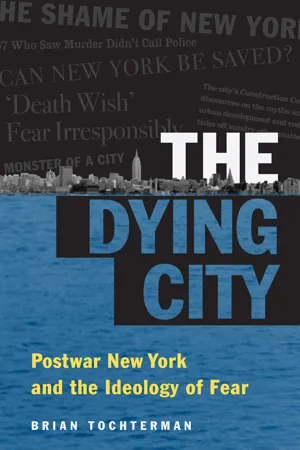
In this eye-opening cultural history, Brian Tochterman examines competing narratives that shaped post–World War II New York City. As a sense of crisis rose in American cities during the 1960s and 1970s, a period defined by suburban growth and deindustrialization, no city was viewed as in its death throes more than New York. Feeding this narrative of the dying city was a wide range of representations in film, literature, and the popular press — representations that ironically would not have been produced if not for a city full of productive possibilities as well as challenges. Tochterman reveals how elite culture producers, planners and theorists, and elected officials drew on and perpetuated the fear of death to press for a new urban vision.
It was this narrative of New York as the dying city, Tochterman argues, that contributed to a burgeoning and broad anti-urban political culture hostile to state intervention on behalf of cities and citizens. Ultimately, the author shows that New York’s decline — and the decline of American cities in general — was in part a self-fulfilling prophecy bolstered by urban fear and the new political culture nourished by it.
- 296 pages
- English
- ePUB (mobile friendly)
- Available on iOS & Android
eBook - ePub
About this book
Information
Part I Highbrow versus Hard-Boiled
Literary Visions of New York, 1947–1952
1 E. B. White’s Cosmopolis
In New York City, the postwar era began with a moment of triumph, euphoria, and optimism. After the A-bomb’s revelations and the end appeared near, a crowd gathered in Times Square to follow the inevitable surrender on the wires and news tickers at the intersection of Broadway, Seventh Avenue, and Forty-Second Street. The revelers danced to the stylings of a big band, and at sunset Mayor Fiorello LaGuardia announced that surrender had indeed been reached. It was August 15, 1945, V-J Day, when the lights of the square glowed at night for the first time in four years, and New York City was full of collective elation and celebration. Alfred Eisenstadt captured the story and the sense of relief and promise in his iconic photograph of a sailor forcing a kiss upon a woman in a white nurse’s uniform. Appearing on the cover of the next Life magazine, the photograph conveyed a narrative, one that was not the full story: as the nation’s leaders brokered a deal that salvaged Japan’s dignity, Americans celebrated like mad on the “crossroads of the world,” the most famous corner in the country. It captured the exaltation of the United States at the end of World War II, when New York City was a symbol of national power and economic progress—the assured metropole of what Life’s publisher Henry Luce termed the “American Century” and a beacon of modernity that contrasted with the rest of the war-ravaged world.1
Three years later, in the summer of 1948, and perched in a steamy hotel room off Times Square, essayist E. B. White penned a literary snapshot of New York City as it negotiated its place within the postwar landscape. In many respects, White’s text defined the moment after World War II when, as historian Thomas Bender has noted, New York “was finally recognized … as an international cultural metropolis.”2 In “Here Is New York,” published in the April 1949 issue of Holiday magazine, White questioned New York’s sustainability in the atomic age: “The city, for the first time in its long history, is destructible.… A single flight of planes no bigger than a wedge of geese can quickly end this island fantasy, burn the towers, crumble the bridges, turn the underground passages into lethal chambers, cremate the millions.” The allies emerged victorious, but in the process the United States unleashed the mysterious and omnipotent power of the hydrogen atom on Hiroshima and Nagasaki, demonstrating its might to the rest of the world. White’s fear of New York’s nuclear annihilation was legitimate in the burgeoning Cold War between the United States and the U.S.S.R. As the country’s densest, most populated city as well as its center of finance, New York was a certain target in any imagined atomic battle between the world’s two superpowers. In this respect “Here Is New York” functioned as White’s warning about the potential cost of losing the city, a cost measured by the exceptional gift of dense, primal, and vibrant urbanism that White witnessed in meditative drifts around the “island fantasy” of New York.3
“Here Is New York” put forth a narrative of New York City as a safe harbor for fearless migrants after the horrors of war. By 1948, White foresaw that changes in the metropolitan region were set to alter the city’s demographics for years to come. The year prior, builder William Levitt opened his model postwar suburb Levittown in Nassau County, ushering in decades of ceaseless suburban development. The Taylorist, assembly-line style construction of single-family homes on former farmland provided a much-needed safety valve for the postwar housing crisis. Returning veterans found themselves in cramped urban quarters, and Levitt’s efficient homebuilding along with the GI Bill provided them modest homes with no down payment. The homebound fifties were still a few years away, and suburban living would soon prove more affordable and more attractive than the city for many Americans. For citizens fearing the intrinsic correlation between density and destruction, leaving the city had to be attractive to many New Yorkers, and White’s celebratory narrative sought to ensure that cosmopolitan newcomers filled the vacuum.4
Like the millions of Americans who absorbed early representations of postwar suburbanization, White was not immune to the lure of the rural. As such, he had a complicated and deliberate view of the city, yet nothing less than unbridled enthusiasm carried “Here Is New York.” After spending a childhood in the vicinity of the city’s northern reaches, White longed to reside within New York proper from the moment he graduated from college. He hit a few snags over the course of achieving that goal, but his perseverance and some fortuitous encounters with an upstart magazine, the New Yorker, contributed to that achievement. At the New Yorker White honed his craft in the pages of “Talk of the Town,” yet he hungered for the life of the national syndicated columnists he admired. Harper’s offered him greater liberty in his writing, and a chance to reside in his other preferred setting: rural Maine. At the New Yorker and Harper’s White displayed a keen knack for observing and capturing in print the natural and unnatural world. His competing interests in the rural and urban shaped much of his most popular writings, from the children’s books Stuart Little (1945), about a mouse in the city, and Charlotte’s Web (1952), a barnyard tale, to his essays on the “Death of a Pig” and the hyperurban “City of Tomorrow.” As the United States joined the world at war, however, White returned to the city, carrying with him a thirst for more overt political commentary and a growing obsession with international cooperation and world governance.5
Preserving liberty and democracy in the postwar era framed White’s interest in a new world order, and the intensity he brought to this subject wrought “Here Is New York.” The city for White encapsulated these virtues like no other place, and nowhere were there more citizens and migrants “yearning to breathe free” than in New York. It served as a destination first for the castoffs of colonialism, war, economic decline, and religious persecution across the seas. In the early twentieth century, it became a sanctuary for Americans hobbled by Jim Crow, sex or gender discrimination, and undemocratic conformity in smaller cities and towns across the country. The resilient city and its citizens survived fire, war, riot, crime, discrimination, and poverty through its persistent accommodation of difference and its cultivation of ambitious and enthusiastic youth. For these outcasts, New York City advertised itself in various media cultures as a safe harbor. To White, then, New York was a goal that these intrepid migrants sought to achieve, and as long as it remained such a destination, the city’s resilience would be preserved. In the midst of a great fear about its sustainability in the atomic age, the city too would remain.6
This narrative of New York as Cosmopolis had been a chapter in the city’s story from time immemorial, and manifested itself in a variety of cultural forms. In the postwar era it would help frame the debate over the city at a crucial moment for the political economy of urban governance. White’s publication of “Here Is New York” coincided with the implementation of federal policies meant to aid cities in acclimating to the atomic age. Arguments in favor of slum clearance and urban renewal similarly sought the preservation of the city and its values in the postwar era. Meanwhile, fellow writers and cultural producers carried on the narrative of Cosmopolis in their works, even though White resisted many requests to revisit the topic. Over the following three to four decades, White’s image of New York and its legacy in the culture would function as a bulwark against an increasingly hegemonic discourse of decline that imagined the city as Necropolis. Purveyors of declensionist narratives made the preservation of New York a goal in their arguments, but only White and his acolytes prioritized the city’s reputation for individual freedom and mass democracy, its integration of the natural into an unnatural environment, and its mix of savory and unsavory elements over the desire for order at their sacrifice.
______
Born in 1899, E. B. White spent his younger years just outside New York City, growing up in a large house in suburban Westchester—Mount Vernon, to be exact—as his father oversaw a piano manufacturing firm in Harlem. From Mount Vernon he followed family tradition upstate to Cornell University. He demonstrated a talent for writing from an early age, and had his first formal publication at age nine. It was his vocation of choice from then on. Along with writing, living and working in New York City were White’s foremost passions. However, New York City’s cutthroat information and cultural sector proved a barrier to White’s goals, and instead of working in the city he spent his initial postbaccalaureate years traveling across the country via Model T, eventually terminating in Seattle, where he took a job as a reporter with the local Times. In 1923 he returned east and boarded with his parents in Mount Vernon as he searched for employment. Unabashed persistence described White’s enthusiasm for the New York culture industry, and he pestered editors around town for a level entry into the publishing world. While waiting for a letter of acceptance, he settled rather uneasily into the field of advertising and the life of a commuter.7
White was freed from the shackles of these unfulfilling worlds soon enough, and his early career development offered themes that he would return to throughout his life in letters. He illustrated the mundane repetition of a daily routine organized by the time discipline of the metropolitan railroads in an early poem, to wit: “Commuter—one who spends his life / In riding to and from his wife; / A man who shaves and takes a train / And then rides back to shave again.” White also understood the coercive impulses of marketing and the power of culture in general to shape the decision-making processes of an ill-informed public. As he later put it, “advertisers are the interpreters of our dreams.… Like the movies, they infect the routine futility of our days with purposeful adventure. Their weapons are our weaknesses: fear, ambition, illness, pride, selfishness, desire, ignorance. And these weapons must be kept as bright as a sword.” Sentiments such as these were affected not only in his writing but in the way he lived. He consistently fought against the use of his intellectual property and likeness in the marketing of others’ products and publicity materials, and he never lived in a suburban place again—settling for New York City and the rural confines of coastal Maine.8
In 1925 a new magazine that would change White’s fortunes burst onto the city’s literary scene. From its inaugural issue, he was as enchanted with the New Yorker—a publication dedicated to satire, humor, and highbrow reportage and literature—as publisher Harold Ross was with him. White submitted short pieces to the magazine, and soon Ross and editor Katherine Angell pushed White to join the staff. In 1927 he accepted their offer and spent his time writing the anecdotal sections that commenced each issue, “Comment” and “Talk of the Town.” For the most part, “Talk of the Town” offered just that, brief interludes and observations about everyday moments in New York City. The magazine’s editors expected authors to have an ear for urban life and the epistolary acumen to ensure their descriptions transcended the mundane reality of sidewalks and parlors. Within a few years, White was instrumental in the evolution of these departments from humorous vignettes employing the editorial we to a mix of opinionated bylined sketches, a transition that also paralleled the writer’s own professional development into the long-form essayist that marks his legacy. It was also around this time that White achieved his goal of migrating from his parents’ home into the city, taking an apartment with college friends in Greenwich Village, then the epicenter of literary bohemianism. His concurrent marriage to divorcee Katherine Angell—his coworker and occasional editor—spoke to White’s cosmopolitan enlightenment in a world often policed by prejudice and taboo. White’s father, for instance, expressed private shame regarding his son’s coauthored (with fellow humorist James Thurber) send-up of the era’s sexual handbooks, Is Sex Necessary? (1929), because it mocked suburban upper-class mores.9
In 1938, White left New York City and the New Yorker for his farm in North Brooklin, Maine, and the pages of Harper’s Magazine. As literary scholar Robert Root suggests, “throughout the 1930s occasional hints of dissatisfaction appeared in White’s Notes and Comment writing, and evidence in his letters reinforces the sense that the anonymity, tone, and format of Comment writing were becoming increasingly difficult for him to live with.”10 Instead of sweating the stressful grind of weekly production, confined to the shallow depths of minute brevity in the pages of the New Yorker, the monthly Harper’s offered deliberate respite and a column of his own in which to hone the essay craft. Under the title “One Man’s Meat,” and inspired by the popular columns he read as a young adult, White wrote some of his most enduring pieces, including “Once More to the Lake,” a travelogue about returning to the upstate home where the White family decamped during summer. He also visited New York City for the 1939 World’s Fair and published a column titled “The World of Tomorrow.” During his encounter with the General Motors (GM) exhibit of the same name, White was seduced by the utopian vision of the United States in 1960, one “of complete religious faith in the eternal benefaction of faster travel.” As he was quick to point out, the future city and its harmonious highways failed to consider the seemingly mundane yet rewarding aspects of urban and rural life in GM’s master plan. He wr...
Table of contents
- Cover
- Series Page
- Title Page
- Copyright
- Dedication
- Epigraph
- Contents
- List of Figures
- Acknowledgments
- Introduction
- Part I: Highbrow versus Hard-Boiled
- Part II: Cancer and Death
- Part III: The Other New York
- Part IV: Detour to Fun City
- Epilogue
- Notes
- Bibliography
- Index
Trusted by 375,005 students
Access to over 1.5 million titles for a fair monthly price.
Study more efficiently using our study tools.
Frequently asked questions
Yes, you can cancel anytime from the Subscription tab in your account settings on the Perlego website. Your subscription will stay active until the end of your current billing period. Learn how to cancel your subscription
No, books cannot be downloaded as external files, such as PDFs, for use outside of Perlego. However, you can download books within the Perlego app for offline reading on mobile or tablet. Learn how to download books offline
Perlego offers two plans: Essential and Complete
- Essential is ideal for learners and professionals who enjoy exploring a wide range of subjects. Access the Essential Library with 800,000+ trusted titles and best-sellers across business, personal growth, and the humanities. Includes unlimited reading time and Standard Read Aloud voice.
- Complete: Perfect for advanced learners and researchers needing full, unrestricted access. Unlock 1.5M+ books across hundreds of subjects, including academic and specialized titles. The Complete Plan also includes advanced features like Premium Read Aloud and Research Assistant.
We are an online textbook subscription service, where you can get access to an entire online library for less than the price of a single book per month. With over 1.5 million books across 990+ topics, we’ve got you covered! Learn about our mission
Look out for the read-aloud symbol on your next book to see if you can listen to it. The read-aloud tool reads text aloud for you, highlighting the text as it is being read. You can pause it, speed it up and slow it down. Learn more about Read Aloud
Yes! You can use the Perlego app on both iOS and Android devices to read anytime, anywhere — even offline. Perfect for commutes or when you’re on the go.
Please note we cannot support devices running on iOS 13 and Android 7 or earlier. Learn more about using the app
Please note we cannot support devices running on iOS 13 and Android 7 or earlier. Learn more about using the app
Yes, you can access The Dying City by Brian L. Tochterman in PDF and/or ePUB format, as well as other popular books in History & North American History. We have over 1.5 million books available in our catalogue for you to explore.